Harakers Church: A Medieval Church in Skultuna, Sweden
Site at a Glance
- Country
- Sweden
- Primary era
- Medieval
- Eras represented
- Medieval, Early Modern, Modern
- Civilizations
- Swedish
- Site type
- Religious
- Remains
- Church
On this page18 sections
History
Medieval foundations and conflict
Harakers Church is a Lutheran church in Skultuna, Sweden. Its present building was erected in the second half of the fifteenth century and dedicated during that century. The church belongs to the Church of Sweden and is associated with the Diocese of Västerås, a regional church administration, and Norrbo parish, a local congregation. Its wall paintings are among the best-preserved works in the diocese from the period after the Reformation.
An earlier church stood a little west of the present building. Its date is uncertain, but it was probably built around 1200. Archaeological investigation in 2014 located its remains. The larger present church replaced it in the second half of the fifteenth century. Although the building has sometimes been assigned an earlier, fourteenth-century date, investigation supports the later dating.
The area around the church was the scene of two battles. In 1437, during the Puke feud, a Swedish political conflict of the 1430s, Karl Knutsson Bonde and Erik Puke fought just north of the church. In 1464, Danish forces fought peasants from Dalarna and Uppland in the surrounding woods. A local legend connects the church’s construction with spoils taken in war.
Paintings and rebuilding
A western tower was added late in the fifteenth century. In 1618, the landowner Ebba Brahe and her husband, Jakob De la Gardie, paid for the church’s wall paintings. The year was also the year of their marriage.
By the eighteenth century, the church needed extensive repairs. Work continued over several decades, and iron rods were used in efforts to hold the walls steady, but the tower continued to deteriorate. Plans for a replacement tower were approved in 1793, and construction began in 1795. The church was lengthened six metres to the west to serve a growing congregation. The rebuilding also involved demolishing its western section, tower and vaults, along with the southern porch and three covered gates in the churchyard wall.
Restoration and cultural memory
A major restoration in 1935–1936 reshaped the interior. The floor was replaced, the benches were altered on the model of eighteenth-century examples, and the wall paintings were uncovered and conserved. The altarpiece installed in 1843 was removed, and the earlier one from the 1680s was returned with a new painting. Façade work in the 1970s removed the cement base and extended the coarse exterior render down to ground level. In 1974, Gösta Lindström cleaned and conserved the paintings using 400 loaves of bread.
The church also appears in the cultural memory of the region through Karl Asplund’s poem Altarskåpet, which imagines its sculptures coming to life at midnight.
Remains
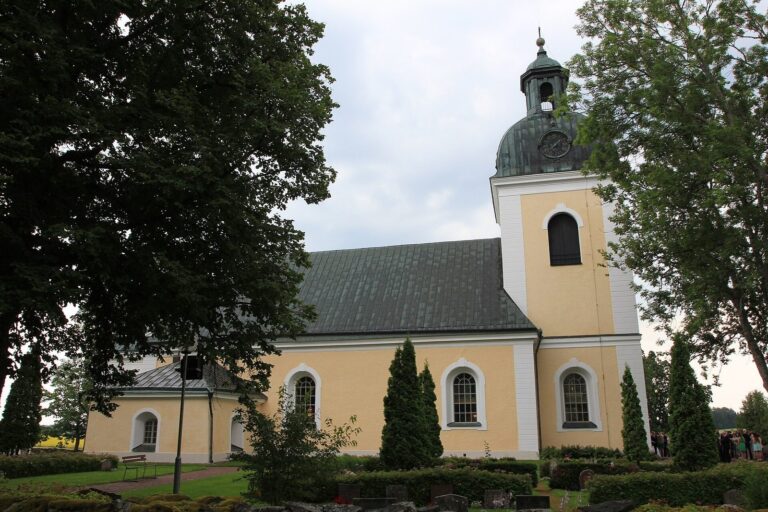
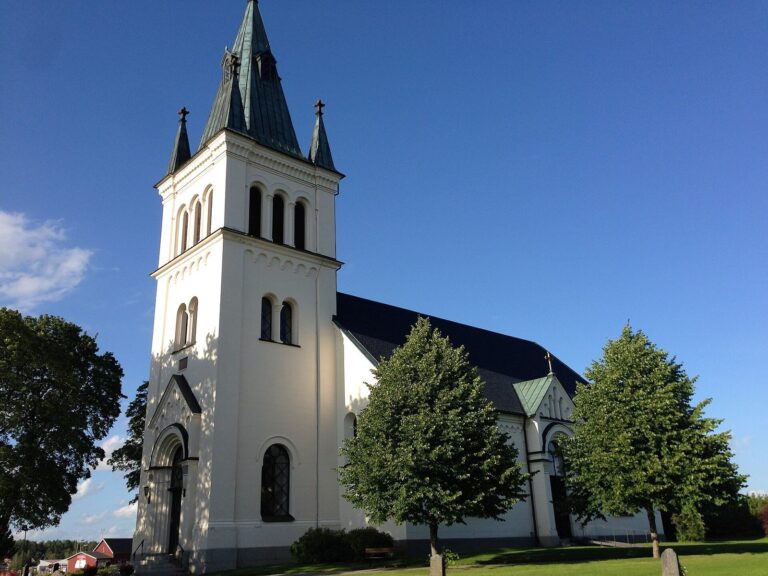
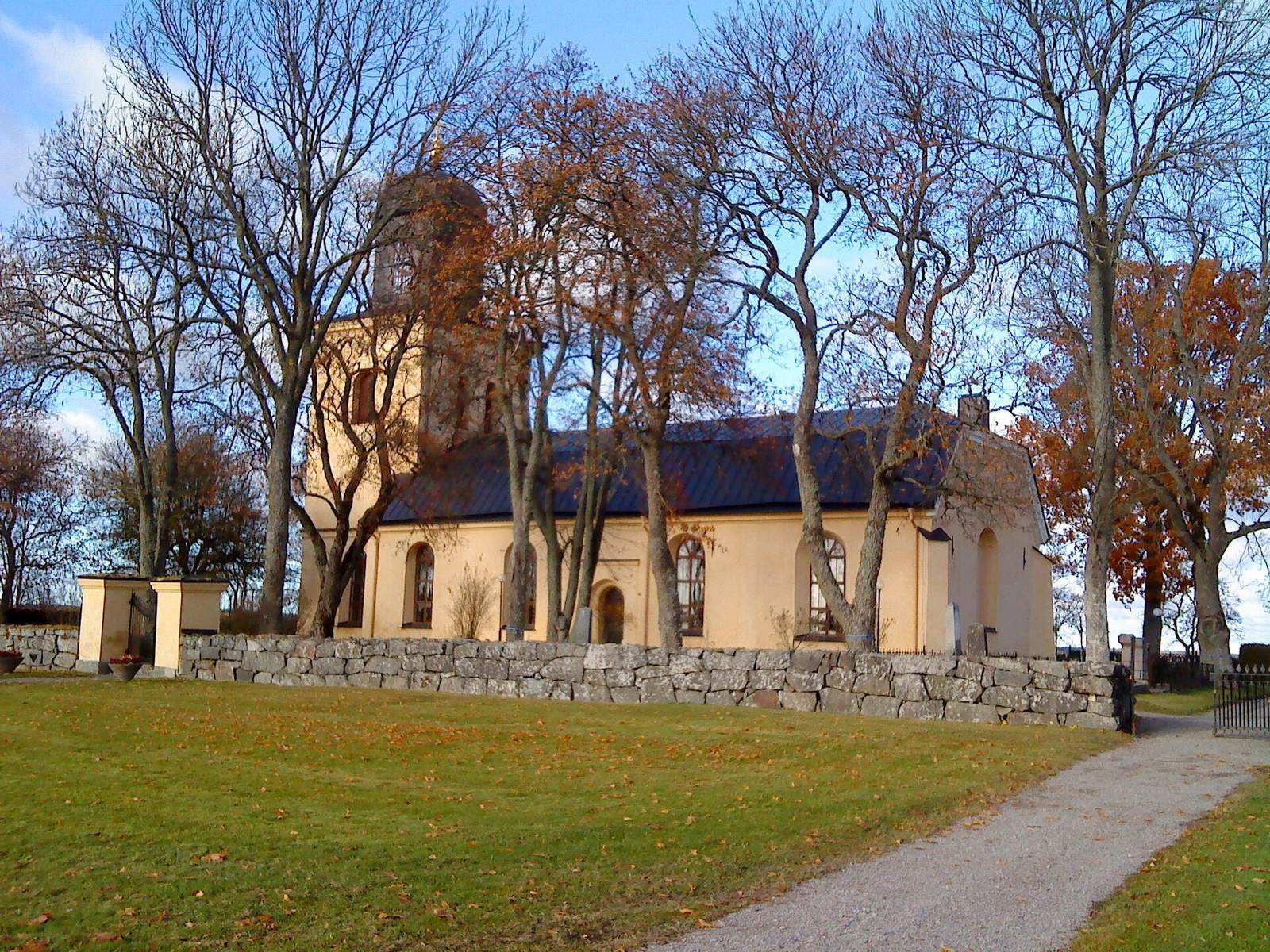
The present church is a rectangular, single-nave hall church, with a broad, undivided interior. Its walls are mainly brick, with natural stone at the base, and have a light ochre-yellow render. A sacristy, a room for clergy and church furnishings, stands on the north side; a tower crowned by a raised lantern stands at the west end.
Present building
Exterior
The nave has a mansard roof, with two slopes on each side and a steeper lower slope, while the sacristy has a tent-shaped roof. Both are covered in black sheet metal. Four large round-arched windows and a portal face south, and three windows face north. The tower has a large window on each side, with a western portal and a semicircular window above it. The exterior render has a coarse texture and continues to ground level.
Interior
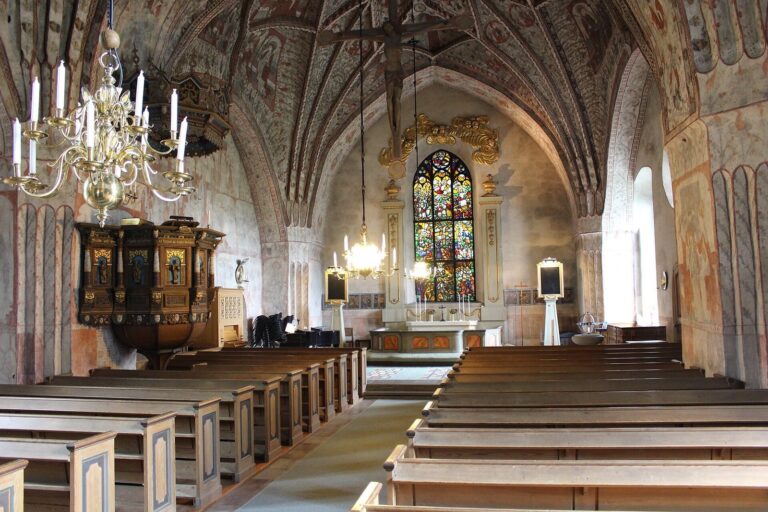
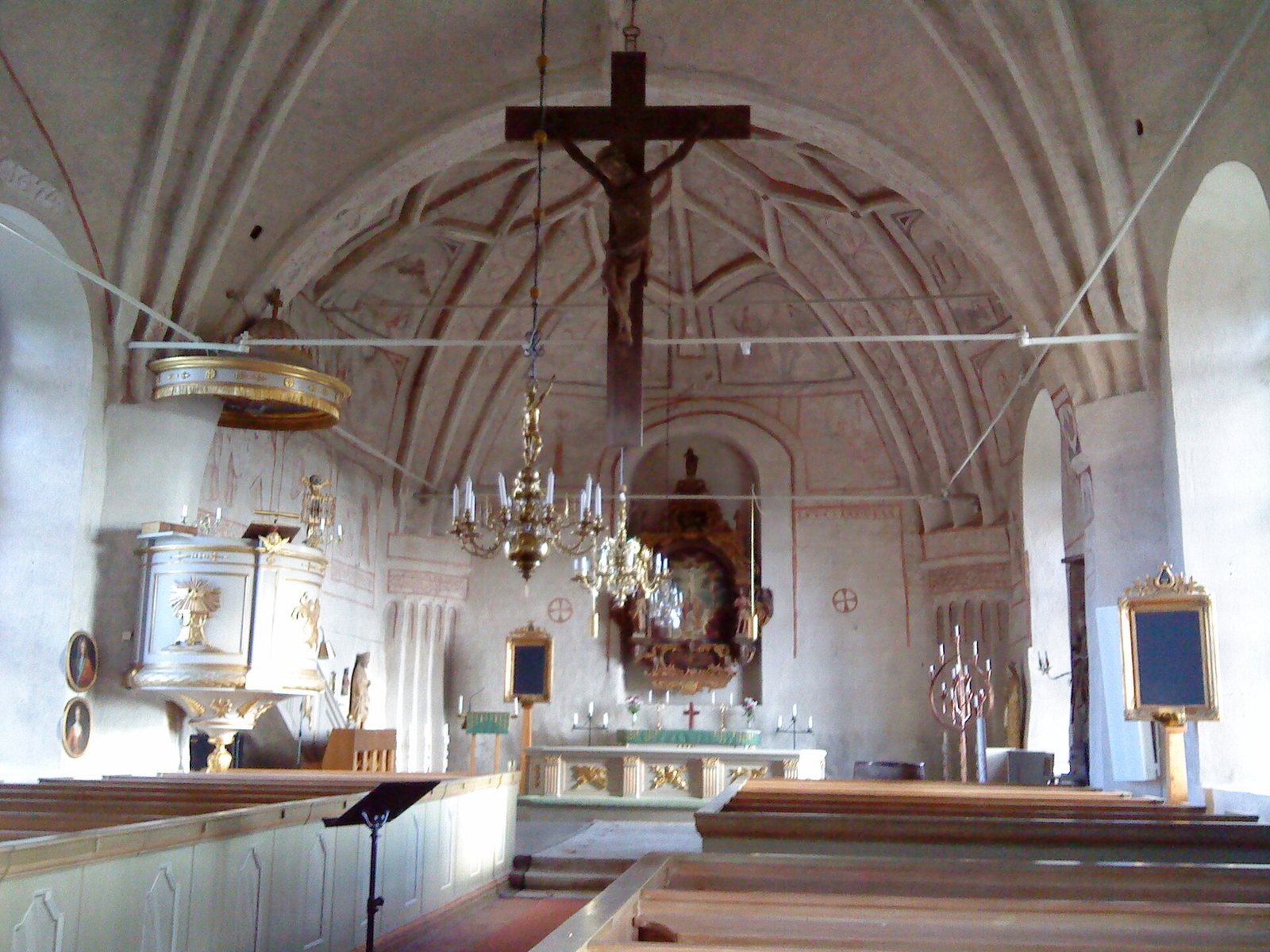
Two star vaults, whose ribs form a star-like pattern, cover the eastern part of the nave; a continuous barrel-shaped vault covers the western part. Visible iron rods help steady the walls and vaults. The eastern chancel, the part of the church around the altar, is raised by two steps and has a limestone floor. An organ loft occupies the west end. The closed pews date from 1936 and follow the design of eighteenth-century benches.
Earlier churches and medieval fabric
Predecessor church
The excavated stone foundations of the earlier church’s chancel measure two by eight Swedish ells, a historical unit of length, or about 1.1 by 4.4 metres. The remaining parts of that church may have been built of timber or stone.
Fifteenth-century fabric
The fifteenth-century church originally had three star vaults supported by seven exterior buttresses, two of which remain. The porch and sacristy had brick vaults, and eight crosses marking the church’s ritual dedication survive inside. A gallery above the sacristy opened toward the chancel; a niche in the sacristy marks the former doorway. The late-fifteenth-century western tower once carried a tall, pointed wooden spire inspired by the tower of Västerås Cathedral.
Wall paintings and sculpture
Wall paintings
The church’s black and red wall paintings depict apostles and scenes from the Old and New Testaments, including the Last Judgment, the Fall, and episodes from the life of Jesus. Images of Ebba Brahe and Jakob De la Gardie on the north wall were partly damaged when a window was enlarged. On the south side of the triumphal arch, which separates the nave from the chancel, are images of Martin Luther and Philipp Melanchthon, leading figures of the Protestant Reformation. The Luther image is the earliest known depiction of him in a church setting in Sweden; the images of both reformers are the earliest known depictions of them in a Swedish church.
Medieval saints
The church holds numerous medieval wooden sculptures. Its oldest depicts Saint Olaf standing on a troll identified as Skalle and dates to the early fourteenth century. A late-fifteenth-century sculpture of the crowned Virgin Mary, about 1.4 metres high, shows her holding the infant Jesus above a moon face. A rosary around her includes representations of Jesus’s wounded hands and one foot. Two sculptures of Saint Olaf and Saint Erik, each about 1.3 metres high, probably once formed part of an altarpiece, a decorated structure behind an altar. Five other sculptures came from a separate altarpiece: three larger figures, including John the Baptist and Saint Bridget, and two saint-kings, Olaf and Erik.
Crucifix and narrative figures
An oak triumphal crucifix made in the Mälardalen region in the mid-fourteenth century was returned to its position on the triumphal arch in 1963, after having been moved in the eighteenth century. Two sculptures from about 1500 show Saint Martin on horseback sharing his cloak with a poor person and Saint George on horseback fighting a dragon, with a princess also represented. Figures of the evangelists John and Mark date to 1645 and were once attached to a pulpit made that year.
Furnishings and objects
Altar and pulpit
The altarpiece dates to the 1680s and has a central painting made by Torsten Nordberg. The altar, altar rail, and pulpit date to 1843 and retain their original painted finish. The earlier pulpit, made in 1645, was sold to a tailor and later burned.
Organ, textiles, and metalwork
The mechanical organ was built in Stockholm in 1830 by Pehr Lund, then working as a journeyman under organ builder Pehr Zacharias Strand. It was altered in 1857 and 1934, then restored to its original condition in 1967 by the Moberg Brothers of Sandviken. Its 14 stops control sets of pipes, which are grouped on either side of the console. The oldest object in the church is a sandstone baptismal font from about 1200; a well-preserved red-velvet chasuble, a sleeveless outer garment worn by a priest during worship, dates to the fifteenth century. Chandeliers, candle plates, and candlesticks span the seventeenth to nineteenth centuries. A nave chandelier, probably made in the Netherlands, was donated in 1645 by military field secretary Lars Örnstierna, an administrative officer serving with a military force. His funeral hatchment, a panel displaying a deceased person’s coat of arms, is also kept in the church.