Takasaki Castle: A Strategic Fortress and Domain Seat
Site at a Glance
- Country
- Japan
- Primary era
- Early Modern
- Eras represented
- Early Modern
- Civilizations
- Tokugawa, Toyotomi regime
- Site type
- Military
- Remains
- Castle
On this page9 sections
History
Takasaki Castle was a Japanese flatland castle built in 1597 in Takasaki, Japan, on the site of Wada Castle. Its position was intended to control the junction of the Nakasendō and Mikuni Kaidō, major historical routes, and it later became the administrative center of Takasaki Domain.
Wada Castle and the Wada Clan
Local tradition credits Wada Yoshinobu, a leader of the Wada clan, with establishing Wada Castle in the late Heian period, an era in Japanese history. He is said to have built a fortified residence beside the Karasu River. During the Muromachi period, the Wada clan served the Uesugi, whose head held the office of Kantō kanrei, a senior deputy of the Ashikaga shogunate in the Kantō region around modern Tokyo.
In 1561, Wada Narishige transferred his allegiance to the Takeda after Uesugi Kenshin was appointed Kantō kanrei. The Wada stronghold resisted repeated Uesugi attacks. Narishige’s son, Wada Nobunari, later served the Hōjō. During Toyotomi Hideyoshi’s 1590 campaign against Odawara, forces led by Uesugi Kagekatsu and Maeda Toshiie besieged Wada Castle and captured it on May 22. The castle was then abandoned.
Takasaki Under Tokugawa Rule
After Tokugawa Ieyasu gained control of the Kantō region in 1590, he assigned his general Ii Naomasa to nearby Minowa Castle. Ieyasu later ordered Naomasa to build a fortress on the former Wada Castle site. Naomasa moved to the new castle in 1598 and named it Takasaki following a monk’s advice that a pine might wither, while height had no limit. He also transferred residents, temples, and shrines from Minowa to form a castle town.
Following the Battle of Sekigahara in 1600, the Ii family moved to Sawayama in Ōmi Province. The castle subsequently passed through the hands of the Suwa, Sakai, Toda, Matsudaira of the Fujii branch, Andō, Matsudaira of the Nagasawa-Ōkōchi branch, and Manabe families, before returning to the Nagasawa-Ōkōchi Matsudaira. Andō Shigenobu began an extensive renovation in 1619. Work continued through three generations over 77 years.
In 1633, shogun Tokugawa Iemitsu exiled his younger brother, Tokugawa Tadanaga, to Takasaki Castle and ordered him to take his own life. Tadanaga died there that December. The Ōkōchi Matsudaira established their residence at the castle in 1695. Apart from a break between 1710 and 1717, they held it until the end of the Edo period, when the castle was the seat of Takasaki Domain’s government.
Disuse, Army Occupation, and Urban Change
The castle was decommissioned in 1871. Two years later, the Castle Abolition Order designated the site for retention, and an army detachment from the Third Division was established there. Many buildings were sold or demolished, and the moats were filled. Much of the former grounds later came into use by the Imperial Japanese Army’s Takasaki-based 15th Infantry Regiment, which occupied them before the end of the Second World War. The grounds have since been substantially built over, with Takasaki City Hall, the music center, and the central library occupying parts of the former castle land.
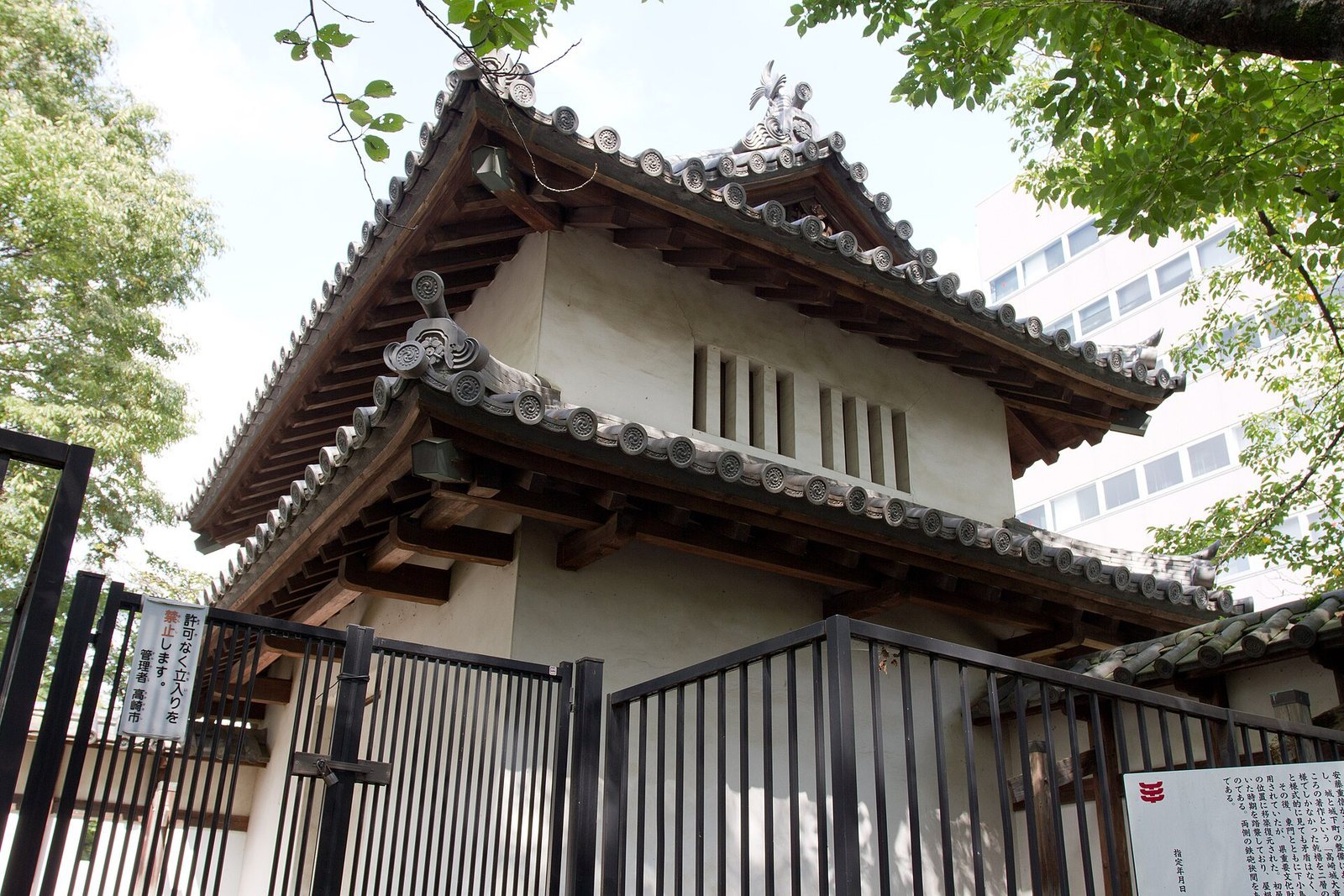
The outer earthwork and moat of the third bailey are designated a Takasaki municipal historic site. The Inui tower is a Gunma Prefecture Important Cultural Property, and the East Gate is designated by Takasaki City. Protected historical materials also include a Takasaki Castle map, documents formerly held by the Sakurai family, and an old map of Wada Castle and a temple precinct.
Remains
The castle’s plan combined concentric enclosures with terraced levels beside the Karasu River. Earthen ramparts formed its defenses, alongside sections of stone wall. Enclosed areas within the defenses, known as baileys, were arranged around the main bailey, while the second and third baileys occupied stepped levels.
Main Bailey and Enclosures
The main bailey was bordered by the West Bailey, Plum Grove enclosure, Enoki enclosure, West Enclosure, and Tile Storehouse enclosure. It held a three-story principal tower, with towers at its northwest, northeast, southeast, and southwest corners. The northwest tower, known as the Inui tower, was sold to a local farmer and used as a barn before the city acquired it in 1974. It was relocated and restored on a simulated stone wall in the third bailey.
East Gate
The castle had 16 gates, including the East Gate, which served as a service entrance. The gate was moved and restored near the Inui tower in 1980.
Earthworks and Water Features
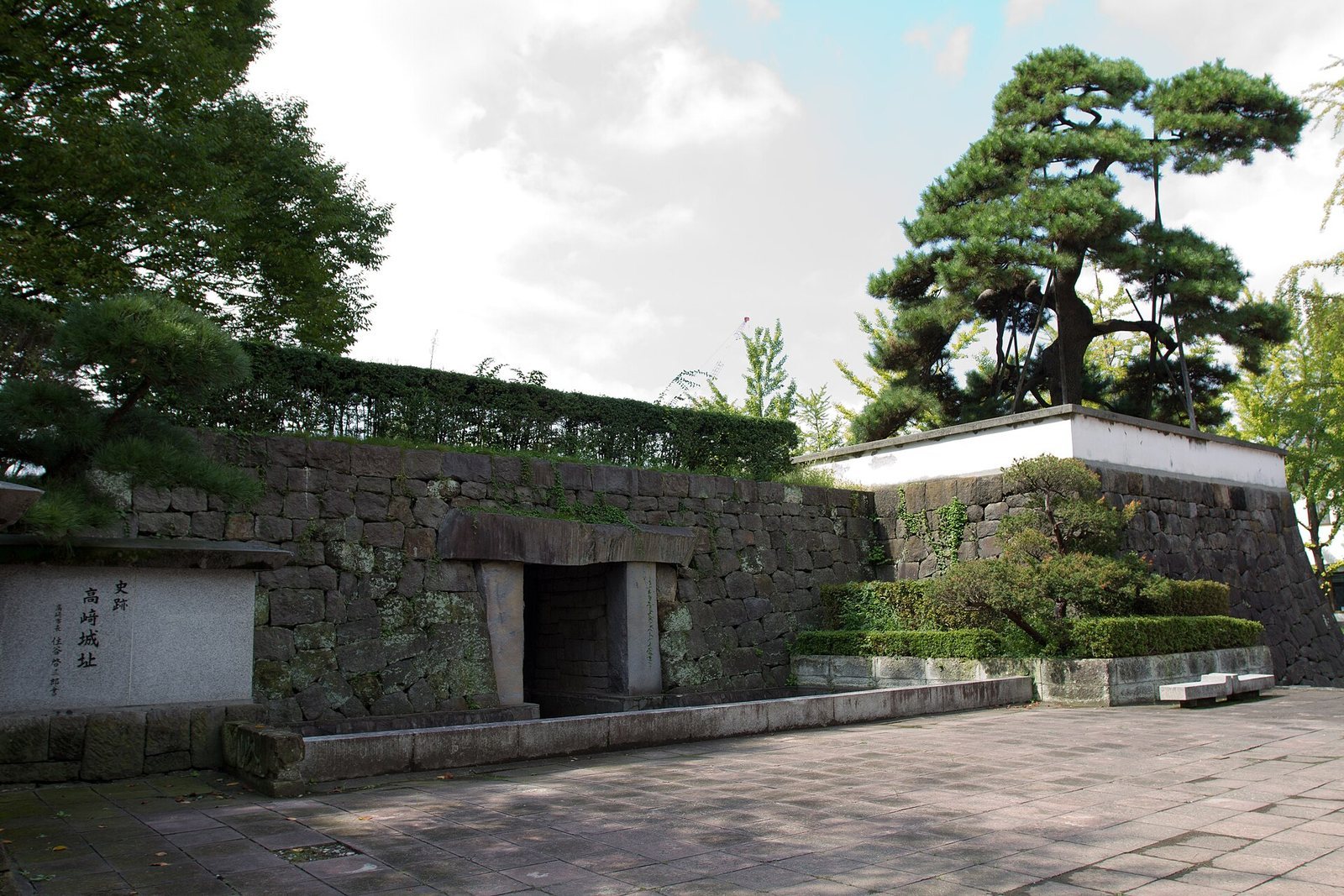
Sections of earthwork and water moat remain, including the outer rampart and moat of the third bailey. A promenade follows the top of the ramparts. Archaeological investigations also uncovered a stone-lined water channel and part of a stone conduit; both were relocated and reconstructed near the main entrance of Takasaki Central Library.
Relocated Shoin
A shoin, a Japanese reception or residential building, was transferred from the castle to the grounds of Chōshō-ji. It now serves as the priest’s residence.