The Rollright Stones: A Prehistoric Monument Complex in England
Site at a Glance
- Popularity
- Very High
- Country
- United Kingdom
- Primary era
- Bronze Age
- Eras represented
- Stone Age, Bronze Age, Modern
- Civilizations
- British
- Site type
- Religious
- Remains
- Sanctuary
On this page11 sections
History
The Rollright Stones are a group of prehistoric monuments near Long Compton, on the boundary between Oxfordshire and Warwickshire in England, United Kingdom. Built in separate phases between the fourth and second millennia BCE, they grew from a long tradition of ritual activity on sacred ground. The three monuments have different dates and likely served different purposes.
Prehistoric monuments
The Whispering Knights is the earliest monument. It is usually placed in the Early or Middle Neolithic, a prehistoric period associated in Britain with the spread of farming, with a proposed date of about 3800–3500 BCE. The chamber was probably used for burial, perhaps for repeated burials that continued into the Bronze Age, a later prehistoric period when bronze was used alongside continued stone construction.
The King’s Men followed in the Late Neolithic or Early Bronze Age, with a proposed date around 2500 BCE. The King Stone is generally considered the latest of the three, although its construction date is unknown. Its purpose is also uncertain. One leading explanation is that it marked a cemetery, since Bronze Age burial mounds and cremations occur nearby; a broad wooden post marked one cremation burial. Other interpretations have treated it as an astronomical marker, a guide to the King’s Men, part of a stone avenue, or a remnant of a long burial mound. Its alignment with the rising star Capella around 1750 BCE has prompted an astronomical interpretation, but does not settle the question.
Early records and local traditions
The origin of the name Rollright is disputed. One proposal connects it with the personal name Hrolla and an Anglo-Saxon word for property. Other explanations derive it from Celtic wording for a circular arena near a gorge, or from a phrase in an early British language meaning “wheel-enclosure groove.” In the last interpretation, the groove refers to a narrow valley near Great Rollright, while the wheel enclosure is the King’s Men circle.
The earliest known written description appears in a fourteenth-century tract called The Wonders of Britain. Its anonymous author says that the stones’ makers and purpose were unknown and gives their local name as “Rollendrith.” John Leland referred to the monuments in a sixteenth-century travel account. William Camden described them in Britannia in 1586, recording local folklore and speculating that the stones commemorated a victory, perhaps one involving Rollo the Dane, the Norse leader traditionally associated with the founding of Normandy. In 1610, Camden recorded a rhyming version of the king-and-witch story. The antiquarian Robert Plot later described the stones in the seventeenth century, in an account accompanied by a drawing by David Logan.
An Elizabethan tapestry map of Warwickshire, made in the late 1580s for Ralph Sheldon, is believed to be the earliest known map to depict the stones. Cleaning and conservation of the map in 2012 drew attention to a possible image of standing stones near Long Compton. John Aubrey and William Stukeley helped develop antiquarian study of the monuments. In 1743, Stukeley described the Whispering Knights as standing on a round burial mound, an interpretation that later investigation did not resolve.
Folklore recorded from the early modern period tells of a king who could become King of England if he saw Long Compton after taking seven strides. Rising ground blocked his view, and the witch Mother Shipton turned him into the King Stone, his followers into the King’s Men, and four knights who had fallen behind into the Whispering Knights. The tale remained part of local teaching into the nineteenth century. Other traditions said that the King Stone came alive at midnight or that the king and his men rose on certain saints’ days. The Whispering Knights were said to descend the hill on New Year’s Eve to drink from the stream below. In another story, twenty-four horses could not move the tallest stone to the stream, and it returned to its place. A further belief held that the number of stones changed each time they were counted.
From the late eighteenth century into the nineteenth, the stones also acquired fertility associations. Local girls were said to run naked around them at midnight on Midsummer’s Eve in the hope of seeing their future husbands. Childless wives were said to pray to or near the King Stone, or to rub their bare breasts against it.
Archaeology, protection, and modern use
In 1882, the landowner arranged for some fallen stones to be raised again. The site was also designated a scheduled monument that year, a form of legal protection for archaeological sites in England. Government investigation in 1981–82 combined documentary research, aerial photographs, geophysical surveys, fieldwalking, and limited excavation. The work included the complete excavation of a small, heavily ploughed-down round burial mound. Archaeologist George Lambrick directed the later work and published reports between 1983 and 1988, greatly expanding understanding of the monuments and their archaeological setting.
The stones became a focus for modern Pagan and esoteric practices. In 1959, a Gardnerian Wiccan group, belonging to one tradition within Wicca, a modern Pagan religious movement, met at the King’s Men hoping to reunite with a group led by Doreen Valiente that had split from them. The Regency, a Pagan group formed by former members of another coven, also met at the site during the 1970s. Practices have included meditation, ceremonies, offerings, and the scattering of cremated ashes. Diana Paxson has described performing seidr, a Norse-inspired form of ritual practice associated with divination and altered states. Local Pagan groups have objected to outside practitioners’ plans to “awaken” the stones, saying they were already spiritually active.
From the late 1970s, Earth Mysteries proponents explored proposed connections among ancient sites, landscape alignments, and unusual phenomena. Alfred Watkins proposed a ley line, a supposed alignment linking landscape features, between the stones, churches at Long Compton and Chipping Norton, and a burial mound near Charlbury. The Dragon Project, led by Paul Devereux, reported detecting ultrasonic pulses, sound waves above the range of human hearing, at the King Stone at sunrise, but not in the King’s Men circle at the summer solstice. Its members suggested that the circle shielded the site from low levels of ultrasound detected elsewhere. Devereux and fellow researcher Thomson also proposed ley lines linking the stones with Arbury Banks, Wroxton, and the Uffington White Horse.
After the landowner decided to sell the site in the 1990s, a campaign to protect public access and prevent commercial development led to the creation of the Rollright Trust in 1997. The Trust secured ownership in 2001 through private donations and a grant from the Hanson Environment Fund. It has worked with the Pagan community and allows groups to arrange ceremonies at the stones. Archaeological and Pagan communities have also developed a working relationship, discussing the site’s interpretation, religious use, and preservation. The Trust’s wardens’ hut was destroyed beyond repair in an arson attack in January 2006.
Remains
The three limestone monuments occupy a ridge along the edge of the Cotswold Hills, between the Stour valley to the north and the Swere valley to the south. The Whispering Knights and the King’s Men are in Oxfordshire; the King Stone stands in Warwickshire. The local bedrock is Chipping Norton limestone, part of the Jurassic Great Oolite series, and the monuments were made from limestone found in the area. Their positions and forms differ: a burial chamber lies east of a stone circle, while a single standing stone is north of the circle.
The Whispering Knights
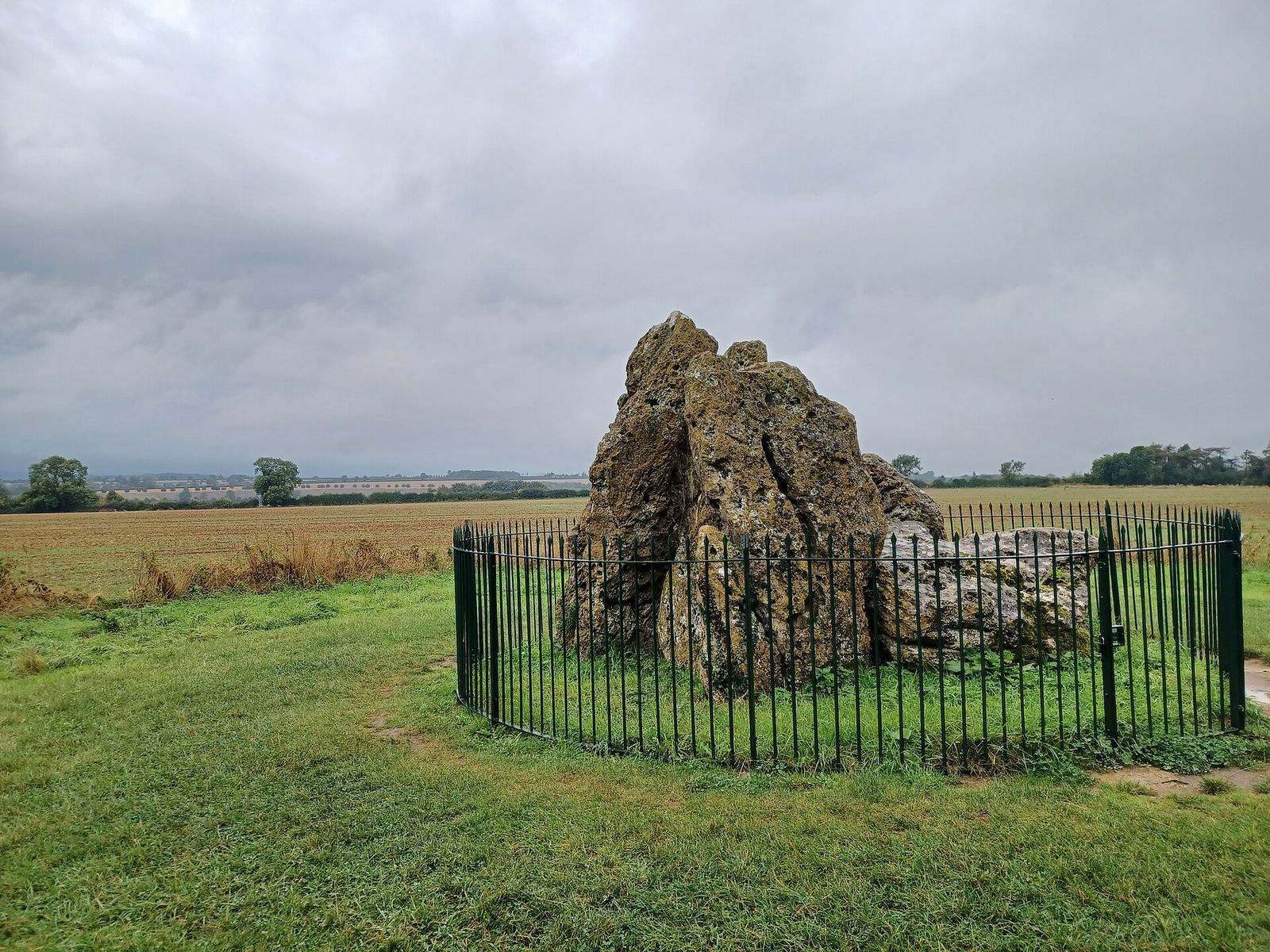
About 400 metres east of the King’s Men, the Whispering Knights is the surviving burial chamber of a portal dolmen, a tomb formed from upright stones supporting a capstone. Four uprights enclose a chamber about two square metres in area. A fifth stone lies across the ground and is thought to be the collapsed capstone. Excavation recovered Neolithic pottery nearby.
Whether the chamber originally stood on a round burial mound or had a mound-like base remains unresolved. Ploughing may have moved soil uphill and removed it downhill, while some excavated layers could represent a mound of stones, known as a cairn. One proposed construction method for the heavy capstone involved building a ramp of collected stones behind the chamber and hauling the slab on rollers over logs laid lengthwise along the ramp.
The King’s Men
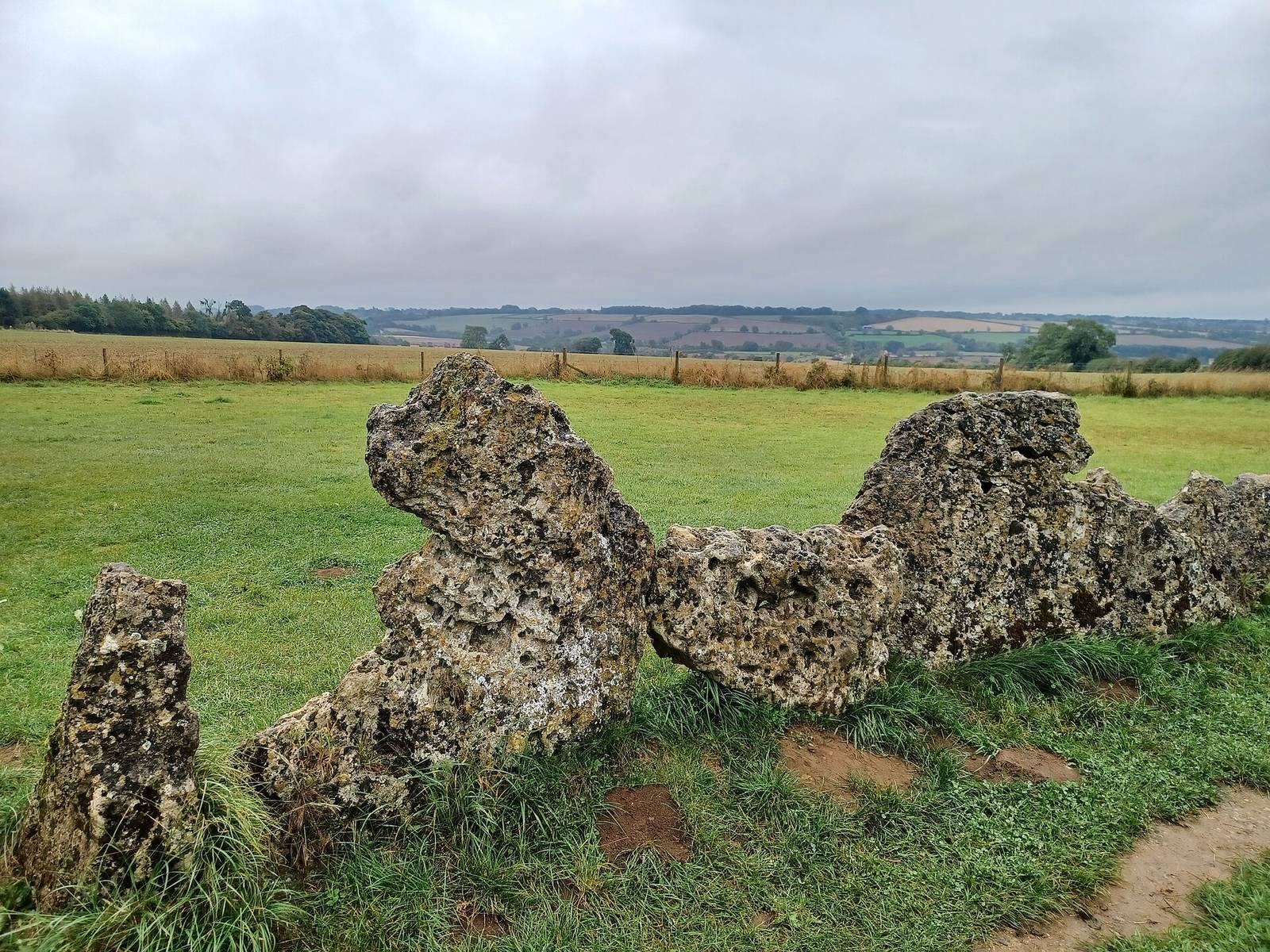
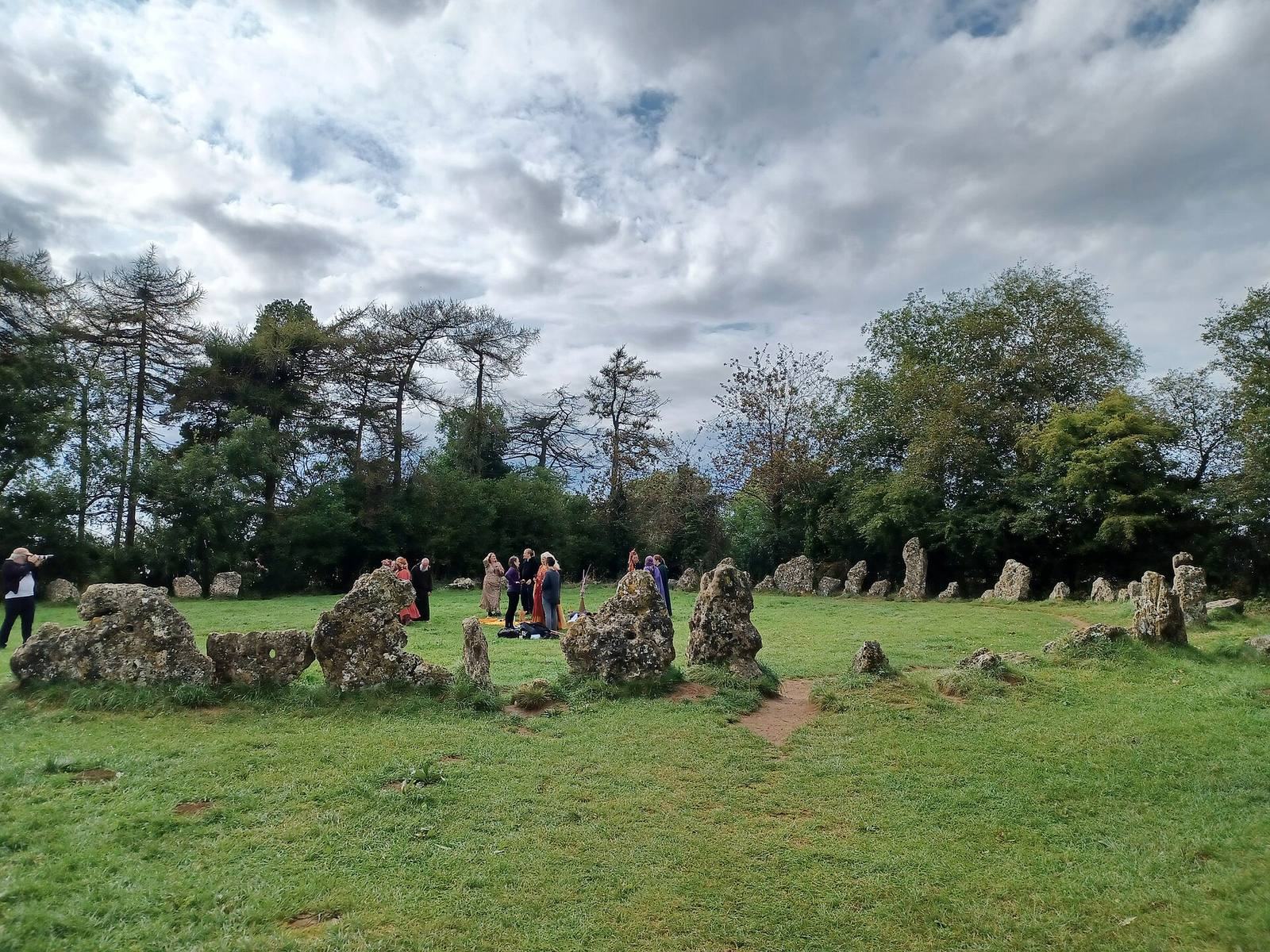
The King’s Men is a stone circle about 33 metres across. Seventy-seven stones stand there today, some reaching about 2.7 metres in height. The stones may originally have formed a more complete ring, perhaps touching one another, with smoother faces turned inward and rougher faces outward. Its entrance is a four-poster arrangement: two stones outside the circle frame an entrance facing outward. The layout closely resembles the circle at Swinside, while the same entrance arrangement occurs at Long Meg and Her Daughters.
The circle is classed among the “Cumbrian circles,” large enclosures with many stones, open interiors, and clearly defined entrances. This architectural tradition is associated with the exchange of Group VI axes, polished stone tools made from volcanic rock in the Langdale area of Cumbria. The monuments are now understood as regional expressions of a shared tradition rather than as a distinct precursor to henges.
The circle has been partly reconstructed since the nineteenth-century re-erection. About a third of the fallen stones were raised, some away from their original positions, and stones were added where originals had been lost or destroyed. Lichen growth and documentary evidence have helped identify additions. Lambrick judged that probably no more than two of the stones now standing are modern additions. Four smaller stones added to the circle were stolen during the twentieth century.
The stones appear to have been gathered as naturally weathered boulders rather than cut from a quarry. A possible source lies where springs emerge between the Inferior Oolite and Lias clay. If the stones came from there, the shortest uphill routes averaged a gradient of about one in fifteen and ran roughly 450 metres to the King’s Men. Sledges were probably used, possibly with timber rollers beneath them. Construction estimates suggest about 83 journeys by the work team and 137 hours of building activity; including postholes and timber equipment, the total is estimated at about 4,035 person-hours, or roughly three weeks for twenty workers.
Magnetic surveys identified four unusual readings that may mark pits linked to ground irregularities or localized burning. These could be prehistoric features, or could relate to later refuse deposits or holes made for planting trees.
The King Stone
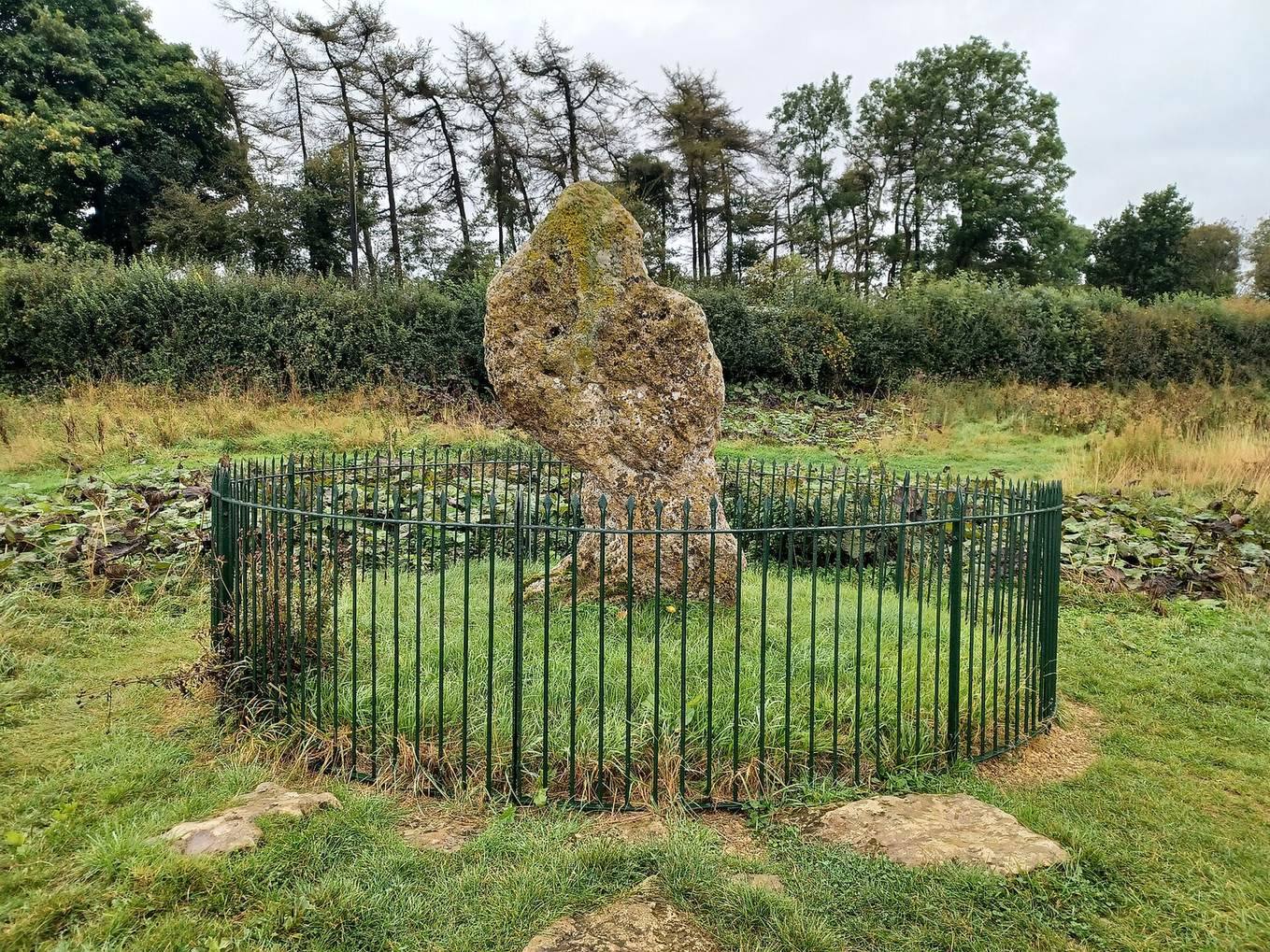
The King Stone stands 76 metres north of the King’s Men. It is a single, weathered limestone stone about 2.4 metres high and 1.5 metres wide. Its original weight has been estimated at approximately 4.7 tonnes, although substantial material has since been chipped away. If it was hauled from the proposed source near the spring line, the shortest route to it would have been about 450 metres uphill. Estimates for raising the stone suggest a team of 58 workers could have done the work in about two hours.
Excavated material and later features
Archaeological evidence
Investigation across the wider complex recovered stone artifacts, pottery, soil-profile evidence, mollusc remains, carbonized plant material, and animal and human bones. A small round burial mound, heavily reduced by ploughing, was excavated completely. During a 2003 excavation, two recently buried crystals were found in the centre of the King’s Men.
Modern features and condition
A sculpture representing a witch stands near the three monuments. David Gosling made it from intertwined willow branches, ivy, and hazel, drawing on the king-and-witch legend. Part of the King Stone was chipped off in 2001, and yellow gloss paint was splashed on the King’s Men in 2004. Flowers placed in cracks, coins wedged into them, and fires can damage the stones, their lichens, and the surrounding vegetation.