Church of Agios Dimitrios: An Early Christian Basilica in Thessaloniki
Site at a Glance
- Popularity
- Very High
- Country
- Greece
- Primary era
- Medieval
- Eras represented
- Classical, Medieval, Early Modern, Modern
- Civilizations
- Byzantine, Greek, Ottoman, Roman
- Site type
- Religious
- Remains
- Basilica
On this page21 sections
History
Origins and Early Christian Basilica
The Church of Agios Dimitrios is an Early Christian Hellenistic basilica in Thessaloniki, Greece, built on a large scale in 412–413 by Leontius, a Roman provincial official. Its architectural tradition blends early Christian church forms with Greek and eastern Roman building practices. The church honors Saint Demetrius, an early Christian martyr venerated as Thessaloniki’s patron saint.
The site’s earliest church is dated in different ways. One chronology places a small Christian oratory here after 313, with a proposed date of 313–323; another places the first basilica in the fifth century. Traditions associate the earlier building with a prison or the saint’s grave, at a place also linked to Roman baths and a stadium. Leontius built the larger basilica in gratitude for recovering from paralysis, and its altar stood above the presumed burial place of Demetrius.
A tradition holds that Thessalonian Christians secretly buried Demetrius’s relics there in 306 and that they were found during Leontius’s building work. Another interpretation places the beginnings of the saint’s cult at Sirmium, a Roman city in present-day Serbia, and proposes that his relics reached Thessaloniki after Sirmium was captured, either by Attila in 441 or by the Avars in 582. Archaeologists have challenged that explanation.
Fire, Rebuilding, and Byzantine Worship
A fire damaged the basilica during the reign of Byzantine emperor Heraclius, probably between 629 and 634. Archbishop John then directed repairs and an expansion, with financial help from the city’s residents. The church became a five-aisled basilica, the general form it retains. Earthquakes and fires are also associated with this rebuilding. Mosaics were made as part of the work, and the interior was substantially complete by the mid-ninth century.
An early ninth-century mosaic inscription, recovered after the 1917 fire, says that the church prospered again “in the time of Leo.” Leo may have been the father of Cyril and Methodius and a military commander from Thessaloniki. Writing in the mid-seventh century, Archbishop John described a silver canopy over a sacred focus in the central aisle; the fire destroyed it.
The basilica remained in use when Arab forces captured and sacked Thessaloniki in 904, and it escaped damage. Norman forces seized the city in 1185, looted the church, and desecrated Demetrius’s tomb. They also gathered the fragrant substance associated with the saint’s relics and used it irreverently. Repairs and renovations took place in the thirteenth century. A chapel dedicated to Saint Euthymius was added late in that century and painted in 1303.
Relics and the Myrrh Tradition
Veneration of Demetrius’s relics as producers of myrrh, a fragrant substance, is associated with the church from early times. The chronicler John Skylitzes first described this belief in 1040. Worshippers collected the myrrh in glass containers, some of which date to the eleventh or twelfth century. Muslims also gathered it, regarding it as medicinal.
From the fourteenth century, people said that myrrh-scented water flowed from a well in the crypt. A legend grew that the missing relics had been hidden there. References to myrrh from the well ended after the church became a mosque. The relics no longer produce myrrh, but at the vigil before the saint’s feast the reliquary is opened and worshippers receive cotton soaked in a fragrant liquid not identified as myrrh.
Demetrius’s relics were probably taken from Thessaloniki to Italy in the late twelfth or early thirteenth century. They were found in 1520 at the abbey of San Lorenzo in Campo. The saint’s head returned to Thessaloniki in 1978, followed by the main portion of the relics in 1980; six large fragments remained in Italy.
Ottoman Rule and the Return of Christian Worship
After Ottoman forces captured Thessaloniki in 1430, Sultan Murad II ceremonially left the basilica in Christian hands. The building was nevertheless looted, and the decorations of the church and Demetrius’s tomb were destroyed. A marble canopy associated with the saint was also lost in the capture.
In 1493 the basilica became the Kasimiye Mosque. It remained a mosque until 1912, when Christian worship resumed after Greek forces entered the city during the Balkan War. Under Ottoman rule, Christians retained access to Demetrius’s memorial in a small annex on the west side of the left aisle. Plaster and new walls concealed mosaics and frescoes, while repairs under an Ottoman governor exposed some mosaics.
During this period, devotion to Demetrius was also associated with a separate church by the sea, built in the late thirteenth or early fourteenth century on the site of the present Metropolitan Cathedral. The saint’s celebrated icon and other sacred objects were transferred there. That church burned in 1890.
Fire, Restoration, and the Church Today
The Great Fire of Thessaloniki in August 1917 destroyed about two-thirds of the city and almost completely burned the basilica. Reconstruction began in 1926, followed by a major restoration campaign that continued from the 1930s through 1948. The work uncovered the crypt entrance and a glass vessel believed to contain Demetrius’s blood beneath the altar, and cleaned surviving mosaics and frescoes. Aristotelis Zachos’s notes, drawings, and photographs informed the rebuilding, undertaken with the cooperation of several architects and scholars. The church was rededicated on 26 October 1949.
The crypt has housed an archaeological museum since the 1980s and has served as an exhibition space since 1988. The basilica remains an active Eastern Orthodox church within the Metropolis of Thessaloniki and the Ecumenical Patriarchate. In 2003 Metropolitan Panteleimon II, whose efforts were credited with securing the return of Demetrius’s relics, was buried in a tomb built at the entrance. The church forms part of the UNESCO World Heritage property “Paleochristian and Byzantine Monuments of Thessaloniki,” inscribed in 1988.
Remains
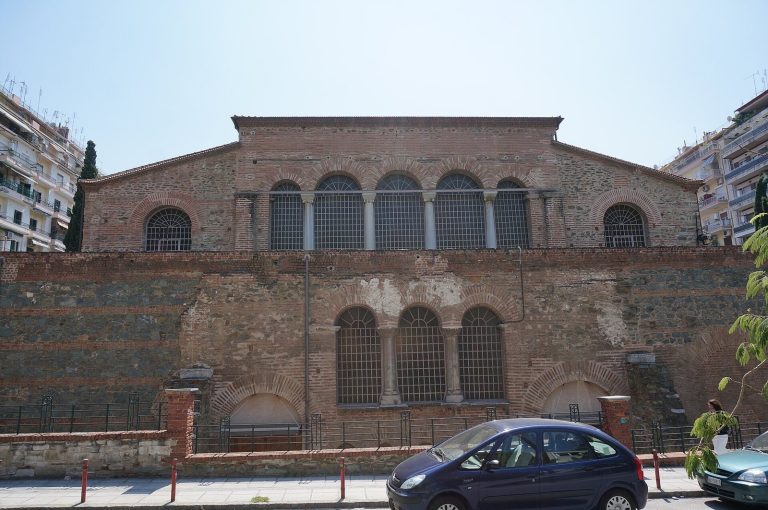
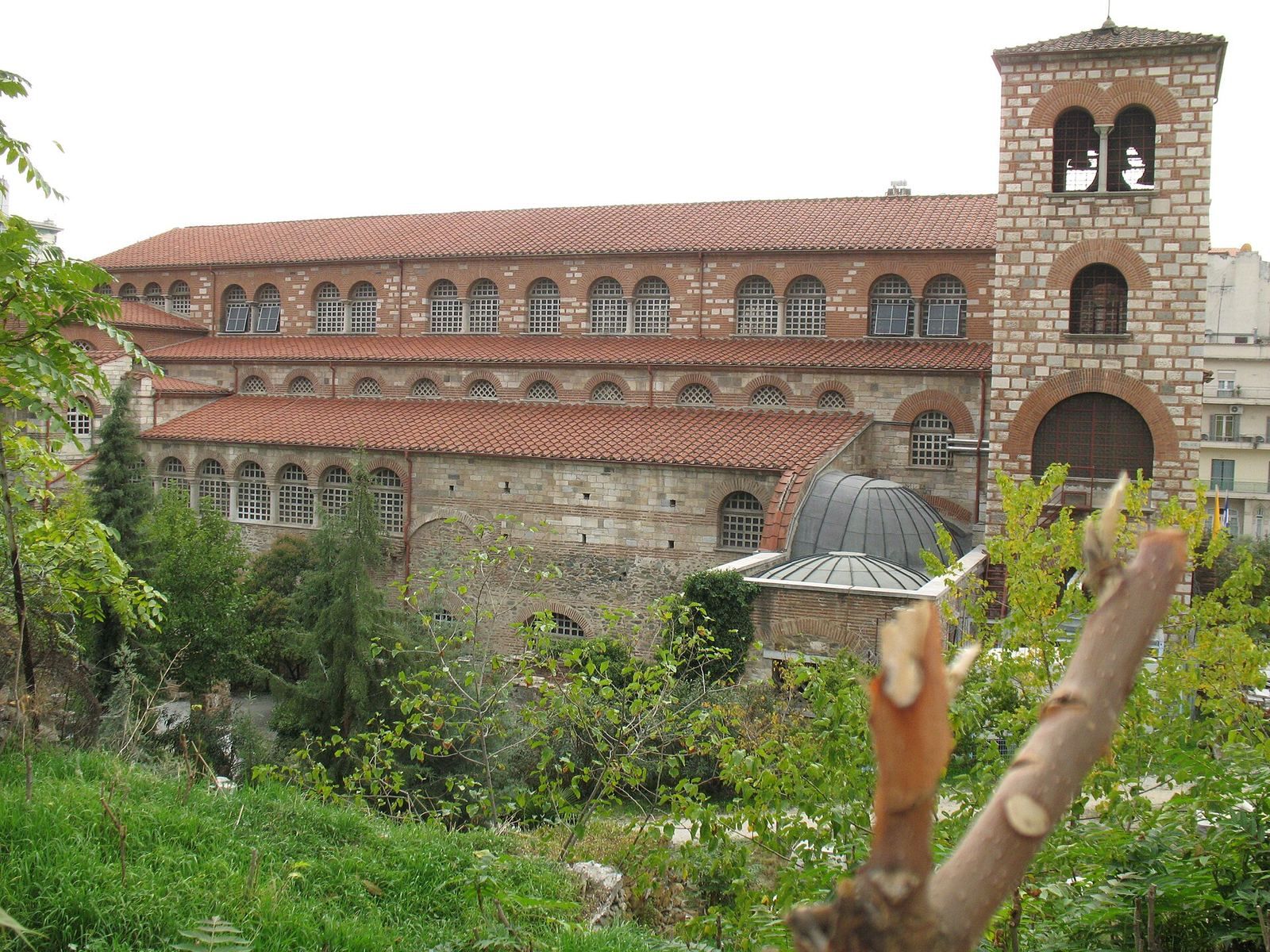
The basilica is rectangular, built partly of brick and stone reused from earlier buildings, and measures 43.58 metres long, including the sanctuary, by 33 metres wide. Four rows of marble columns divide its interior into five lengthwise aisles. A sixth aisle crosses them near the raised church platform, forming a transept. The central aisle is wider and taller than the side aisles, whose stepped roofs accommodate windows in the outer walls.
The Basilica
Plan and entrances
A narrow entrance hall, shorter than the church, spans its west end; its south aisle serves as a stairway. Two west doors align with the north and south side aisles, and further entrances open in the basilica’s north and south walls. A central opening divided into three parts connects the entrance hall to the church. Two green columns of Thessalian marble frame it.
Colonnades and carved stone
The columns separating the aisles are white, green, and dark-red marble. Their varying heights and column tops suggest that they came from earlier buildings. Carved forms include tops with two rows of acanthus leaves and curled corner ornaments, as well as examples decorated with eagles or rams. Acanthus is a leafy plant motif used in classical and Byzantine decoration. Some columns have rams’ heads with curled horns.
The arches once carried dark-blue or greenish marble on their faces and geometric patterns in white, black, and red marble beneath. Most of this decoration is now gone, though early twentieth-century drawings preserve its appearance. Marble wall panels, screens, columns, column tops, and window details formed part of the church’s decoration. Older masonry remains especially in the lower walls, where irregular rubble and brickwork follow the arches of doors and windows. Four fifth-century Skyrian-marble slabs in the central aisle and entrance hall have veins arranged to resemble a person at prayer.
Fifth-century carved blocks between columns and arches survive at the three-part opening and on a support in the central aisle colonnade. Those at the opening bear toothed acanthus and animal busts. Carving on the colonnade support includes acanthus, vine tendrils, birds, peacocks, and two-handled drinking vessels. A large sloping cornice runs around the central aisle at gallery-floor level; two further cornices decorate the sanctuary apse.
Sanctuary and roof
The sanctuary occupies the end of the central aisle and terminates in a semicircular apse, a curved recess at the church’s eastern end. A semi-dome covers its conch, and a large five-lobed window lights the space. A high marble screen separates the sanctuary from the rest of the church. The present screen imitates an early Christian design and incorporates patterns based on sculpture found during excavations. Inside, a bishop’s throne stands above tiered seating for clergy.
The altar stands over a cross-shaped recess containing a marble container shaped like a sarcophagus. The roof has five slopes and no dome. Though rebuilt in concrete after the 1917 fire, it retains the appearance of an open timber roof associated with Early Christian Hellenistic basilicas. The façade is asymmetrical, with a cross-topped bell tower on the left. Balconies are present in the central aisle and along the side roof slopes.
Mosaics and Frescoes
Mosaics
The church’s mosaics span the fifth through ninth centuries. Eleven survived the 1917 fire, on the east face of the wall between the entrance hall and main church and on the two large supports in the sanctuary. Some seventh- and eighth-century panels are among the religious images that survived the Byzantine controversy over the use and veneration of such images. Several preserved panels portray Demetrius with clergy, worshippers, children, civic leaders, or other saints.
On the west side of the sanctuary, Demetrius appears with children whose faces are individually rendered. He rests one hand on a child’s shoulder and raises the other, probably in prayer. The work may date from soon after the mid-seventh-century rebuilding. The saint appears as a young man wearing a tunic and richly decorated cloak. Another mosaic, found when a wall built during Ottoman rule was removed beside the altar, shows Demetrius with clergy. He touches a priest’s shoulder; the frame behind the priest has been interpreted as a city-wall battlement. Its inscription presents the saint as devoted to the city and cared for by its residents and visitors.
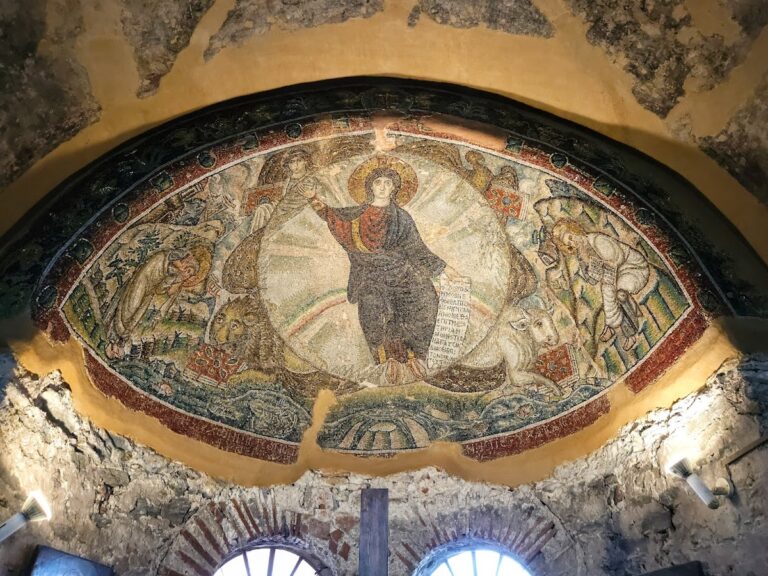
A further panel shows Demetrius with the city’s religious and civic leaders, placing his hands on their shoulders. The figures are thought to represent Leontius and Archbishop John. Its inscription calls them builders of the church and credits them with driving off a hostile fleet and saving the city, a reference to the Slavic siege of about 615–616. A mosaic on the south side of the sanctuary shows the Virgin Mary and Theodore Stratelates praying beneath Christ, who raises a hand in blessing. Mary holds a prayer scroll; an inscription suggests the panel was commissioned in gratitude for healing. It dates to the late ninth or early tenth century.
Other surviving mosaics include Demetrius praying with a young man, with his hands rendered in small gold pieces, and a panel of the saint with two angels. A series in the inner north aisle, dated to the beginning of the seventh century, follows episodes involving a child and the saint. On the northeast sanctuary support, a fifth- or sixth-century image shows Saint George with two children above the holy-water well. Other mosaics on the supports portray Demetrius, the Virgin, and a military saint, with a bust of Christ above. Detached pieces from the church, including images of Demetrius and a peacock, are held in the Museum of Byzantine Culture, along with a seventh-century panel of geometric and plant designs in multicoloured marble.
Frescoes
Frescoes survive in the right aisle and belong to phases ranging broadly from the seventh to the fourteenth century. They include Saint Luke of Stiris, a praying Demetrius dated to the eleventh or twelfth century, and an allegorical scene of a man pursued by a wild animal, possibly a unicorn. One painting depicts the Slavic siege of about 615–616 and attributes the city’s victory to Demetrius. An inscription identifies the basilica in the scene as the “holy church by the stadium.” Some painted areas imitate marble wall panels.
A fresco from the last third of the fourteenth century shows Demetrius covering a haloed bishop in liturgical dress as the bishop censes the saint, with the Virgin and Child above. The bishop has been identified as Gregory Palamas. The Virgin and Child have also been interpreted as the Virgin with Josaphat, the monastic name of John VI Kantakouzenos, though that reading is disputed. A well-preserved scene on the south wall shows an emperor, perhaps Justinian II, approaching the city on horseback with a military retinue. A large arched opening cuts through part of the painting.
Crypt and Other Spaces
Crypt
The crypt lies beneath the altar and includes a single-aisled basilica, a semicircular area enclosed by railings and columns, and water cisterns. Near its centre, a marble canopy rests on seven columns above a marble basin used to collect myrrh, traditionally believed to flow from the saint’s relics. Burial places of Thessalonian bishops occupy the northern part. The spring dates to the early Christian period and was supplied by underground hot water; a channel for the water was built in the tenth century. A well remains at the spring. The present entrance is by stairs to the right of the altar.
The crypt museum displays excavated sculptures and architectural fragments, along with mosaics removed from the basilica. Its exhibits include a vessel associated with the veneration of Demetrius, the restored raised church platform, and sculptures from the early church.
Chapel and water-blessing hall
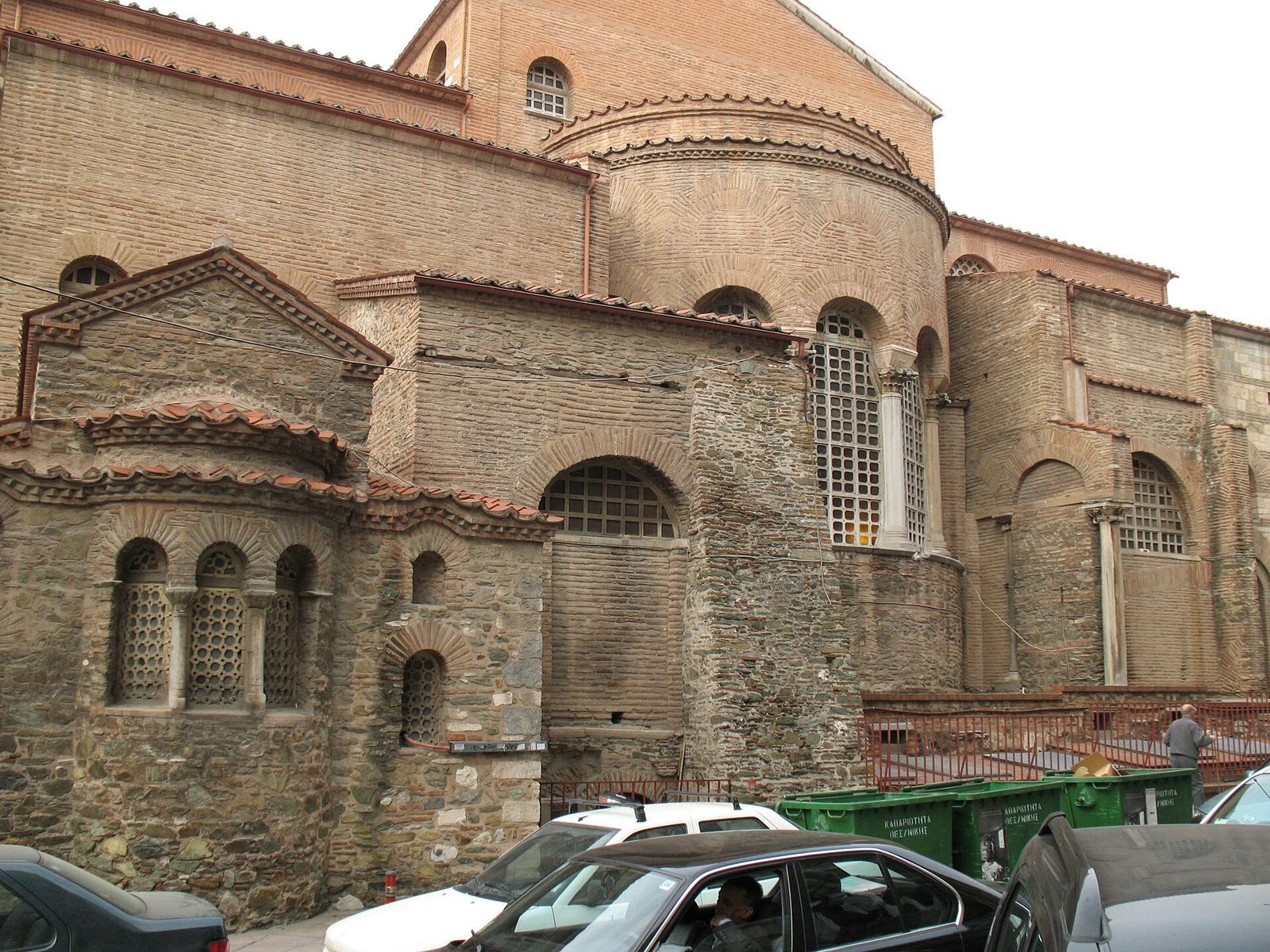
The Chapel of Saint Euthymius is attached to the basilica’s southeast side, to the right of the main altar. It is a small basilica with three aisles. Another addition is a vaulted, columned hall dating to the fifteenth century, used for the blessing of water.
Courtyard
A round marble basin from a Byzantine holy-water fountain survives in the basilica’s courtyard.
Relics and Tombs
Shrines and reliquaries
Demetrius’s relics are kept in the north aisle in a silver reliquary beneath a replica of the earlier marble canopy associated with the saint. The relics of Anysia of Thessalonica and Gregory Kallidis are also held in the church. Anysia’s silver reliquary is near the raised church platform.
Monumental tomb
A monumental tomb in the northwest corner of the central aisle, between a support and the first column, belongs to a Thessalonian notable buried in 1481. Probably made in Italy, it has Renaissance features, floral decoration, and a Greek inscription of twenty-two lines.