Gamla: A Jewish Town and Stronghold of the Revolt against Rome
Site at a Glance
- Popularity
- Very High
- Country
- Israel
- Primary era
- Classical
- Eras represented
- Classical
- Civilizations
- Roman, Seleucid
- Site type
- City
On this page20 sections
History
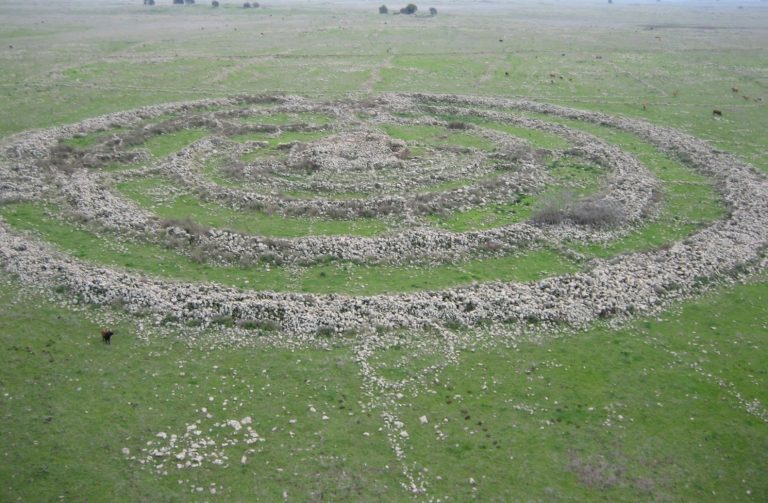
Gamla, an ancient Jewish town at Gamla Observation Point in Israel, is commonly dated to a foundation in 81 BCE, when Alexander Jannaeus brought it into the Hasmonean kingdom. It later served as the Golan’s capital and became a major stronghold in the revolt against Rome.
Early settlement and Hellenistic phases
Archaeological evidence places a settlement here in the Early Bronze Age. It probably relied on farming, as indicated by flint sickles; objects from the earlier Copper Age also come from the site. This early settlement was abandoned around 2700 BCE. A military outpost appeared much later, during the Hellenistic period.
One proposal is that a Seleucid fort, established during the Syrian Wars, conflicts between the Seleucid and Ptolemaic kingdoms in the third century BCE, developed into a civilian town in the late second century BCE. Coins of John Hyrcanus I indicate Jewish settlement in the region by at least the second century BCE, perhaps before Alexander Jannaeus’s conquests. A suggested explanation is that some Jewish settlers had returned from Babylonia.
Hasmonean and Herodian rule
The Hasmoneans were a Jewish ruling dynasty that established a kingdom in Judaea. Josephus, the first-century Jewish historian, says Alexander Jannaeus captured Gamla from the Seleucid ruler Demetrius Eucaerus. The date 81 BCE is commonly used for its entry into the Hasmonean kingdom. The town’s name is linked to the word for ‘camel,’ referring to the shape of the hill.
For about 150 years, Gamla served as the Golan’s capital and gained a reputation for high-quality olive oil. It grew substantially under Herod the Great, a Roman-backed king of Judaea. Later, its territory lay in dispute between Herod Antipas, Herod’s son and ruler in Galilee, and Aretas IV, the Nabataean king. Gamla was a traditionalist Jewish community.
People from Gamla or its surrounding community later became involved in resistance to Rome. Judah the Galilean led an anti-Roman revolt at Sepphoris in 4 BCE and was killed when it was suppressed. His sons Jacob and Simon fought Rome in 46 CE. Menahem ben-Yair became a leader of the Sicarii, a radical anti-Roman group, while his relative Eleazar ben-Yair led the defense of Masada.
Revolt and Roman siege
During the Jewish revolt against Roman rule, which lasted from 66 to 71 CE, Gamla became a center of resistance. Josephus relates that the town initially remained loyal to the authorities. Rebels opposed to Agrippa II, a ruler allied with Rome, arrived and helped turn the townspeople toward revolt. Philip, a general of Agrippa II, left the town, and a local leader called Joseph, known as ‘son of the midwife,’ persuaded its elders to resist. Leadership then passed to the Zealots, opponents of Roman rule.
In 66 CE, Gamla endured a seven-month siege organized by Agrippa II. Before the later Roman assault, the town sheltered rebels from Galilee and people from neighboring villages. Its population had grown crowded. Josephus had earlier helped strengthen Gamla’s defenses; after Rome captured him at Yotapata, he watched the siege from the Roman camp. His descriptions of the town’s topography have helped identify its features, though some details of his account of the fighting remain unconfirmed.
On 12 October 67 CE, Vespasian began a second siege. The Roman general, who later became emperor, brought three legions, V Macedonica, X Fretensis, and XV Apollinaris. Josephus estimated the force at about 60,000. He put Gamla’s population, including armed defenders, at 9,000, a figure Kenneth Atkinson considers greatly exaggerated; estimates for the town before the revolt range from 3,000 to 4,000. Vespasian’s campaign sought to suppress resistance centers along the army’s route, including smaller ones. Gamla’s defenders also hoped for help from Jewish communities in Babylonia and intervention by Parthia, a powerful empire east of Rome, although these hopes had little basis.
Roman forces bombarded Gamla for about a month and eventually broke through at several points. An initial assault was repelled: the narrow streets restricted the attackers, while defenders held higher ground. On 10 November, Roman troops broke through again and captured the town. Josephus says about 4,000 inhabitants were killed and others leapt into the ravine rather than be taken prisoner; he reports that two women survived by hiding. Archaeologist Dani Syon has questioned whether a planned mass leap on this scale took place, given the difficult descent and limited space at the possible jumping point. Some inhabitants may instead have died while trying to descend the cliffs.
Destruction and rediscovery
Gamla was abandoned after the Roman destruction and was never rebuilt. Some defenders who had escaped earlier joined rebels in the Judaean Desert. The town’s defense is sometimes compared with that of Masada, but historians including Dani Syon and Kenneth Atkinson emphasize the difference: Masada was a fortress, whereas Gamla was a town fortified for wartime and saw heavy fighting before its capture. Menachem Stern wrote that the defense of Gamla and other Judaean towns impressed contemporaries, and that the victory was regarded as a major military achievement of the Flavian dynasty, the Roman imperial house founded by Vespasian.
The location of ancient Gamla was debated from 1845. Suggested sites included the area now identified as Hippos, Beth Yerah, and a location near Tell ed-Drāʿ proposed by Konrad Furrer in 1889. Confusion over the location of Taricheae, an ancient town near the Sea of Galilee, also contributed to the problem until its location was corrected in 1909.
After Israel took control of the Golan Heights in 1967, an expedition led by Itzhaki Gal identified Gamla in 1968 with the site then known as Tell es-Salam or es-Sanam, a name referring to a hump. The landscape and archaeological remains matched Josephus’s descriptions. A survey supported the identification in 1970, and excavations began in 1976. Shmarya Guttman led 14 seasons between 1976 and 1989; after his death, Danny Syon and Zvi Yavor continued work from 1997 to 2000. Investigations also took place in 2008 and 2010. Difficult terrain required excavation by hand, and about five percent of the ancient town was investigated.
The ancient town became part of the Gamla Nature Reserve in 2003. A large fire caused by a shell fired during military exercises damaged the ruins in May 2010. The phrase ‘Gamla will not fall again’ later became a political expression of the importance assigned to control of the Golan Heights. Benjamin Netanyahu used it in 2009 while arguing against returning the Golan to Syria.
Remains
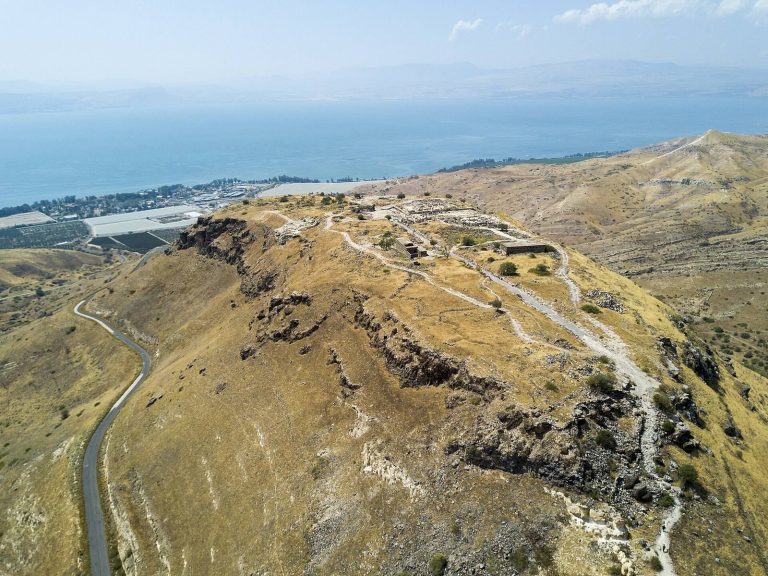
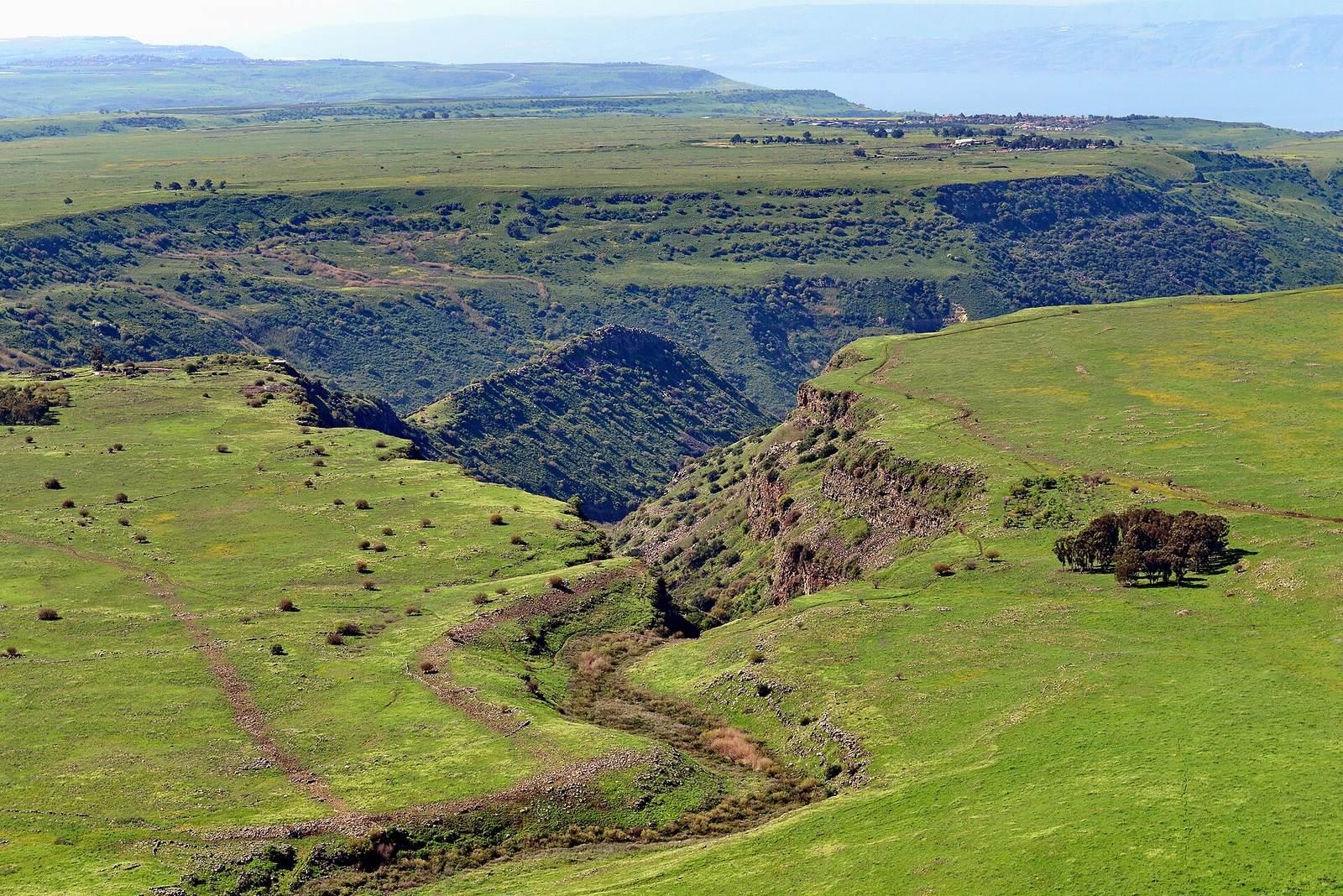
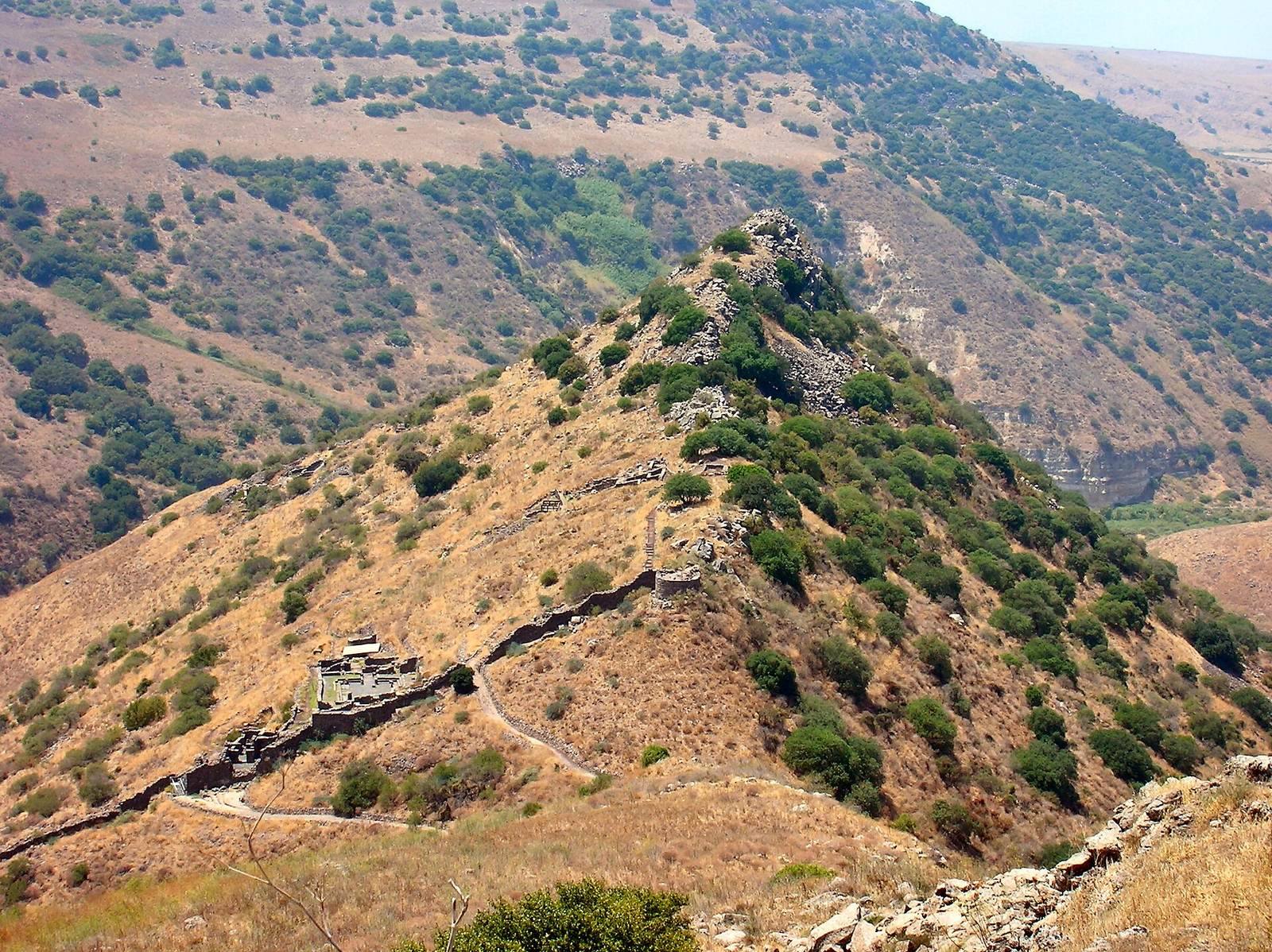
Gamla’s built area covered about 45 acres on a basalt ridge between the valleys of the Gamla and Daliot streams. Deep ravines border the ridge, and the town occupied its gentler southern slope, on the southeastern side of Mount Gamla, about 18 kilometers northeast of the Sea of Galilee. Buildings followed the terraces and were connected by stairs; a single road approached from the east.
Defenses and entrances
The wall and towers
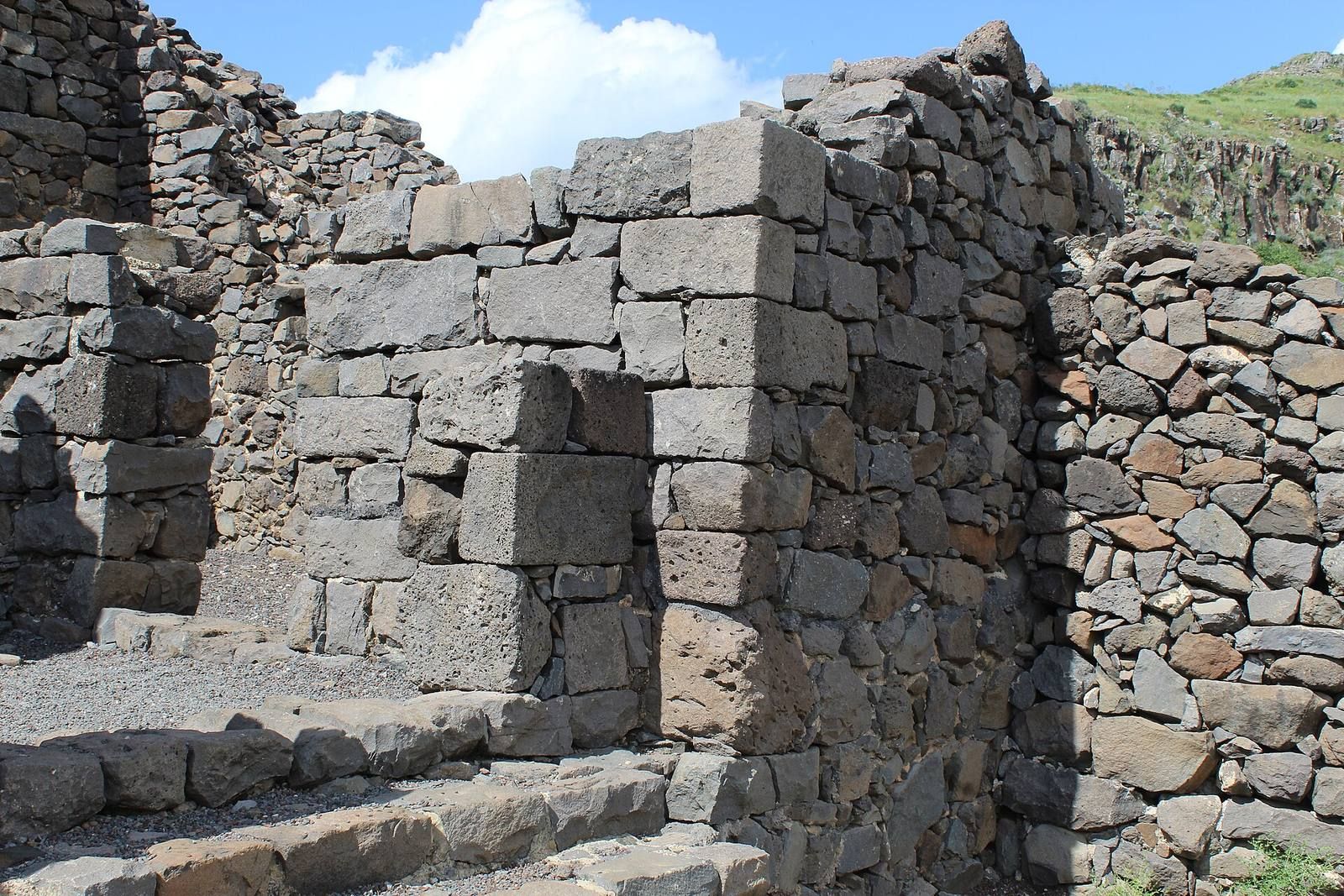
A defensive wall crossed the northern saddle of the ridge. Built from squared basalt blocks, it extended about 350 meters and reached six meters in thickness. The wall was assembled in sections to close gaps between existing houses, and some buildings along its course were demolished. Square towers stood along the wall. Near its northern end, a round tower on the hilltop predated the wall and probably dates to the Seleucid period. It may have been the town’s only defensive structure before the revolt. The tower rested directly on the ground without a foundation. Josephus describes Roman soldiers bringing it down; although the account has often been treated as embellished, Syon considered its collapse physically possible given its construction.
Entrances
Two towers in the lower part of the wall guarded an entrance known as the ‘Water Gates.’ A separate central entrance, called the ‘Gate of the Two Towers,’ has been interpreted as the town’s formal gateway.
Residential and production areas
Houses and workshops
Excavations in the western part of Gamla uncovered wealthy houses and buildings used for production. The remains include oil presses and facilities for storing oil, as well as large buildings with colored plaster. Together, these features show how housing and production occupied the same part of the town.
Water and ritual features
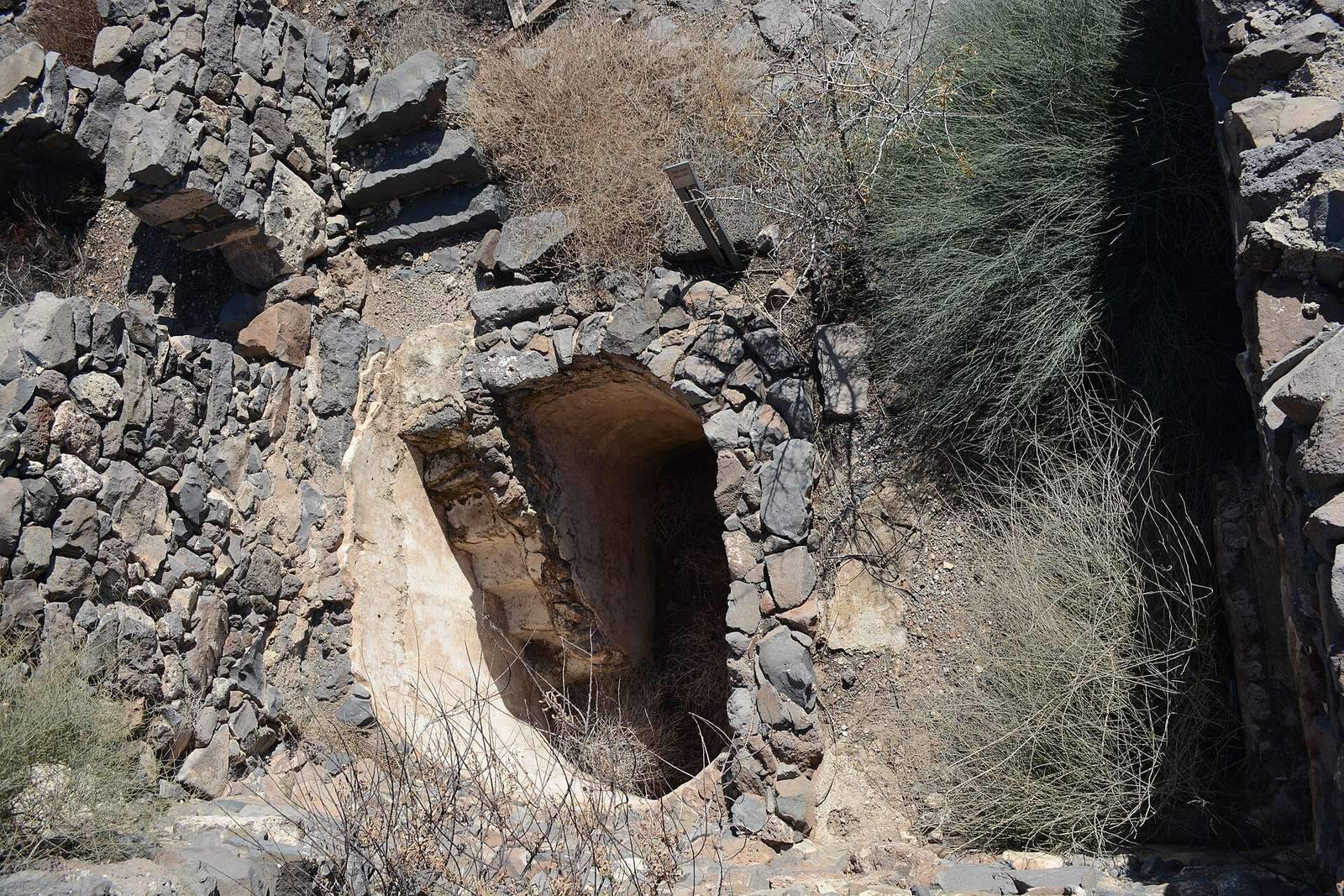
Four ritual baths and a water-conduit system are among the town’s remains. The water installations form part of the evidence for how Gamla’s terraced settlement was supplied and used.
Alley pilasters
Pilasters, shallow rectangular projections from a wall, were added beside both entrances to a narrow alley between two houses, partly obstructing them. Their practical purpose is unclear. They have also been interpreted as markers of an eruv, a ritual arrangement allowing objects to be carried between spaces on the Sabbath.
The synagogue
Plan and construction
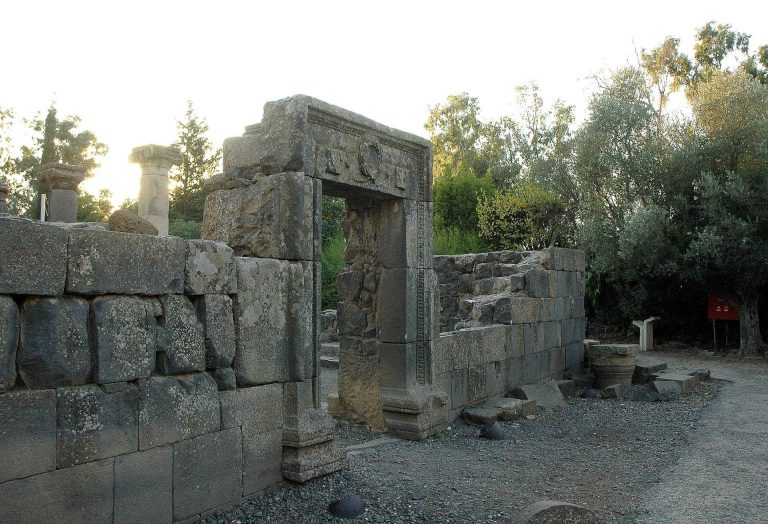
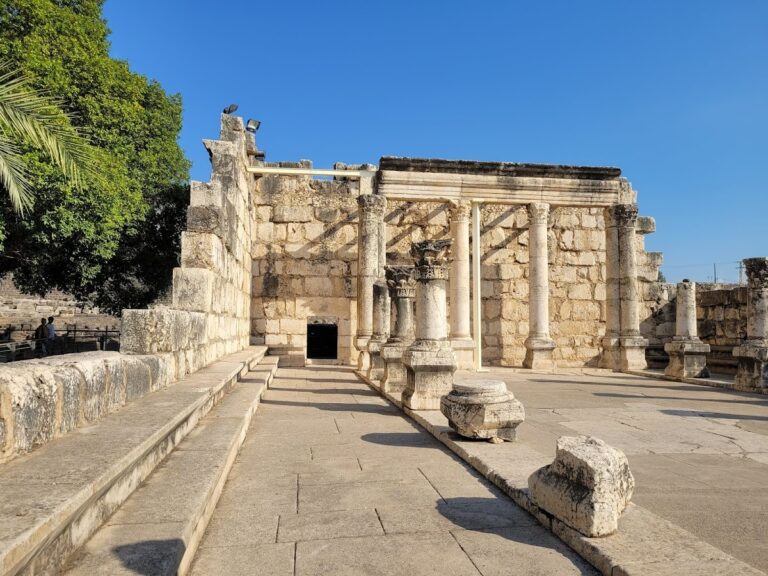
The synagogue, a Jewish communal place for prayer and study, stood in eastern Gamla beside the outer defensive wall. Built of dressed stone, it was rectangular and measured about 25.5 by 17 meters. Four rows of stone benches ran along the walls, while columns in the central area supported the roof. The plan included pillared aisles and a Doric colonnade, a row of columns in a classical style; the corner columns were heart-shaped. The entrance faced southeast. Broad steps in the courtyard descended to a ritual bath.
Dating and use
The synagogue’s construction date remains debated. It was once assigned to the first century BCE, a date that would make it one of the region’s earliest known synagogues. Stephen Fine places its construction after 40 BCE, while Uri Zvi Ma’oz argued for a date around 50 CE. The building was in use before Rome destroyed the Jerusalem Temple in 70 CE. Ma’oz proposed that its ritual bath was added in 67 CE and had previously served as a water cistern.
Before Gamla fell, the synagogue appears to have been adapted to shelter refugees. Hearths, cooking pots, and storage jars beside its northern wall support this interpretation. Excavators also found 157 ballista stones, projectiles from ancient artillery engines, in the hall, with 120 arrowheads nearby.
Evidence of the siege and revolt
Breaches and weapons
Several breaks in the defensive wall mark the fighting. One breach, probably made by a battering ram, lay near a concentration of projectiles. Along a narrow stretch about 50 meters wide, the wall was broken at several points; the largest opening reached five meters across. Ballista stones and arrowheads were found both inside and outside this breach. Roman artillery positions were about 300 meters from the walls.
The excavated arsenal includes about 100 catapult bolts, 1,600 metal arrowheads, and roughly 2,000 basalt ballista stones, a quantity unmatched elsewhere in the Roman Empire. Roman military equipment includes parts of helmets and armor, shields, bronze armor scales, identification tags, and pieces of lorica segmentata, Roman armor made from overlapping metal strips. An officer’s helmet visor and cheek guard were also recovered. A siege hook found in the breach could be used to stab a defender or catch onto a wall.
Coins and inscriptions
Excavations recovered 6,314 ancient coins, including coins minted at Gamla. A further 153 coins attributed to the town were later found in the collection of Kibbutz Sasa. Nine known examples of revolt-period coins minted at Gamla include seven found at the site, one at Alexandrium, a fortress in Judaea, and one in a collector’s possession that may have come from Gamla. The coin from Alexandrium points to contact between the rebels and Galilee.
The revolt coins carry inscriptions in Paleo-Hebrew and Aramaic lettering. One side reads ‘Deliverance’ and the other ‘To Holy Jerusalem.’ Their production and wording have been interpreted as propaganda supporting the struggle for liberation.
Household and ritual objects
Other finds include oil lamps, Jewish ritual lampstands, household objects, jewelry, stone vessels, and Herodian oil lamps. Most of the excavated assemblage is held at the Golan Archaeological Museum in Katzrin.