St Bartholomew and St George Parish Church in Volkach: A Medieval and Baroque Landmark
Site at a Glance
- Popularity
- Medium
- Country
- Germany
- Primary era
- Medieval
- Eras represented
- Medieval, Early Modern, Modern
- Civilizations
- German, Holy Roman Empire, Kingdom of Bavaria
- Site type
- Religious
- Remains
- Church
On this page16 sections
History
From chapel to parish church
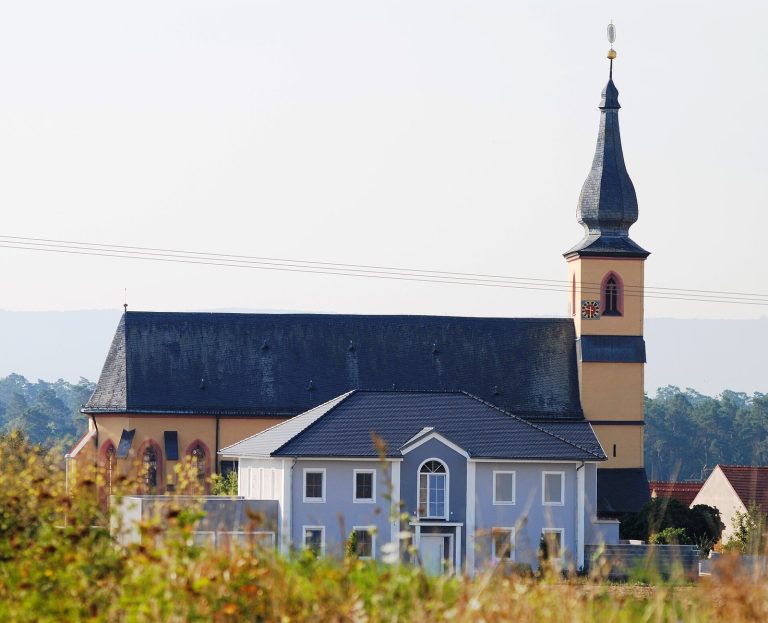
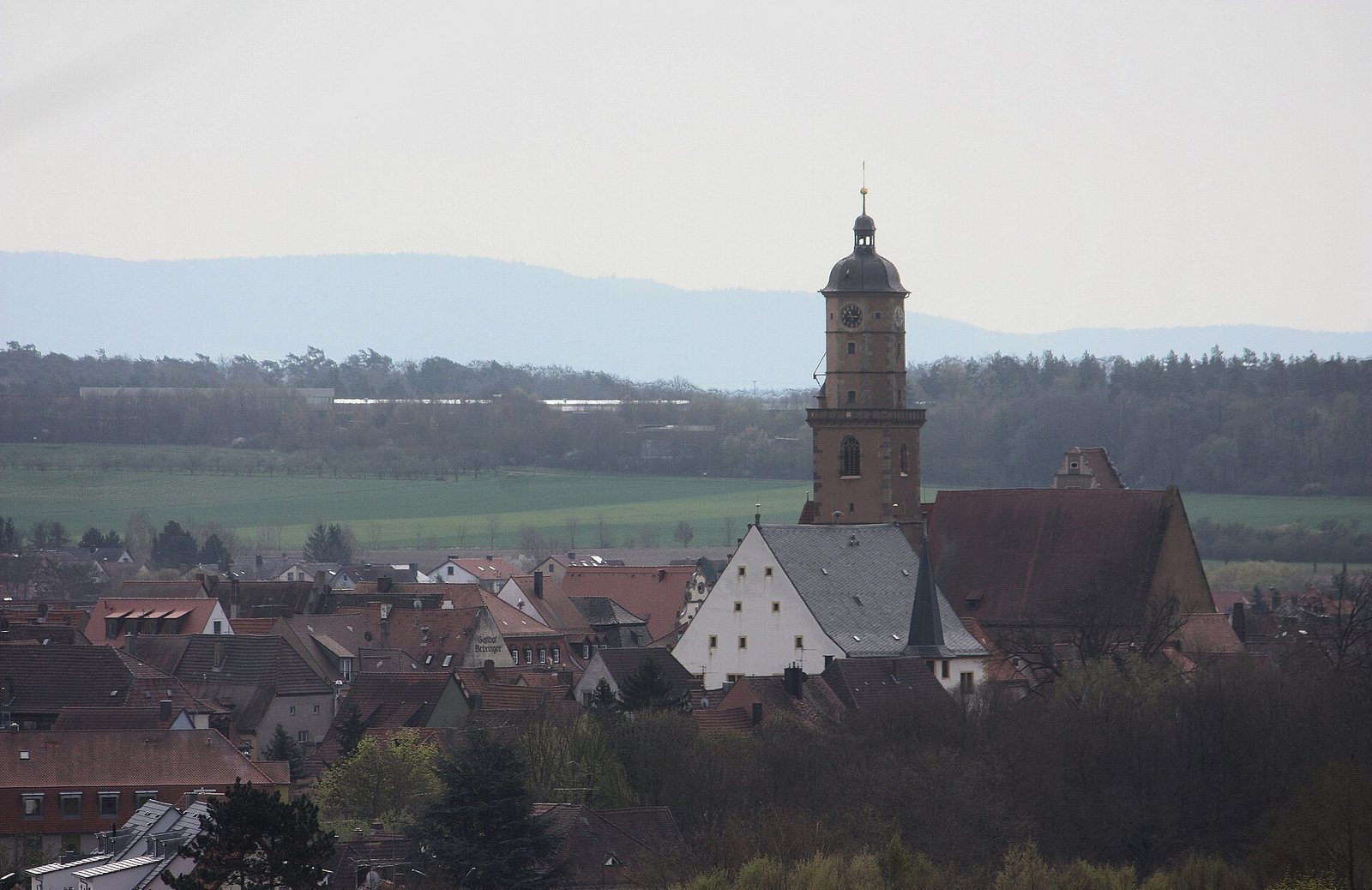
St Bartholomew and St George Parish Church is a Catholic church in Volkach, Germany. It stands in one of the town’s early settlement centers and is Volkach’s largest building as well as a local landmark. A church dedicated to St George stood here by the 12th century, but it was a chapel rather than the parish church. That role belonged to the pilgrimage church of Maria im Weingarten on nearby Kirchberg. An endowed Mass was established at the town church in 1335, and it became the parish church during the 14th century.
A major rebuilding began on 22 February 1413, a date preserved in an inscription on the choir. The work began at the east end with the choir, dedicated to St Bartholomew and St George. By 1442, the new choir had been joined to the older nave. Builders then extended the nave westward, enlarging the church and straightening the main street. A saints’ altar was installed on 25 November 1442, and in 1447 the Bartholomew altar was moved from Kirchberg into the new choir. A small chapel dedicated to the Archangel Michael was also added to the nave. In 1468, the church received a privilege from Rudolf von Scherenberg, the Prince-Bishop of Würzburg, an office combining senior Catholic authority with territorial rule.
Rebuilding and changing use
Renewal of the nave began in 1472. The town council appointed master builder Friedrich Reuß, whose first proposal was for a church with three aisles. Following design changes, the building was completed with a single main worship space and no side aisles. Work continued until 1517–18. In 1513, Würzburg cathedral master builder Hans Bock was commissioned to renew the tower. Its location at the town’s highest point also suited its intended use as a lookout. After an interruption, its octagonal upper section and stair tower were finished by 1597. The cemetery that had once surrounded the church was moved to the upper suburb in 1544.
A small wooden gallery was installed in 1573, and the church underwent its first renovation in 1607. The Rosary Brotherhood, a Catholic lay association devoted to the Rosary prayer, was founded in Volkach in 1642 and later transferred its worship from Kirchberg to the town church. A pilgrimage to Burgwindheim began in 1646 after a vow made during a plague. The church escaped major damage during the Thirty Years’ War, a 17th-century European conflict, and was not used for Protestant worship, unlike many churches in Franconia. A restoration in 1688 was noted in a document placed inside the tower’s orb.
Baroque remodelling and later changes
A Baroque remodelling began in 1727. The tower was renovated in 1738, and a flat ceiling was installed in the nave in 1753. A proposal to enlarge the church was rejected in 1843. In 1864, parish priest Georg Scheurich sought to replace the Baroque interior with a Gothic Revival design, but the congregation opposed the plan and it was abandoned.
The church suffered minor damage in the final year of the Second World War. Repairs followed in 1949, and a comprehensive renovation took place in 1951. In 1972, the sanctuary was rearranged in response to the Second Vatican Council, the Catholic Church council held from 1962 to 1965 that prompted changes to worship and church interiors. Adelmar Dölger made a new lectern for readings, and the crypt of the chapel now called the Nikolauskapelle was rededicated for worship. A restoration in 1990 was followed by work in 2006–08, when medieval wall paintings on the ceiling were uncovered. The church remains the Catholic parish church of Volkach, and its congregation has long been part of the town’s civic life.
Remains
The east-facing church has a single nave, meaning one main worship space without side aisles, and a polygonal choir at its eastern end. The two-storey Nikolauskapelle adjoins the west end, while the tower rises north of the choir. Houses enclose the church on three sides; its east side faces the main street. Medieval stonework forms the core of the building, while the interior furnishings chiefly reflect its 18th-century Baroque remodelling.
Church fabric and tower
Choir
The choir façade is articulated with buttresses, which reinforce the walls. Foliage decorates the projecting supports beneath tall canopies intended to hold statues, which were never made. An inscription on the fourth buttress gives the date 1413 and dedicates the construction to the Apostles Bartholomew and the holy knight George. The choir’s polygonal form marks the east end of the church.
Nave
Four window bays with ornamental stone tracery divide the nave. Its interior ceiling has a netlike pattern of ribs. Portals open into the church from both sides of the nave, and the door fittings date to the second half of the 15th century. Above the southern porch, projecting stone rib supports point to a plan for a chapel over the entrance. The present pews date to 1729, and the windows were installed in 1922.
Tower and bells
The tower stands north of the choir and reaches 45 metres across seven storeys. Its square lower section was built by 1517; an octagonal section, fitted with four clocks, was in place by 1597. A gallery leads to the upper part, which served as a residence for the tower keeper. A round stair tower with a small dome is attached on the east. The tower’s lookout function made it an indirect part of Volkach’s fortifications. Its first storey bears the arms of the Voit von Salzburg family and the date 1517. The second displays the arms of Prince-Bishop Lorenz von Bibra, possibly made in the workshop of the late-Gothic sculptor Tilman Riemenschneider. Elaborate stone tracery fills the four windows in the uppermost square storey.
A shallow dome and lantern crown the tower. Above them, a five-metre spike links the weather vane and a sphere 40 centimetres across. The vane carries a crescent about 90 centimetres in size and a seven-pointed star measuring 1.15 metres across. These motifs may derive from the arms of Mayor Georg Wagner. The belfry occupies the upper rectangular storey, with sound louvres on each of its four sides. Five bells in the tower are dated to 1519, 1840 and 1953. The early-16th-century Ave Maria bell and the Mary bell, cast in 1840, are among them; three bells made by the Otto foundry in Bremen arrived in the 1950s. A bell from 1313, the oldest furnishing associated with the church, is displayed beside the Cross Altar. The Storm Bell, also known as the Wine Bell, was melted down during the Second World War. Its ringing had marked the end of work in the vineyards.
Nikolauskapelle
The chapel at the west end of the nave was first mentioned in 1447. Initially dedicated to the Archangel Michael, it was later named for St Nicholas and probably served as a bone store. It is entered beneath the parish church gallery. Its crypt was put back into worship use in 1972, when a beam ceiling and 15th-century apostle crosses were uncovered inside. The furnishings include a copy of a painting known as Mary Help from the workshop of Lucas Cranach and an icon of St Nicholas. The former Latin school, where Latin was taught, adjoins the chapel.
Baroque interior and furnishings
Ceiling and painted decoration
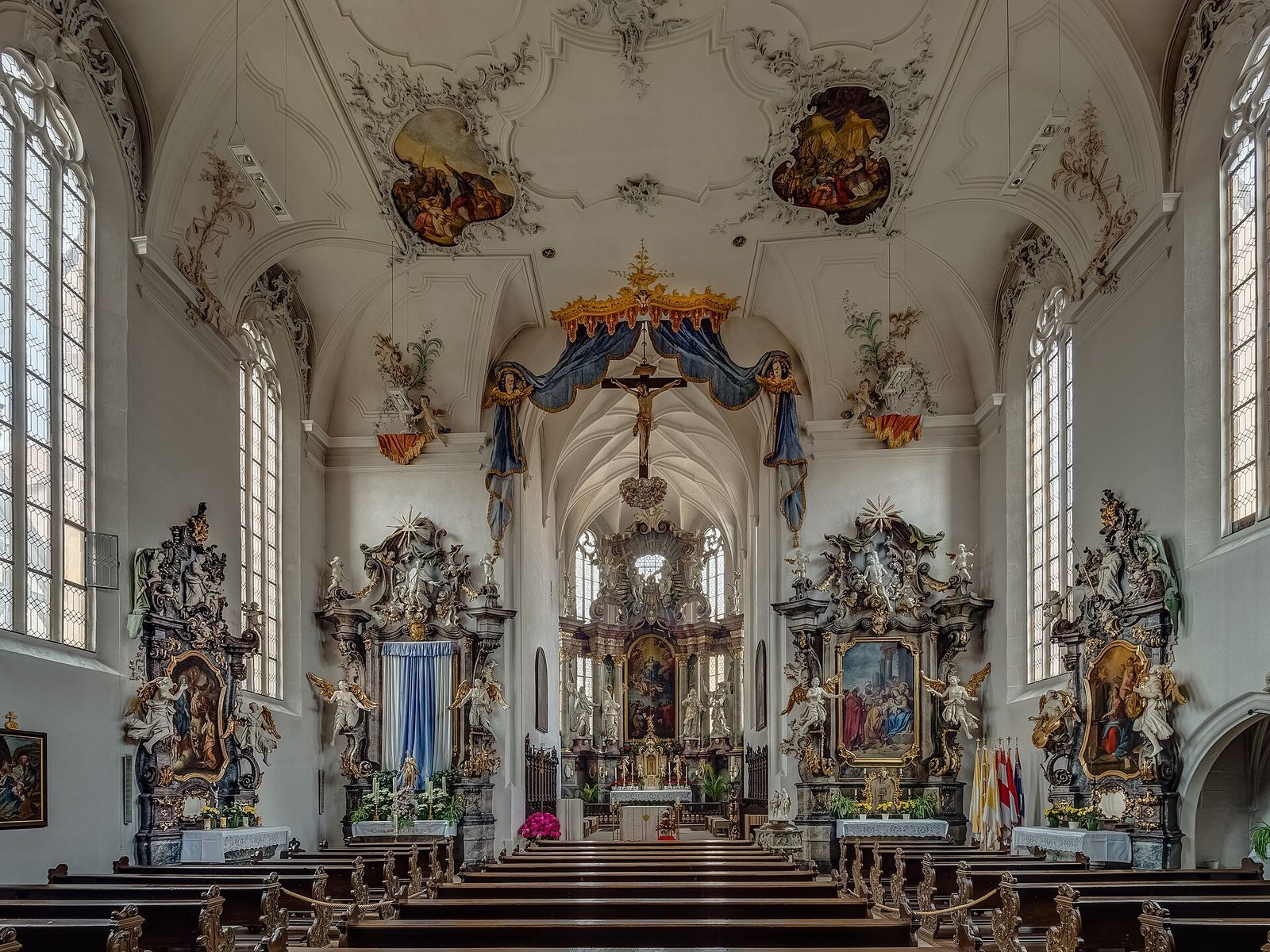
The nave’s flat, stuccoed panel ceiling was made during the 18th-century remodelling. Rococo ornament, a light and highly decorative style, frames painted medallions; decoration also covers the upper window recesses and the curved coves at the ceiling’s edges. Stucco vases run along the east cornice, and coloured putti with garlands adorn the ceiling. Above the chancel arch, a gathered blue stucco curtain frames a Baroque crucifix.
Johann Michael Wolcker of Würzburg painted the ceiling scene, the Adoration of the Blessed Sacrament, in 1753. Allegorical figures honour the Trinity, the Christian belief in one God as Father, Son and Holy Spirit, while the devil falls into hell before the consecrated Eucharist. The image also includes figures representing the Church, the Empire and the Duchy of Franconia, represented by the Prince-Bishop’s flag. Four surrounding medallions show Old Testament subjects: Melchizedek’s sacrifice, the Israelites’ manna, the Ark of the Covenant and the table of the showbread.
High altar
The high altar fills the choir’s east wall and measures 14 by 7.3 metres. Its construction was entrusted in 1732 to court carpenter Johann Georg Neßtfell of Wiesentheid, after an earlier appointment did not meet the town council’s requirements. Georg Sebastian Urlaub painted the central panel in 1733, and the altar was consecrated in 1739. Sculptor Reutel of Kitzingen made its four large saints in 1771; Johann Peter Wagner added the tabernacle, the container for the consecrated Eucharist, in 1772 and altered it in 1791.
Six columns with recessed panels at their bases and richly decorated capitals support a high cornice. Stucco curtains drawn back at the outer columns frame the structure. Four larger-than-life figures represent St Bartholomew, St Kilian, St Aquilin and St George. The central painting depicts the Assumption of Mary, the Catholic belief that Mary was taken into heaven body and soul. Above it, a scene of the Trinity shows Jesus with the cross beside God the Father, with a dove representing the Holy Spirit above a halo of clouds. Angels and putti surround the scene, and stucco vases mark the sides of the upper section. The white-and-gold tabernacle displays the Blessed Sacrament at its center, with the Eye of Providence and Lamb of God above, praying putti beside it and angels at the outer edges.
Side altars
Four side altars were made as part of the nave’s remodelling and are probably the work of Kitzingen sculptor Reiner Wierl. Their shared design uses curved pilasters with scroll-shaped ends, kneeling angels beside the central paintings and raised upper sections framed by putti. The north-side Rosary Altar dates to 1755 and is associated with Volkach’s Rosary Brotherhood. Its painting presents Mary as Queen of the Rosary, while the upper section shows St Anne teaching her daughter Mary.
The Cross Altar beside the left side of the chancel arch received a new painting in 1853 from Volkach artist Peter Geist. The panel shows Christ taking on his suffering, with angels carrying instruments of the Passion, St John Nepomuk above and the Eye of Providence at the top. The altar to the right of the arch is dedicated to St Sebastian. Its replacement painting, also by Geist, depicts the Adoration of the Magi; a figure of St Sebastian stands above, flanked by angels carrying a sceptre and crown. On the south wall, the Cecilia Altar is linked to Volkach’s Cecilia Brotherhood, founded in 1625. Georg Anton Urlaub’s signed 1755 painting depicts St Cecilia, drawing on a work by Peter Paul Rubens. Angels hold musical instruments beside the panel, and St Wendelin appears above.
Pulpit, galleries and organ
Johann Peter Wagner received the commission for the pulpit in 1791 and began work the following year. First placed to the left of the chancel arch, it now stands on the nave’s south wall. Three putti on its body carry a cross, a chalice and an anchor, representing faith, hope and charity. The front relief depicts the Adoration of the Shepherds, and a bust of the young Evangelist John is set into the right side. A relief on the back shows the handing of the keys to Peter. Putti ornament the front of the sounding board, vases decorate its rear, and a large figure of Moses holding the tablets of the Law crowns it.
The present galleries, with balustrades, were built around 1716, with two supporting columns added in 1823. The three-tier gallery at the west end is Baroque and houses the organ. The current instrument by Vleugels is installed in the case made for Johann Philipp Seuffert’s 1757 organ, whose front was made by Sommerach sculptor Matthias Sporer. An organ from Würzburg’s Neumünster church had been brought to Volkach in 1625, and Johannes Klais Orgelbau of Bonn renewed the organ works in 1948. The present instrument has three keyboards and 38 stops, which control the sets of pipes and the sounds produced. Its controls combine mechanical and electrical systems.
Other furnishings and artworks
The choir stalls on either side of the high altar date to 1771 and were made by Reutel. A medieval recess for the Eucharist remains in the choir; above it is a bronze memorial to Johann Christoph Hausher. A 15th-century head of Christ above the sacristy door may originally have served as the central stone of an arched portal. Two paintings by Oswald Onghers, showing the Beheading of John the Baptist and St Anthony of Padua, came from the pilgrimage church of Maria im Weingarten. An epitaph for parish priest Georg Philipp Vogel, who died in Volkach in 1710, is on the church’s right side. A sculpted scene of Christ on the Mount of Olives, dated 1581, is on the north choir wall.
The 1972 sanctuary furnishings include a Mass altar and a priest’s chair by Adelmar Dölger. The church has had an ambo, a stand for readings during worship, since 2008. The baptismal font dates to 1559 and bears the arms of Prince-Bishop Friedrich von Wirsberg, Volkach and church wardens Johann Schwan and Cunz Rücker. Its reliefs depict the Baptism of Christ, Mary, the risen Saviour and the Twelve Apostles. A wooden group of the Baptism of Christ was probably made around 1750 for the Baroque remodelling.
The 18th-century Stations of the Cross comprise 14 scenes, with the 12th and 14th added later; donors’ initials appear on the panels. Two 18th-century figures of Mary were made for domestic devotion. Reiner Wierl made two confessionals in 1754, one for the Nikolauskapelle; a figure of the Apostle Judas Thaddaeus stands on the confessional to the right of the north portal. A small chapel on the church’s south side holds a late-Gothic Pietà, a sculpture of Mary holding the dead Christ, made in Volkach in the mid-15th century. It belongs to the refined Soft Style and was probably produced in Lower Bavaria. A Baroque crucifix stands on the east side of the church, and a weathered wayside shrine depicting the Crucifixion is set against the nave’s south wall.