Megalithic Tombs near Lüdelsen: A Neolithic Burial Complex in Germany
Site at a Glance
- Popularity
- Very Low
- Country
- Germany
- Primary era
- Stone Age
- Eras represented
- Stone Age
- Civilizations
- Unclassified
- Site type
- Burial
- Remains
- Necropolis
On this page11 sections
History
The Megalithic Tombs near Lüdelsen are a group of six Neolithic burial monuments in Germany, associated with the Deeply Incised Pottery culture, an archaeological classification of prehistoric communities and their material remains. They date to 3700–3350 BC, during the Neolithic, the later Stone Age period associated with farming and settled communities.
Nineteenth-Century Records
Johann Friedrich Danneil described the tombs in 1843. Two other tombs, south of the road, were destroyed during the nineteenth century. In the early 1890s, Eduard Krause and Otto Schoetensack identified these as KS 135 and KS 136. A field-name meaning “At the Great Stone” has also prompted suggestions that a ninth tomb may have existed.
Survey and Excavation
Since 1972, members of the Young Archaeologists of Altmark association have cleared vegetation from the surviving tombs each year. A joint survey in 2003–04 measured the surviving megalithic tombs of the Altmark. Later excavations by Christian-Albrechts-Universität Kiel examined Tomb 3 in 2007 and Tomb 6 in 2009–10, under archaeologist Denis Demnick.
Remains
The tombs were originally arranged in three groups. Tombs 1–5 form a line about 200 m long in woodland roughly 2.1 km east of Lüdelsen’s center, north of the road to Stöckheim. Tomb 6 lies about 800 m west of this group. The structures use large stones to form burial chambers, with mounds and stone enclosures surviving around some of them.
Tombs 1–5
Tomb 1
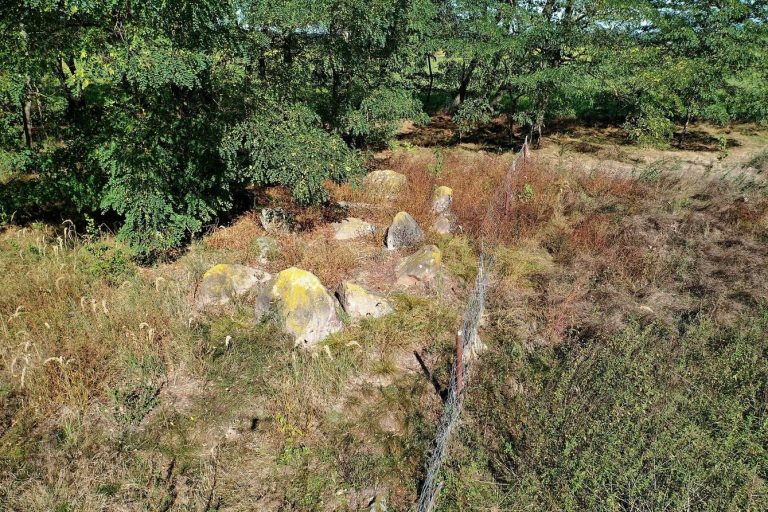
Tomb 1 is a polygonal dolmen, a prehistoric chamber tomb built from large stones, often with upright supports carrying a capstone. It stands on a mound that rises 1.8 m on the south side and 0.8 m on the north. Ploughing has shaped the mound into a pointed oval. Six of the tomb’s original eight wall stones remain. Its capstone measures 2.9 × 2.2 × 1.0 m and bears cup-shaped depressions on its upper surface. The visible chamber is 2.5 m long, 1.2 m wide, and 0.6 m high. The tomb stands in a field among a group of trees.
Tomb 2
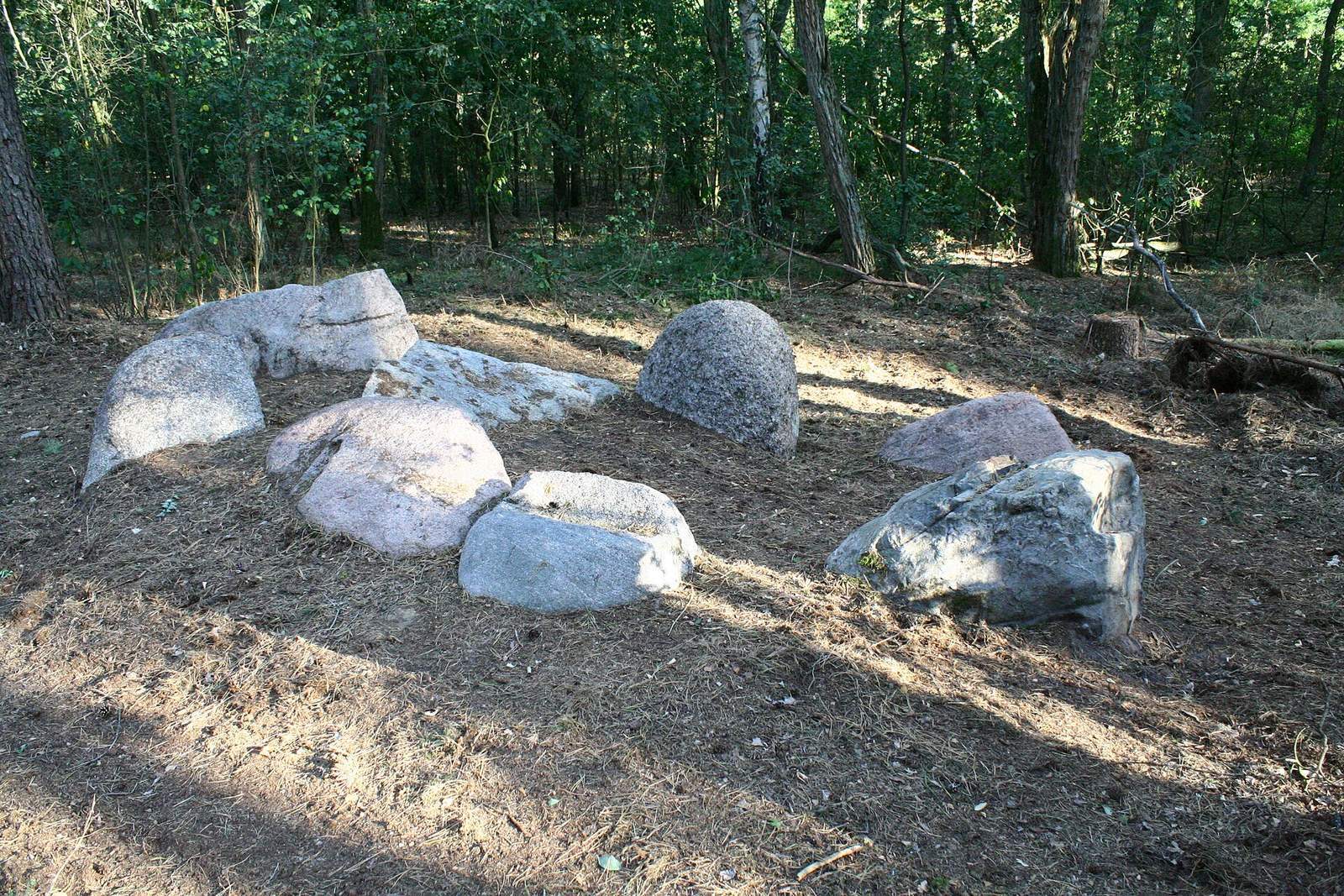
Tomb 2 is a great dolmen, an archaeological type of large megalithic chamber tomb, on a slope descending south. Construction of the nearby road damaged the tomb and altered its long mound, which was partly built up and partly cut into. Eleven perimeter stones trace part of an east–west oval enclosure about 8.5 m wide. The chamber also runs east–west and consists of two broken capstones and six wall stones. The larger, eastern capstone measures 2.7 × 1.9 × 1.1 m and has about eleven cup-shaped depressions on its south side. The rectangular chamber is at least 3.5 m long and 1.6 m wide; collapsed capstones have severely damaged it.
Tomb 3
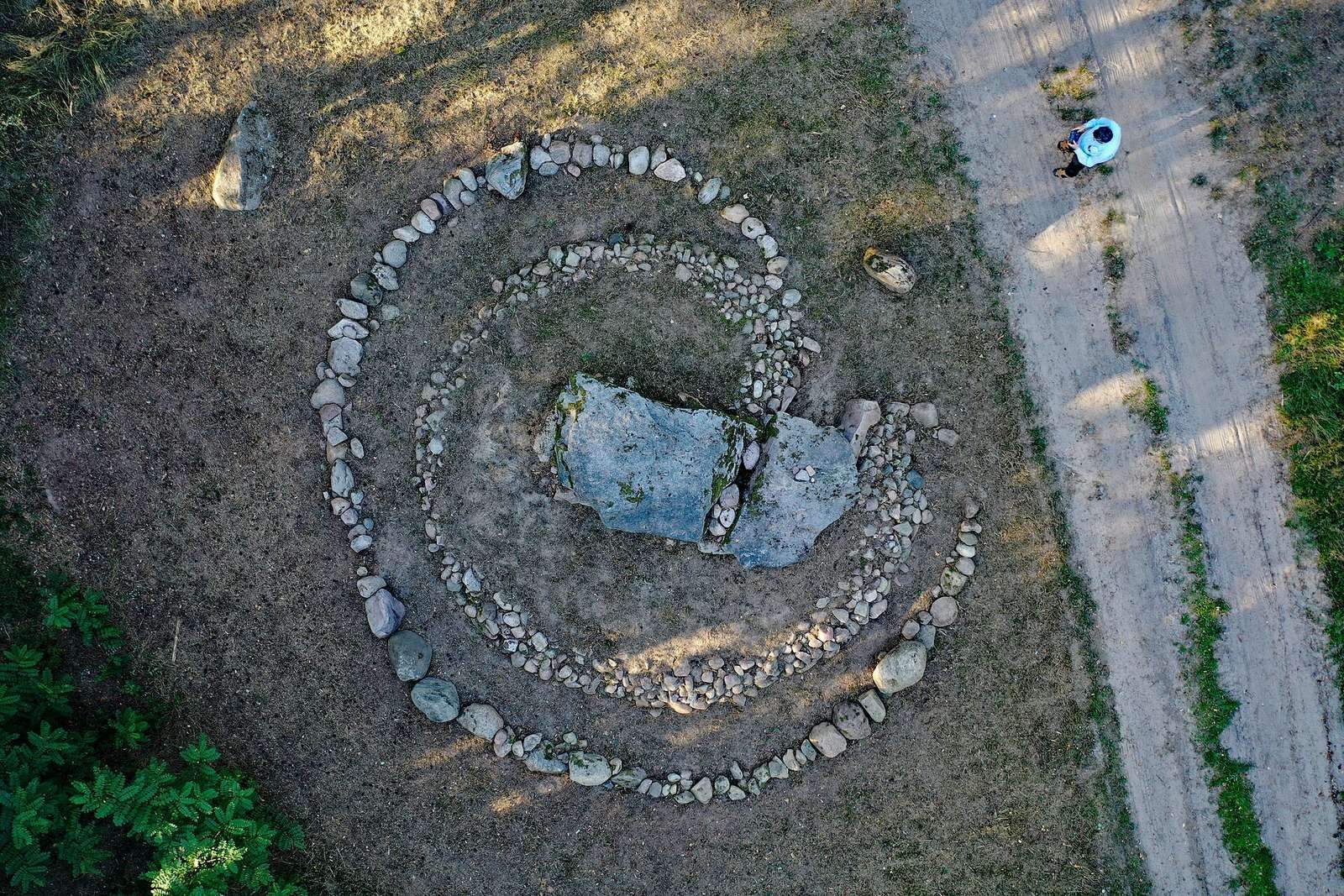
Tomb 3 is an extended dolmen, another type of megalithic chamber tomb, on a south-facing slope. Excavation showed that its mound was built in two phases, with the later mound reaching about 30 m across. At least two stone-circle enclosures were identified. The inner circle, made from fieldstones 10–40 cm across laid in two or three courses, could be reconstructed; the inner mound ends at this circle. Part of a row of larger outer stones also survives, though its original shape is uncertain.
The chamber measures 4.2 × 2.6 m externally. Seven supporting stones carry two capstones, and two further stones to the east form an entrance that turns north. Pottery fragments and flint objects from the chamber are associated with the Funnel Beaker culture (4200–2800 BC), Globular Amphora culture (3100–2700 BC), and Single Grave culture (2800–2100 BC), archaeological classifications based on prehistoric material remains. A secondary burial, an interment made after an earlier burial or funerary treatment, may belong to the Corded Ware culture (2800–2200 BC). Pottery found in front of the chamber indicates use into the Iron Age, a later prehistoric period associated with the widespread use of iron.
Tomb 4
Tomb 4 is a great dolmen on a gentle south-facing slope. Its east–west chamber is rectangular or trapezoidal and measures 3.3 × 1.4 m internally. The chamber originally had eight wall stones and three capstones; one wall stone and one capstone survive. The remaining capstone measures 1.8 × 1.1 m. A deep groove in the northwestern wall stone is probably natural.
Tomb 5
Tomb 5 is another great dolmen on a gentle south-facing slope. Its heavily eroded mound runs northwest–southeast and reaches about 0.6 m high. A nearby stone may indicate an enclosure. The tomb originally had eight wall stones and three capstones; six wall stones and one capstone survive. Its rectangular chamber runs northwest–southeast and measures 2.5 × 1.4 m internally. The surviving capstone is 2.2 × 1.5 × 0.8 m, with at least three artificially made cup-shaped depressions alongside natural hollows.
Tomb 6
Tomb 6 is a passage grave, a tomb whose chamber is reached through an entrance passage. The whole complex runs east–west. Its trapezoidal enclosure is 35.1 m long and 5.8–8.5 m wide, narrowing at the center. Fifty of the approximately 60 original stones survive. Four large corner stones, known as guardian stones, mark the enclosure; the two western ones stand in front of it. Three corner stones and five other enclosure stones have toppled. The eastern guardian stones measure 2.5 × 0.9 m and 2.0 × 1.7 × 1.0 m; the southwestern guardian measures 2.7 × 1.6 m.
The long mound inside the enclosure reaches 1.7 m high at its eastern end and 1.2 m at the center. Its rectangular chamber measures 7.9 × 1.7 m internally and stands 1.1 m high. Fifteen wall stones surround it, and all five capstones survive, with the two central stones collapsed. The largest capstone measures 2.2 × 1.9 × 0.8 m. Gaps in the chamber’s south side and in the enclosure stones indicate a probable entrance.