Behistun: An Archaeological Site and Achaemenid Monument in Iran
Site at a Glance
- Popularity
- Very High
- Country
- Iran
- Primary era
- Iron Age
- Eras represented
- Iron Age, Classical, Medieval, Early Modern, Modern
- Civilizations
- Achaemenid, Ilkhanate, Median, Parthian, Qajar, Safavid, Sassanid, Seleucid
- Site type
- Civic
- Remains
- Monument
On this page18 sections
History
Behistun is an archaeological site on the lower slopes of Mount Behistun, about 32 kilometres east of Kermanshah, Iran. Around 520 BC, Darius I commissioned a rock relief and inscription there. The monument presents his claim to the throne and his defeat of a rival, Gaumata, during the rule of the Achaemenids, the dynasty that governed the Persian Empire from the sixth to the fourth centuries BC.
Early occupation and traditions
Behistun stands beside a major passage through the Zagros Mountains, used by caravans and armies travelling from Babylon and Baghdad toward Ecbatana. The route also linked the Mediterranean region with China. The name may come from Bagastana, meaning “place of the gods.” An ancient tradition preserved by the Greek historian Diodorus Siculus, drawing on the account of Ctesias, a Greek writer at the Persian court, credited the carving to Semiramis, a legendary Assyrian queen, and associated the mountain with Ahura Mazda, the supreme deity of Zoroastrianism. The place-name developed through Middle Persian and early Islamic forms; one early Islamic interpretation understood it as “good” or “better column.”
Caves at Behistun show that people occupied the area in prehistoric times, and a sanctuary at the site is attributed to the Median period, associated with the Medes, an ancient Iranian people.
Darius and the Achaemenid monument
Darius’s inscription recounts his accession and the events through which he established his rule. It describes the death of Cambyses, the revolt and death of Gaumata in autumn 522 BC, rebellions across the empire, and Darius’s victories in 19 battles, including a difficult campaign against the Scythians. The narrative sets out the Achaemenid lineage and rejects the claims of those Darius calls rebels.
The text also turns its account into advice for later generations. It credits Ahura Mazda, urges readers to uphold truth and reject falsehood, and offers prayers for the country and its people. It names Darius’s supporters, addresses future kings and readers, and says that the account was circulated throughout the empire in three languages.
Seleucid and Parthian periods
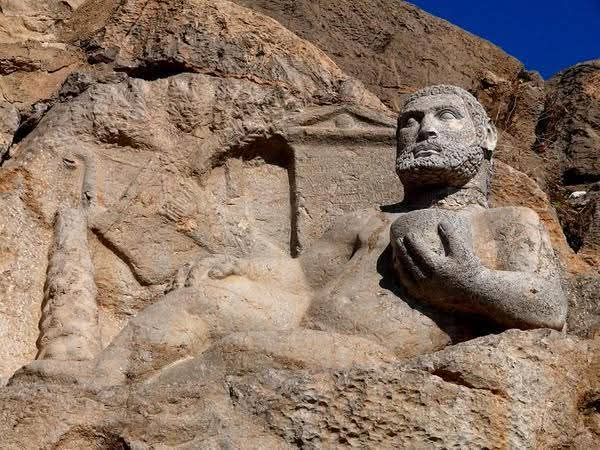
A relief of Heracles belongs to the Seleucid period, when the Seleucids ruled much of western Asia after the conquests of Alexander the Great. Road construction exposed the carving beside the ancient highway, close to the path leading toward Darius’s monument. Its Greek inscription gives the date 148 BC.
Parthian reliefs present scenes of royal homage and mounted combat. One shows Mithridates II receiving homage from satraps, provincial governors in an ancient empire. Another depicts an armoured rider striking a fallen opponent with a spear. The opponent’s identity remains uncertain. One interpretation connects the scene with Gotarzes II’s victory over Meherdates around AD 50. Other readings link it to victories over Mithridates, a rival, and Cassius, a Roman commander. A further interpretation identifies the rider as Gotarzes I, who issued coins at Babylon near the end of Mithridates II’s reign and is called “satrap of satraps” in a neighbouring inscription.
Sasanian works and later occupation
Two major Sasanian projects at Behistun remained unfinished: a palace and a large rock-cut undertaking west of Darius’s monument. One interpretation proposes that the latter cut away an earlier relief and Akkadian inscription showing the goddess Inanna, spear-bearers and possibly a king. This proposed lost carving, rather than the relief of Anubanini at Sarpol-e Zahab, may have provided a model for Darius’s monument.
The unfinished palace area later held an Ilkhanid caravanserai, a roadside lodging and service complex for travelling caravans. An earthquake destroyed that building, and a village was subsequently built over the area during the Qajar period. The bridge east of the site also changed over time. Its late Sasanian foundations were left incomplete; local Hasanwayh rulers completed it in the fourth century of the Islamic calendar. Ilkhanid work rebuilt its fifth span, while Safavid and Pahlavi-period work altered other parts.
A Safavid endowment inscription commissioned by Sheikh Ali Khan Zanganeh, vizier to Shah Suleiman, was cut across part of the Gotarzes relief and damaged it. The site also includes a separate Sasanian building and a bridge known as the Khosrow Bridge.
Archaeological study and recognition
Carleton Coon began exploring Hunters Cave in 1949 and excavated there for two weeks after an initial visit. Philip Smith excavated another cave in 1965. Eric Trinkaus and Fereydoun Biglari later studied and published the human remains from Hunters Cave, while Sonia Sheidrang examined and published stone tools from the other cave. Archaeological investigation of the palace area began after about 270 houses built over it were acquired; six excavation campaigns have taken place.
Twenty-eight historical works from Mount Behistun are included in Iran’s national heritage list. In 2006, UNESCO inscribed Behistun on the World Heritage List, including the inscription and 13 associated works.
Remains
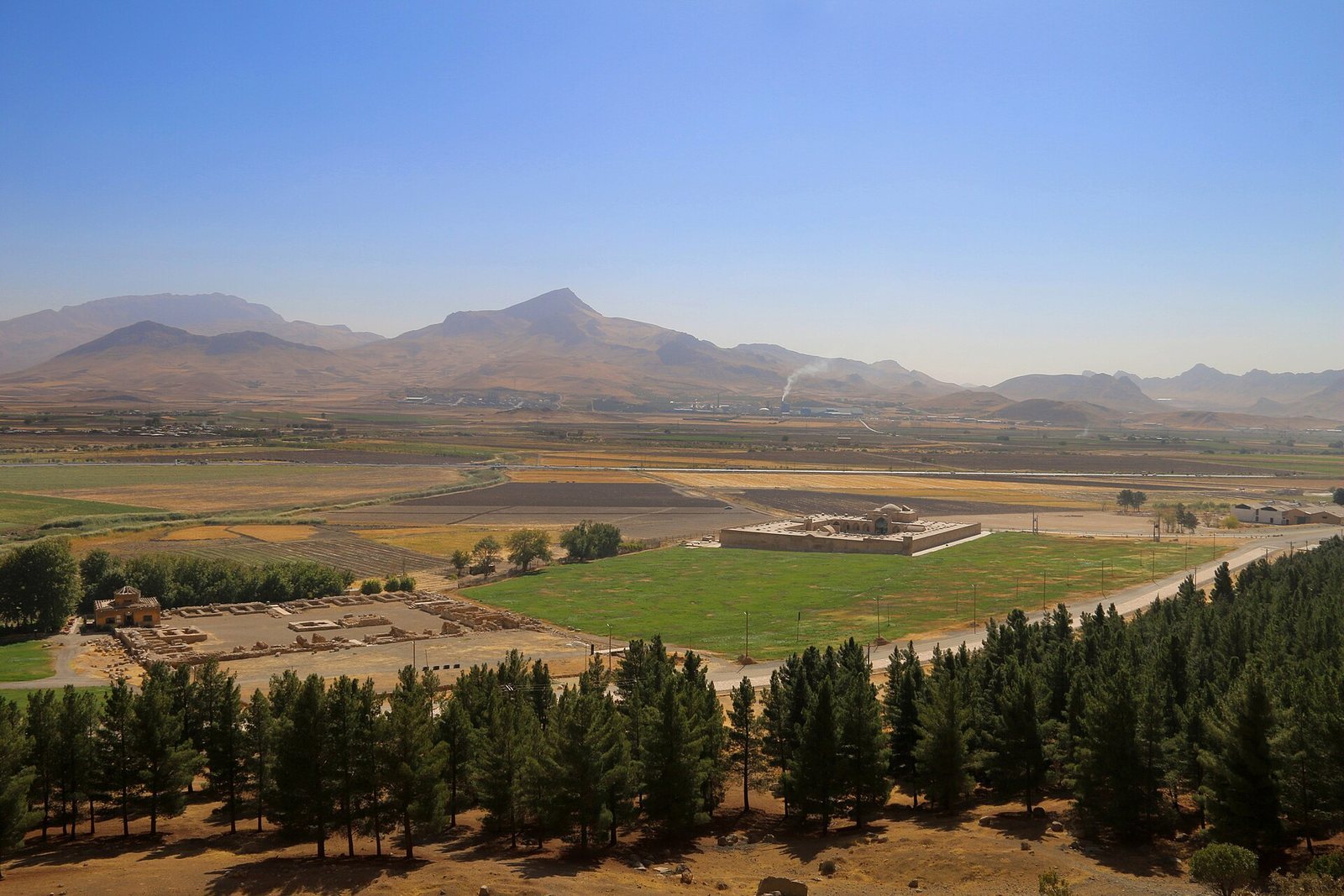
The site occupies the lower slopes of Mount Behistun, beside the ancient Kermanshah–Hamadan route. The mountain is part of the Paraw range; its cliff face is about 1,200 metres high and more than five kilometres wide. The Behistun spring lies within the archaeological area, which includes prehistoric caves, rock-cut monuments, inscriptions, and buildings from several later periods.
Prehistoric and early ritual features
Caves
Hunters Cave dates to the Middle Palaeolithic, or Middle Stone Age. Excavations produced thousands of Mousterian tools, part of a stone-tool tradition especially associated with Neanderthals, along with bones of hunted animals such as deer and wild horses. These finds are estimated to be about 70,000–40,000 years old, and Neanderthal remains were also recovered. A second cave contains evidence from the Middle and Upper Palaeolithic and the Epipalaeolithic, a later phase between the Palaeolithic and Neolithic. It is about 27 metres long and up to six metres wide, at an elevation of 1,420 metres. Its south-facing entrance overlooks a plain and the meeting of the Gamasiab and Dinavar rivers. Stone tools from this cave are held by the National Museum of Iran and the Museum of the University of Montreal.
Median sanctuary
A sanctuary attributed to the Median period forms part of the archaeological site.
Rock reliefs and inscriptions
Darius’s relief and inscription
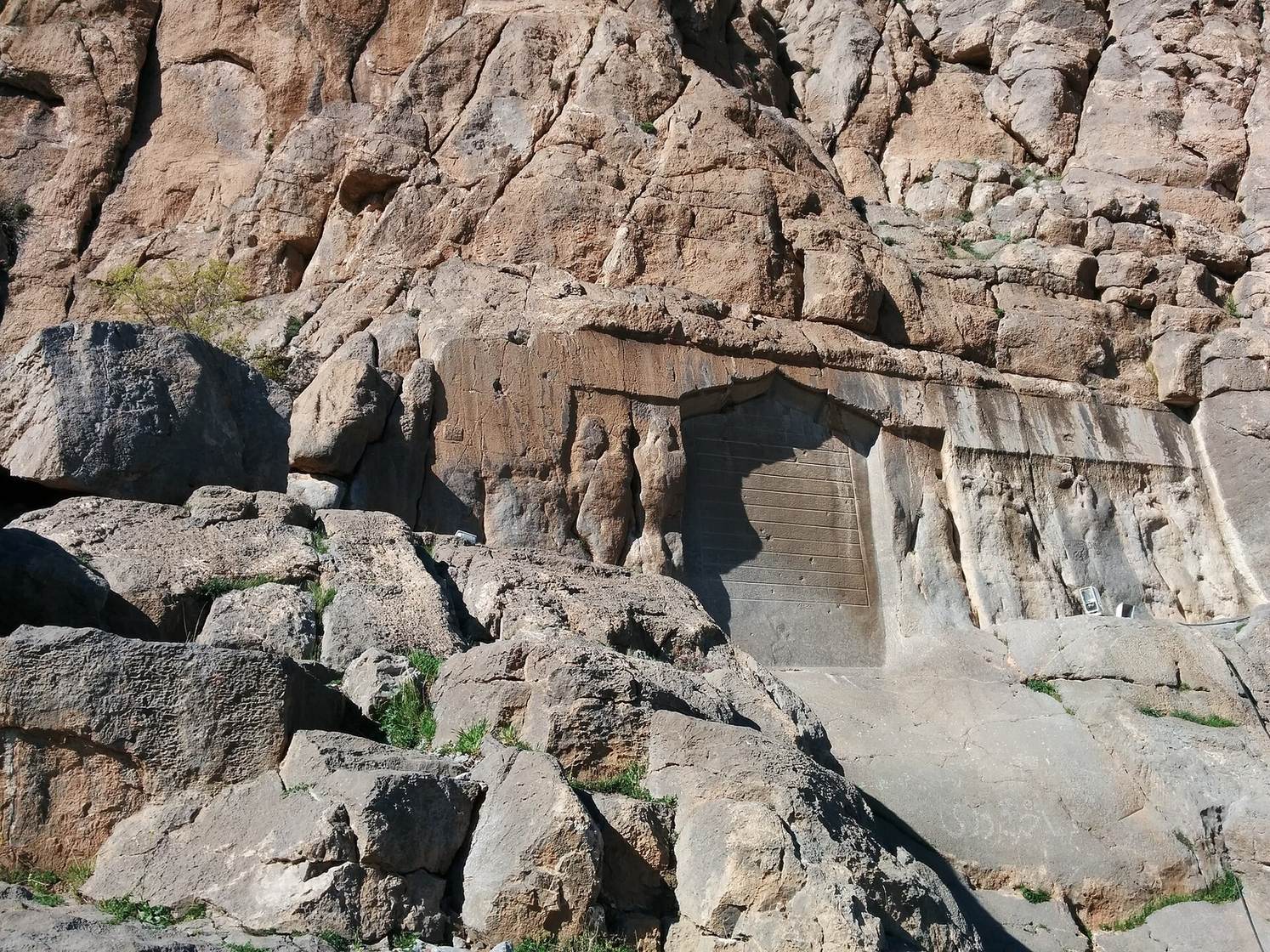
Carved into the mountainside, Darius’s relief measures about five metres across and three metres high. Darius places a foot on Gaumata; nine captive rebel kings stand before him beneath a winged symbol. The image supports the king’s claim to the throne. A panel beneath the carving contains about 1,200 lines in Old Persian, Elamite, and Babylonian/Akkadian cuneiform, a script formed from wedge-shaped marks. Two lines in Sasanian Middle Persian were added below. The inscription was a major aid to deciphering cuneiform, in a role comparable to the Rosetta Stone’s contribution to reading Egyptian hieroglyphs.
Heracles relief
The Heracles figure is carved in raised relief from the mountain rock and remains attached at the back. It shows the hero reclining on his left side, propped on his left elbow, with a cup near his face. His right hand rests on his thigh, and one leg supports the other. The figure is 1.47 metres long and rests on a platform 2.20 metres long. A seven-line Greek inscription is associated with the sculpture and dates it to 148 BC. The carving lies beside the ancient highway, about three metres above the path leading toward Darius’s relief.
Parthian reliefs and inscriptions
On a cliff face opposite Darius’s inscription and below it, Mithridates II faces five Parthian nobles. They raise offerings in their right hands, and the king raises his hand in response. A Greek inscription above names figures and gives titles, including Mithridates the confidant, Gotarzes as “satrap of satraps,” and Mithridates as “great king.”
An adjacent carving shows an armoured rider on horseback thrusting a long spear at another rider and knocking him from his horse. The Greek inscription identifies the armoured figure as Gotarzes, son of Giv; the figure above him has been interpreted as Nike, the Greek goddess of victory. A separate Parthian relief is associated with Balash. Inscriptions in Parthian writing appear inside the bases of fire-altar carvings associated with Balash and Gotarzes. A fire altar is a structure used in Iranian religious ritual. The Mithridates relief also has Parthian-language writing in the Greek alphabet. An endowment inscription in Arabic script, recording property or revenue dedicated to a religious or charitable purpose, crosses part of the Gotarzes relief.
Later structures
Palace area and caravanserais
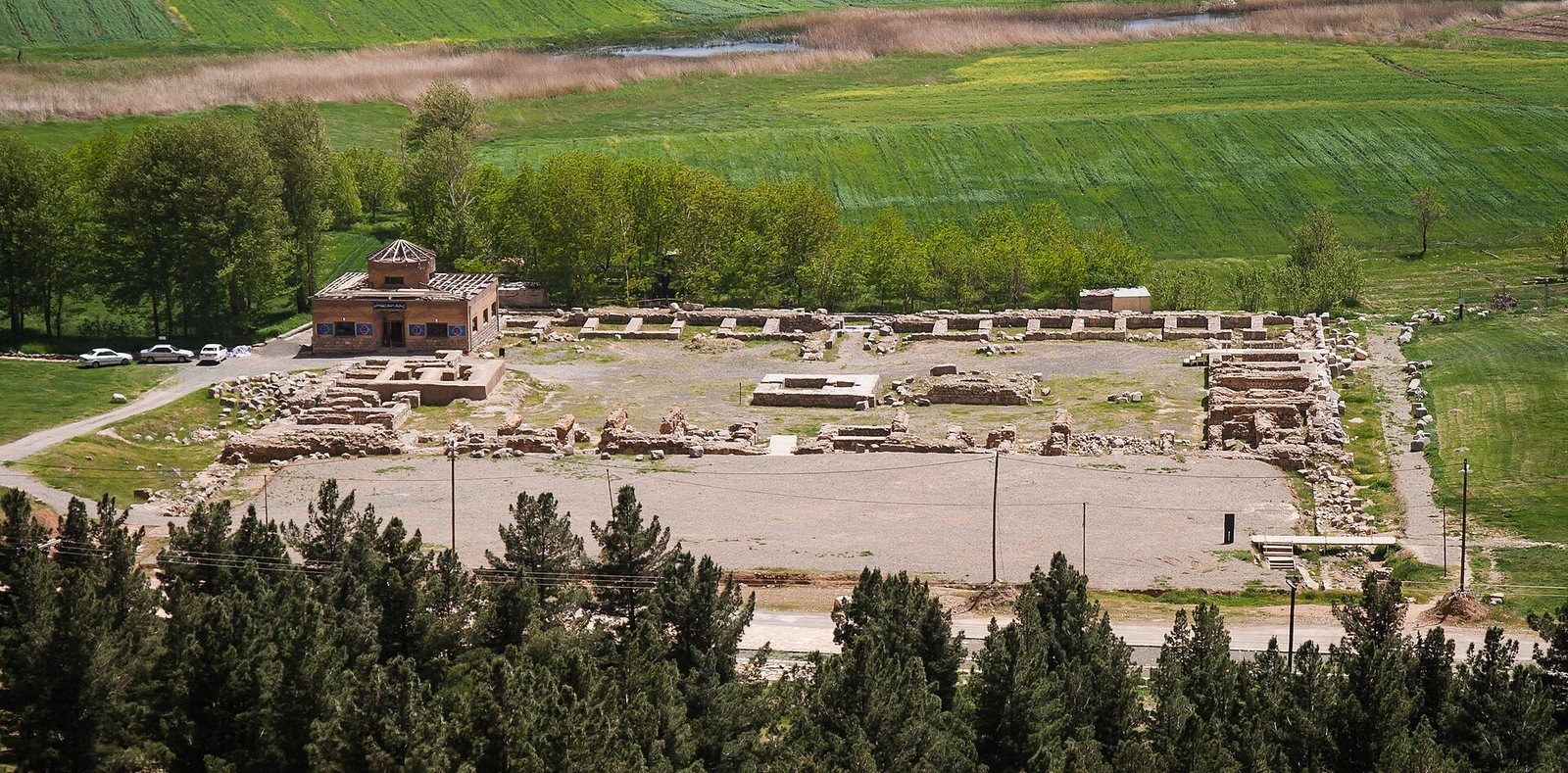
The remains of an unfinished Sasanian palace have been excavated in the area later occupied by the Ilkhanid caravanserai and a Qajar-period village. A caravanserai was a roadside lodging and service complex for travelling caravans. The site also contains a Safavid caravanserai associated with Shah Abbas, as well as inscriptions in Arabic script on a caravanserai.
Sasanian rock-cut work and building
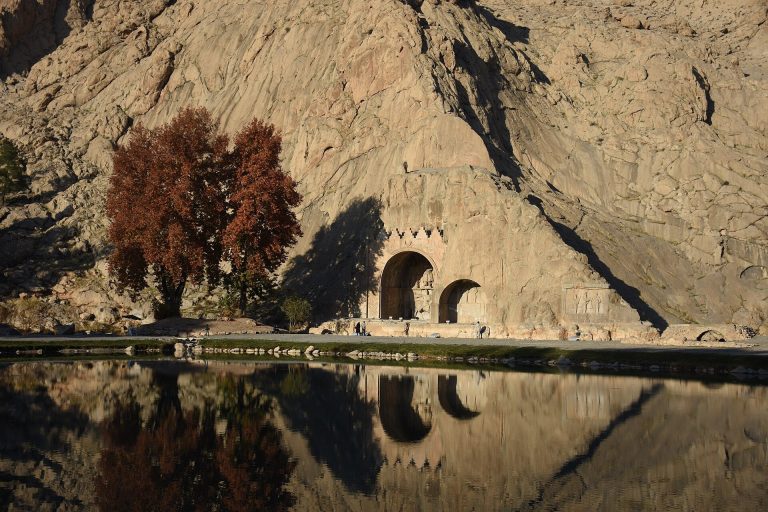
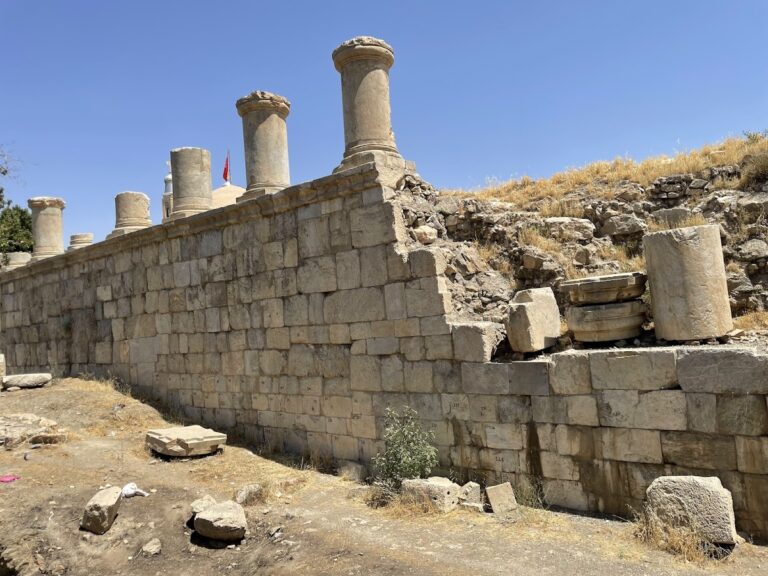
West of Darius’s monument, a large unfinished rock-cut face measures about 45 metres high and 200 metres wide. The site also preserves the remains of a separate Sasanian building.
Bridge
The bridge in eastern Behistun is also called the Old Bridge, Shah Abbas Bridge, Safavid Bridge, Naderabad Bridge, and Dinorud Bridge. From its earlier construction, the arches of the second and third spans and their rounded buttresses survive. The Ilkhanid fifth span has triangular buttresses. Brick kilns northwest of the bridge supplied bricks for its construction. Its façade reflects Safavid rebuilding, while the fourth arch was rebuilt in the Pahlavi period.