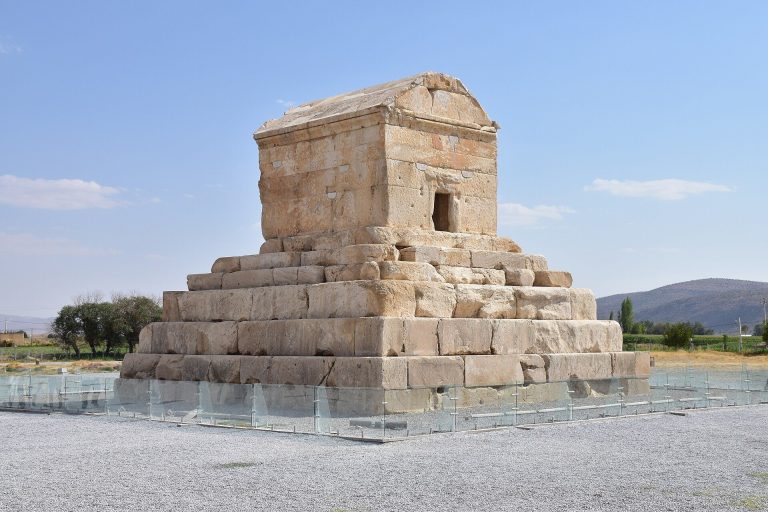
Istakhr: An Ancient Persian City and Zoroastrian Center in Iran
Site at a Glance
- Popularity
- Very High
- Country
- Iran
- Primary era
- Medieval
- Eras represented
- Classical, Medieval
- Civilizations
- Achaemenid, Buyid
- Site type
- City
On this page16 sections
History
Istakhr was an ancient Persian city in Estakhr, Iran, that developed near the Achaemenid royal residences at Parsa. A distinct urban center emerged in the second half of the fourth century BC, after Alexander the Great’s Macedonian conquest of the Persian Empire and the decline of Persepolis. Istakhr later served Persian rulers, became the first capital of the Sasanian Empire, and remained an important Zoroastrian center.
Achaemenid and Hellenistic origins
Some archaeologists have identified early settlement at Istakhr with a residential quarter of Parsa, the city associated with Persepolis. A local foundation tradition instead credits the legendary first king Kayumars with founding the city. Istakhr is a New Persian form of Middle Persian names understood to mean “stronghold.” The archaeologist Ernst Herzfeld proposed that it came from Old Persian Parsa-staxra, meaning “stronghold of Pars,” and interpreted the letters PR BR on coins as an Aramaic abbreviation for that name. Related forms include Istahr in Syriac and Stahr in Armenian; Istahar may be a form of the name found in the Talmud.
The city’s religious importance reaches back to the fourth century BC, during the reign of Achaemenid king Artaxerxes II. He ordered a statue of Anahid, an Iranian goddess associated with water and fertility, and a temple built near the later city. A tenth-century geographer described temple ruins about a parasang from Istakhr. These may have belonged to the Achaemenid sanctuary, which Macedonian forces under Alexander likely destroyed and plundered.
After Seleucus I, one of Alexander’s successors and founder of the Seleucid dynasty, died in 280 BC, local Persians began asserting greater independence. Istakhr appears to have become a center of resistance. From the third century BC into the early third century AD, it flourished under the Frataraka, Persian rulers of Persis during the Hellenistic period, and the later local Kings of Persis. A winter route connecting Persis with Isfahan, by way of Pasargadae and Abada, also passed through the city.
Sasanian capital and religious center
Sasan, the ancestor of the Sasanian dynasty, came from Istakhr and served as keeper of its important fire temple, a Zoroastrian sanctuary where a sacred fire was maintained. Tradition says he married into the Bazrangi dynasty, which ruled Istakhr as a Parthian vassal in the early third century. In 205/6, Sasan’s son Papak deposed Gochihr, the ruler of Istakhr. Papak’s sons Shapur and Ardashir V became the last Kings of Persis.
In 224, Ardashir V established the Sasanian Empire and adopted the royal name Ardashir I. Istakhr served as his empire’s capital from 224 to 226. It then remained the principal city and religious center of the Sasanian province of Pars, as well as the dynasty’s ancestral home.
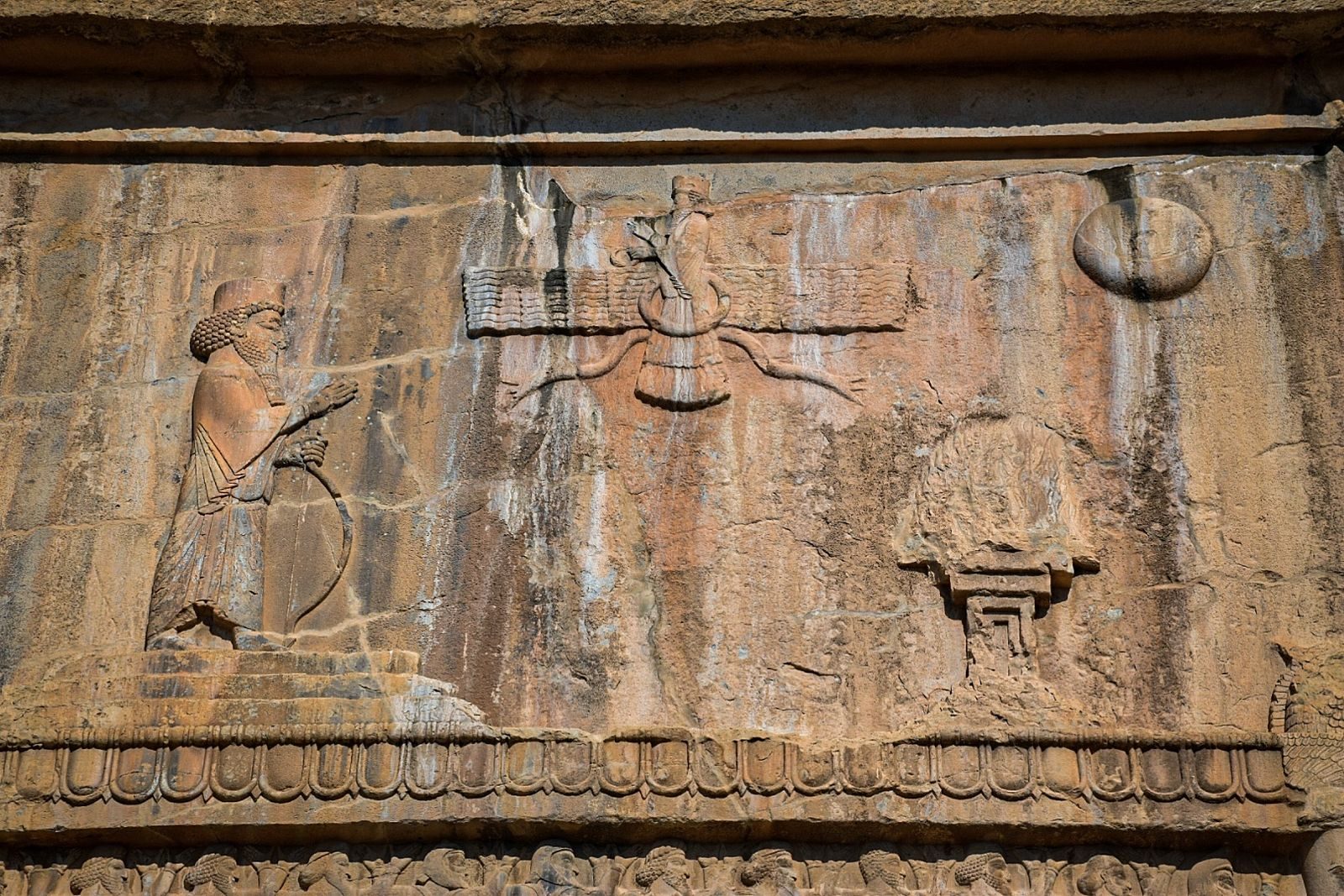
The Sasanians restored the sanctuary associated with Anahid. One tradition says the site began as a temple for images before the legendary ruler Homay turned it into a fire temple. An early Sasanian movement against religious images may have replaced Anahid’s statue with a sacred flame, although the sanctuary continued to be linked to the goddess. A later account called it the “house of Anahid’s fire.” During the reign of Bahram II, the powerful Zoroastrian priest Kartir was put in charge of fires associated with Anahid-Ardashir and Anahid the Lady.
Istakhr prospered as a religious and economic center. Its mint, marked with the abbreviation ST on coins, produced currency from the reign of Bahram V, beginning in 420, until the Sasanian dynasty fell. The royal treasury held a copy of the Great Avesta, a collection of Zoroastrian sacred writings. That copy may have been among the texts from which the surviving Avestan manuscript ultimately descended.
Conquest and early Islamic rule
During the Arab conquest of Pars, Arab forces first based themselves at Beyza. An attempt to take Istakhr in 640, led by Al-Ala al-Hadrami, failed. Commanders Abu Musa al-Ash’ari and Uthman ibn Abu al-As captured the city in 643, but its inhabitants soon rebelled and killed the governor installed by the conquerors.
In 648/9, Abdallah ibn Amir, governor of Basra, retook Istakhr after heavy fighting. Further revolts and campaigns, including one in 649, brought many deaths. The city’s Sasanian fortress became the final point of resistance to the Arab conquest of Pars. Rebellion continued: after Uthman ibn Affan was killed in 656, Ali ibn Abi Talib ordered Abdullah ibn Abbas to suppress an uprising at Istakhr. In 659, Ali sent Ziyad ibn Abih to quell unrest in Fars and Kerman.
Istakhr remained a Zoroastrian stronghold after the Sasanian Empire ended in 651 and retained regional importance in the early Islamic period. Coins made there under the Umayyad and Abbasid dynasties included Arab-Sasanian and reformed Umayyad issues. During periods of political unrest, Iranian aristocrats such as Farrokhzad and his father, Gushn-Anosh, cooperated with Arab authorities as local sub-governors and had coins struck at Istakhr and other settlements.
The city’s fortress served local rulers as a treasury, and Umayyad governors also lived there. Ziyad ibn Abih stayed at the castle for an extended period while engaged in conflict with Muawiya I, founder of the Umayyad caliphate.
Decline under later dynasties
After the Abbasids came to power, Shiraz gradually replaced Istakhr as the political center of Fars. The city nevertheless remained involved in regional struggles. On 11 April 890, the Saffarid ruler Amr ibn al-Layth defeated the caliphal governor Musa Muflehi there. The last coin attributed to the city was probably issued by the Dulafids in 895/6.
Istakhr became part of the Buyid realm in the first half of the tenth century. A travel writer from the region described it as a medium-sized town around the middle of that century. Buyid ruler Adud al-Dawla built a dam to gather snowmelt for the fortress garrison. During a visit to the castle, Abu Kalijar apparently encountered large stores of silver and precious stones. The last coin assigned to the castle itself, rather than the city, was issued in 1063 by order of the Seljuq prince Rasultegin.
When Seljuq sultan Alp Arslan captured the castle in 1066/7, its governor presented him with a valuable cup bearing the name of Jamshid, a legendary king of ancient Iran. In the final years of Abu Kalijar’s rule, a dispute between his vizier and a local landowner led him to send an army under Qutulmish. The force sacked and destroyed Istakhr. The city never recovered and dwindled to a village of about one hundred people.
In 1074, rebel leader Fadluya occupied the castle after taking control of Fars. The Seljuq vizier Nizam al-Mulk besieged it, captured Fadluya, and imprisoned him there. Fadluya was executed the following year after trying to escape. In later periods, the castle served as a state prison for senior officials and princes.
Later destruction and archaeological study
The castle was apparently still inhabited and in good condition around 1590. A Safavid rebel general later sought refuge there, and Shah Abbas I besieged and destroyed it. The Italian traveler Pietro della Valle found Istakhr in ruins in 1621.
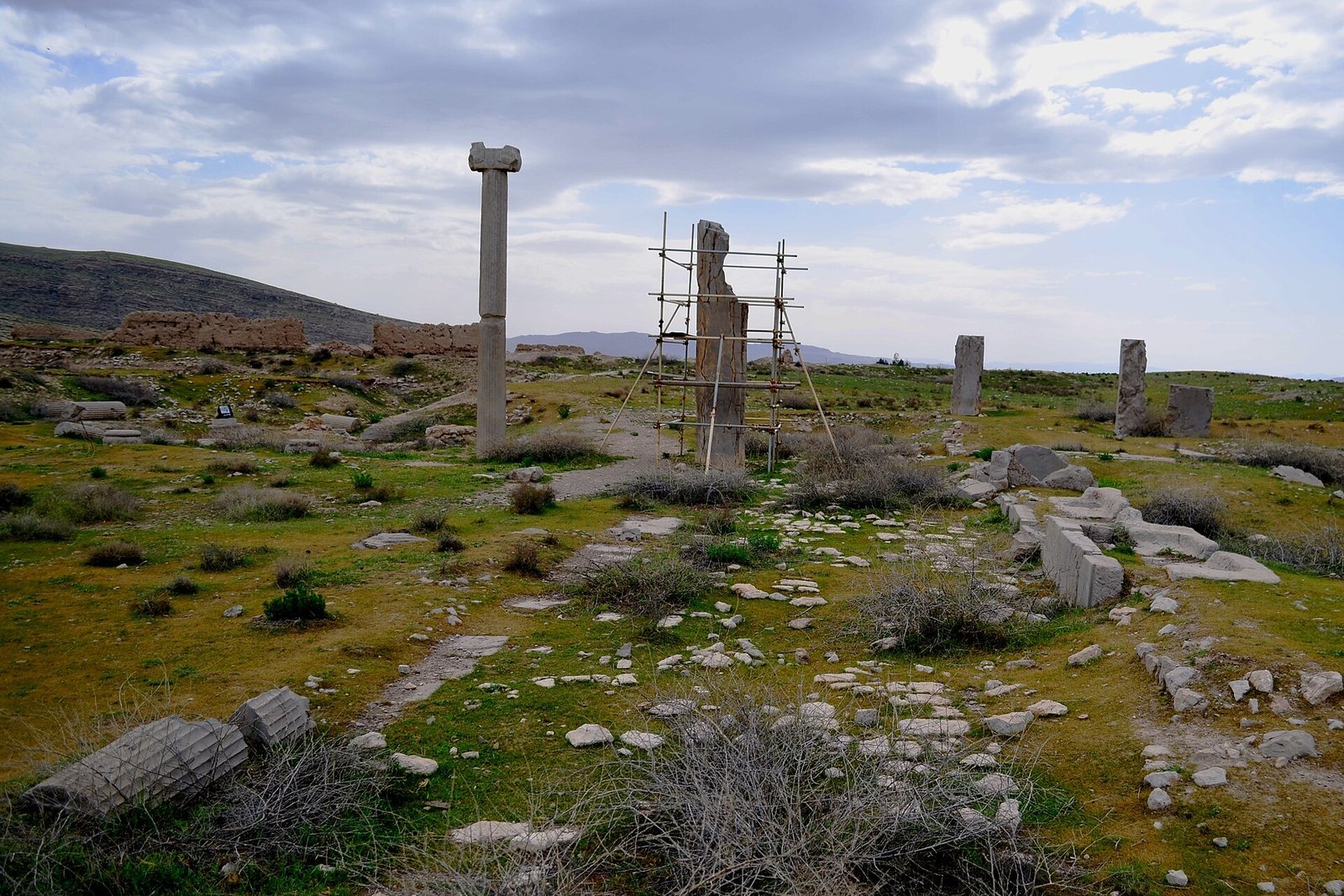
Eugène Flandin and Pascal Coste recorded the ruins in late 1840. Ernst Herzfeld made brief investigations in the first half of the twentieth century, followed by work by a University of Chicago team led by Erich Schmidt. Much of Sasanian Istakhr remains unexcavated. Conservation work on the stone remains has focused on the site’s only tall stone pier. Iran added the ruins to its National Heritage List in 1931.
Remains
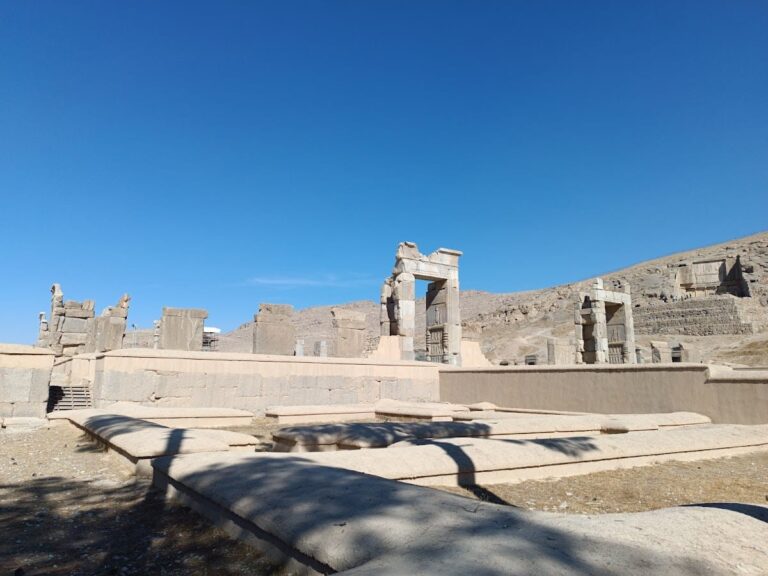
The ruins cover about 60 hectares in the Polvar River valley, roughly five kilometres north of Persepolis and 54 kilometres from Shiraz. The valley opens onto the Marvdasht plain between Kuh-e Rahmat and Naqsh-e Rostam. The city’s central area lay south and east of the Polvar. Descriptions place Istakhr on one bank of the river or across both, and its full extent is uncertain. The stated boundaries reach from Sidan in the east to Zangiyabad near Naqsh-e Rostam in the west, with the Hajiabad mountains to the north and Kuh-e Rahmat to the south.
City fabric and gateways
Reused stone and gateways
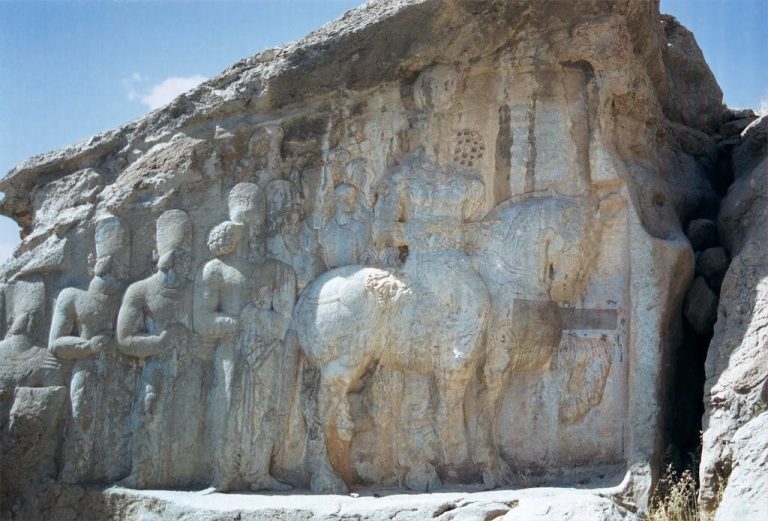
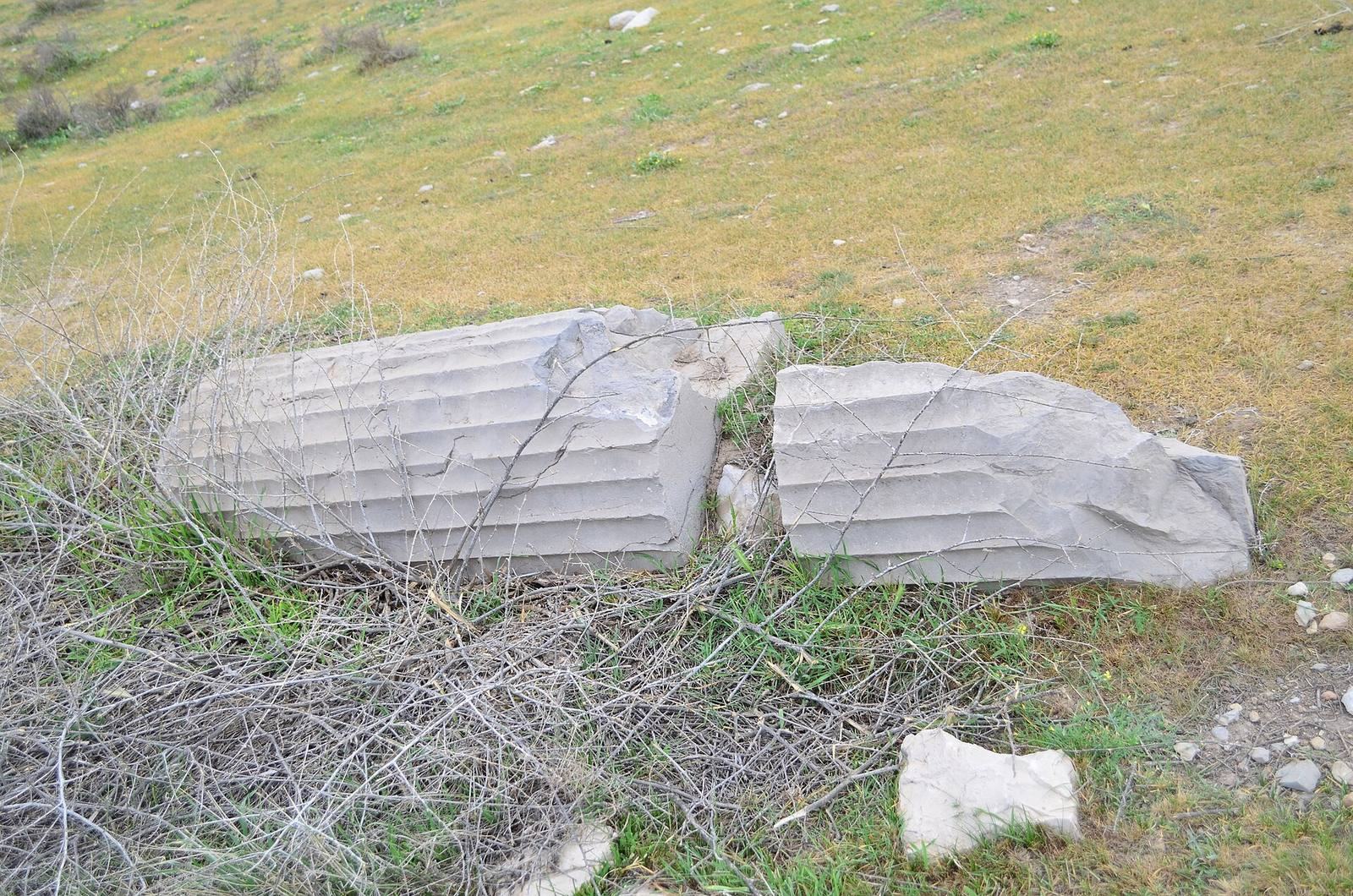
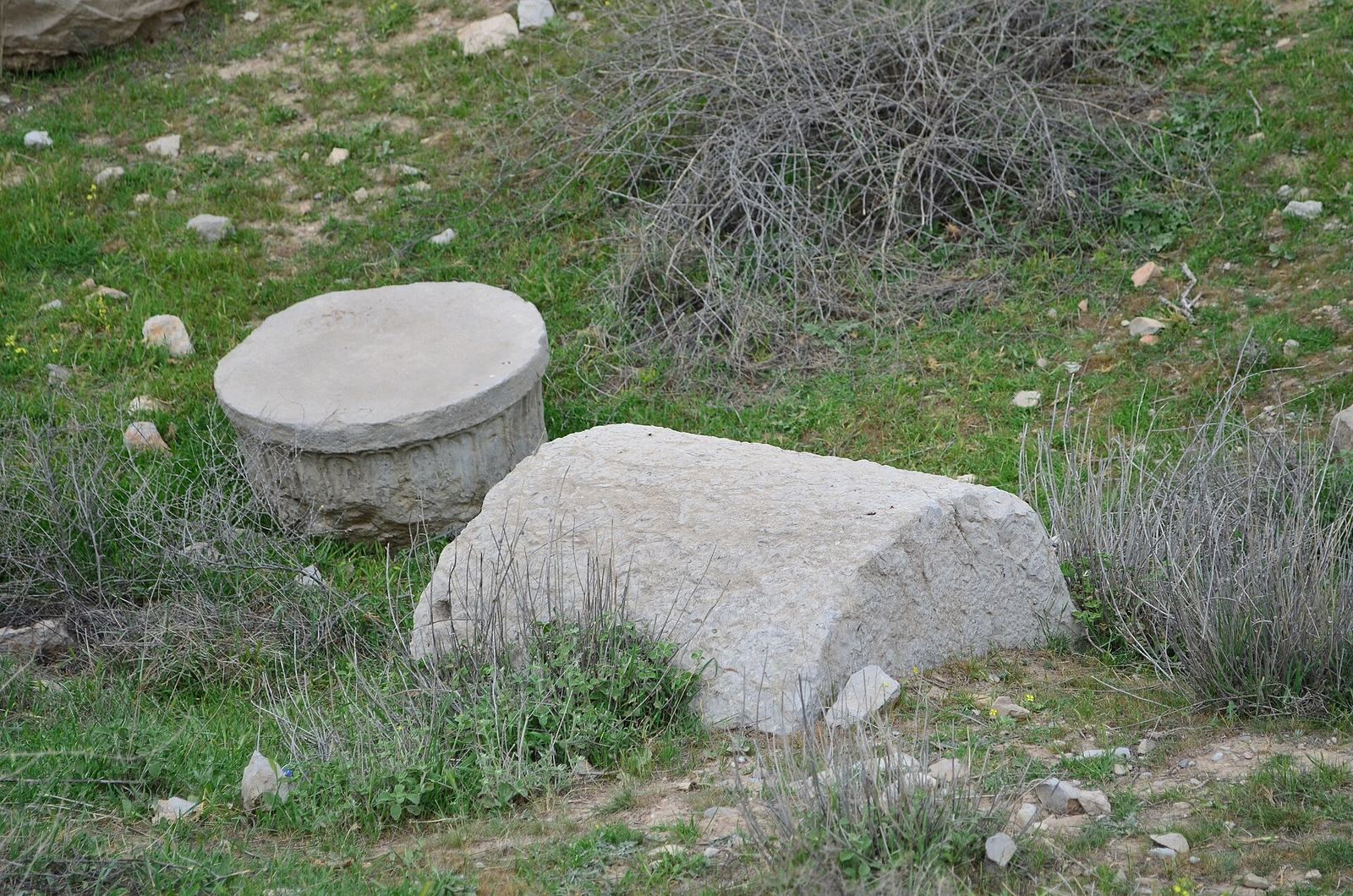
Stone and rubble from Persepolis appear to have been reused in Istakhr’s construction. East of the gateways lie broken columns and capitals, the upper parts of columns, along with other carved blocks generally attributed to the Achaemenid period and compared with work at Persepolis. Several carved blocks stacked to resemble a gateway form a landmark known as the Peacock Throne projection.
Moat and fountain pool
Mounds beside the road near the gateway are identified as earth banks from the city’s moat. A pool with several fountains stands beside the gateway, and carved stone fragments are scattered around it.
Fortifications and waterworks
Principal fortress
Istakhr’s main fortress stood on the easternmost rise of the Marvdasht plain. Its water system collected snowmelt that accumulated above the castle. A dam directed the water into a cistern, or storage reservoir, behind it.
Outlying fortifications
Two other forts stood some distance from the city’s central area but were treated as parts of greater Istakhr in the medieval period. Qal-e-ye Shekaste was used to store textiles, while Qal-e-ye Oshkonvan served as an armory.
Civic and religious structures
Bridge and park
A bridge crossed the Polvar River at Istakhr, and the city also had a park. Both were noted in medieval descriptions of the settlement.
Chief mosque
The chief mosque was described with capitals carved in the form of bulls and was said in a medieval account to incorporate carved stone from Persepolis. One interpretation identifies it with the Sasanian sanctuary of Anahid-Ardashir, where a sacred fire was maintained and Yazdegerd III, the last Sasanian king, was crowned. Another interpretation dates the mosque to the seventh century, during Arab rule, rather than treating it as a converted Sasanian temple. A medieval tradition likewise associated the mosque with an earlier fire temple and Persepolis stonework.