Hill of Tara: Ireland’s Ancient Ceremonial and Burial Centre
Site at a Glance
- Popularity
- Very High
- Country
- Ireland
- Primary era
- Iron Age
- Eras represented
- Stone Age, Bronze Age, Iron Age, Modern
- Civilizations
- Unclassified
- Site type
- Religious
- Remains
- Sanctuary
On this page19 sections
History
The Hill of Tara is an ancient ceremonial and burial site on a limestone ridge near Skryne in County Meath, Ireland. Its visible monuments span the Neolithic to the Iron Age, and activity at the site continued into medieval times. Irish tradition presents Tara as the inauguration place and seat of the High Kings, rulers regarded as pre-eminent among Ireland’s regional kings, though that title did not always mean control over the whole island.
Early kingship and royal tradition
Tara’s political control is thought to have shifted from the Érainn, an early Irish people, to the Laigin, a political grouping, probably in the third century. In the fifth century, the site became the ceremonial seat of Niall of the Nine Hostages and the Uí Néill, a powerful dynasty with northern and southern branches. Kingship alternated between those branches until the eleventh century. Later claimants to the High Kingship placed greater importance on control of Dublin, Limerick and Waterford. Before the ninth century, however, no king is thought to have exercised effective authority over all Ireland.
Irish king lists trace Tara’s succession back to legendary rulers. Many of the earliest names are considered mythical, while rulers placed between the first and fifth centuries are regarded as more historically credible. Lóegaire mac Néill, a fifth-century king, is traditionally described as the last ruler to reign from Tara.
Ritual, myth and Christian Ireland
Early Irish tradition links Tara with the Feast of Tara, a royal gathering held at Samhain, the Gaelic festival marking the start of winter. A text written after 600 describes an inauguration in which a High King climbed the hill, drank ale and took part in a symbolic marriage with Ireland’s heavenly patroness. Tara’s ceremonial importance outlasted its use as a royal residence, and rulers continued to claim the title King of Tara into the twelfth century.
Tradition also connects Tara with Saint Patrick, the fifth-century Christian missionary, and says that he visited the hill. One story attributes the end of Tara’s use as a royal residence after Ireland’s Christianization to Patrick’s curse on the pagan centre and its rulers. This account did not erase the site’s dynastic or ceremonial standing in later tradition.
Medieval battles and national gatherings
The legendary third-century Battle of Cath Gabhra is said to have pitted High King Cairbre Lifechair against the Fianna, the warrior band led by the hero Fionn mac Cumhaill. The Fianna were defeated, and tradition associated their graves with the Rath of Gabhra, an enclosed earthwork, including the grave of Oscar, son of Oisín. In 980, Gaelic forces from Meath under Máel Sechnaill mac Domnaill fought Norse Vikings from Dublin led by the ruler Amlaíb Cuarán in the Battle of Tara.
During the Irish rebellion of 1798, the United Irishmen, a republican organization, set up a camp on the hill. British troops attacked on 26 May and defeated the rebels; about 400 rebels died. The Lia Fáil was allegedly moved in their memory. In 1843, Irish nationalist Daniel O’Connell held a peaceful gathering at Tara to demand Irish self-government and repeal of the Union with Britain. More than 750,000 people attended.
Excavation, protection and the wider landscape
In the nineteenth century, British prime minister John Russell inherited the Tara estate. From 1899 to 1902, British Israelites, adherents of a movement claiming that British people descended from the lost tribes of Israel, excavated the hill in search of the Ark of the Covenant, a sacred chest described in the Hebrew Bible. Retired judge Edward Wheeler Bird led the work, with permission from landowner Gustavus Villiers Briscoe, and the excavation damaged the site, particularly Ráth na Seanadh. Irish cultural nationalists protested. Douglas Hyde tried to stop the digging and was threatened with a rifle; Maud Gonne relit a bonfire Briscoe had lit for Edward VII’s coronation and sang “A Nation Once Again.” Arthur Griffith, George Moore and W. B. Yeats also opposed the excavation.
The Irish government acquired the southern part of the hill in 1952 and the northern part in 1972. Tara is protected as a national monument and cared for by the government’s Office of Public Works. Archaeological investigations, including the Tara Discovery Programme, which began in 1992, helped establish the hill as the centre of a much wider ancient landscape.
The M3 motorway, opened in 2010, crosses the Tara-Skryne Valley about 2.2 kilometres from the hill and meets the old N3 at Blundelstown, between Tara and the Hill of Skryne. Opponents called for a route about six kilometres farther west, arguing that it would be straighter, cheaper and less destructive.
Remains
About twenty ancient monuments are visible on the limestone ridge. Geophysical surveys and aerial photography have identified at least three times as many features. The landscape includes passage tombs and burial mounds, circular enclosures formed by banks and ditches, a standing stone and a long rectangular ceremonial feature.
Prehistoric monuments
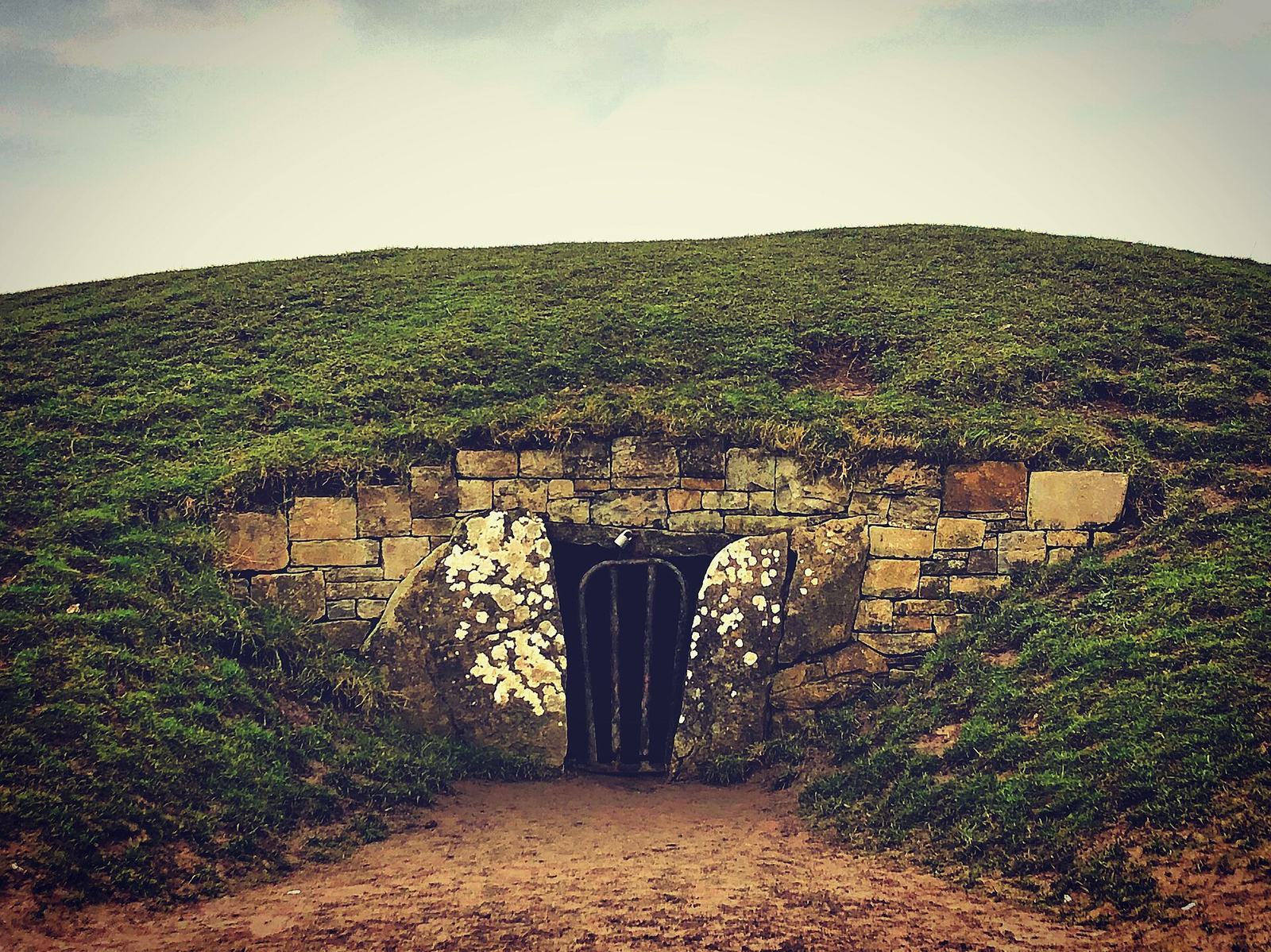
The Mound of the Hostages
The Mound of the Hostages is a passage tomb, a burial monument with a chamber reached through a passage, built around 3200 BCE. It held the remains of hundreds of people, mostly cremated. For about a century, the tomb served as a communal burial place, receiving nearly 300 burials. Around a thousand years later, a further 33 people were buried first in the passage and then in the mound. These later burials included selected high-status individuals from several communities. The last identified burial was of a high-status young man buried with an ornate necklace and dagger. Two gold torcs, rigid metal neck rings, found at the tomb date to around 2000 BCE.
The passage aligns with sunrise around Samhain and Imbolc, the Gaelic festival marking the beginning of spring. Its shorter length gives a less precise solar alignment than the passage at Newgrange. In The Stones of Time, Martin Brennan argued that the daily movement of a 13-foot beam of sunlight could still help identify particular dates.
The timber circle and burial mounds
A double timber circle about 250 metres across was built on the hilltop during the late Neolithic or early Bronze Age, around the Mound of the Hostages. At least six smaller burial mounds formed an arc around it, including Dall, Dorcha, the Mound of the Mercenary Women and the Mound of the Cow. The timber structure eventually decayed or was removed, and the smaller mounds are now barely visible.
Enclosures and burial grounds
Ráth na Ríogh
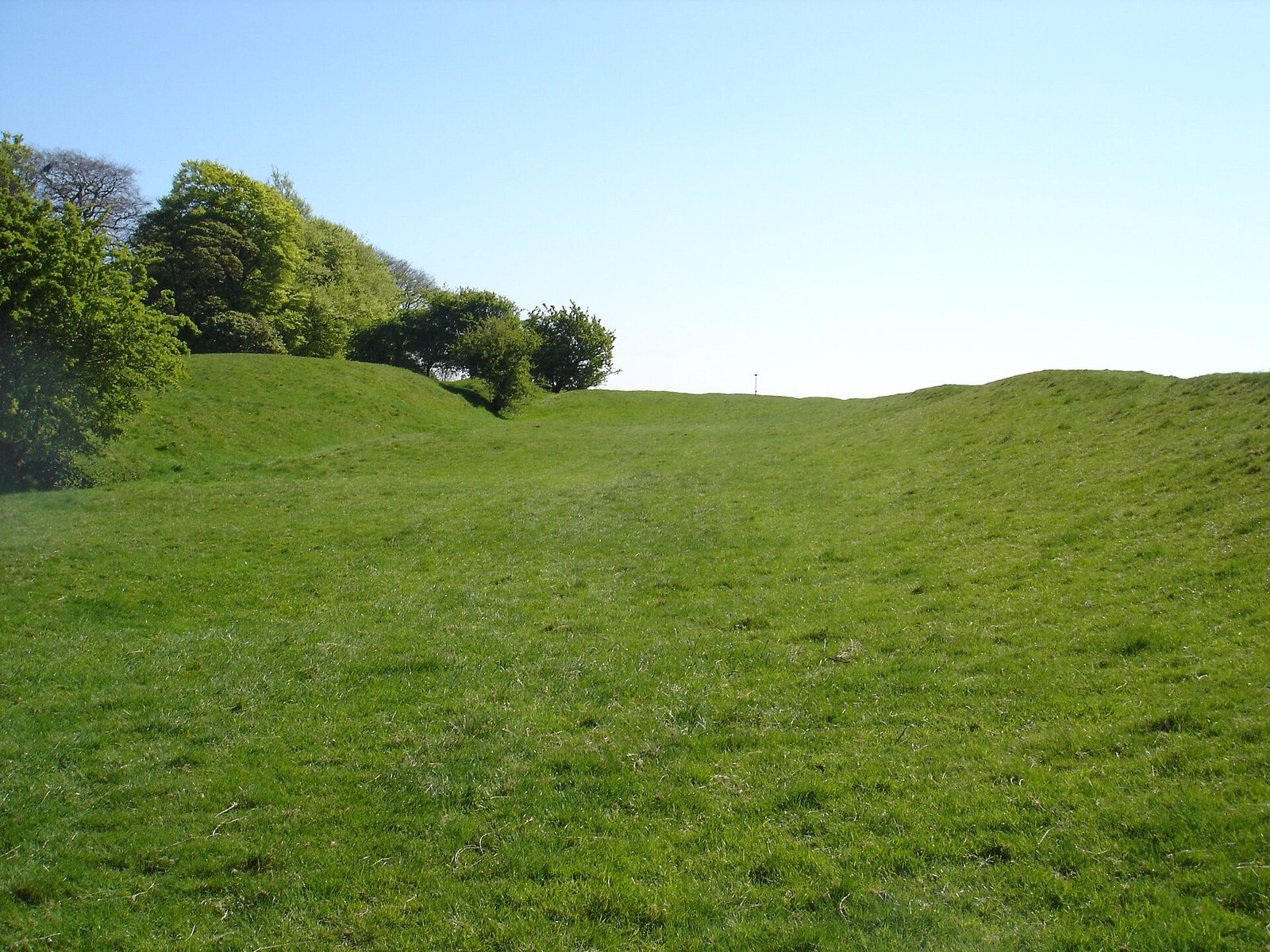
The largest and most central ring enclosure, an earthwork surrounding a circular area, is Ráth na Ríogh, or the Enclosure of the Kings. Dating to the first century BCE, it measures about 1,000 metres around and 318 metres from north to south by 264 metres from east to west. An inner ditch and outer bank define its perimeter; at first, a wall of stakes marked the boundary. Excavations in its ditch uncovered human burials and a high concentration of horse and dog bones.
The inner circular enclosures
Within Ráth na Ríogh, two circular enclosures with double ditches form a figure-eight arrangement. One is Teach Chormaic, or Cormac’s House; the other is the Forradh, or Royal Seat, which incorporates earlier burial mounds. A standing stone on the Forradh is believed to be the Lia Fáil. Its original position is thought to have been beside or on top of the Mound of the Hostages. Irish mythology says the Tuatha Dé Danann, a supernatural people, brought the stone to Ireland and that it roared when touched by the rightful king. Another tradition says the original Stone of Destiny was taken to Scotland in the early medieval period and later brought to England.
Ráth na Seanadh
North of Ráth na Ríogh, within the area of the former timber circle, lies Ráth na Seanadh, or the Rath of the Synods. Its circular enclosure has four rings of banks and ditches and includes earlier burial mounds. It was altered several times and once contained a large timber building resembling one at Navan. Roman artefacts were found there, and a churchyard has partly destroyed the enclosure.
Southern and northwestern burial areas
Ráth Laoghaire is a circular enclosure at the southern edge of the hill. Tradition identifies it as the burial place of the king of that name. At the northwestern edge, the Claonfhearta, or Sloping Graves, include Ráth Gráinne and Ráth Chaelchon. These burial mounds have ring ditches and occupy sloping ground.
Rath Meave
About half a mile south of the hill is Rath Meave, a large ring enclosure associated in tradition with Medb or Medb Lethderg, figures connected with Tara’s sovereignty. The traditions may conflate two distinct figures.
Ceremonial feature and later buildings
Teach Miodhchuarta
At the northern end of the hill, Teach Miodhchuarta, or the Banqueting Hall, is a rectangular feature interpreted as a ceremonial avenue leading towards the hilltop. It appears to have been among the last monuments built at Tara.
St Patrick’s Church
St Patrick’s Church stands on the eastern side of the hilltop beside a graveyard. The present church was built in 1822-1823 on the site of an earlier church. A stump of the earlier building’s wall marks its location, and some of its stonework was reused. An image from 1791 shows the earlier church divided into a main worship space and an altar area, with a bell tower at its western end.
Celtic high cross
A Celtic high cross, a monumental freestanding stone cross, is also identified among Tara’s features.