Naveta Alemany: A Bronze Age Domestic Building on Mallorca
Site at a Glance
- Popularity
- Low
- Country
- Spain
- Primary era
- Bronze Age
- Eras represented
- Bronze Age
- Civilizations
- Unclassified
- Site type
- Domestic
- Remains
- House
On this page9 sections
History
Bronze Age habitation
Naveta Alemany is a prehistoric dwelling at Cala Vinyes on Mallorca, Spain. A naveta is an elongated prehistoric building found in the Balearic Islands; habitation navetas served domestic purposes, unlike the funerary navetas of Menorca. Construction at Alemany is assigned to the earlier Bronze Age and generally associated with the Naviforme phase, a period of Balearic Bronze Age history linked to these buildings. Its precise chronology is uncertain because radiocarbon dating has not been carried out. The earliest occupation is placed around the middle of the second millennium BCE, while pottery may indicate later use around 1400–1200 BCE.
Evidence of food preparation, animal keeping, gathering, and hunting supports the building’s domestic use. Its size has been interpreted as suggesting organized labor and a developed social hierarchy. Its position near the coast has also prompted the possibility of maritime contact and exchange with other settlements, though this remains an interpretation. An early excavation was understood to show a single occupation level. Later work identified another level, with some material attributed to the Early Talayotic period, a later prehistoric phase in the Balearic Islands. This later occupation is distinguished from the building’s earlier construction.
Discovery and investigation
The building was discovered in the late 1960s during construction of the road between Magaluf and Sol de Mallorca. Its name commemorates Lluís Alemany Vich, the landowner at the time of discovery. He financed the first excavation, directed by archaeologist Catalina Enseñat in 1971, which found that the apse had been plundered.
The Island Council of Mallorca carried out further excavations in 1997, 1998, and 2003. Restoration took place during the 1990s, followed by further work from 2010 to 2012 after Naveta Alemany’s inclusion in Calvià’s 2009 heritage-recovery plan. The site has been designated a Spanish Asset of Cultural Interest since 1966 and was also added to Calvià’s municipal heritage catalogue in 2009.
Remains
Setting and layout
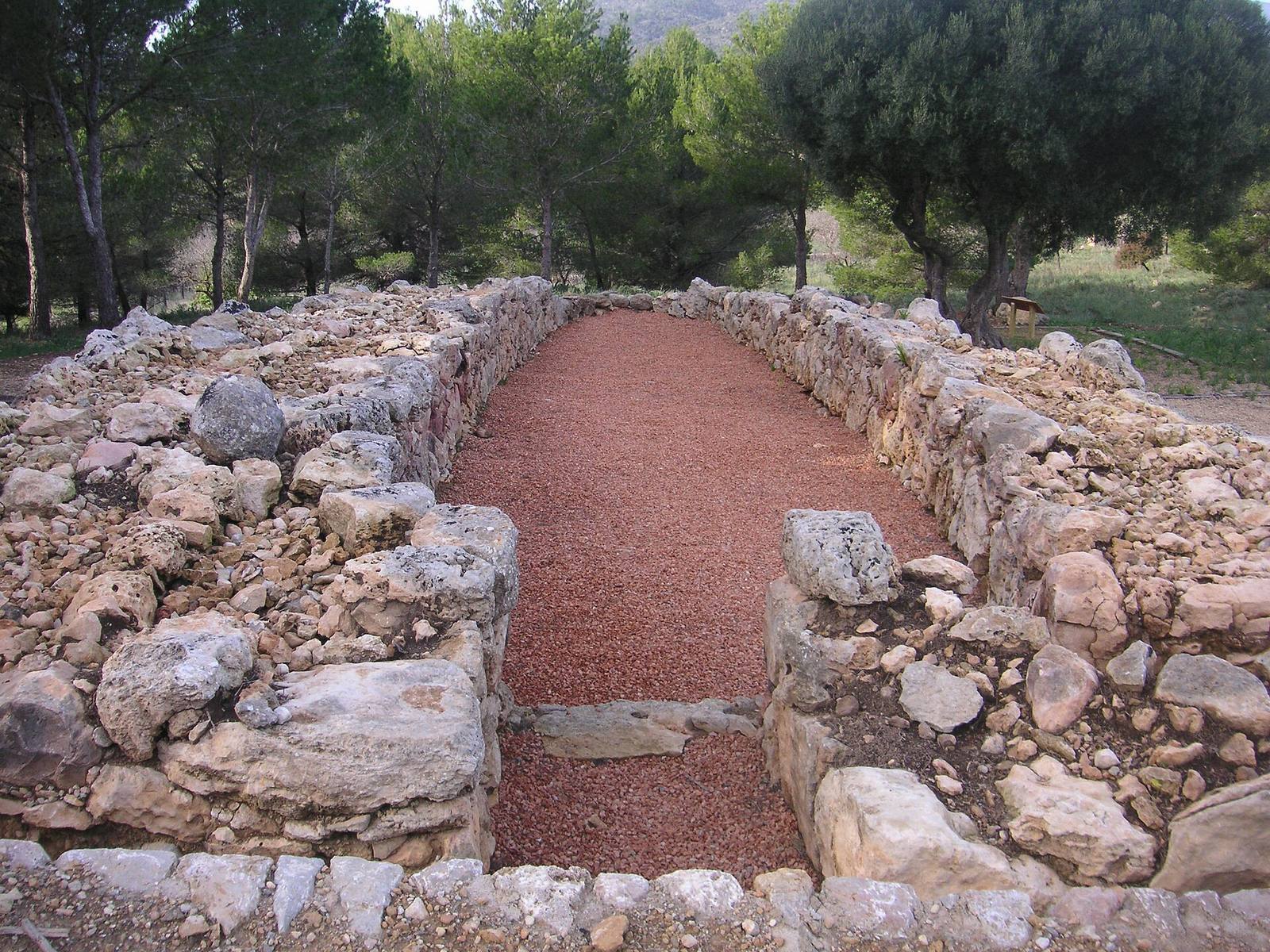
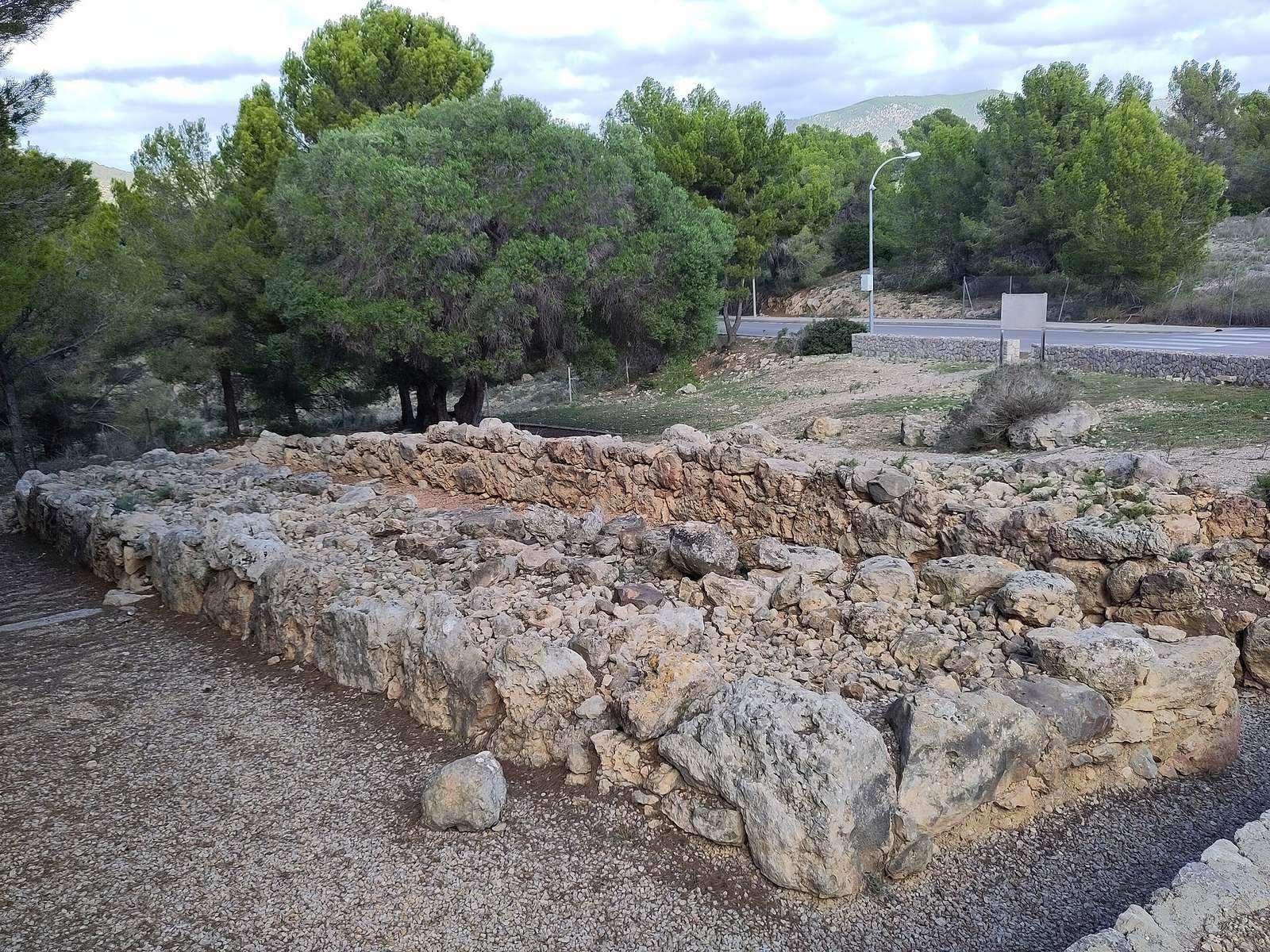
The site occupies a small hill on sloping ground, about 1.5 kilometres from Magaluf and less than a kilometre from the coast. The former Magaluf lagoon lies about 500 metres away, and an agricultural field is roughly 100 metres from the building. Nearby prehistoric features include artificial caves at Son Massot, about 350 metres to the northwest, and at Cala Salomó, less than a kilometre away, as well as the Son Ferrer settlement and tumulus, the cave of Can Calbet, and a deteriorated rectangular structure around 200 metres away. The surviving site consists of one isolated building. It is elongated and about 19 metres long, reaching a maximum width of 4.10 metres. Its apse is now lost. A straight front wall contains a south-facing entrance leading into a corridor about 1.10 metres wide and roughly 2.10 to 2.40 metres long along its sides. The side walls average about 2.40 metres in thickness.
Stonework, floors, and preservation
Large, irregular stones were laid without mortar in two outer wall faces, with smaller stones, mud, and plant material packed between them. The blocks average about 0.5 by 0.75 metres, although some exceed two metres in length. Because the building stands on a slope, a second stone wall supports the rear half around the apse. Paving at the back of the main room helped even the floor, which was clay; stone paving was also described in the apse area. In the entrance corridor, a clay layer and slabs defined a small paved area. Plant remains suggest that branches or leaves covered with mud may have formed the roof. Two areas of burning were found inside, with charcoal and ash near the centre. Estimates place the surviving portion at 10 to 50 percent of the original structure. The walls now stand about one to 1.5 metres high; many blocks are original, while artificial blocks were added during conservation to stabilize them. The surrounding ground is heavily eroded and cracked, with Mediterranean vegetation including pine, wild olive, myrtle, rosemary, and lavender.
Excavated finds
Pottery and food remains
Pottery includes globular and hemispherical vessels, some decorated with impressions along their lips, large incomplete vessels with flat bases, and a barrel-shaped vessel of Horgen type. Animal remains include sheep and goat bones, and the excavations also recovered mollusc shells.
Tools and other objects
Finds include stone grinding tools, bone awls, and a bone spatula. Three objects have been interpreted as archers’ wristguards or as polishers. Other objects include a triangular bronze dagger, a flint knife worked on both faces, and a flat flint sickle element also worked on both sides. Excavators recovered polished chalcedony and a polished stone block with three small cavities, interpreted as a betyl, a sacred or cult-associated stone, or another religious object. A small ceremonial figurine was also found.