Castle of Bendinat: A Nineteenth-Century Neo-Gothic Estate in Mallorca


Site at a Glance
- Rating
- 4.3
- Popularity
- Very Low
- Country
- Spain
- Primary era
- Modern
- External website
- Open
- Eras represented
- Modern
- Civilizations
- Spanish
- Site type
- Domestic
- Remains
- Castle
On this page8 sections
History
Foundation and earlier traditions
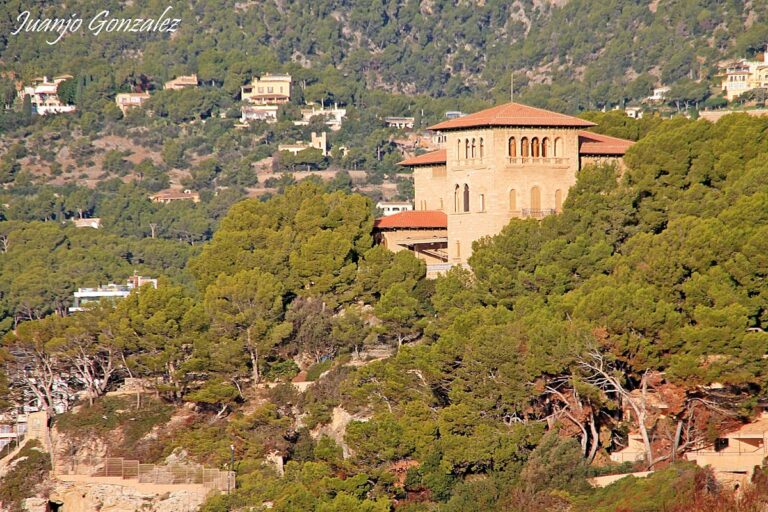
Castle of Bendinat is a nineteenth-century neo-Gothic building in Spain, located in Bendinat within the municipality of Calvià on Mallorca. Pedro Caro y Álvarez de Toledo, the 5th Marquis of La Romana, commissioned and built it in the style of Central European castles. The castle rose over the houses of an earlier Islamic alqueria, a rural settlement or agricultural estate in medieval Islamic Iberia.
In the fifteenth century, the estate belonged to the Mallorcan Burgues d’Ençà family before passing by inheritance to the Marquis of La Romana. Local and family tradition connects the area with King James I of Aragon, whose campaigns brought the Christian conquest of Mallorca from Muslim rule. According to this tradition, James I camped there with his army after a bloody battle and later said be hem dinat, meaning “we have eaten well.” Other explanations for the name Bendinat derive it from Arabic expressions interpreted as “son of Dinat” or “son of the beardless man.”
Ownership, inheritance, and collections
The Marquis of La Romana sold the castle in 1880, after which it was acquired by the Truyols family. Its later succession passed through Joana-Adelaida Dameto i de Verí, Countess of Perelada, her cousin Juan Miguel de Sureda, Marquis of Vivot, the Fortuny heirs in 1912, and the Montaner heirs in 1973. The property subsequently passed to Ferran Truyols i Despuig, Marquis of La Torre, who was the nephew of the countess’s husband, and then to his descendants.
Joana-Adelaida Dameto i de Verí maintained a billiard room in the castle. In 1881, she bought its billiard table and accessories for 8,000 reales de vellón, a historical Spanish monetary unit. Her sudden death in unclear circumstances led to a prominent legal dispute over the succession.
In 1999, the castle’s furnishings were sold at an auction described as unprecedented in Spain and noted for its record sales. Furniture dating from the seventeenth to the twentieth century brought more than 400 million pesetas. A private collection of about 240 paintings, assembled from the inherited possessions of successive owner families, was also sold. One French eighteenth-century porcelain plate from the auction is now held by the National Museum of Decorative Arts in Madrid.
Conversion into a museum
In 2008, Carlos Delgado Truyols, who had also served as mayor of Calvià, and other family heirs sold the castle and its adjoining 700 hectares to the Astroc Foundation. The foundation converted the property into a museum, giving the building a new institutional use after its long history as a privately held estate.
Remains
Layout and architectural character
The castle stands between the settlement of Bendinat and the Na Burguesa mountain range. Its architectural character is nineteenth-century neo-Gothic, a revival of medieval Gothic forms, and it follows the appearance of Central European castles. The building occupies the site of the houses of the earlier Islamic alqueria. Woodland surrounds the castle grounds, with Aleppo pine (Pinus halepensis), stone pine (Pinus pinea), pistachio trees, and carob trees (Ceratonia siliqua).
Water infrastructure
The grounds contain a cistern, a tank or underground reservoir used to collect and store water, together with the remains of an aqueduct, a structure or channel designed to convey water. These features are catalogued as ethnological heritage and form part of the physical remains associated with the castle estate.
Heraldic feature
A coat of arms occupies the center of the rear facade. It belongs to the Truyols family, identified here as Counts of Montenegro. The design shows the family arms as an animal-powered mill called a trull in Catalan, with an upper beam. A helmet surmounts the arms, which are enclosed by a garland of plant elements.
Nearby sites