Castra of Jagsthausen: A Roman Frontier Fort in Germany
Site at a Glance
- Popularity
- Low
- Country
- Germany
- Primary era
- Classical
- Eras represented
- Classical
- Civilizations
- Roman
- Site type
- Military
- Remains
- Fort
On this page16 sections
History
The Castra of Jagsthausen was a Roman cohort fort in Germany, built around AD 160 on the Upper Germanic Limes, Rome’s frontier in what is now southwestern Germany. Its position helped the garrison watch routes between the Jagst and Kocher rivers, which offered natural approaches into Roman territory. Soldiers may also have monitored the High Road running along the ridge between the rivers.
The Cohors I Germanorum probably served here from the fort’s establishment. Recruited in the province of Germania Superior, it was transferred to Jagsthausen around AD 159. A previous posting at Wimpfen is possible, but uncertain. The cohort may have included cavalry, although this remains unresolved. It was a separate unit from a similarly named cohort at Capidava in Lower Moesia. An inscription dated AD 222–235 gives it the additional title Alexandrianae.
An inscription fragment from the fort provides evidence for the frontier’s earlier development. It is the earliest datable find from the Front Limes between the Main and Rems rivers. On the basis of an analysis of the inscription, historian Géza Alföldy proposed that this stretch of the frontier was constructed around AD 155 under the governor Gaius Popilius Carus Pedo.
Repairs and the end of Roman occupation
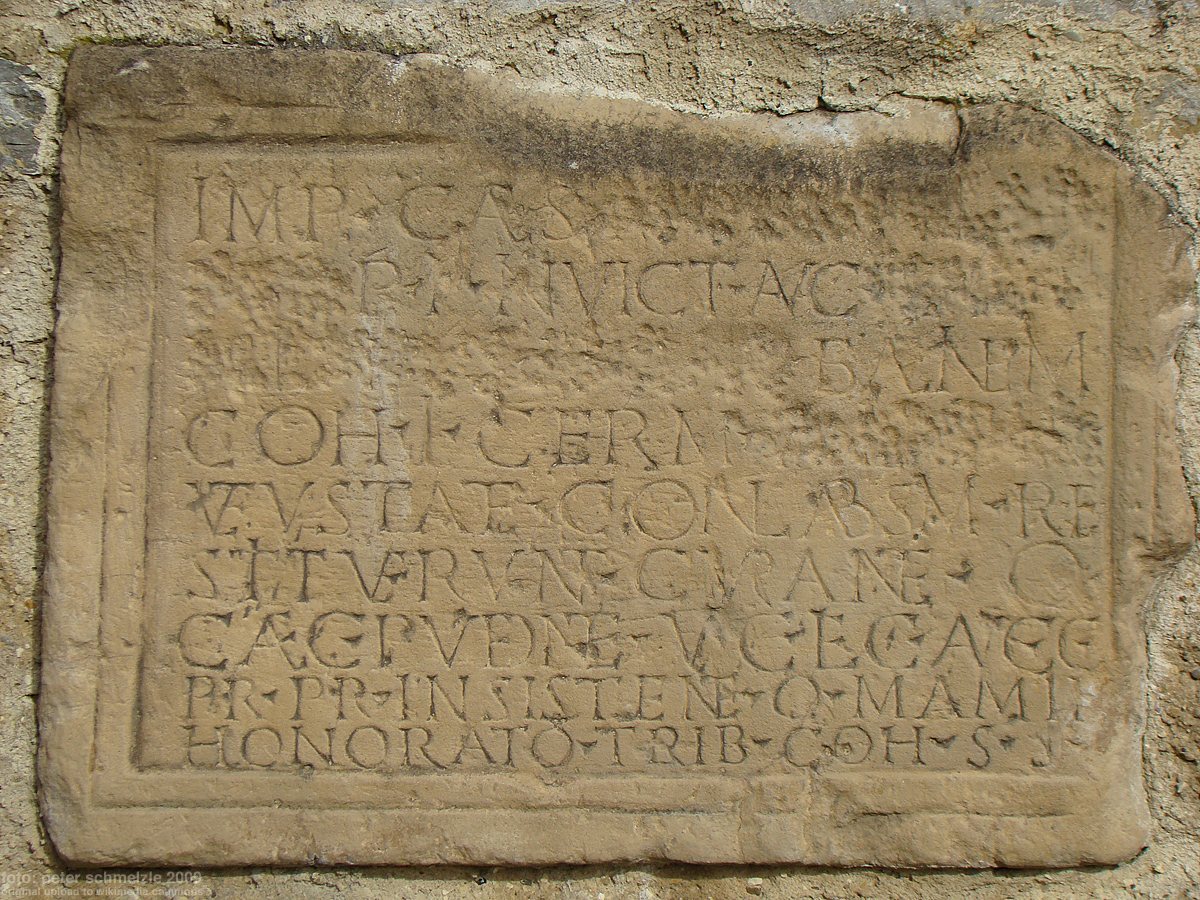
Inscriptions from the baths record major repairs. Around AD 205, after the large bath had deteriorated, governor Caesonius Rufinianus ordered its renovation, supervised by the cohort tribune Iulius Clodianus. The inscription originally named Caesar Geta, whose name was later erased on the orders of his brother and co-emperor Caracalla after Geta’s murder. The smaller bath was restored between AD 244 and 247 under governor Quintus Caecilius Pudens, at the initiative of tribune Quintus Mamilius Honoratus. The inscription naming emperors Philip the Arab and his son Philip Caesar was later altered to suppress their public memory.
Under Philip the Arab, the cohort received the honorific Philippiana, perhaps in recognition of service in fighting against the Alamanni, a confederation of Germanic peoples that opposed Rome along the frontier. The cohort also repaired the large bath. In AD 248, tribune Valerius Valerianus dedicated an inscription to Fortuna, associating the goddess with the bath and a safe return. Supplies reached the garrison by river along the Jagst and Kocher.
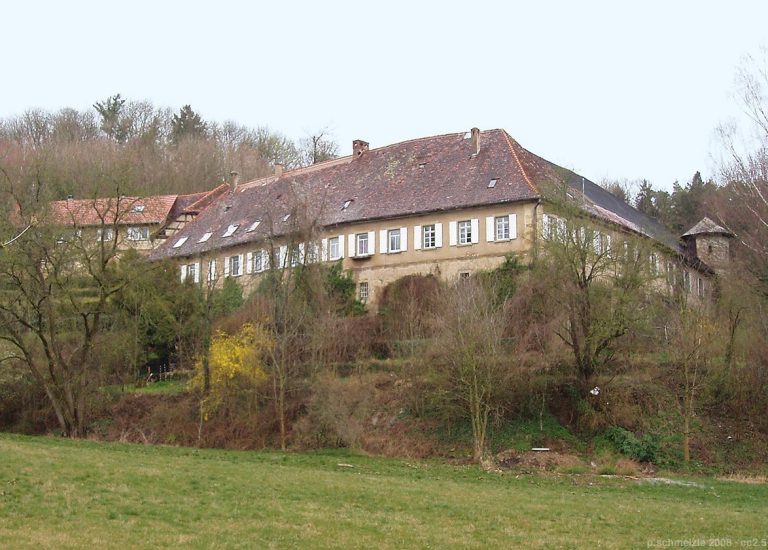
A civilian settlement, or vicus, grew beside the fort. It included workshops, substantial buildings, and the narrow-fronted houses on long plots commonly found along Roman streets. Some inhabitants may have traded beyond the local market. Around AD 259–260, an Alamannic attack overran the fort, settlement, and baths, forcing their abandonment. Later stone robbing added to the destruction, and stone from the Roman remains was probably reused in the later castle at Jagsthausen.
Excavation and protection
Antiquarian Christian Ernst Hanßelmann included early excavation reports in works published during the eighteenth century. His account of a discovery in 1766, which he described as a Roman bath, probably refers to the smaller bath. In the nineteenth century, local official Joachim Fest assembled historical finds. The smaller bath was rediscovered in 1886; the Reich Limes Commission examined parts of the fort walls in 1892 and 1906. Excavators recovered finds from the western cremation cemetery between 1908 and 1913, with smaller investigations following in the 1920s, 1930s, and 1960s.
Systematic archaeological work resumed under Baden-Württemberg’s monument authority in 1984. The large bath was excavated in 1992, and geophysical surveys examined parts of the largely built-over fort in 1996. An open-air museum with a display of casts of important stone finds opened at the bath site in 1995. Since 2005, the fort and related remains have formed part of the UNESCO World Heritage-listed Upper Germanic-Raetian Limes. They are also protected as cultural monuments under Baden-Württemberg law.
Remains
The Roman remains include a stone fort, two baths, a civilian settlement, and burial grounds. The fort stood on the eastern side of a broad valley, on ground sloping gently toward the Jagst. South of the site, the river turns sharply west, while the opposite bank rises steeply. The Limes ran north–south about 400 metres away. The settlement spread mainly south and southwest of the fort, with part extending east of the river.
The fort
Enclosure, gates, and towers
The stone enclosure measured about 185 by 152 metres and covered roughly 2.9 hectares. Much of the fort is now beneath later buildings, but excavations identified the southern gate as the principal gate on the right and the northern gate as the principal gate on the left. Three intermediate towers were identified along the north wall. Two lay in its forward section, between the northern gate and the northeast corner tower; the third stood in the rear section, between the gate and the northwest corner tower. A geophysical survey verified the rear tower along an 80-metre stretch of wall. A fourth tower was proposed between it and the northwest corner. The reconstructed plan places the fort’s front toward the Limes, near the steep ground descending to the Jagst, although its precise alignment remains uncertain. The Reich Limes Commission suggested that it may have faced northeast.
Headquarters and residence
The fort’s headquarters building is only partly known. Walls south of it, partly overlain by a church, have an uncertain function and may belong to the commander’s residence. The later Red Castle is thought to cover part of that residence.
Baths
Large bath
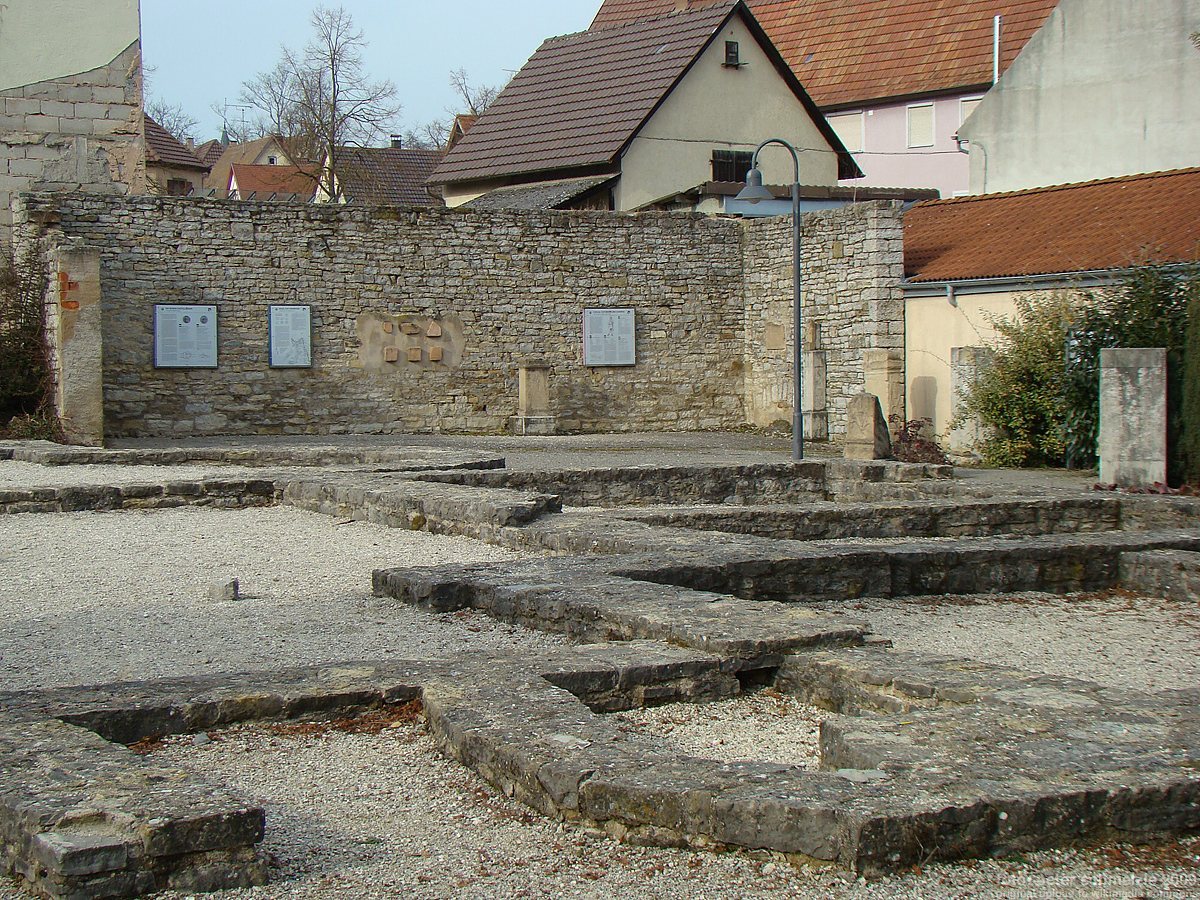
The large bath stood beside the road leaving the southern gate. It was a bathhouse whose rooms were arranged in sequence, and the known section extends for 30 metres. Its entrance is thought to lie beneath the present main street. The bath was probably built around AD 160 and may have remained in use into the first half of the third century. Excavated remains were well preserved. After the walls were examined, they were reburied, and the plan was marked at ground level on a full scale using ancient masonry methods. The reconstructed foundations are visible on the site. More than 70 bricks stamped by the Mainz-based Legio XXII Primigenia were recovered here, with over 15 different stamp designs. The sandstone inscription relating to the bath’s renovation is now held in the Central Finds Archive of the Archaeological State Museum of Baden-Württemberg in Rastatt.
Small bath
The smaller bath lay about 200 metres south of the fort, in the former Steinäcker field area south of present-day Gartenstraße. It measured about 31 by 15 metres and was aligned north–south. Its walls survive to a height of up to 1.5 metres. Excavation revealed sandstone floor slabs, traces of floor screed, coloured wall plaster, and bricks stamped by Legio XXII Primigenia. Finds included two nearly matching reliefs of Fortuna holding a cornucopia and rudder, a female statue torso about half life-size, and two hands found placed together. An altar carried the dedication to Fortuna. The bath’s building inscription is held in the archaeological collection at Rastatt.
Civilian settlement and burial grounds
Workshop and houses
A pottery workshop at the settlement’s northwest edge stood near the fort’s western exit road. Excavated in 1963–1965, it contained five kilns. Its wares included vessel shapes and mixing bowls with vertical rims not otherwise found along the Limes, forms that may point to trade northward. Other finds included fine red-coated Roman tableware, water pipes, glass, the upper portion of a Jupiter-and-giant column, and a small bronze Hercules figure probably made in Italy. The figure may reproduce a sculpture by the Greek artist Lysippos, who lived in the fourth century BC.
Excavations in the western settlement in 1984 uncovered narrow-fronted houses on long plots, with their gables facing the exit road. The buildings went through several phases and included both earth and stone cellars. Work beside the main road in 1987–1989 exposed timber-framed and stone buildings above cellar rooms. Some walls survived almost 1.5 metres high and contained carefully built niches. Further excavations in the southern settlement in 1991–1992 and 1995 found timber buildings, two stone cellars, and an earth cellar. The settlement also included larger stone buildings with comparatively elaborate plans.
Burial grounds
Burial grounds lay near the large bath at the southeastern edge of the settlement and west of the fort along the route of an exit road. Excavations in the western cemetery between 1908 and 1913 identified about 200 cremation burials in urns and remains of four tower-shaped tombs. Another burial ground lay within the settlement near present-day Sennenfelder Straße, which curves west around the ancient fort site.
Inscriptions and sculpture
Dedications and altars
An inscription associated with the fort records a dedication made in AD 221 by standard-bearer Iunius Iuvenis to Jupiter, Juno, Mars, and Hercules, described as half-brothers. A separate stone dedicated at Jagsthausen in AD 179 was set up by Lucius Pompeius Gratinus, a soldier assigned special duties who came from Legio VIII Augusta at Strasbourg. A sandstone altar found at Olnhausen names cohort centurion Lucius Petronius Tertius and is dedicated to Jupiter and Juno. It is now in the Limes Museum in Aalen and may have been moved there from the civilian settlement after the Roman period. Another altar, dedicated at Olnhausen in AD 166 by Lucius Flavius Paternus to Jupiter, Juno, and a local guardian spirit, was rediscovered in 1905. It is held in the Rastatt museum depot; its connection with Jagsthausen is uncertain.
Statues and collected finds
A finger from a large bronze statue, dated to AD 150–250, was recovered from the fort ditch. Finds collected by Joachim Fest are now in the museum at Jagsthausen Castle. The Roman collection assembled by local researcher Friedrich Krapf is displayed in the Friedrich Krapf Museum in the Old Town Hall.