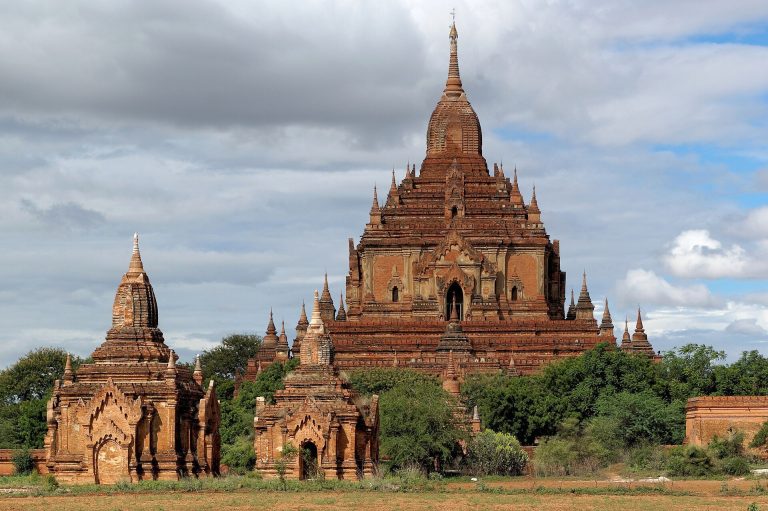
Bagan: Capital and Religious Center of the Pagan Kingdom
Site at a Glance
- Popularity
- Very High
- Country
- Myanmar
- Primary era
- Medieval
- Eras represented
- Medieval, Early Modern, Modern
- Civilizations
- Burmese Kingdoms, Pagan Kingdom, Pyu
- Site type
- City
On this page15 sections
History
Bagan is a historic city and archaeological landscape in Old Bagan, Myanmar. The Mranma, or Burmans, established a settlement there in the mid-to-late ninth century, and Bagan became the capital of the Pagan Kingdom, also called the Bagan Empire. From 1044 to 1287, it was the kingdom’s political, economic, and cultural center. The kingdom brought together territories that later formed Myanmar.
Origins and early growth
Burmese chronicles traditionally trace Bagan’s foundation to the second century CE and credit King Pyinbya with fortifying it in 849. They describe Pyinbya as the 34th successor of the early city’s founder. Historical reconstruction places Bagan’s foundation in the ninth century, during the arrival of Burmans in the Irrawaddy valley from Nanzhao, a kingdom in what is now southwestern China. The city existed among competing Pyu urban centers, and its Burman settlement gained influence in the late tenth century.
The name Bagan developed from the Old Burmese form Pukam through the later name Pugan. Its classical name in Pali, a language of Buddhist learning, was Arimaddanapura, meaning City that Tramples on Enemies.
The Pagan Kingdom
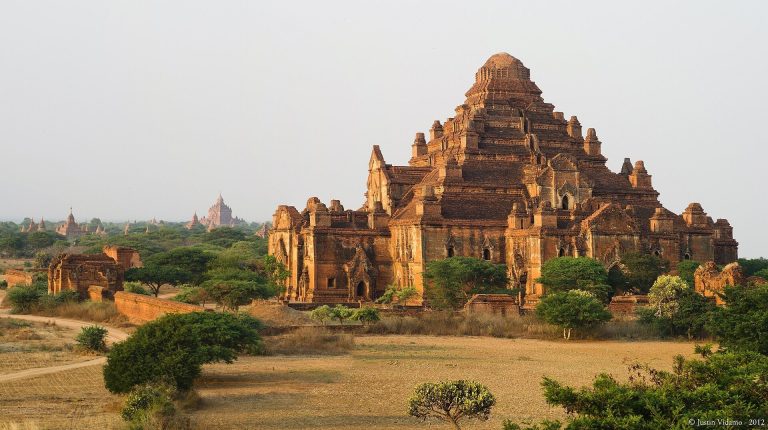
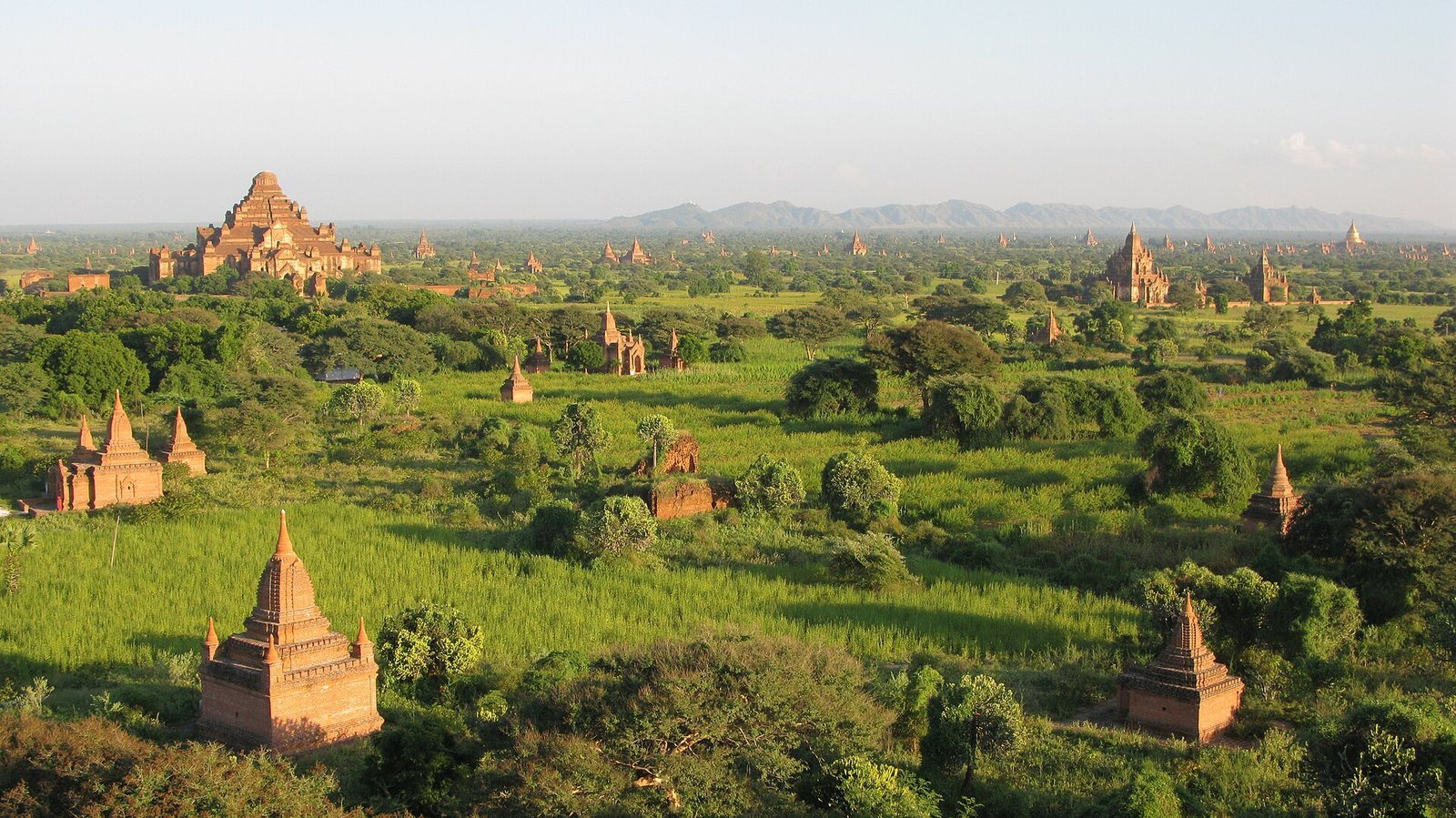
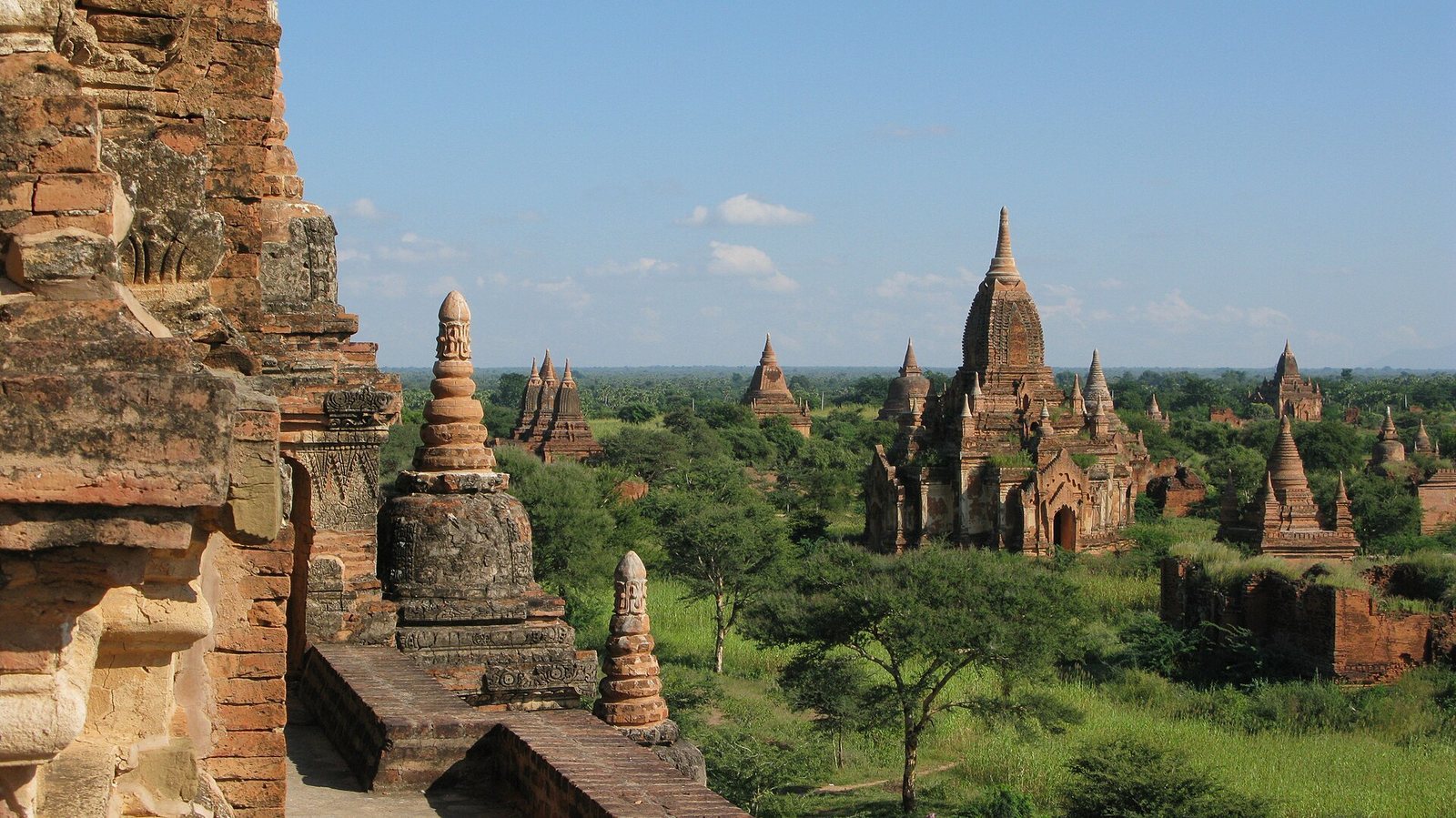
Over roughly 250 years of royal and elite support, more than 10,000 religious monuments were built across the Bagan plains. Estimates include about 1,000 stupas, 10,000 small temples, and 3,000 monasteries. Monument building took place along the main settlement strip during the eleventh century, with activity that may have extended to village communities. Construction reached its peak around 1150–1200, when many of the largest buildings were erected.
Bagan’s religious life encompassed Theravada, Mahayana, and Tantric Buddhist traditions, as well as Hindu worship centered on Shiva and Vishnu and local practices concerning spirits known as nats. Royal support for Theravada Buddhism grew from the mid-eleventh century, gradually giving it primacy, while other traditions continued. Bagan also became a center of religious and secular study. Its scholars worked on Pali grammar and abhidhamma, the analytical and philosophical study of Buddhist teachings, as well as subjects including medicine, law, astrology, and poetry. Monks and students came from India, Sri Lanka, and the Khmer Empire.
Building and maintaining religious monuments sustained work in brickmaking, masonry, metalworking, carpentry, woodcarving, and pottery. Inscriptions point to residents and workers from varied linguistic and cultural backgrounds. Migration from elsewhere in Myanmar, and probably from regions including Dvaravati, Srivijaya, and the Chola Empire, accompanied Bagan’s growth. By the thirteenth century, clusters of monasteries and smaller monuments had developed farther east, including at Minnanthu. The increased emphasis on monastery-centered building may reflect both shrinking resources and wider participation by private donors.
Decline and continued pilgrimage
The Pagan Empire collapsed in 1287 amid repeated Mongol invasions between 1277 and 1301. The extent of Mongol action at Bagan is uncertain, and damage to the city appears to have been limited. The causes of Bagan’s decline are also unclear. One interpretation is that provincial governors who defended their territories gained power, shifting political influence toward their own capitals. The city’s population, estimated at 50,000 to 200,000 at its height, fell as Bagan became a small town. In December 1297, it formally ceased to be Burma’s capital as the Myinsaing Kingdom became the leading power in Upper Burma.
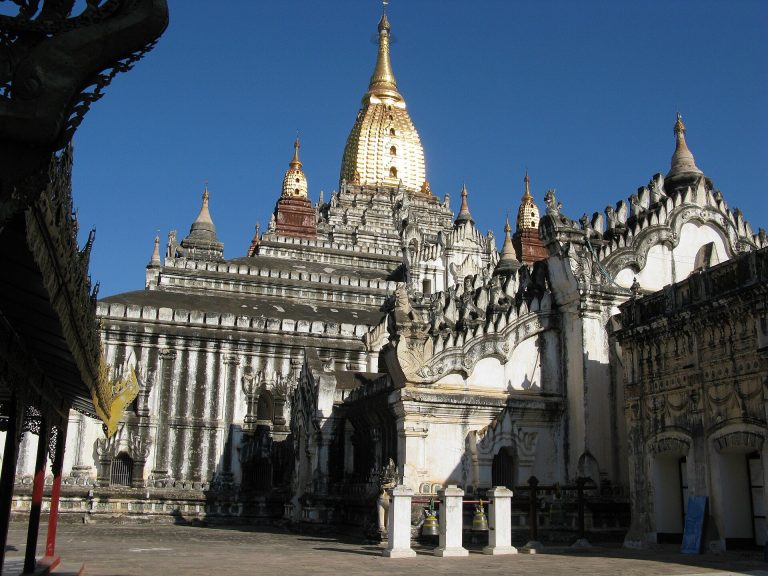
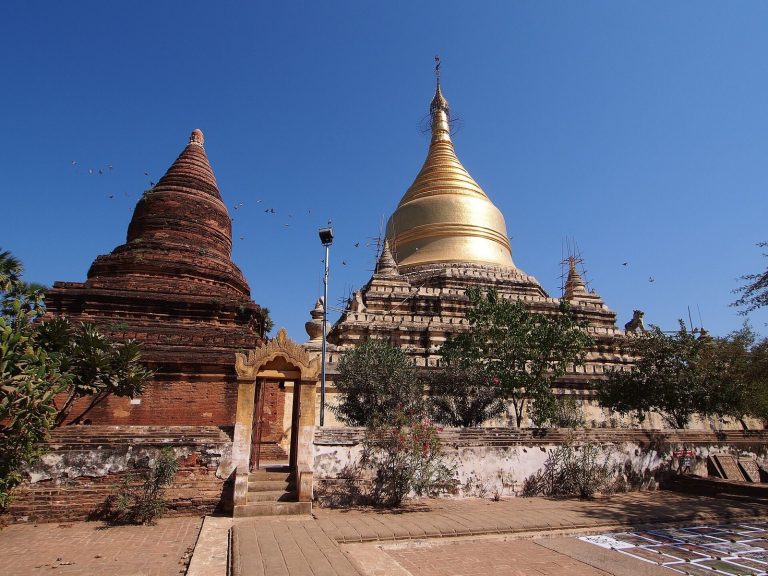
Bagan remained inhabited into the fifteenth century and continued as a pilgrimage destination during the imperial period. New religious monuments were built until the mid-fifteenth century, followed by fewer than 200 temple constructions between the fifteenth and twentieth centuries. Pilgrims concentrated on temples including Ananda, Shwezigon, Sulamani, Htilominlo, and Dhammayazika, as well as sites along an ancient road. Regular patronage brought repairs and additions to these temples, while less-visited monuments deteriorated.
During the Konbaung period, the last dynasty of Burmese kings, from 1752 to 1885, state-sponsored renovation changed many temples’ original designs. Some received rough plaster finishes, and the interiors of Ananda and Thatbyinnyu were whitewashed. New inscriptions and murals were added, continuing an earlier pattern in which fresh paintings and Buddha images sometimes replaced older devotional work.
Earthquakes and preservation
More than 400 earthquakes were recorded at Bagan between 1904 and 1975. On 8 July 1975, shaking reached intensity 8 on the Modified Mercalli scale, which measures earthquakes through observed effects and damage, at Bagan and Myinkaba, and intensity 7 at Nyaung-U. Many temples were damaged, and Bupaya was severely damaged beyond repair.
In the 1990s, the military government restored many earthquake-damaged pagodas using modern materials and approaches that art historians and conservationists criticized for paying little attention to original architectural designs. Bagan was first nominated for World Heritage status in 1996 and inscribed on 6 July 2019, becoming Myanmar’s second World Heritage site after the Ancient Cities of Pyu. An earthquake on 24 August 2016 severely damaged nearly 400 temples, including Sulamani and Myauk Guni. The Bagan Archaeological Department began survey and reconstruction work with UNESCO’s help. In three campaigns between 2017 and 2018, the Zamani Project used LiDAR, a laser-based method of recording structures, to document 12 monuments.
Remains
The Bagan Archaeological Zone covers about 13 by 8 kilometres on the Upper Burma plains, at a bend in the Irrawaddy River. Old Bagan lies near its center, with Nyaung-U to the north and New Bagan to the south. A principal line of monuments extends for about nine kilometres along the river’s east bank, while monuments are spread across roughly 8,000 hectares. Old Bagan’s walled core occupies 140 hectares on the riverbank and is enclosed by three walls. River erosion has affected parts of the settlement, and buildings have collapsed into the Irrawaddy upstream and downstream of the core. In total, 2,229 temples and pagodas survive across the wider landscape.
Religious architecture
Stupas
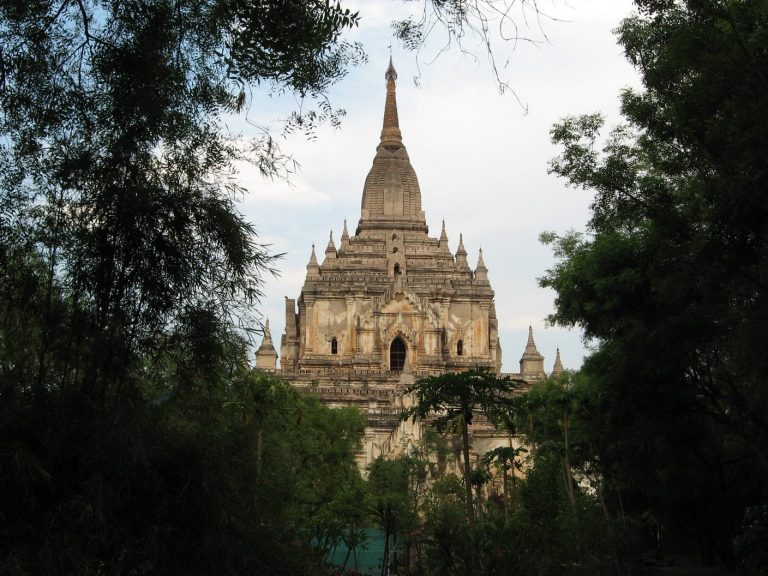
A stupa is a solid Buddhist monument, often associated with relics. Bagan’s stupas developed from earlier Pyu designs, with connections to forms from Andhra, especially Amaravati and Nagarjunakonda, and to Sri Lankan examples. Early Bupaya, dating to about the ninth century, follows the Pyu style of Sri Ksetra. The form evolved from a rounded body topped by a rectangular enclosure and a shaft bearing ceremonial umbrellas. At Bagan, the body grew more elongated and cylindrical before developing a bell shape. By the eleventh century, the umbrellas had become diminishing tiers of rings ending in a point, while the upper enclosure developed into a lotus-bud form and later an extended banana-bud apex.
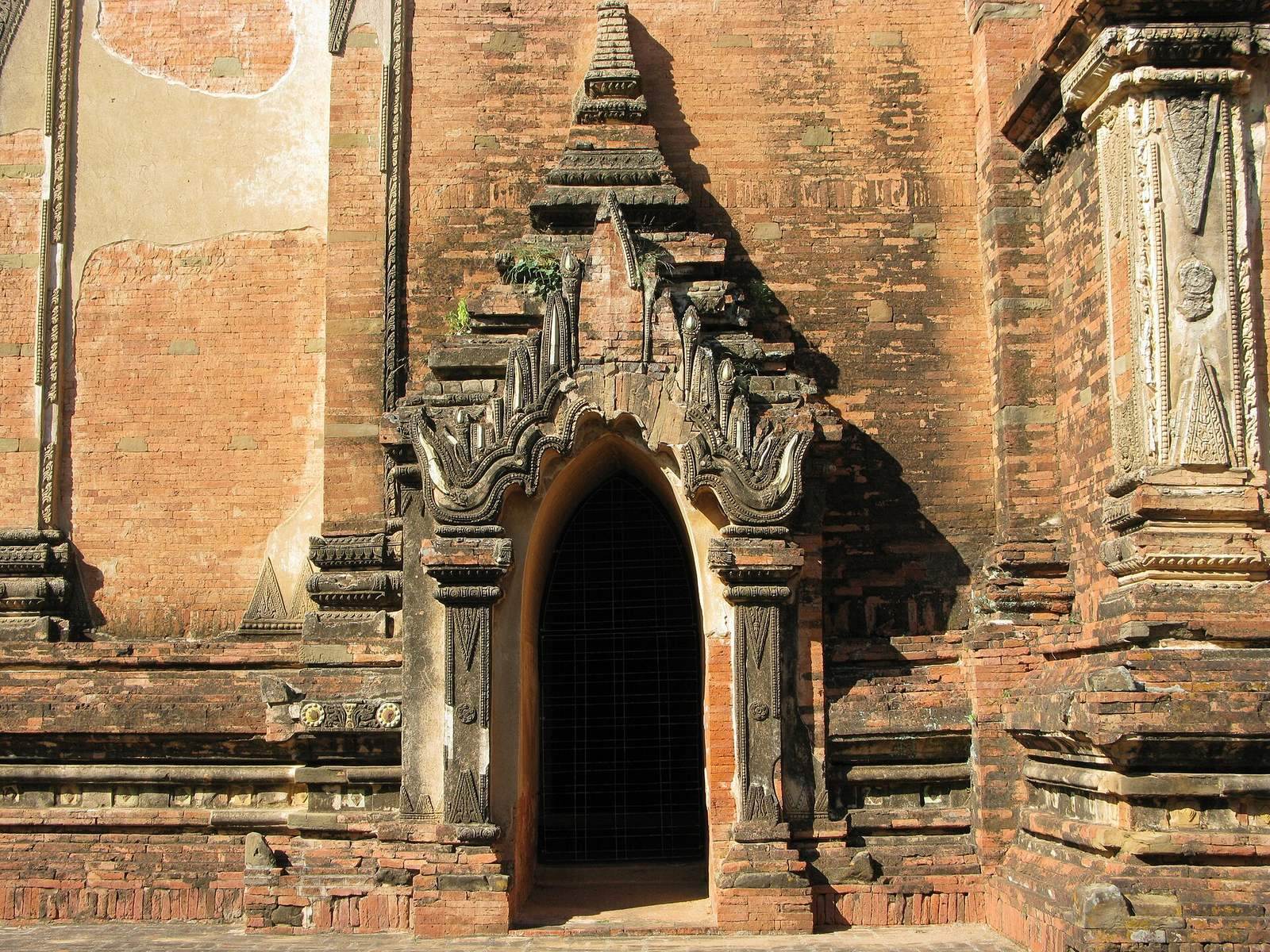
Many stupas stand on three or four rectangular terraces, sometimes with galleries of terracotta tiles showing Jataka stories, accounts of the Buddha’s previous lives. Shwezigon and Shwesandaw are early examples of this arrangement. Later bell-shaped forms appear at Dhammayazika, from the late twelfth century, and Mingalazedi, from the late thirteenth. Brick surfaces were often coated with stucco and relief decoration, including rows or pairs of ogre-like guardian figures. The stupa’s shape represents Mount Meru in Buddhist cosmology, while its umbrella represents the world axis.
Hollow temples
A gu temple is a hollow Buddhist building with interior space for worship or meditation. Its plan could provide one main entrance, four entrances, five faces, or a combination of forms. The one-entrance and four-entrance traditions are associated respectively with Beikthano in the second century and Sri Ksetra in the seventh. Bagan’s hollow temples grew larger over time, and pointed arches and vaulted chambers became characteristic features.
The earliest vaulted temples at Bagan date to the eleventh century. Their carefully fitted masonry supported spacious interiors, and the building techniques included keystone arches. Bagan’s pentagonal temple plan combined features of one-face and four-face designs, allowing devotion to Maitreya, the Buddha expected in the future, alongside the four Buddhas who had already appeared. Dhammayazika and Ngamyethna are examples of this plan.
Pottery Hill
Mounds and monuments
Pottery Hill, also called Otein Taung, lies two kilometres south of Ananda in Old Bagan. Its two mounds, about 500 metres apart, are covered with dense layers and scatters of pottery fragments. About 40 small monuments, mostly dating to the thirteenth century, occupy the area. Several stand near a monastery south of the western mound, while another group forms a straight line that may mark a property boundary or road. Other monuments cluster south of the eastern mound or lie between the two rises. A large temple between them was probably built in the twelfth century and was restored in 1999.
Excavated material
Radiocarbon dating indicates activity at Otein Taung from at least the ninth century. Excavation recovered charcoal, preserved burnt bamboo filaments, animal bones, pig teeth, and fine-textured potash layers consistent with fuel from bamboo and other grasses. More than 50 straight spouts and necks from sprinkler pots, known as kendis, were found, along with earthenware tubes about 60 centimetres long and 40 centimetres wide that may have served as parts of toilets.
Otein Taung may have been a pottery-production area or a large residential refuse deposit, and the evidence does not settle the question. Finds that may relate to pottery work include earthenware anvils and a small clay tube that could have been used to stamp decoration. The area’s clay-rich subsoil is still used for brickmaking, and four nearby tanks may have originated as clay pits.
Palace site and museum
Anawrahta’s Palace
Anawrahta’s Palace was rebuilt in 2003 on the basis of foundations at the old palace site. The structure above those foundations is conjectural.
Bagan Archaeological Museum
The three-storey Bagan Archaeological Museum displays objects from the Bagan period, including the original Myazedi inscriptions.