Pohlsberg: A Prehistoric Burial Mound in Germany
Site at a Glance
- Popularity
- Very Low
- Country
- Germany
- Primary era
- Stone Age
- Eras represented
- Stone Age
- Civilizations
- Unclassified
- Site type
- Burial
- Remains
- Burial Mound
On this page17 sections
History
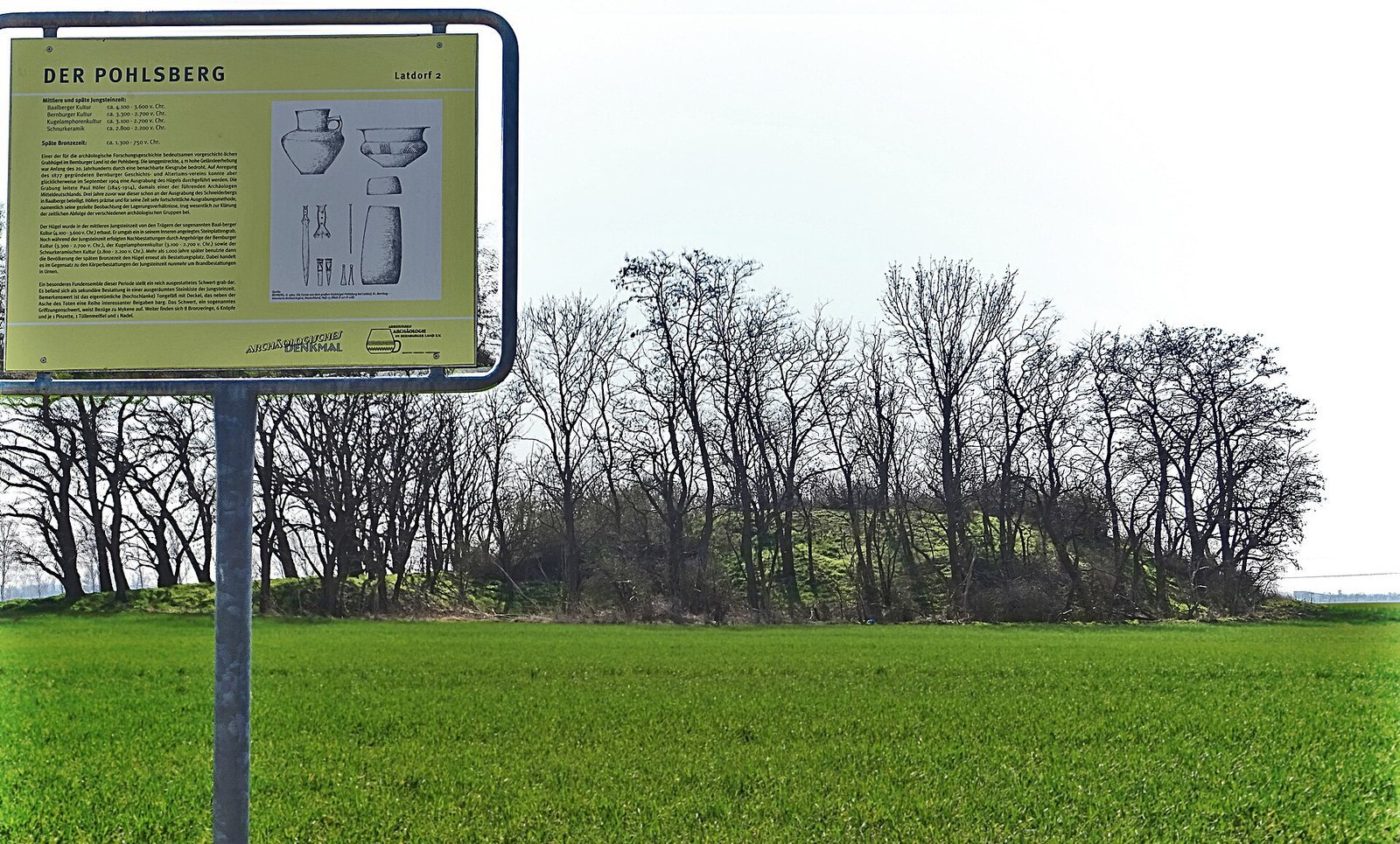
Pohlsberg is a prehistoric burial mound at Latdorf, now within Nienburg (Saale), in Saxony-Anhalt, Germany. Its oldest burial dates to 3900–3400 BCE and belongs to the Baalberge Culture. Burials associated with later archaeological cultures and groups show that the mound was used across several prehistoric periods. These cultural labels distinguish traditions through characteristic material remains; they do not necessarily represent historically documented political communities.
Prehistoric burials
After the Baalberge burial, finds and graves at Pohlsberg are associated with the Walternienburg Culture (3350–3100 BCE), the Globular Amphora Culture (3100–2650 BCE), and the Corded Ware Culture (2800–2050 BCE). Later burial use belongs to the Late Bronze Age Saale Estuary Group, dated to 1300–750 BCE. The nearby Schneiderberg mound has a closely similar sequence of cultural use.
Military use in 1644
During the Thirty Years’ War, a major European conflict fought from 1618 to 1648, Swedish commander Lennart Torstensson established a military camp near Bernburg in 1644. Its fortified perimeter enclosed Latdorf. Pohlsberg was one of the hills used as an observation point for the fortification’s projecting defensive platforms.
Excavation in 1904
Gravel extraction threatened the mound, leading the Bernburg Antiquarian Society to arrange an excavation in 1904. Archaeologist Paul Höfer directed the work in September. The team began with ten trenches, each about 2 m wide, near the mound’s base, and later added four more. After the excavation, the trenches were refilled and the mound’s exterior was restored. Finds from Pohlsberg are now held at Schlossmuseum Bernburg. Höfer tentatively connected a child burial in a small chamber made from stone slabs to the Corded Ware Culture, but considered Stone Age the most secure attribution.
Remains
The mound is an elongated earthwork, about 40 m long, 18 m wide, and an average of 4 m high, oriented approximately east–west. Its main body consists of humic soil heaped over gravel. A later extension, roughly 15 m long, was added at the western end using sand. Gravel extraction at a neighboring pit damaged that end, while rabbit burrows disturbed the mound fill and partly shifted human remains and grave goods. The principal grave lies near the center; other burials and findspots extend through the mound, particularly to its east and south.
Early graves and finds
Central Baalberge grave
The mound’s original grave sits above a slight natural rise, where the gravel surface is about 0.8 m higher than at the edges. Built roughly 0.6 m above the gravel, its enclosure is a trapezoid formed from granite boulders and aligned approximately east–west. The eastern end, 6.45 m across, is made of eight stones. Smaller stones fill gaps between the boulders, and one overturned enclosure stone is 1.4 m long. The northern side was traced for 25 m and the southern side for 19.5 m; at that point the sides were 4.25 m apart.
A chamber lies near the enclosure’s centerline, 3.9 m from its eastern end, 2.4 m from its northern side, and 2.3 m from its southern side. Sandstone slabs form its walls and roof. The cover slab measures 2 m by 1 m, and the chamber’s interior is 1.42 m long, 0.7 m wide, and 0.95 m high. Its south wall slab is 1.62 m long and its north slab 1.76 m long; both are 0.95 m high. Clay sealed the joints. Three upright slabs supported the outside of the southern wall, braced by a sloping slab and a block measuring 0.5 m by 0.5 m by 0.36 m.
Excavators opened the chamber by removing the western half of its southern wall. The burial survived as highly porous bone fragments, chiefly shafts and joint ends of long bones. A jug in the northeast corner was its sole grave good. It stands 17.5 cm high, measures 16.3 cm across at its widest point, and has an 8.5 cm mouth. Small incisions form a band where the neck meets the shoulder, an unusual decoration for Baalberge pottery, which was generally plain.
Findspots A and B
Findspot A lay in the mound’s eastern part, about 19 m east and 6 m south of the center. A sandstone slab rested on the mound’s base, 1.25 m below the surface, beneath ash and human and animal bones. About 3 m to its north, a second slab of sandstone, 0.7 m across, lay without associated finds.
At Findspot B, a sandstone slab stood at an angle, oriented north–south. It measured 1.55 m long, almost 1 m high, and 0.5 m thick, and leaned about 45 degrees to the east. Stones packed against its southern end extended westward. Pottery fragments at the lower end of the slab’s upper surface allowed three vessels to be reconstructed. One is a gray amphora, a handled pottery vessel, assigned to the Walternienburg Culture. It has a conical neck, four loops, and a band of dotted zigzags around its body. The other reconstructed vessels include a black, globular form and a reddish-brown pot with a distinct cylindrical neck. Two further fragments came from among the packing stones. One belonged to the gray vessel; the other carries two rows of rectangular horizontal impressions above a simulated cord line.
Walternienburg findspot
Findspot C, about 11.5 m east and 6 m south of the mound’s center, lay 0.75 m below the surface. It contained one undecorated, two-coned cup, 9 cm high, with a 4 cm base, a maximum width of 9 cm, and a 7 cm mouth. Two human skull fragments lay nearby, though their relationship to the cup is uncertain. They may have been moved by animals or may have belonged to a grave disturbed before the findspot was excavated.
Corded Ware burial and deposits
An upper burial lay about 3 m east and 1.5 m south of the center, at a depth of 1 m. The body had been placed on a sandstone slab 4 cm thick, broken into two pieces. The poorly preserved skeleton had an incomplete lower jaw. Fragments from Findspot C may have belonged to this burial. Its objects included two vessels, pottery fragments, a stone axe, and small ring-shaped beads. An undecorated reddish-brown globular amphora stood on a stone. It was 27 cm high, with a 9.5 cm base and a maximum width of 27.4 cm, and had two loops on its body. A black-brown beaker decorated with cord impressions lay 70 cm to its north; it is 14 cm high and has a 10 cm mouth. Other fragments came from a knobbed vessel with two rows of dots and a reddish beaker decorated with a herringbone pattern.
The burial’s faceted axe is made of mottled, dark-gray syenite, a type of stone. It measures 14 cm long, and its facets meet through softly rounded transitions. The ring-shaped beads are about 4 mm wide and 7–8 mm across. Although Höfer first considered them bronze, chemical analysis in Halle (Saale) identified them as pure copper. A second axe, 7.7 cm long and made of dark-gray syenite, was found after the excavation. Höfer thought it might have come from this upper burial, where another axe of the same material had been recovered.
Findspot D was a concentration of pottery fragments immediately south of Bronze Age cist IV–V. Some pieces belonged to a rounded amphora, 24 cm high and 26 cm wide at its broadest point, with four loops. Zigzag bands decorated the area between the loops, the neck–shoulder junction, and the spaces between those bands. Other fragments carried cord impressions. Höfer reconstructed a short-necked beaker from the represented vessels. It measures 17 cm high, with a 10 cm body and 7 cm neck, a 7 cm base, and a mouth 11.5 cm across. He proposed that these vessels belonged to an older burial disturbed during construction of cist IV–V.
Child burial in a stone cist
About 11.5 m east and 4.4 m south of the center, at a depth of 1.6 m, a stone cist held the burial of a child. Its interior measured 0.90 m long, 0.55 m wide, and 0.37 m high. Sandstone slabs lined the sides, with wall slabs 5, 7, and 13 cm thick and a cover slab 6 cm thick. After the grave was temporarily reburied, it was found looted the following day, its cover removed and bones scattered. The original arrangement could nevertheless be reconstructed. The incomplete skeleton belonged to a child about four years old and 99 cm tall, apparently buried in a crouched position. A femur 22.5 cm long was well preserved, and part of the lower jaw remained with a molar. No grave goods could be identified.
Bronze Age graves
Stone cist I
Stone cist I lay about 6 m east and 2.6 m south of the center, 1.2 m below the surface. A sandstone floor slab, four wall slabs, and a cover slab formed the small chamber. Inside was a fragile, soft-pottery urn, 25 cm high, with a maximum width of 31.5 cm and a mouth 25 cm across. Three horizontal grooves encircle it above the shoulder. Its broken lid was placed with it, and cremated remains filled the vessel to a depth of 12 cm. The grave also held two-thirds of a ceramic ring, a bone tube, and a smaller, kettle-shaped urn. The smaller vessel, 8.5 cm high and 9 cm across its mouth, contained cremated remains. It has two loops, two horizontal grooves at their level, and five sets of three vertical grooves descending from them. Half a metre west of the cist were a fragment of a bronze needle and two loops from a ceramic vessel, which may have been associated with the burial.
Stone cist II
Cist II was about 9 m east and 1.6 m south of the center, at a depth of 1.8 m. Its 4 cm-thick sandstone slabs were reinforced on the outside with oak planks 14–15 cm thick, traces of which survived. The north–south chamber measured 60 cm long and 40 cm wide. An undecorated black pot with a distinct rim stood at the southern end. It is 35 cm high and 22.5 cm across at its widest point. At the north end stood a broad bowl with a curved profile and diagonal grooves, 10 cm high and 35 cm in diameter. It contained a grooved dish 11.8 cm across and a slightly barrel-shaped, lidded vessel with two loops. The vessel is 16 cm high, 13 cm wide at its broadest point, and 10.7 cm across its mouth. Its decoration combines horizontal lines and zigzags, while its slightly domed lid is 4.2 cm high.
Stone cist III and spearheads
Cist III, 11 m east and 2 m south of the center, was 1.1 m below the surface. Its east–west interior measured 1 m long, 0.6 m wide, and 0.6 m high. Oak planks were identified inside. The grave contained four ceramic vessels and three bronze spearheads. At the eastern end stood a rounded terrine, 27 cm high and 52 cm wide at its broadest point, with a sharply defined shoulder and flaring rim. Four raised bosses decorated its body, each with concentric semicircles; vertical grooves separated the areas between the bosses. A plain, flat plate lay inside it. To the west stood a rounded amphora with a conical neck, two loops at the shoulder, and eight horizontal grooves across the shoulder. It is 26.5 cm high, 35 cm wide at its broadest point, and 16 cm across its mouth. Inside was a flat, two-part cup with vertical grooves around its body.
The three bronze spearheads had been placed beneath stones outside the cist’s eastern side, with their points directed south. Their wooden shafts would have been too long to fit inside the chamber. Each has a narrowing socket that extends almost to the point and two rivet holes near its lower end. The spearheads measure 15.2, 10.5, and 8.2 cm long.
Burial beneath cist III
A second stone chamber lay only 20 cm beneath cist III, separated from it by earth and small flat stones. Oriented north–south, it had an internal length of 1.02 m and a width of 0.92 m at the north end and 0.91 m at the south. Two cover slabs measured 1.4 m by 0.7 m; one was 21 cm thick and the thinner northern slab was 8 cm thick. Clay sealed the joints between the wall slabs, and flat stones laid horizontally and vertically filled the chamber. Its dimensions and construction led Höfer to propose that it was first built in the Neolithic and reused as a Bronze Age sword grave. He reasoned that most wall slabs were lower than the lidded vessel, which stood 58 cm high, and that the surrounding stone packing reached 65 cm deep. He estimated the chamber’s original interior height at about 40 cm.
A brownish cylindrical vessel with a lid stood in the southeast corner. It was already broken when found and measured 51 cm high and 17 cm wide; its lid was 10 cm high. It may have been made to hold the bronze sword placed inside. The sword is 53 cm long. Its tang, the part that extends into the hilt, is attached by three rivets, and the blade broadens toward its lower end into a lance-like shape. The vessel also held small bones, eight cast rings, six double buttons, one smaller button, broken tweezers, a socketed chisel, and a needle. Most rings are 2.7 cm across, while one is 3.4 cm. The double buttons have plates 1.6 cm and 1.2 cm across and are 1.3 cm long. The smaller button measures 0.8 cm across. The tweezers are 6.5 cm long, and the chisel is 9 cm long, with a 2 cm mouth and a 1.2 cm cutting edge. The needle measures 16 cm. A bone fragment bears small circular decoration and may have formed part of the sword grip.
Stone cist IV–V
Cist IV–V lay about 13.5 m east and 2.6 m south of the center, 1.4 m below the surface. This large, richly furnished east–west chamber was made from sandstone slabs about 5 cm thick and surrounded by a layer of stones. Its interior measured 1.45 m long, 0.5 m wide, and 0.45 m high. Two urns filled with cremated remains stood inside. The larger, at the western end, was 32 cm high, 52 cm wide at its broadest point, and 40 cm across the mouth. The smaller, in the middle, measured 25 cm high, 35 cm across at its widest point, and 32 cm at the mouth. The grave also contained two cups and two bowls. A bowl covered the smaller urn; another had been turned upside down inside the larger one because it was smaller than the opening. The smaller urn contained a bronze wire ring.
Two additional black, undecorated cylindrical pots with distinct necks stood east of the urns. The western pot is 26 cm high and 16 cm across its mouth; the eastern is 21 cm high and has the same mouth width. Another Bronze Age stone cist was discovered 28 m north of Pohlsberg.