Crosby Hall, London: A Medieval Merchant’s Hall
Site at a Glance
- Popularity
- High
- Country
- United Kingdom
- Primary era
- Medieval
- Eras represented
- Medieval, Modern
- Civilizations
- British, English
- Site type
- Domestic
- Remains
- Elite Residence
On this page10 sections
History
Crosby Hall is the surviving Great Hall of a medieval merchant’s mansion on Cheyne Walk, in the United Kingdom. The hall was built for Sir John Crosby as part of Crosby Place, a mansion on the grounds of St Helen’s Convent beside St Helen’s Church in Bishopsgate. It is identified as the only surviving example of a medieval merchant’s house from the City of London, and its Great Hall is considered London’s most important surviving secular domestic medieval building.
The Bishopsgate mansion and Richard III
Crosby, a wool merchant who held civic offices, leased the main property before 1466. That year he renewed the lease to include neighboring holdings and developed the estate as his residence. Work on the Great Hall and Parlour began in 1466 and continued into the 1470s; the hall is generally dated to 1466–1475. Crosby died in 1475, and the hall passed by bequest to his widow, Anne, in 1476.
By 1483, Richard, Duke of Gloucester, had acquired the Bishopsgate property. He later became King Richard III, ruling England from 1483 to 1485. During the period when the sons of Edward IV, known as the Princes in the Tower, were in his protection, he used Crosby Place as a London residence. The princes later disappeared, an episode that remains a major historical controversy. The hall is generally believed to have hosted the duke’s council and political plotting. Shakespeare’s play Richard III later referred to Crosby Place and used it as the setting for several scenes.
Tudor owners and literary visitors
Catherine of Aragon stayed at Crosby Hall in 1501 while in England to marry Arthur, the eldest son of Henry VII. The owner, Sir Bartholomew Reade, Lord Mayor of London, lived there and held feasts for ambassadors of Maximilian I, Holy Roman Emperor. During the Lombard Street riots of May 1511, Sheriff John Rest occupied the hall. People arrested in the disturbances were held there before being transferred to Lambeth Palace.
Thomas More leased the house from 1519 and bought it in 1523. He also owned the riverside estate in Chelsea where Crosby Hall now stands. That year, he transferred the remainder of his Bishopsgate lease to his friend and patron Antonio Bonvisi, a wealthy Anglo-Italian merchant. Bonvisi protected the lease after More’s execution and during the Dissolution of the Monasteries, Henry VIII’s suppression of England’s monastic institutions. In 1547, he leased the house to More’s nephew William Rastell and son-in-law William Roper. A tradition that More wrote the second part of Utopia at Crosby Hall is unlikely: the book appeared in 1516, before he took possession, although later editions were conceived during his lease.
In 1594, alderman John Spencer bought and improved the house, where he held his mayoralty. He entertained Queen Elizabeth I, Shakespeare, the French Duke of Sully, a younger son of the Prince of Orange, and ambassadors. Sir Walter Raleigh lodged there in 1601. Henry Howard, Earl of Northampton and Lord Privy Seal, owned the hall during Mary Sidney’s likely residence from 1609 to 1615. Sidney, a poet and literary patron, welcomed figures including Shakespeare and Ben Jonson into her circle.
Company offices, conflict, and fire
The East India Company, an English trading company engaged in overseas commerce, used Crosby Hall as its headquarters from 1621 to 1638. Its offices and merchant meetings occupied the building, and the Great Hall stored traded goods. During the English Civil War, the conflict between supporters of Parliament and the monarchy, the tenant Sir John Langham supported Parliament. The hall was temporarily used to hold Royalist prisoners. Langham divided the building between a Presbyterian congregation, a Protestant community governed by elders, and the East India Company.
Crosby Hall survived the Great Fire of London in 1666, but another fire in 1672 badly damaged the property. Only the Great Hall and one wing remained. The other damaged sections were demolished, and the land was sold for development, forming the site of present-day Crosby Square.
Preservation and relocation
Efforts to repair the deteriorating hall began in 1835–1836. Maria Hackett took over the lease and its liabilities, provided most of the needed funds, and oversaw the removal of inserted floors. Stones were also laid for an adjoining council chamber. The hall became a restaurant and bar in 1868, and Gordon & Co. bought it outright in early 1873.
In 1907, the Chartered Bank of India, Australia, and China bought the property and proposed replacing it with new offices. A preservation campaign involving the City of London Corporation, the National Trust, and the British Archaeological Society sought to save the hall; King Edward VII also expressed the hope that it would be preserved. In 1910, the medieval structure was dismantled and moved from Bishopsgate to a site provided by the London County Council at Cheyne Walk, Chelsea. It was restored there and formally opened in 1926 by the Duchess of York, later Queen Elizabeth, the Queen Mother.
Refuge, scholarship, and later restoration
During the First World War, the hall sheltered Belgian refugees and hosted fundraising concerts. The British Federation of University Women later took a long lease and made the premises a residence for visiting university women, including scholars supported by international fellowships. The expanded complex also housed offices of the British and International Federations of University Women. Theodora Bosanquet, the international federation’s executive secretary from 1920 to 1935, developed its library and encouraged intellectual exchange.
After the Nazi rise to power in Germany, the British federation raised support for women academics forced from their posts under the country’s 1933 Law for the Restoration of the Professional Civil Service, which removed Jewish people and others deemed politically undesirable from civil-service employment. It added three one-year residential fellowships to seven existing ones. Recipients included Emmy Klieneberger-Nobel, Betty Heimann, Helen Rosenau, Adelheid Heimann, Gertrud Kornfeld, Dora Ilse, and Erna Hollitscher. The hall was requisitioned during the Second World War and reopened in 1946.
After the London County Council was abolished in 1965, the site passed to the Greater London Council, Greater London’s metropolitan authority from 1965 to 1986. It was put up for sale after that council was abolished. Businessman and philanthropist Christopher Moran bought the hall in 1988 and commissioned its restoration and conversion into a private residence. A proposal to enclose the frontage, previously open to Cheyne Walk and the Thames, and the central garden, which had been open to the public, received approval after a public inquiry in 1996 and two earlier refusals by the local council. Restoration and expansion continued through 2021, when the complex was renamed Crosby Moran Hall. The hall received Grade II* listing in 1954, a high level of statutory protection for buildings considered particularly important in England.
Remains
The hall and later buildings
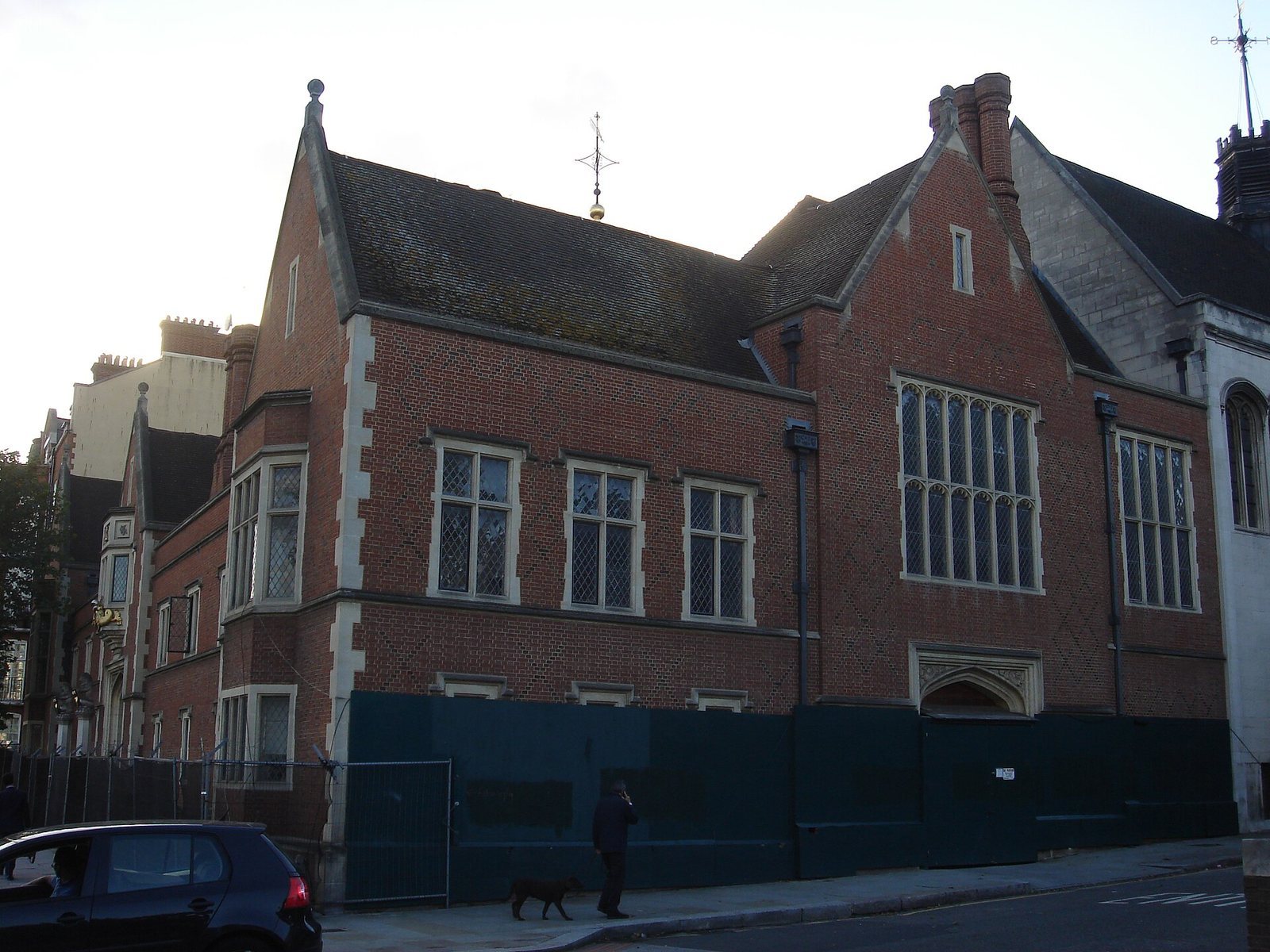
At Chelsea, the Great Hall forms the medieval core of a larger complex of later brick buildings. Its medieval fabric includes Reigate stone, a building stone quarried in Surrey, and the exterior is faced with Portland stone. The structure was reassembled from at least 1,500 separately inventoried pieces. Archaeological fieldwork in 1982 and 2005–2009 partly revealed the layout of the Bishopsgate mansion, which included a parlour as well as the hall. Brick additions in Neo-Tudor style, later architecture adapting features associated with Tudor buildings, were built around the hall for its relocation. A tall Arts and Crafts residential block, reflecting a movement that valued traditional craftsmanship and materials, stands at right angles to the hall and dates to 1925–1927. Further brick buildings were added in the late 20th and early 21st centuries, including construction that enclosed the frontage.
Garden and carved heraldry
The restored garden uses plants found in Tudor England. Carved heraldic beasts, including lions, decorate the front gates. Stone carvings by Dick Reid display the heraldry of Christopher Moran and residents associated with the property from 1466. Their designs draw on Tudor, Elizabethan, and early Stuart precedents.
Memorial and chapel
A memorial at Crosby Hall recalls Belgian exiles’ gratitude to the Chelsea War Refugee Committee and its relief work for persecuted and exiled Belgians and wounded Belgian soldiers. It includes a poem by Belgian poet Émile Cammaerts, dated 1914–1919, expressing the exiles’ appreciation of freedom and England’s hospitality. The complex also contains a chapel, blessed at a 2023 ecumenical service involving different Christian traditions.