Jewish Cemetery in Słubice: A Medieval Jewish Burial Ground
Site at a Glance
- Popularity
- Medium
- Country
- Poland
- Primary era
- Modern
- Eras represented
- Early Modern, Modern
- Civilizations
- German, Holy Roman Empire, Kingdom of Prussia, Margraviate of Brandenburg
- Site type
- Burial
- Remains
- Necropolis
On this page17 sections
History
The Jewish cemetery in Słubice is a former Jewish burial ground in Poland, on elevated ground east of the Oder. Its first recorded mention dates to 1399, while its existence near the end of the thirteenth century is inferred from the earlier Jewish community in Frankfurt (Oder). It is regarded as one of Europe’s oldest Jewish burial grounds.
Origins and early community
In July 1399, Frankfurt’s council confirmed the Jewish community’s rights and obligations for burials on the Judenberg, beyond the Kuhburg watchtower. Each burial required a payment of six Bohemian groschen. The original charter has not survived; local historian and pastor Christian Wilhelm Spieker transcribed it in 1835. Before the cemetery was established on the Judenberg, burials took place on land belonging to the Hokemann family, which was later acquired by the city.
The cemetery’s first section was in use before 1399 and remained open until 1866. Repeated expulsions of Jews from Frankfurt restricted the community’s ability to expand the grounds. Records of a city fee established in 1799 refer to additions made in 1704 and 1764. The cemetery served people from Frankfurt and surrounding settlements, as well as some from farther away. Its burial register notes many children’s graves and includes names associated with Frankfurt’s Hebrew printing and bookselling.
A register records approximately 2,000 burials between 1677 and 1866, although its title gives the narrower span of 1690 to 1864. The first entry, dated 19 November 1677, concerns Zirel, daughter of Gerson KaZ. The Hebrew manuscript appears to contain entries in two hands: earlier entries are thought to have been copied around 1850, with additions continuing into the 1860s. The register did not include every burial, and some people may have been marked only by wooden signs that had decayed by the time it was compiled.
In 1937, Breslau rabbi Bernhard Brilling sent the manuscript to Berlin’s General Archive of German Jews. Its head, Jacob Jacobson, arranged for a German translation, completed in Berlin in 1940, which contains about 1,100 entries and does not match the Hebrew version exactly. Jacobson took a photocopy with him when he was deported to Theresienstadt in 1943. After the camp was liberated in 1945, he emigrated to England. Brilling made a copy from Jacobson’s photocopy in 1960; it eventually entered the Jewish Museum Frankfurt am Main. Local historian Eckard Reiß’s research led to the rediscovery of the Hebrew and German versions in 2007.
An 1862 account by Louis Weyl, head and teacher of Frankfurt’s Jewish elementary school, described two partly illegible stones from 1693 and 1702. They marked the graves of Rabbi Aron Levi Heller and his wife, Mirls or Mirels, who died in 1693, and their son Rabbi Moses Levi Heller and his wife Nissel, who died in 1702. The register also contains an undated supplementary entry for these burials. The cemetery was associated with Frankfurt rabbis including Josef ben Meir Theomim, Mendel von Podheiz, and Jehuda Lejb Margaliot.
Expansion and congregational life
Prussian reforms beginning in 1797, during the reign of Frederick William III, expanded Jewish rights, including the ability to acquire land. Frankfurt’s Jewish congregation became a public-law association on 19 October 1853. Its statute promised a grave to each member and to every Jew who died within its district, in exchange for a fee that could be waived for people in poverty. The congregation then numbered 828 people. State Minister Eduard von Flottwell confirmed the statute on 1 December 1853.
In 1805, the congregation had bought adjoining farmland from Martin Hanschke of Kunersdorf for a future second section. The land was levelled in 1865, construction was completed in 1867, and the new section opened in 1868. The first section closed once the new grounds were ready. Its final burial was Taube Bergau’s, on 12 October 1866.
From 1870, the cemetery’s first non-Jewish caretaker was Heinrich Billerbeck. His son Robert took over in 1900, followed by Robert’s son Otto on 1 April 1919. Around 1920, the congregation acquired garden land for a third section, which Otto laid out as a garden. Burials began there in 1940. It was used for people who had died by suicide and, after the second section filled, for other burials in its northern part.
On 12 August 1759, the surrounding hills formed part of the Battle of Kunersdorf, fought between Prussian forces and a Russian-Austrian allied army. Frederick II of Prussia, also known as Frederick the Great, wrote that his troops had driven the enemy as far as the Jewish cemetery and that the fighting there had cost his forces many lives. Some gravestones were damaged by gunfire associated with the battle.
Persecution and the Second World War
In 1936, the Reichsbund of Jewish Front Soldiers, a Jewish veterans’ organization, funded a memorial in the third section for 17 Jewish soldiers from Frankfurt who had died in the First World War. Nazi authorities’ ban on outdoor Jewish gatherings delayed its dedication from spring 1937 until summer. The Gestapo watched the ceremony, attended by Jews from Frankfurt and nearby communities. Lawyer Alfred Kann, head of the Reichsbund’s Landsberg local group and a recipient of the Iron Cross, First Class, gave the address. The memorial was destroyed during the November 1938 Kristallnacht pogrom.
Under Nazi pressure, Otto Billerbeck was dismissed on 27 May 1941 and sent to the Falkenhagen labour camp. He was soon released because of illness, but continued to care for the cemetery and assist with burials despite a Gestapo prohibition. He also saved prayer books, banners, and Torah scrolls from Frankfurt’s synagogue by burying them in the grounds. In 1941, 110 young Jewish people from a labour camp operated by the Märkisches Elektrizitätswerk at Finkenheerd were buried at the cemetery. Almost all came from Łódź, and their bodies showed signs of malnutrition and abuse.
In 1942, Nazi authorities ordered Jewish cemeteries in Germany transferred to the administration of the Reich Association of Jews in Germany, a body compelled to offer them for sale to the relevant municipalities. After Kunersdorf became part of Frankfurt that year, the city received an offer to buy the cemetery on 29 December. The forced sale of its 20,907 square metres was completed on 2 December 1944. The city considered the land of little value and had no planned use for it; the land-register transfer remained incomplete at the end of the war.
A British air raid on Frankfurt on 15 February 1944 dropped two bombs on the cemetery and another nearby. The attack damaged graves, the funeral hall, and the caretaker’s house. The last official Jewish burial was that of Frankfurt physician Hermann Marcus on 11 December 1944. Despite the circumstances, Billerbeck arranged for him to receive a gravestone.
Postwar disruption and preservation
From May to September 1945, at least 82 mostly identified German war dead found in the surrounding area were buried along the main path to the funeral hall. They included 51 members of the armed forces, 14 members of the Volkssturm, three Reich Labour Service members, four civilians, and ten unidentified people. After the war, German residents returning to Kunersdorf were compelled to dismantle parts of the ornamental iron cemetery fence. Some sections were reused around a Soviet war memorial at the village cemetery, first featuring an ISU-122 self-propelled gun and, from the 1990s, a T-43 tank.
In 1945, the territory east of the Oder became part of Poland, and the German population was expelled; many people from western Poland settled in the area. Billerbeck visited the cemetery in autumn that year. His house had been destroyed, but he found no other damage to the cemetery at the time. By 1956 the grounds were somewhat overgrown but intact. Polish authorities had placed name plaques at the war graves; by 1965 the plaques were gone and the cemetery was deteriorating. From 1972, Billerbeck reported gravestone thefts and the opening of graves.
The cemetery had been formally closed in 1961. A regional decision in 1972 approved its early liquidation, citing the closure, lack of care for the graves, and aesthetic considerations. It incorrectly stated that the last burial had occurred in 1936. The land was designated for municipal green space. Construction of the Staropolski inn in 1975–76 involved extensive earthworks that disturbed graves and human remains. The inn opened in 1978 and later became the Eden motel and nightclub. In the early 1990s, part of the cemetery and the hotel were privatised and divided among three owners. A proposed transfer in 2001 of the area containing three rabbis’ graves did not proceed. The nightclub’s presence on cemetery land became a public controversy, including during Polish Prime Minister Leszek Miller’s 2002 visit to the United States.
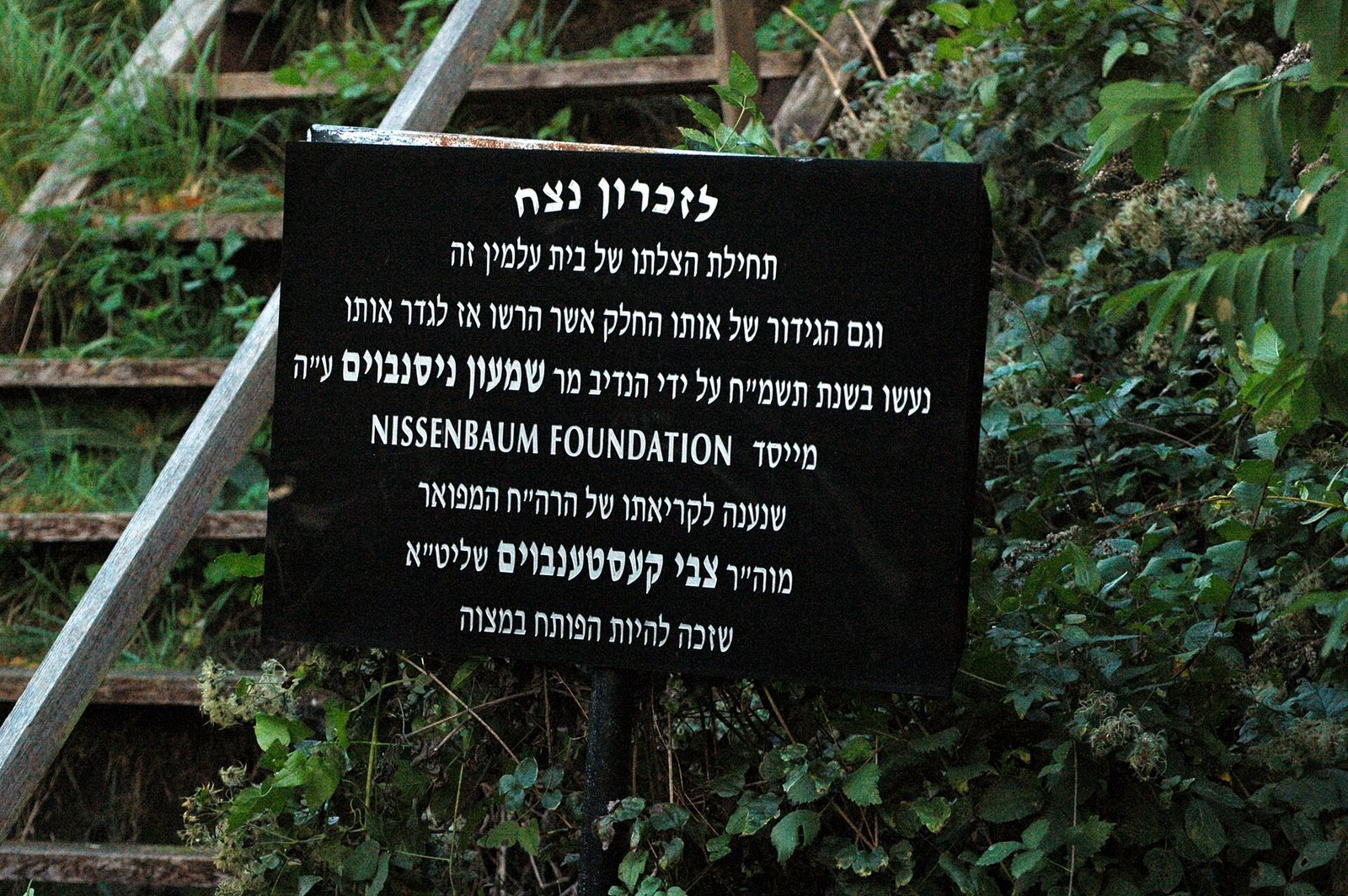
Poland’s heritage-protection service recognised the cemetery’s main area as a historic site in 1985. In 1988, the Nissenbaum Family Foundation cleared and fenced a large part of the damaged grounds, retaining an access route to the hotel. Rabbis from the United States and Israel searching for Josef Teomim’s grave found the cemetery in a severely neglected state in 1999. They installed a plaque identifying him as the author of Pri Megadim, a work of Jewish religious scholarship, but unknown people soon removed it. A US-based Committee for the Restoration of the Jewish Cemetery in Słubice was subsequently established under Rabbi Berel Polatsek.
For the 600th anniversary of the cemetery’s first recorded mention, Słubice and Frankfurt (Oder) erected a three-metre memorial beside the former funeral hall, dedicated on 2 July 1999. In early 2004, Słubice bought the portion not owned by the city on behalf of the Polish state. On 31 March, the land was transferred by notarised deed to the Jewish Religious Community of Szczecin, responsible for Jewish property in western Poland. On 4 May, memorial stones were dedicated at locations then believed to mark three rabbis’ graves. Excavations later showed that the stones were not in the correct locations. The cemetery passed into the ownership of the Foundation for the Preservation of Jewish Heritage in 2007 and is no longer in use.
Five test excavations in 2007 sought the boundary of the first burial section. They also found human remains in soil disturbed during the hotel construction. That soil was declared cemetery earth, returned to the cemetery, and placed in a communal grave. In 2008, excavation exposed the south-eastern wall foundation and established that an apparent break between the first and second sections was a four-channel cable trench. Its construction had destroyed family graves along the former wall in the second section. The cemetery entered the Lubusz Voivodeship register of historic monuments in 2013. In 2021, its volunteer caretaker helped recover a historic ritual handwashing basin from a stonemasonry business in Drzecin. Conservation and restoration of Esther Oppenheim, née Präger’s, 1819 gravestone in plot 835 were completed in 2024.
Remains
The cemetery occupies elevated ground in south-eastern Słubice, east of the Oder. Szosa Rzepińska borders it to the north and north-east, Transportowa to the south and south-west, and an industrial area to the south-east. The grounds developed in three sections. Extensive earthworks for the hotel reshaped the site: soil from the upper slope was moved and levelled on the lower slope, partly beyond the cemetery boundary. A substantial part of the damaged area was later fenced.
The first burial section
The oldest section was relatively small and partly enclosed by a wall no higher than 80 centimetres. Many of its gravestones were sandstone slabs about 15 centimetres thick, with inscriptions framed by Baroque ornament. By 1975, most had been cut down to ground level and broken. The highest ground, away from the principal burial area, is said to have been reserved for people who died by suicide. Separate areas for children and unmarried young women are considered possible, though this arrangement is uncertain.
The second section
The second section covers 10,907 square metres. Its markers reflect changing cemetery practices and use marble, granite, and cast cement; some family graves are elaborate. Its south-eastern wall foundation rests on fieldstones and has as many as eleven courses of brick above them, forming a wall about 1.5 metres high. Excavations found that the apparent opening between this section and the first was a four-channel cable trench rather than a passage through a dividing wall.
Buildings and memorials
Funeral hall
The neo-Romanesque funeral hall has a floor area of 66 square metres. Yellow brick faced the building, whose dome measured 8.12 metres across. The dome was first covered in copper and later in zinc, and a gilded Star of David stood 13 metres above ground. A vehicle entrance was made through the cemetery wall, with a masonry bridge crossing the ditch beside the road. The 1944 bombing pushed the hall’s north wall inward; the zinc roof covering had already been removed by the Nazis.
Caretaker’s house
A caretaker’s house stood within the cemetery and appears to have been built around 1880. Earlier maps show a building at that location, but do not establish whether it was a predecessor. It may have served as a ritual washing house before the funeral hall was built. The 1944 bombing left the house without doors or windows.
Moses Löwenmeyer obelisk
A 2.75-metre obelisk commemorating Frankfurt rabbi Moses Löwenmeyer was dedicated in the second section on 23 October 1897. Frankfurt stonemason Carl Schulz made it from green Swedish granite, with gold lettering on two faces. One inscription identifies Löwenmeyer as a preacher and teacher and gives his birth in Graetz on 23 September 1823 and death in Frankfurt on 17 February 1893. The other quotes Malachi II:6: The teaching of truth was in his mouth, and no falsehood was found on his lips. In peace and uprightness he walked with me, and many he turned away from sin.
The third section
Originally laid out as a garden, the third section was enclosed by wire mesh on a low concrete base, making its 1937 war memorial visible from the road. The memorial honoured 17 Jewish soldiers from Frankfurt killed in the First World War. The Frankfurt firm Grabmalkunst und Marmorwerk Paul Radack made its foundation and surround, and Gersohn of Berlin-Weißensee made the memorial. Its front listed the soldiers beneath the dates 1914–1918; the reverse named the Frankfurt branch of the Reichsbund of Jewish Front Soldiers and gave the year 1937. Hebrew inscriptions on its sides translated as Love is stronger than death and May their souls be bound in the bond of life. The memorial was destroyed in 1938.
Graves, memorials, and recovered objects
War graves and graves damaged by bombing
The graves of Dr Baswitz and his parents, and of Martin Heydemann and his parents, were destroyed in the 1944 bombing, which also damaged nearby graves. The main path to the funeral hall later held the graves of German war dead buried in 1945. The cemetery’s ornamental iron fence was dismantled after the war, and reused sections remain around the Soviet war memorial in Kunersdorf.
Memorials to rabbis
The three-metre memorial erected beside the former funeral hall in 1999 bears an inscription in Hebrew, Polish, and German asking visitors to respect the resting place and identifying the cemetery as founded in the fourteenth century. The three memorial stones installed in 2004 for Zacharja Mendel von Podheiz, Josef Teomim, and Jehuda Lejb Margaliot were later found not to mark the correct grave locations. A 2.5-metre chain-link fence topped with barbed wire encloses the stones.
Returned gravestones and restored features
Three gravestones found in woods near Słubice on a former airfield site were taken to Urad for safekeeping in 1999 and returned to the cemetery in 2011. They commemorate Therese Samuel, born Levy, who lived from 27 December 1856 to 19 September 1924; Julius Biram, born 4 November 1881 and killed near Gorodyze on 5 July 1916; and Berthold Cohn, born 3 March 1876 and killed in the First World War on 4 October 1918. Biram and Cohn are also named on the war memorial.
The recovered historic ritual handwashing basin is associated with the cemetery. Esther Oppenheim’s restored gravestone dates to 1819 and stands in burial plot 835.