Villa of the Mysteries: A Roman Residence and Wine Estate at Pompeii
Site at a Glance
- Popularity
- Very High
- Country
- Italy
- Primary era
- Classical
- Eras represented
- Classical, Modern
- Civilizations
- Italian, Roman
- Site type
- Domestic
- Remains
- Villa
On this page16 sections
History
Origins and development
The Villa of the Mysteries is a Roman villa outside Pompeii, Italy, traditionally dated to the second century BC but possibly built in the early first century BC. This later dating proposal places its construction around the time of Sulla, a Roman general and political leader of the late Republic, the final period of republican government before the emperors. Repeated changes shaped the villa’s recognizable plan between about 80 and 50 BC. It was enlarged and embellished again during the Augustan age, the period associated with Augustus, Rome’s first emperor.
Residence and agricultural estate
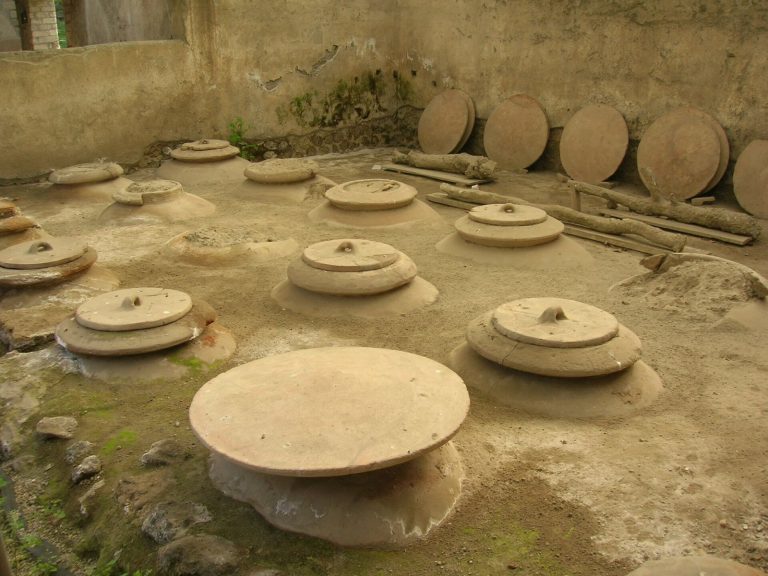
The villa served both as a home for entertaining patrons and business associates and as a working farm. After an earthquake damaged it in AD 62, its use shifted toward agriculture, especially wine production and sales. The presence of winemaking equipment has prompted the suggestion that an owner prospered through the wine trade.
The owners’ identities remain uncertain. A bronze seal bearing the name L. Istacidius Zosimus, a freedman of the Istacidii family, has been taken to suggest that he either owned the property or supervised rebuilding after the earthquake. A statue of Livia, Augustus’s wife, has likewise prompted proposals that she had a connection to the villa. Horse remains with bronze fittings have also been interpreted as evidence that a high-ranking, perhaps military, official lived there near the time of its destruction.
Eruption and burial
The eruption of Mount Vesuvius in AD 79 buried the villa in ash and pumice and brought its occupation to an end. Two women and a child found in lower pumice deposits appear to have been caught in an early phase of the eruption. Six people in higher deposits, including a girl near the entrance, a woman, and four people in a covered passage, appear to have survived its initial phase. Plaster casts were made of the three people found in the lower deposits.
Discovery and conservation
Aurelio Item, a Swiss hotelier and landowner, found the buried villa in January 1909. Giuseppe Spano directed excavations in 1909 and 1910, assisted by the archaeologist Matteo della Corte. Initially called Villa Item after its discoverer, it gained its present name from the Dionysian paintings in the Room of the Mysteries. Amadeo Maiuri’s investigations in 1929 and 1930 renewed attention to the paintings; he used the name Villa of the Mysteries in a report published in 1931. Following negotiations, the Italian state acquired the property on 23 June 1913. Maiuri later led a broad program of investigation and organization at Pompeii.
After excavation exposed the wall paintings, delayed roofing left them vulnerable to moisture and sunlight. Salt deposits marked their surfaces and the pigments faded. Early conservation involved taking down large painted sections, rebuilding the walls, and reattaching the paintings. Wax and petroleum coatings altered their colors, and a German archaeological team carried out further restoration in 1909. From 2013 to 2015, specialists examined the walls with imaging and other techniques, then used laser cleaning to remove old coatings. Treatment with amoxicillin targeted manganese dioxide and pigment-deteriorating streptococci, helping to recover aspects of the original colors.
A 2016 technical warning raised concerns about possible structural collapse, citing moisture trapped by earlier conservation methods, railway vibration, and the weight of protective structures. In 2017, illegal tunnels dug in an attempt to steal artifacts led to excavation of the stable area in 2018, where archaeologists found remains of harnessed horses. Terracotta-colored solar panels installed on the roof in 2024 supply electricity while limiting their visual impact on the landscape. The villa forms part of the UNESCO World Heritage property Archaeological Areas of Pompei, Herculaneum and Torre Annunziata.
Remains
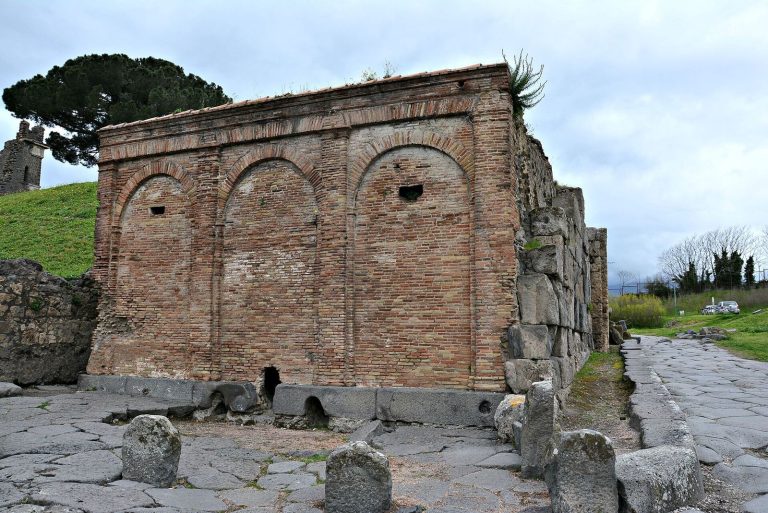
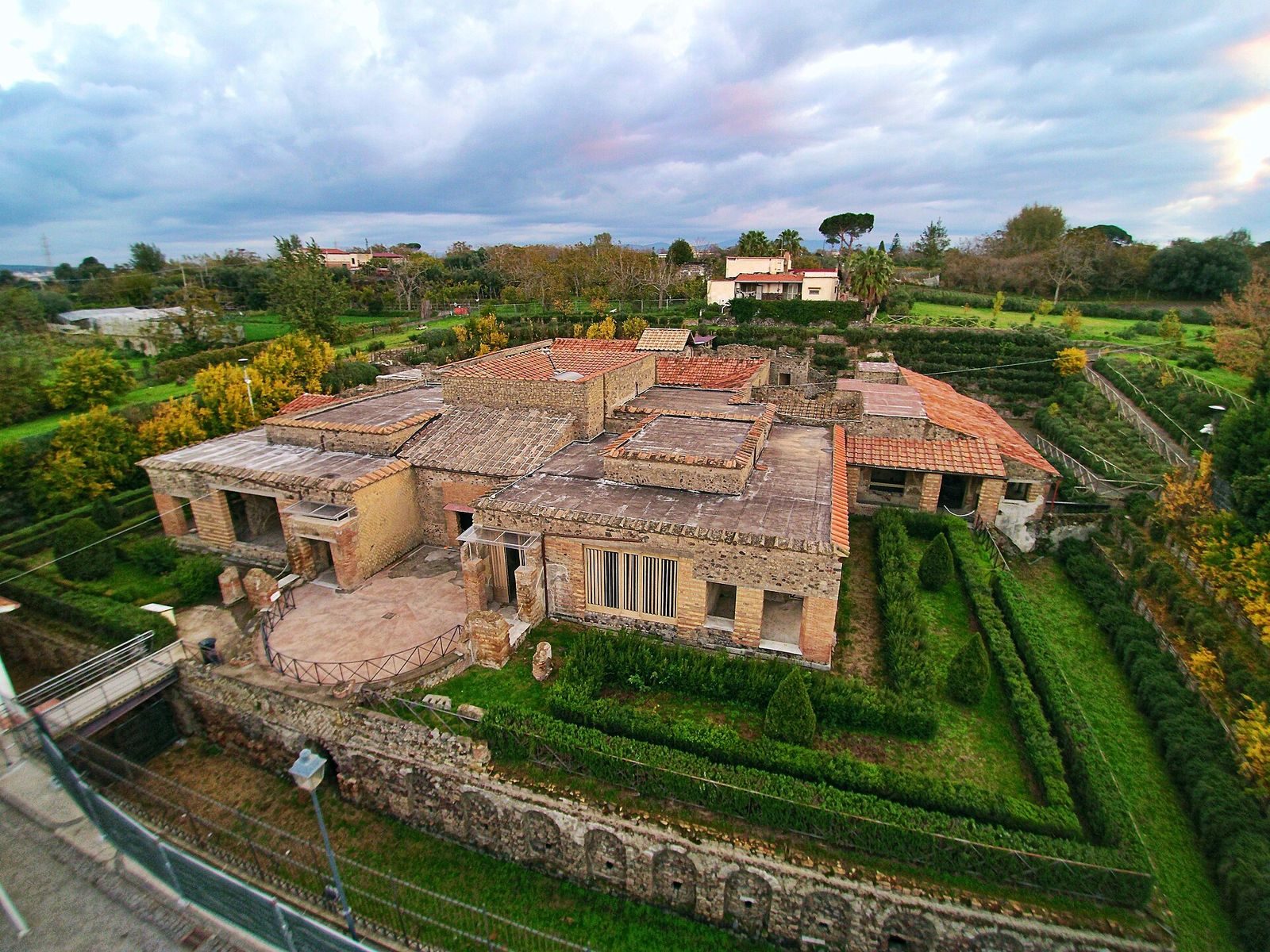
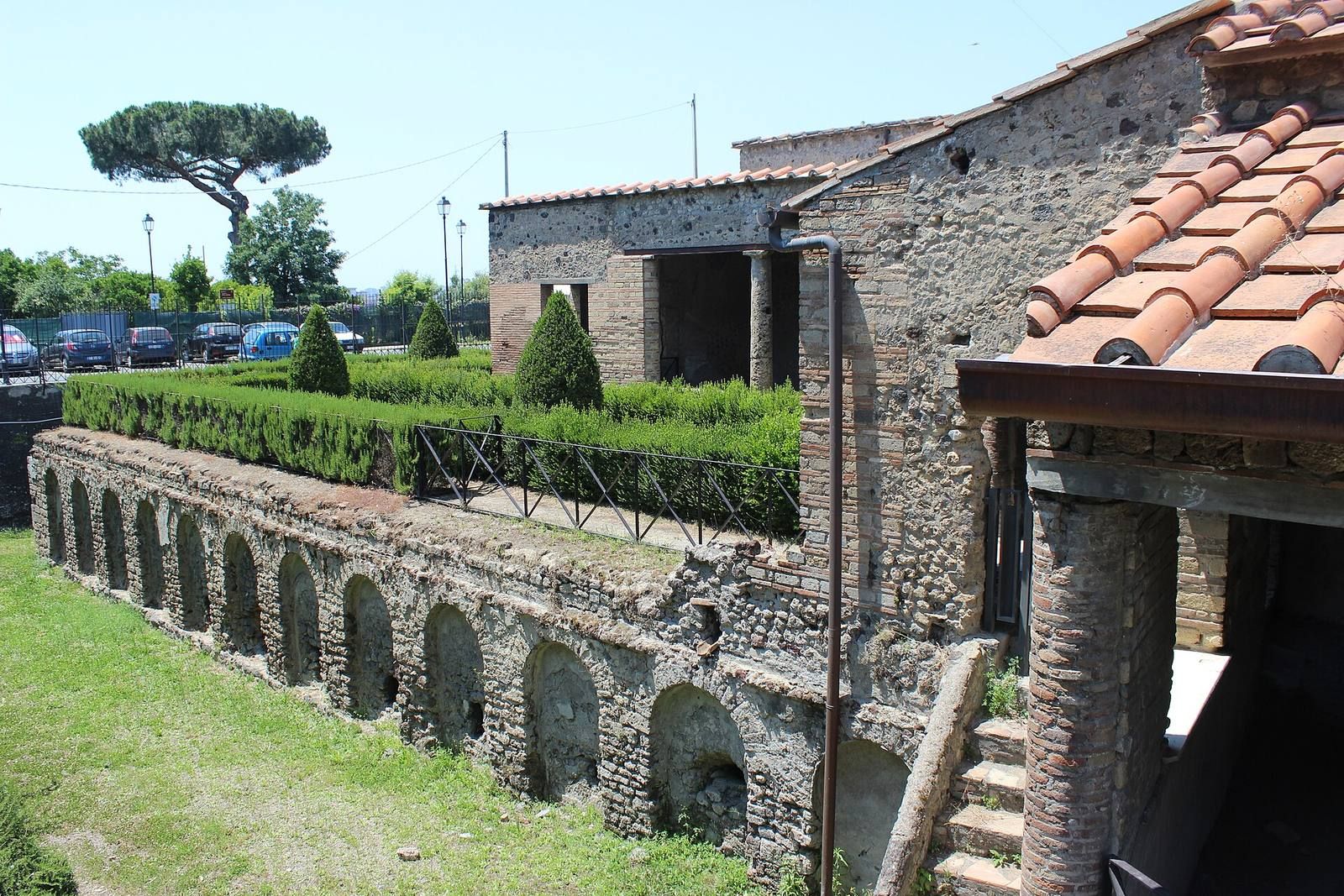
More than 60 rooms make up this complex of residential and agricultural spaces on a hillside overlooking the Gulf of Naples. The villa stands about 400 metres northwest of Pompeii’s Herculaneum Gate, outside the ancient town walls, between the roads Via delle Tombe and Via Superiore, which are lined with funerary monuments. The Villa of Diomedes and the so-called Villa of Cicero are nearby. A cryptoporticus, a covered passage and supporting structure, helps hold the slope; its wall includes arches that do not open through. Although pumice and ash buried the building, most walls and ceilings survived, as did the greater part of its wall paintings.
Entrance and working areas
Entrance and service rooms
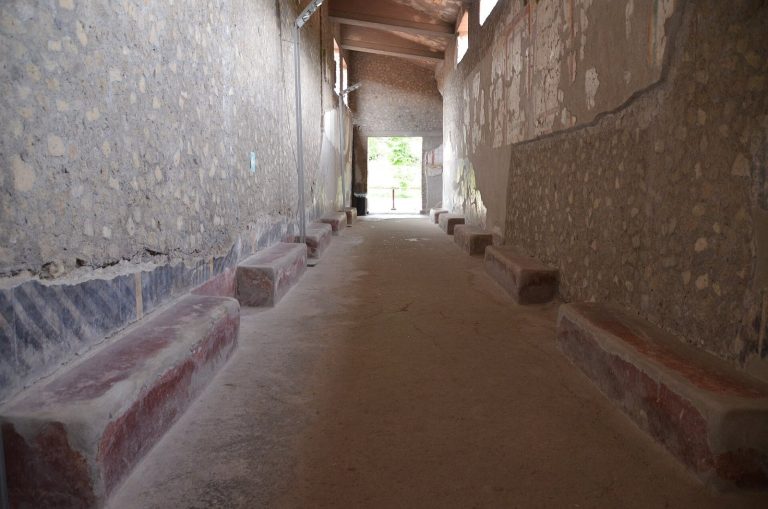
The ancient entrance lay opposite the entrance used today. Benches there provided waiting space, while the entrance led into service areas. These included a courtyard for unloading and storing produce, rooms for servants, and spaces for agricultural tools and equipment.
Wine presses and storage
A work area near the entrance contained two wine presses, one adorned with a sculpted goat’s head. One press has been restored and placed back in its original position. The villa also incorporated a pre-Roman bathhouse beyond the kitchen courtyard, which was later put to use for storage.
Residential and reception rooms
Courtyards, kitchens, and bathing areas
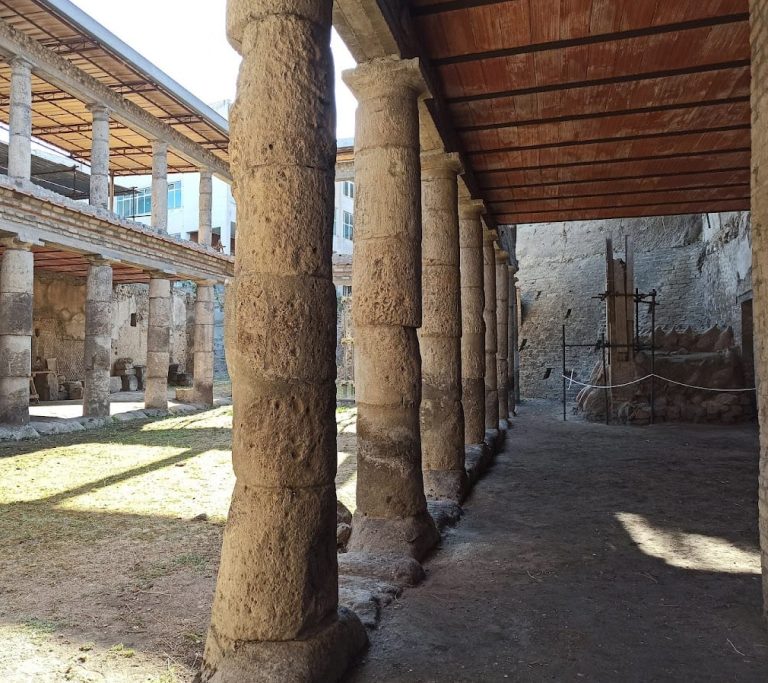
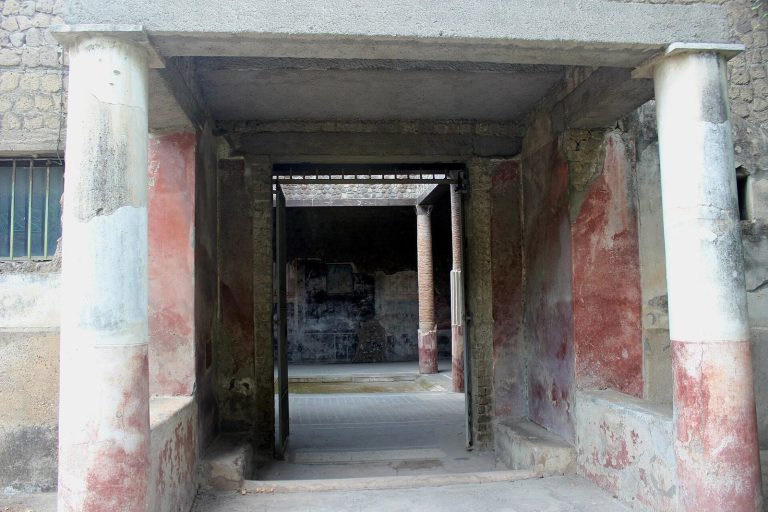
Beyond the entrance are a peristyle, or colonnaded courtyard, bathing facilities, and kitchen spaces. A second courtyard near the kitchen belongs to the service and agricultural areas. The remains of the bathhouse beyond it reflect an earlier building phase and its later storage use.
Atrium, dining room, and portico
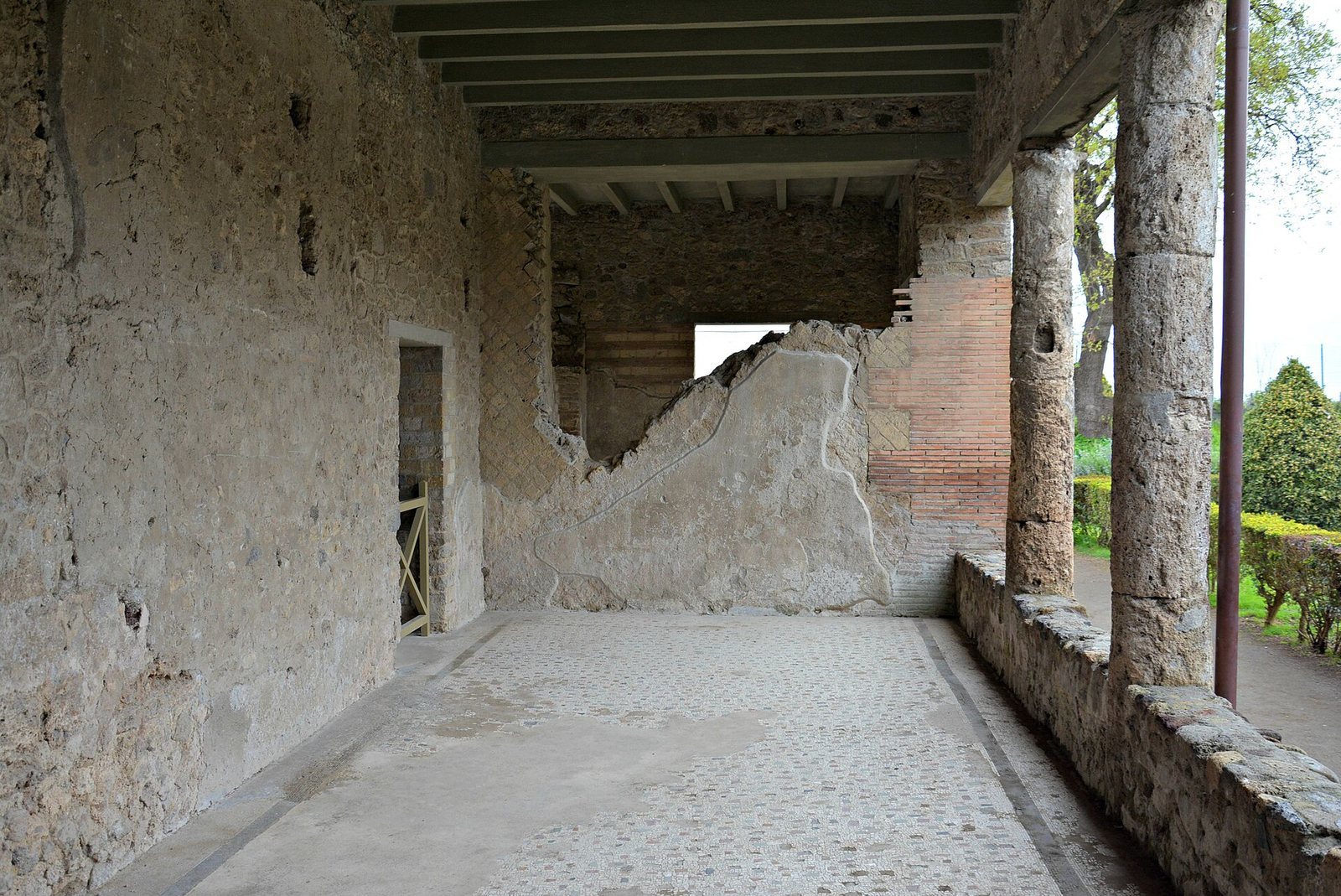
The main atrium, or central hall, contains an impluvium, a basin for collecting rainwater. It leads to a triclinium, a dining room, which in turn opens onto a portico overlooking the Gulf of Naples. Together with the courtyards and work areas, these rooms show how the villa combined domestic and agricultural functions.
Painted rooms
The Room of the Mysteries
Room 5, known as the Room of the Mysteries, stands at the rear of the villa beside a peristyle. It has a single entrance and exit and lies to the right of Room 4, a cubiculum, or private room, often identified as a bridal chamber. Room 5 may have served as a private room, a dining room, or a space with several uses. Its lavish decoration and restricted access have led to the suggestion that it hosted invited guests on special occasions, but its precise function remains uncertain.
Its wall paintings, or frescoes applied to plaster, date to about 70–60 BC and belong to the Second Pompeian Style, a Roman approach to wall painting that creates expansive architectural or pictorial scenes. Painted across three walls, the cycle places red above a green area made to resemble marble. A continuous geometric border runs near the top, with darker curling lines and plant forms above it; small Cupids appear among the foliage. The red pigment may have changed during burial, when heat, gases, and alkaline ash could have affected its color.
The paintings form a clockwise sequence of ten scenes containing 29 figures. A common interpretation sees them as a woman’s initiation into the Dionysian Mysteries, rites of initiation associated with Dionysus, the Greek god of wine and ecstatic ritual, perhaps in connection with marriage. Other readings understand the scenes more broadly as a religious ceremony, and whether the room itself hosted rites remains debated.
The sequence begins with a boy reading from a scroll beside a veiled woman and a seated priestess. A young attendant carries food and a laurel sprig. The scroll has been interpreted as cult instructions, a hymn, or a mythic text, and the boy has sometimes been identified as Dionysus. In the next scene, a priestess prepares a basket offered by a woman; both the basket’s contents and the figures’ identities are uncertain. The priestess also pours a liquid offering, or libation. This action has been read as purification, or, if the plant involved is myrtle, as preparation for a wedding.
Elsewhere, an older Silenus, a companion and tutor of Dionysus in myth, plays a lyre. A figure playing pipes appears with a companion suckling a goat, while a frightened woman has been identified either as Aura, a minor goddess associated with the breeze, or as the initiate. In a central scene, one satyr, a male nature spirit associated with Dionysus, peers into a bowl as another holds up a mask. The episode may represent divination or a frightening revelation. Dionysus reclines against a woman interpreted as Ariadne, a princess associated with him as his consort, or as Semele, his mother.
Nearby, a kneeling woman reaches toward a cloth covering a liknon, a winnowing basket interpreted here as a phallic symbol. A winged woman raises a whip; interpreters have identified her as Aidos, the personification of modesty and reverence, or as a spirit. Later scenes include a distressed woman with a seated companion, women carrying cymbals and a thyrsus, a ritual staff associated with Dionysus, and women arranging their hair as Cupids attend a mirror or portrait. These episodes have been understood as the end of an initiation and preparation for marriage.
The cycle ends with an enthroned woman, variously identified as Mnemosyne, the personification of memory, or as the initiate’s future self. Elaine K. Gazda has proposed that the figures represent members of the household: the enthroned woman as its mistress, the bride as her daughter, Dionysus as its male head, and the other figures as relatives and enslaved people.
The Sacrifice to Priapus
A private room north of Room 5 contains a second painted cycle, called The Sacrifice to Priapus and probably dating to the late first century BC. Its central images include a dancing satyr, a woman, and Dionysus with an older satyr. Above them, figures carry offerings toward a cave associated with Priapus, a fertility god. A man holding a torch and Eros, the Greek god of love and desire, carry a sacrificial pig. The scene contrasts the cave’s dark interior with Eros’s lighter figure, using strong shifts between shadow and light and a sense of movement distinct from the Room of the Mysteries cycle.
Tablinum
A room used as a tablinum, a household office or reception room, retains miniature paintings apparently inspired by ancient Egyptian art.