Tombs of the Nobles: Theban Burial Grounds for Officials and Royal Servants
Site at a Glance
- Popularity
- High
- Country
- Egypt
- Primary era
- Bronze Age
- Eras represented
- Bronze Age, Iron Age, Classical, Medieval
- Civilizations
- Egyptian, Ptolemaic
- Site type
- Burial
- Remains
- Necropolis
On this page14 sections
History
The Tombs of the Nobles are ancient Egyptian burial grounds on the Nile’s west bank opposite Luxor, Egypt. Burials span from the Old Kingdom through the Ptolemaic period, with the greatest concentration dating to the New Kingdom, especially the Eighteenth Dynasty and the period associated with rulers named Ramesses.
Burial grounds across Thebes
The complex encompasses seven principal cemeteries: el-Tarif, Dra Abu el-Naga, el-Assasif, el-Khokha, Sheikh Abd el-Qurna, Qurnet Murai, and Deir el-Medina. Deir el-Medina is included even though its cemetery served artisans rather than nobles. These workers built and maintained royal tombs. The cemeteries reflect changing burial practices across Egypt’s Old, Middle, and New Kingdoms, major historical periods separated in part by the First and Second Intermediate Periods.
El-Tarif contains burials from the late First Intermediate Period, the Middle Kingdom, and the Second Intermediate Period. It also has mastabas, low rectangular tomb structures, attributed to local princes of the Fourth and Fifth Dynasties. Dra Abu el-Naga has both Middle Kingdom and New Kingdom sectors. At el-Khokha, tombs date mainly to the Eighteenth through Twentieth Dynasties, alongside three from the First Intermediate Period. El-Assasif holds burials chiefly from the Eighteenth through Twenty-fifth Dynasties, as well as examples from the Twenty-sixth Dynasty, also called the Saite Dynasty.
Sheikh Abd el-Qurna has a small number of Eleventh- and Twelfth-Dynasty tombs and about 150 dating from the Eighteenth through Twentieth Dynasties. Qurnet Murai includes Eighteenth- to Twentieth-Dynasty burials, along with one from the Saite period and one from the Ptolemaic period. Together, the grounds served officials and others connected with the state and royal households. Their burials preserve evidence of government, work, religious practice, social life, and economic activity, while showing how status and burial customs changed over time.
Officials, workers, and their records
Several tomb owners held senior positions in the Theban administration. Rekhmire served as vizier, a senior state official with duties that could include justice and administration, under Thutmose III and Amenhotep II. Ramose was mayor of Thebes and a vizier under Amenhotep III and Amenhotep IV, who later took the name Akhenaten. His tomb began around the transition between the two kings’ reigns. It was left unfinished and may never have been used; it was probably damaged during Pharaoh Horemheb’s campaign against the Aten, the solar deity promoted by Akhenaten, and its followers.
Nakht was a storehouse scribe under Thutmose IV. His other titles included astronomer and singer for Ra, the sun god, as well as an office associated with Amun, a deity of Egypt’s state cult. Menna, probably active during Thutmose IV’s reign, was a scribe responsible for royal fields. Sennefer became mayor of Thebes under Amenhotep II; earlier, under Thutmose III, he had overseen royal wealth, served as royal seal-bearer, and supervised the gardens of Amun’s temple.
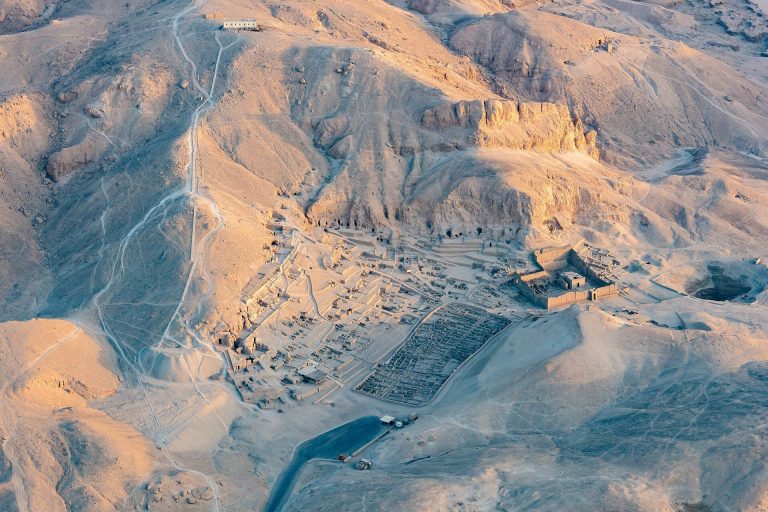
Kheruef lived during Amenhotep III’s reign. Amenemhat, a royal steward and supervisor of Amun’s cattle in the same period, was buried at el-Khokha; his father, Ithy, had also supervised the god’s cattle. At Deir el-Medina, Sennedjem worked during the Nineteenth Dynasty under Seti I and Ramesses II. He was a foreman and a “servant in the Place of Truth,” the name for the community responsible for building royal tombs.
Reuse and later occupation
Some tombs were taken over or used again across many centuries, including in Roman times and afterward. Local residents also made use of tombs as homes or animal shelters, and some were quarried for building stone. During the Coptic period, churches and monasteries were established on tombs, within them, and on accumulated spoil heaps. The Arabic word deir, meaning monastery, became part of several place names in the area.
Rediscovery, excavation, and cataloguing
The tombs were not unknown to local communities, and their rediscovery by outside travelers unfolded over time. French abbot Claude Sicard reached Thebes in the early eighteenth century. In the mid-eighteenth century, Anglican bishop Richard Pococke became the first traveler to mention private Theban tombs and leave drawings of them. The 1799 French expedition was followed by Giovanni Battista Belzoni’s work in Egypt in 1816. As Egypt became more accessible to Western travelers around the nineteenth century, destructive activity increasingly affected the tombs’ structures and decoration.
John Gardner Wilkinson lived in the area from 1824 to 1828 and published drawings and descriptions of tomb paintings in 1837. Ippolito Rosellini and Jean-François Champollion surveyed the region in 1828-1829, followed by Karl Richard Lepsius’s Prussian mission. Systematic excavation began with Alexander Henry Rhind in 1855. Auguste Mariette later became responsible for the area as director of the Antiquities Service, and Victor Loret and Flinders Petrie carried out further excavations in 1878 and 1883.
An Egyptian mission surveyed and copied tomb paintings from 1907 to 1939, including work by Norman and Nina de Garis Davies. More than 300 of their reproductions became a core part of the Egyptian department of the Metropolitan Museum of Art in New York. Many copies show the paintings’ condition at the time, including wear and damage caused by people; others reconstruct how the decoration was thought to have looked originally.
In 1913, Alan Gardiner and Arthur Weigall published a catalogue listing 252 tombs and establishing the numbering system still used for the Theban necropolis. The abbreviation TT means “Theban Tomb.” Numbers generally followed the order of discovery rather than the tombs’ positions, and later finds extended the sequence to TT415. Other tombs remain known without a secure location or number. The cemetery’s distribution is irregular: tombs can overlap, share entrances, or open onto large courtyards.
Remains
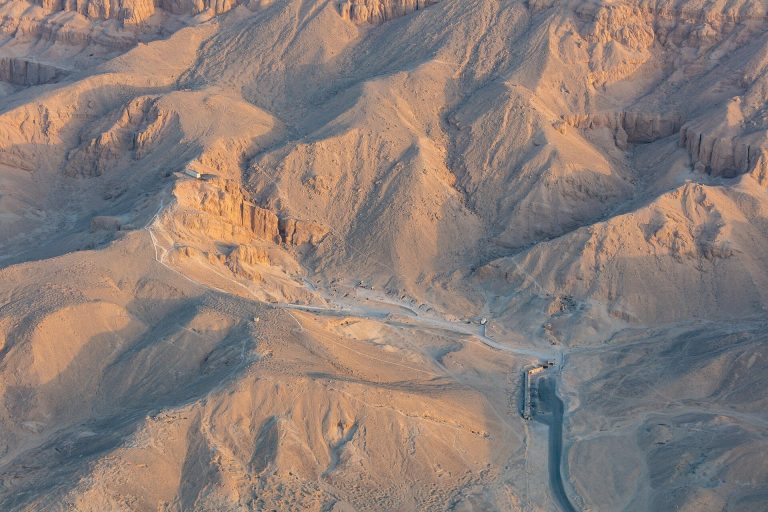
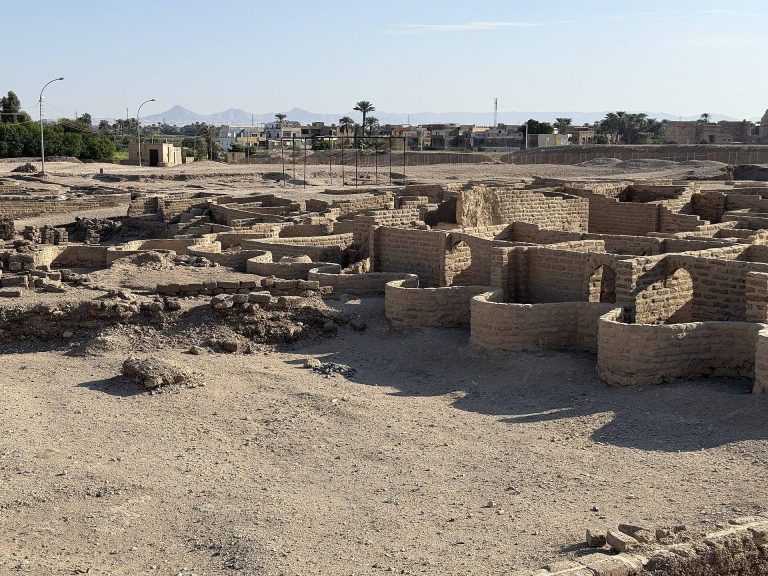
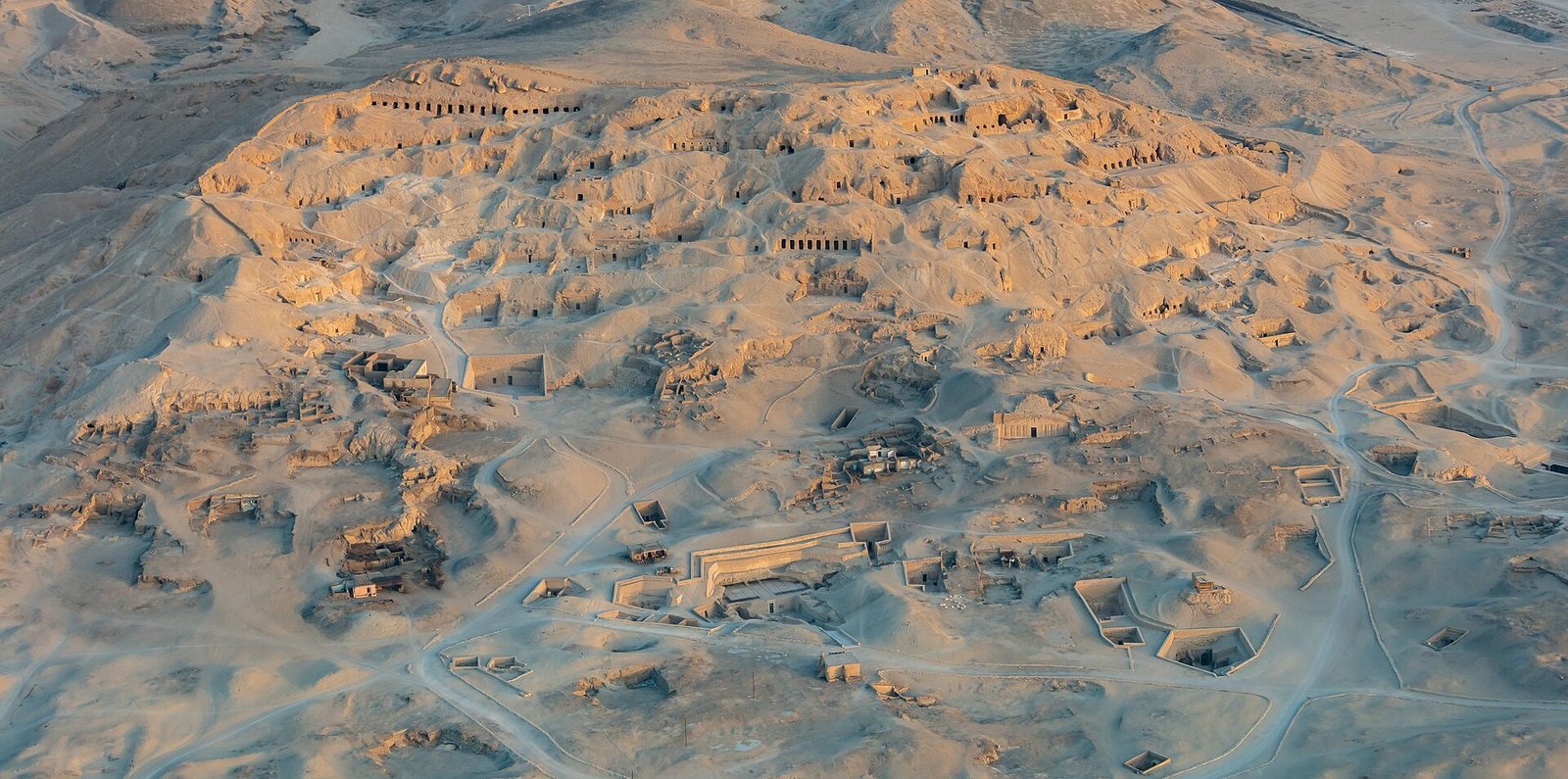
The burial grounds occupy rising, mostly barren land west of a cultivated strip along the Nile about two kilometres wide. The change from fertile floodplain to dry hillside offered ground unsuitable for farming, while the arid conditions helped preserve tombs. Across this landscape, rock-cut tombs vary in plan and decoration. Many begin with an open court, continue through a crosswise hall into a longer chamber, and sometimes end at a statue niche or offering chamber. Burial shafts and underground rooms occur in some tombs, but no single plan applies throughout the cemetery.
Construction and decoration
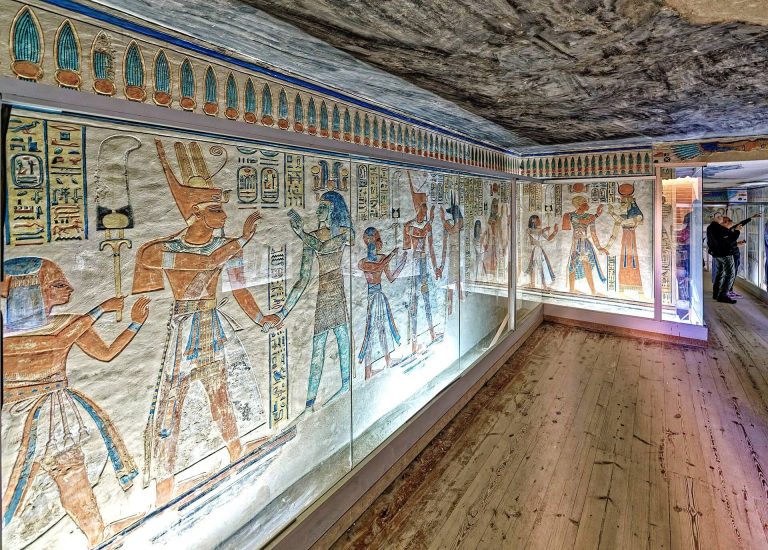
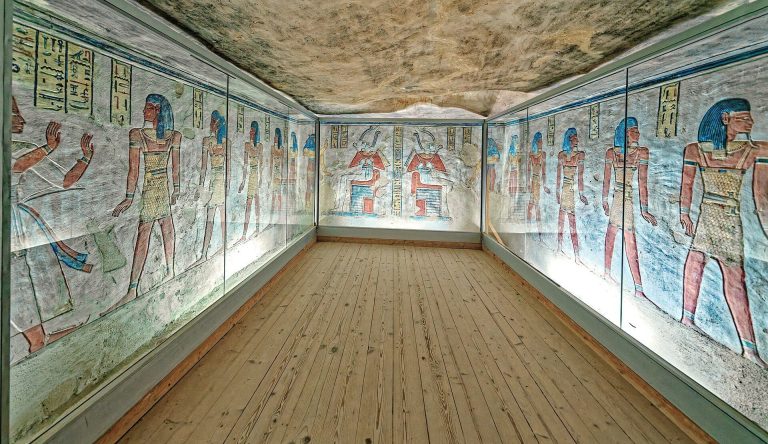
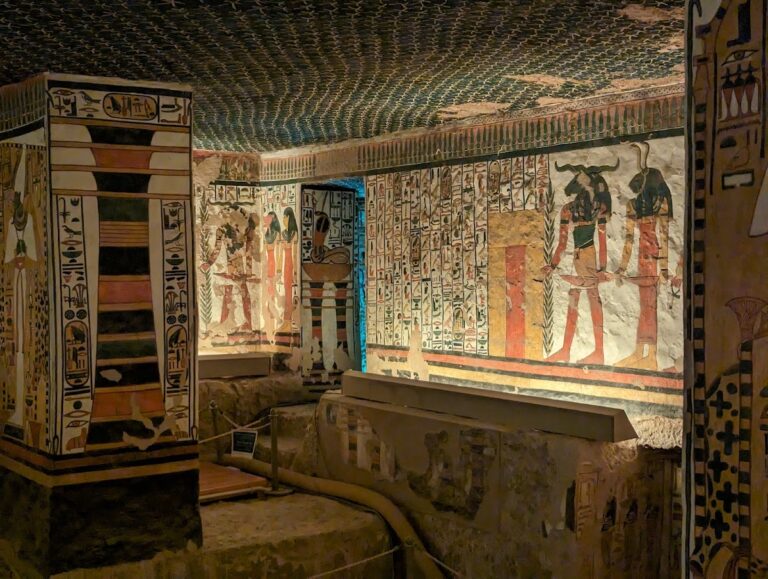
In many tombs, builders covered the cut rock with silt and then lime before adding painted or carved decoration. Walls bear hieroglyphic writing and scenes of worship, funerary ceremonies, farming, hunting, craft work, music, and family life. Subjects and artistic treatment vary across periods. The imagery includes Amun, Ra, Osiris, associated with the dead and the afterlife, Anubis, associated with embalming and cemeteries, Hathor, linked with motherhood and protection, Ma’at, associated with truth and cosmic order, and Thoth, associated with writing and knowledge.
More than 400 funerary cones, small clay objects originally set into tomb façades, have been recovered from the area. They identified a tomb’s owner and title and sometimes carried a short prayer. The original position has been identified for 80 of the recovered cones. More than 400 tombs are listed in the cemetery catalogue, whose sequence reaches TT415.
Notable tombs
TT100, the tomb of Rekhmire
A courtyard and entrance lead into a crosswise hall and then a rock-cut passage more than 30 metres long. Its images include Rekhmire’s court of justice beneath a large canopy supported by columns with palm-shaped capitals. The column shafts carry cartouches, oval frames around royal names, for Thutmose III and Rekhmire. The portrayal of the vizier is damaged; mats and staffs appear before him, while officials and petitioners gather nearby.
Other scenes show goods from Upper Egypt, taxes from the Delta, work in Amun’s temple workshops, agriculture, wine-making, hunting, and crafts. Five horizontal bands, or registers, depict foreign delegations bringing goods from Punt and Keftiu, islands of the “Great Green Sea,” Nubia, and Retjenu. A fifth delegation may represent hostages. Further decoration includes craftspeople, family members, offerings, musicians, funerary rites, and a sacred journey to Abydos, an important centre of Egyptian funerary religion. A raised niche shows Rekhmire kneeling before Osiris and a goddess.
TT55, the tomb of Ramose
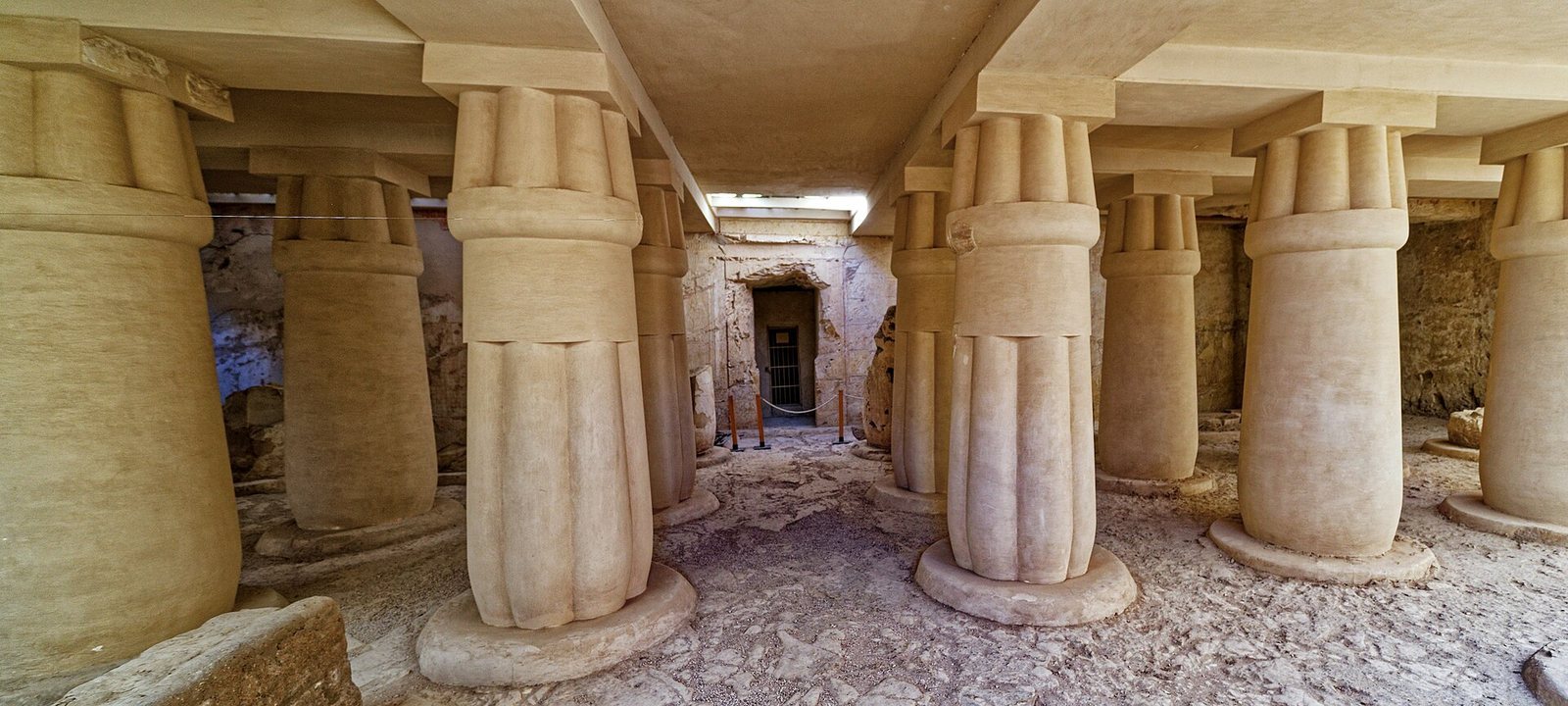
The courtyard, façade, and entrance lead to a crosswise hall planned with four rows of eight columns. Most are ruined, while some have been repaired and rebuilt. Beyond it, a long hall has two rows of four columns shaped like bundled papyrus stalks. At its end, the offering chamber has three niches on each side. Unfinished areas include unpolished sections and scenes left in red outlines with black corrections.
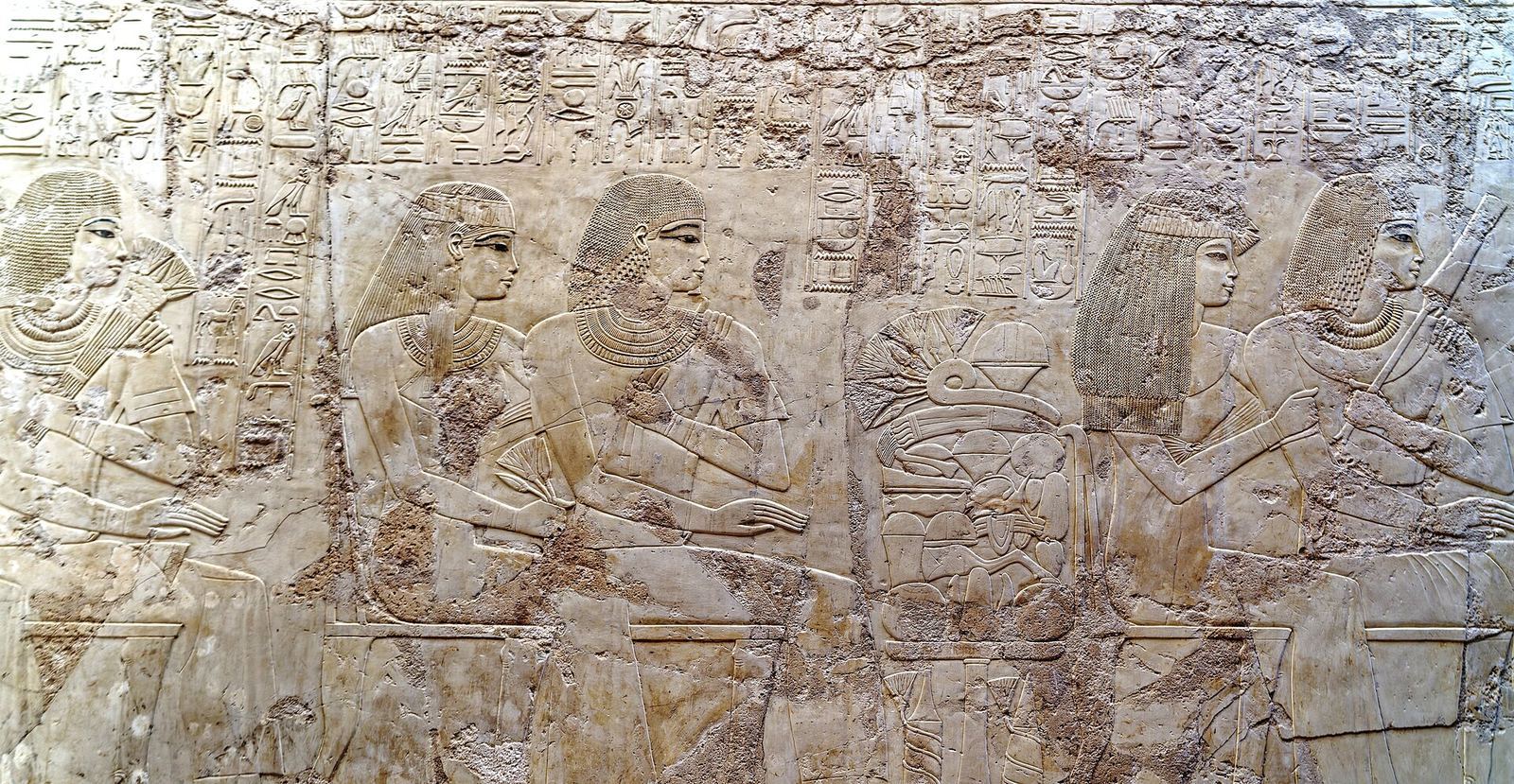
The decoration combines the refined forms and colours of Amenhotep III’s reign with the Amarna style associated with Akhenaten. Scenes show offerings, funeral rites, mourners, and a coffin carried on a sledge. Ramose and his wife worship Osiris. Other incomplete images show Amenhotep IV beneath the Aten, accompanied by Nefertiti as he presents honours to Ramose.
TT52, the tomb of Nakht
An entrance leads to a crosswise room and then a longer chamber ending in a statue niche. The almost-square crosswise room sits noticeably off the tomb’s main axis, possibly because the rock was unsuitable where the long chamber had been planned. A burial shaft in this room descends to a burial chamber. Its painted walls, which are well preserved, show agriculture, grape harvesting and wine-making, hunting and fishing, music, and dancing.
A false door, a symbolic doorway through which the deceased was associated with receiving offerings, is flanked by offering scenes and two goddesses. A small statue showed Nakht kneeling with a tablet bearing a hymn to Ra. It was lost at sea in 1915 while being transported to England; a photograph of the statue is now placed in the niche.
TT69, the tomb of Menna
The plan runs from an open courtyard through a crosswise hall into a long chamber, ending at a statue niche. The rear chamber and niche were left unfinished, and the floor was not prepared for access. A panel outside the entrance, on its left, displays scenes from the long chamber. Four registers depict the surveying of fields, ploughing, sowing, harvesting, threshing, and weighing crops, while scribes record quantities and taxes.
Other scenes show Menna’s chariot, workers and supervisors, hunting and fishing, offerings from his family, a banquet, and funerary rites. In a judgment scene, Thoth records the weighing of Menna’s heart before Osiris and Ma’at. Damage to the balance and to a figure holding its pans is attributed to the same attack that disfigured images of Menna after his death. Coloured decoration remains on the ceiling.
TT96, the tomb of Sennefer
A narrow crosswise room opens into a long passage and a spacious offering chamber resembling a pillared hall, with four pillars arranged in two rows. A smaller room on the north side has a central column. A descending staircase from a front chamber leads to the burial chamber. The uneven, unlevelled ceiling was carved so that painted grape clusters appear raised; grapevines also run along the wall as a decorative band.
The burial chamber’s colourful scenes include Sennefer and his family, funerary furniture and offerings, Anubis, Osiris, and Hathor, as well as a ritual journey to Abydos. The offering chamber is now used for storage.
TT1, the tomb of Sennedjem
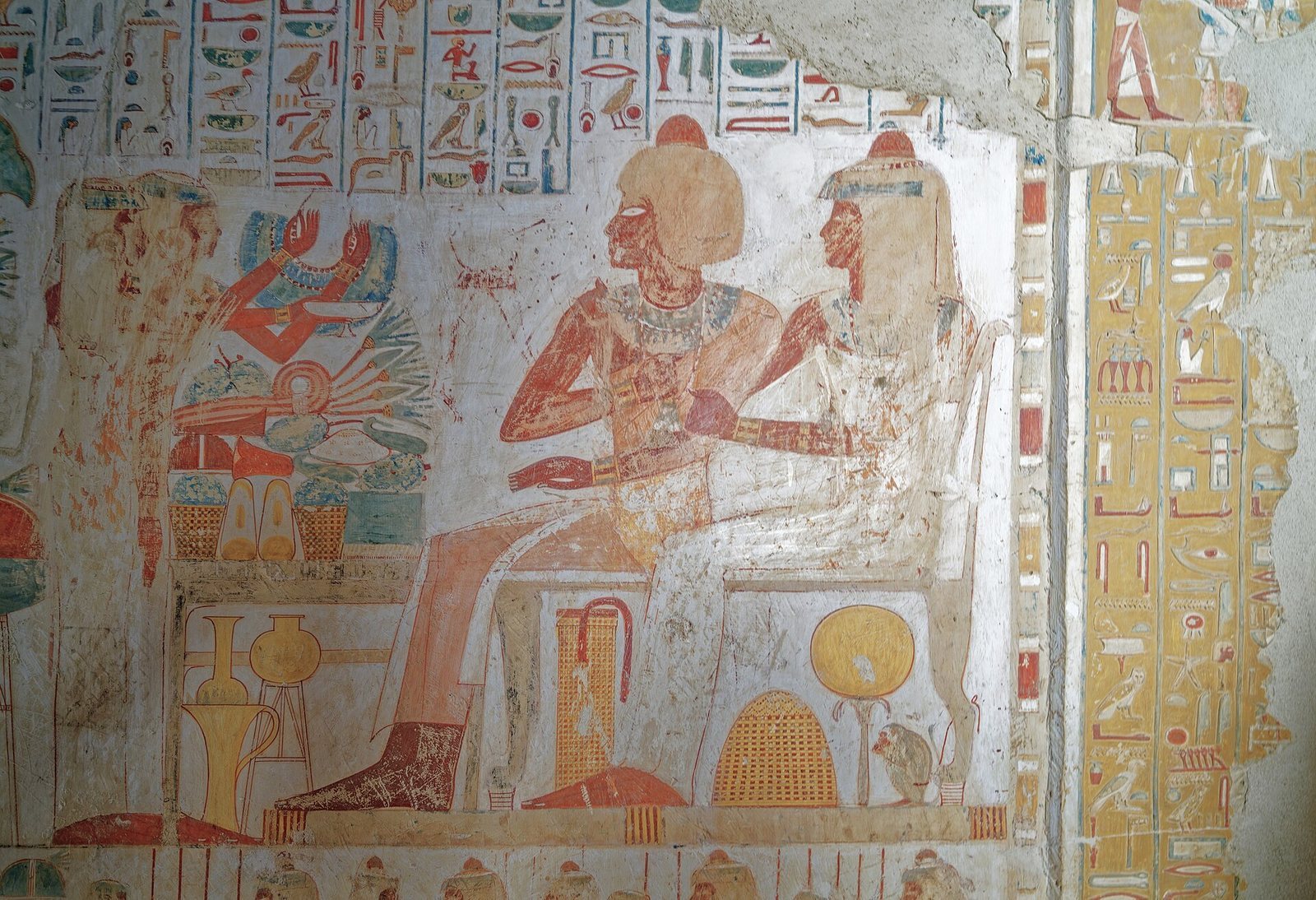
At Deir el-Medina, TT1 consists of a single chamber. Other workers’ tombs there include a composite form with a small, perishable pyramid above an underground chamber roofed with brick vaulting. TT1’s vaulted burial chamber retains exceptionally well-preserved paintings on a yellow-ochre ground. They show Sennedjem and his wife worshipping funerary deities, Anubis performing a rite associated with mummification, and the couple cultivating the ideal fields of the afterlife. Above the entrance, a cat kills a snake.
A crudely made chair, dated to around 1250 BC and covered entirely in paint, was found in the tomb. Sennedjem’s funerary furnishings are now held mainly by the Egyptian Museum in Cairo and the Metropolitan Museum of Art in New York.