Chestnuts Long Barrow: An Early Neolithic Chambered Burial Monument
Site at a Glance
- Popularity
- Medium
- Country
- United Kingdom
- Primary era
- Stone Age
- Eras represented
- Stone Age
- Civilizations
- Unclassified
- Site type
- Burial
- Remains
- Tomb
On this page10 sections
History
Chestnuts Long Barrow is a ruined chambered burial monument at Addington, England, in the United Kingdom. A long barrow is an elongated burial mound, often containing a chamber for collective burials. The monument was probably built in the fifth millennium BC by a pastoral community during Britain’s Early Neolithic, when farming became established. It belongs to the Medway Megaliths, a group of chambered monuments associated with the arrival of agriculture from continental Europe.
Early Neolithic setting
Occupation in the area began before farming, during the Mesolithic, the period before farming became established. Archaeologist John Alexander thought that little time separated this earlier activity from the barrow’s construction. In the Early Neolithic, much of the surrounding landscape was forested, and communities relied mainly on pastoralism while living mobile or semi-mobile lives.
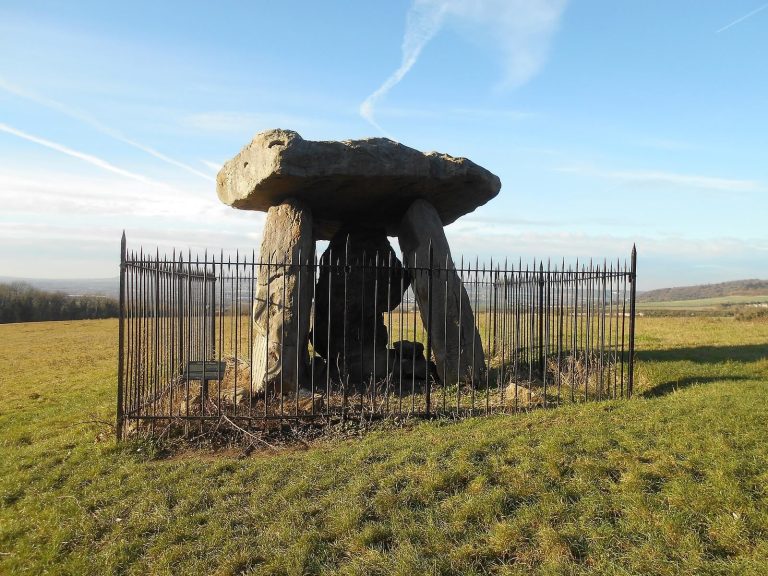
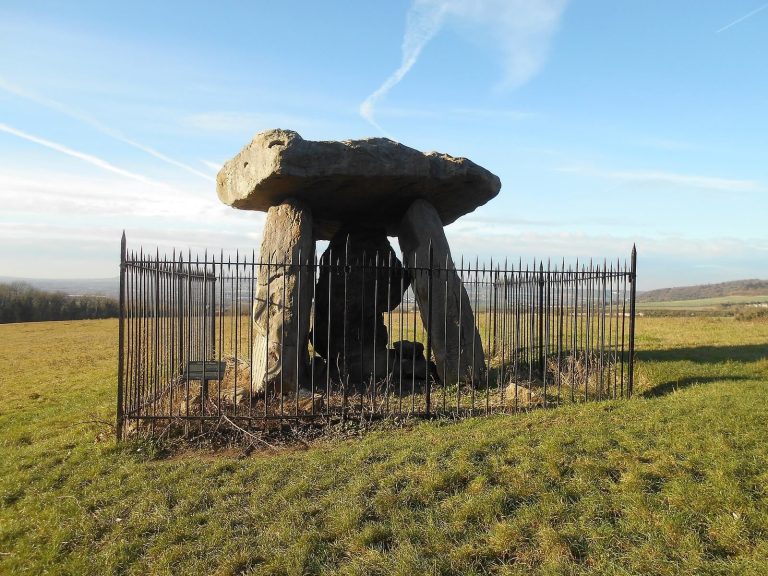
The Medway Megaliths are arranged in two clusters, separated by 8 to 10 kilometres along the River Medway where it crosses the North Downs. Chestnuts lies in the western cluster with Addington Long Barrow and Coldrum Long Barrow. The eastern cluster includes Smythe’s Megalith, Kit’s Coty House and Little Kit’s Coty House; the Coffin Stone and White Horse Stone may also be remnants of similar monuments. As a group, the Medway monuments are among Britain’s largest Early Neolithic funerary groups. They form the most south-easterly megalithic group in the British Isles and the only such group in eastern England.
The monuments may not all have been built at the same time or served identical purposes. Archaeologists have proposed that they hosted communal and ritual activities as well as burials, including ceremonies honouring the dead and seeking their aid. Other interpretations see them as markers of territory, allegiance or ownership, as guides to herding routes, or as monuments placed at locations already treated as sacred in the Mesolithic. Proposed origins range from northern and central Europe to western Britain and the Atlantic coast. Paul Ashbee viewed the Medway group as a local expression of a wider Early Neolithic European tradition and considered its precise point of origin impossible to establish.
Roman and medieval activity
A Romano-British hut was built on level ground beside the barrow in the fourth century AD. Its excavators considered it more likely to have served as a field shelter than as a home.
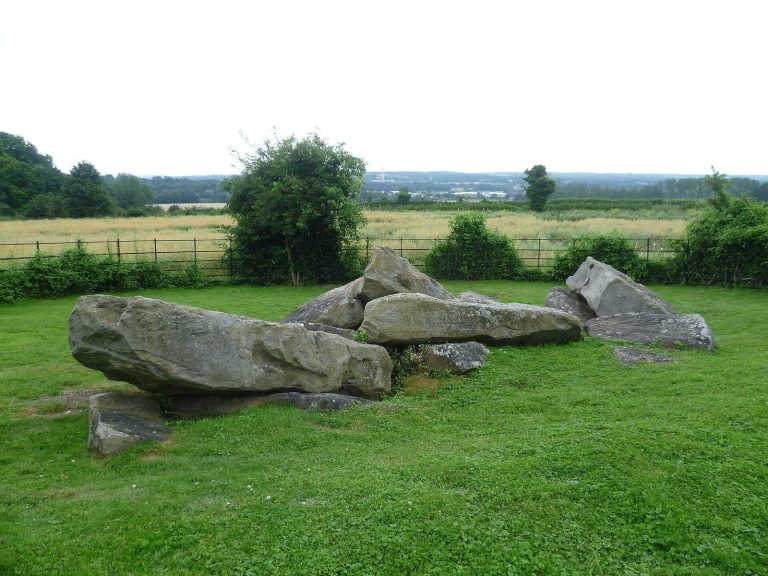
People continued to use the surrounding area in the eleventh to thirteenth centuries, when the monument was systematically damaged. The mound was dug away, and access was forced through the chamber’s north-western stone wall, built without mortar. The chamber was cleared to bedrock; a central stone was pushed onto the excavated spoil and buried, and pits were dug within and around the chamber. The roof stones later collapsed. The two tall inner stones also suffered damage, possibly after being heated and then doused with cold water.
The destruction does not appear to have been ordinary stone-taking or land clearance. Alexander interpreted it as robbery and suggested that a special commissioner might have been involved. He noted that a 1237 order to open burial mounds on the Isle of Wight in search of treasure could reflect a practice that reached Kent. Ashbee instead considered Christian iconoclasm, the deliberate destruction of monuments associated with earlier beliefs, a probable explanation. He interpreted the burial of stones as an effort to defame a pre-Christian monument.
Changing name and modern investigation
The monument was once called Stony Warren or Long Warren. The name Chestnuts came into use in the mid-twentieth century, after Chestnuts Wood on the hill above the site. The survival of Long Warren as a place-name has been taken to suggest that local knowledge of the mound lasted into the eighteenth century. By the twentieth century, gradual erosion had removed the mound, leaving the ruined chamber.
Antiquarians took an interest in the remains during the eighteenth and nineteenth centuries. John Harris made an unclear reference to the monument in 1719, and in 1773 Josiah Colebrooke described it as one of the temples of the ancient Britons. In the early 1840s, the Reverend Beale Post grouped Chestnuts and Addington Long Barrow together under the name Addington Circles.
John H. Evans and Albert Egges van Giffen visited in the late 1940s. In 1953 the field was levelled and ploughed for horticulture, while the ground around the megaliths was left undisturbed. The landowner, Richard Boyle, opened test trenches and found Mesolithic flint tools. Plans to build a house beside the monument led to an excavation directed by John Alexander in August and September 1957. Chestnuts is a scheduled ancient monument, a site given statutory protection in England.
Remains
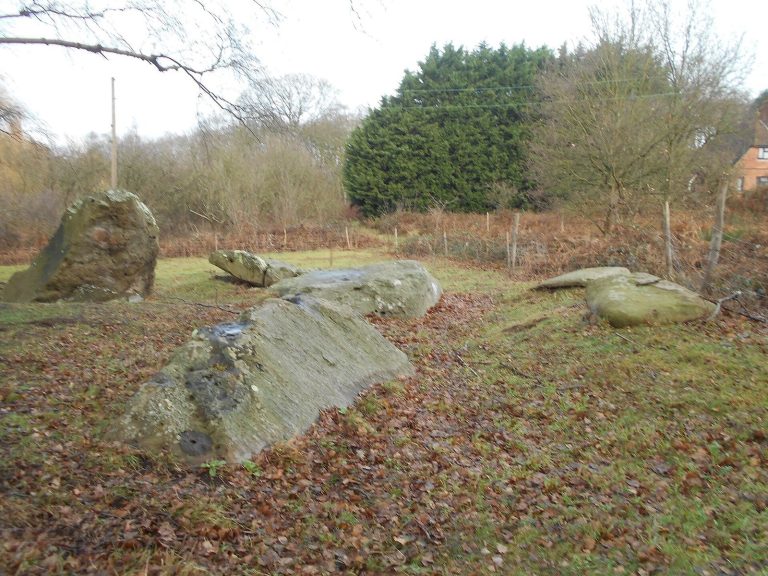
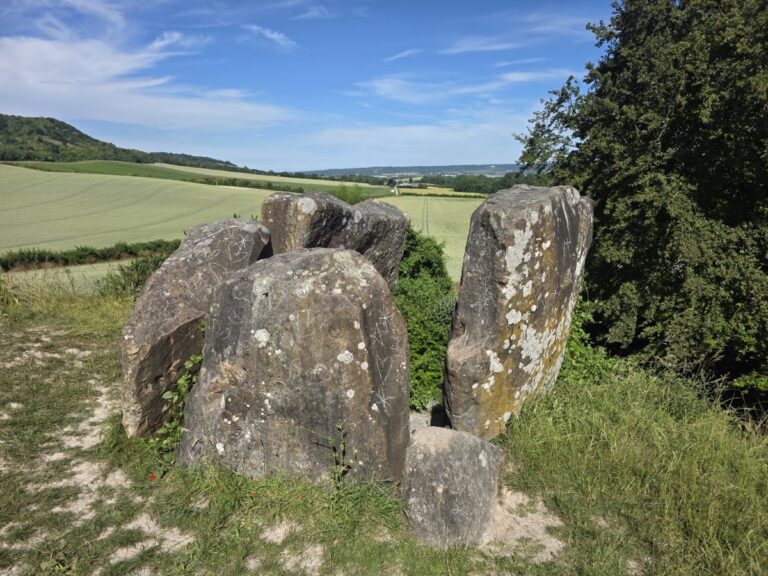
The mound has disappeared, but a ruined stone chamber survives at its eastern end. The monument stood on a hillside in the greensand belt, about 30 metres above sea level. Soft sandstone beneath a layer of white sand forms the local geology. The chamber was made from naturally occurring local sarsen, a dense silica-cemented sandstone.
Mound and setting
The earthen mound, or tumulus, was probably trapezoidal or D-shaped. Its length is uncertain; Alexander estimated it at about 15 metres. It was around 18 metres wide and may have reached 20 metres opposite the entrance front. Excavation identified the northern and eastern edges, while levelling and deep ploughing had removed traces of its western and southern ends. Chestnuts stood west of the River Medway, near Addington Long Barrow and Coldrum Long Barrow.
Chamber and entrance
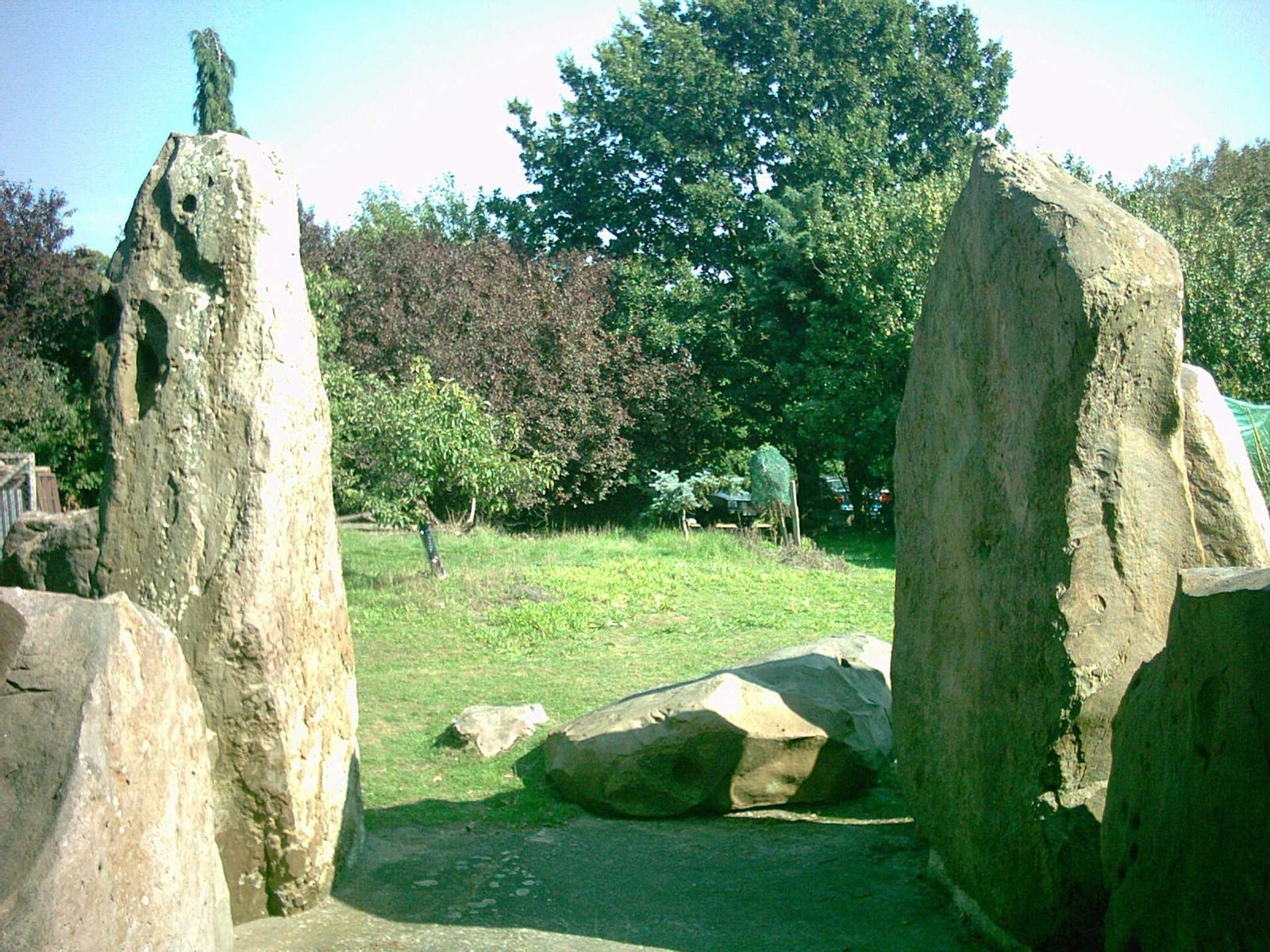
The chamber was almost east-west in alignment and may have faced either the Medway Valley or the North Downs. It measured about 3.7 metres long and 2.29 metres wide, and probably stood about 3 metres high. Two adjoining pairs of upright stones supported horizontal roof stones. A stone front marked the entrance, which a large stone may have almost entirely blocked. A central stone may have divided the chamber, while a wall built without mortar crossed its western end. Damage makes the original internal arrangement difficult to establish.
Excavators identified 18 large sarsen boulders, as well as four smaller stones used in the chamber wall and floor. The floor was paved with stones set in yellow sand. Alexander proposed that builders first raised the mound and used it as a ramp to move the large stones into place. He also suggested that sand filled the chamber temporarily to support the stones while the roof was set, then was removed. The eastern chamber and stone front fit features shared by other Medway long barrows. After the 1957 excavation, fallen stones were returned to their original sockets, restoring part of the chamber and its front. The monument remains ruined, with no mound surviving.
Burials and associated finds
Excavation recovered about 3,500 fragments of human bone, representing at least nine people and possibly ten, including at least one child. The remains included both burials of unburned bodies and cremated bone. The cremated material is unusual for Early Neolithic Britain. Ashbee considered its presence especially important, while Martin Smith and Megan Brickley proposed that it may have been added in the Late Neolithic. Finds associated with the human remains included 34 pottery sherds, three stone arrowheads and a clay pendant. Windmill Hill pottery, an Early Neolithic type, was found with earlier bones. About 100 further sherds of this pottery came from the area outside the entrance and represented at least eight bowls. Alexander proposed that these vessels had first been placed in the chamber and later moved to make room for additional burials.
Evidence of earlier activity
Excavation beneath the monument produced 2,300 Mesolithic flint fragments. Further flints came from test trenches extending towards Chestnuts Wood, at least 180 metres east of the tomb and 370 metres south-west of it. About 30 metres west of the barrow, flints were associated with a feature interpreted as a Mesolithic hearth. Some trenches also found Mesolithic flints directly beneath the megaliths.
Roman and later finds
Four pottery sherds found nearby may date to the Early Iron Age. Excavators recovered 830 Roman-period ceramic sherds, most from the fourth century. The hut beside the mound yielded 750 sherds, along with charcoal, iron nails, burnt clay, bone and flint fragments. Medieval material from the topsoil included about 200 pottery sherds, two sharpening stones and 17 pieces of daub. Later activity left three pits in and around the barrow and evidence of an attempt to dig into the chamber. Finds included pottery, clay pipes dating from the seventeenth to nineteenth centuries, stone and clay marbles, brick, tile and bottles dating from the eighteenth to twentieth centuries.