Himmelpfort Abbey: A Cistercian Monastery in Brandenburg
Site at a Glance
- Popularity
- Medium
- Country
- Germany
- Primary era
- Medieval
- Eras represented
- Medieval, Early Modern
- Civilizations
- Brandenburg-Prussia, Holy Roman Empire
- Site type
- Religious
- Remains
- Monastery
On this page8 sections
History
Himmelpfort Abbey was a Roman Catholic Cistercian monastery in Fürstenberg/Havel, Germany, dedicated to the Virgin Mary and founded in 1299 by Brandenburg’s Margrave Albrecht III, a medieval ruler of a border territory. The Cistercians followed the Rule of Saint Benedict, emphasizing communal religious life and disciplined observance. Himmelpfort was Lehnin Abbey’s third daughter house, a monastery established within Lehnin’s institutional lineage, and the last monastery founded by the Ascanian dynasty in Brandenburg. Its church was built in the brick Gothic style.
Foundation and endowment
Albrecht intended Himmelpfort to serve as a burial place for his family. His sons died before the plan could be fulfilled, but he continued with the foundation. The monastery may also have been meant to encourage settlement in the sparsely populated, wooded Land of Lychen. Although its founding is sometimes linked to efforts to secure the Brandenburg-Mecklenburg border, the site lay at the southern edge of Albrecht’s territory, in relatively unproductive heathland. Albrecht died in 1300, before the abbey was built, and was temporarily buried at Lehnin.
Bishop Volrad of Brandenburg approved the foundation in 1299, and King Albert I confirmed Albrecht’s grants in 1301. Construction probably began after the acquisition of Stolp in 1307, and no earlier than 1308. The monastic community was established no earlier than 1308 and is independently recorded by 1309. Pope Benedict XII confirmed the foundation in 1336.
The initial endowment included six villages in the Land of Lychen: Kastaven, Altthymen, Neuthymen, Garlin, Linow, and Brüsenwalde. The abbey also received woodland, heathland, and 100 Hufen, a medieval unit of landholding, in Neddemin, Warbende, and Flatow in the Land of Stargard. Its resources included fishing and other rights in 39 named lakes, at least nine mills, and recurring payments. Such holdings gave the monastery extensive rights over land and water, though they did not guarantee lasting prosperity.
Expansion, conflict, and decline
In 1304, Henry II of Mecklenburg granted the abbey a manor at Thymen and exempted it from territorial dues. The following year he confirmed Albrecht’s foundation and granted the promised lands in Stargard, along with fishing rights in the Tollense and income from Flatow. Henry’s acquisition of the Land of Stargard as a fief brought Himmelpfort’s territory under Mecklenburg lordship.
In 1307, the Lehnin community acquired Bredereiche, Rudow, also called Regow, Stolp, and Tangersdorf to provide a site for Himmelpfort. Building followed the acquisition of Stolp, on or near whose land the abbey stood. Further grants and purchases added settlements and rights. These included Krumbeck in 1313 and 1319, Regelsdorf and Zootzen in 1317, and Sommerfeld in 1318 as compensation for war damage to the abbey’s villages. In 1318, Fürstenberg’s council and citizens gained permission to cultivate heathland belonging to the abbey in return for annual payments; Himmelpfort retained its authority as landholder and its power to judge serious crimes.
Additional properties and income accumulated over the following decades. The abbey acquired land and water rights at Storkow, and in 1337 the parish of Bredereiche was incorporated into it. In 1342, the Bishop of Brandenburg assigned it the bishop’s tithe, a levy owed to the church, in several villages. Stolp and Altthymen had become monastic farms by this period. Himmelpfort also held land at Podewall, where Duke John of Mecklenburg-Stargard endowed an altar in the abbey church in 1358 for the spiritual welfare of his deceased wife and heirs. Later acquisitions included a manor, land, and mills there, as well as holdings at Cammin and elsewhere.
Disputes over fishing and mill income brought the abbey into conflict with Lychen. Arrangements were mediated in 1315 and 1414, while an agreement in 1331 set out details of fishing rights and mill payments. In 1320, Himmelpfort granted Lychen rights to three lakes in return for a pound of wax. In 1330, farmers from Mahlendorf destroyed the abbey’s Scherpings mill; their lord required them to maintain its dams until the mill was rebuilt. Citizens of Templin plundered Himmelpfort in 1394.
The abbey’s lands were affected by a marginal local economy and political instability. Several villages were abandoned in the mid-14th century and were generally not resettled by the monastery, while parts of the estates returned to woodland and heath. Garlin had probably been deserted by 1358, when the abbey transferred its field to Count Otto of Fürstenberg as a fief, meaning land held under a lord’s grant. Brandenburg and Mecklenburg raiders plundered the abbey’s lands at different times during the first half of the 15th century. Despite its extensive endowment, Himmelpfort did not attain the prominence of Lehnin or Zinna.
In 1442, the Peace of Wittstock, which followed conflict between Brandenburg and Mecklenburg, secured Lychen and the Himmelpfort area for Brandenburg. The northern part of the Land of Lychen remained under Mecklenburg rule. Margrave Friedrich I had confirmed the abbey’s rights in 1421, while the area was still under Mecklenburg lordship.
Dissolution and later history
The abbey’s dissolution took place in stages. In 1536, Elector Joachim II ordered an inventory of its valuables, some of which were taken. Himmelpfort was secularized in 1541, among the first monasteries in the Margraviate of Brandenburg to undergo this transfer from religious control to territorial ownership. Its lands were initially pledged to the von Arnim family and redeemed in 1549–50. Adam von Trott administered the estates from 1551 and received them as a hereditary fief in 1557.
The former monastic lands became known as the lordship of Badingen and Himmelpfort. After the von Trott male line ended in 1727, Frederick William I of Prussia took the fief into royal possession and formed the royal Amt of Badingen, a territorial administrative district. That district merged with the Amt of Zehdenick in 1821; the Amt of Zehdenick was dissolved in 1872.
The village and abbey suffered devastation during the Thirty Years’ War, the European conflict fought from 1618 to 1648. The church ruins, former brewery, and surviving enclosure wall are now protected as historic monuments.
Remains
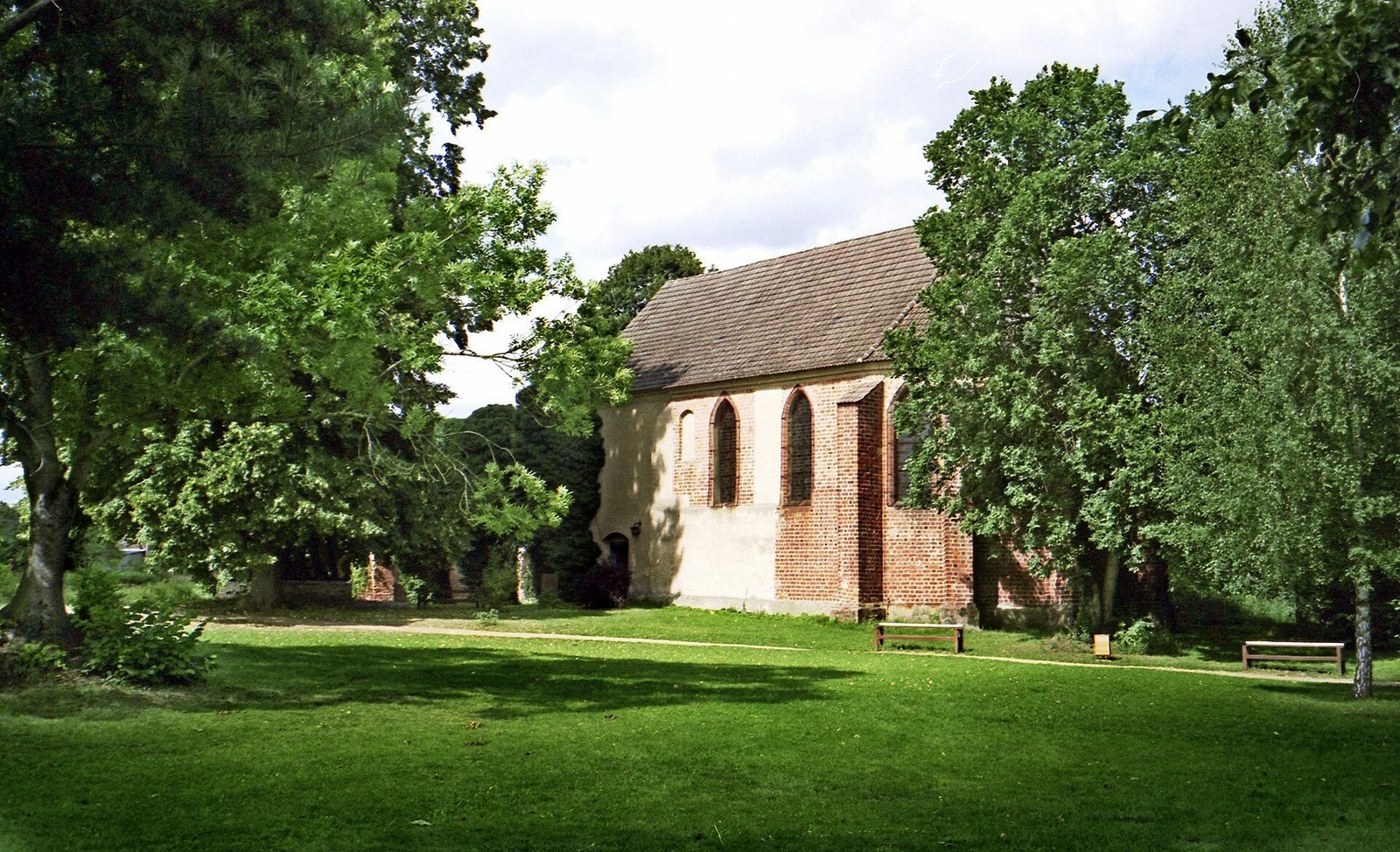
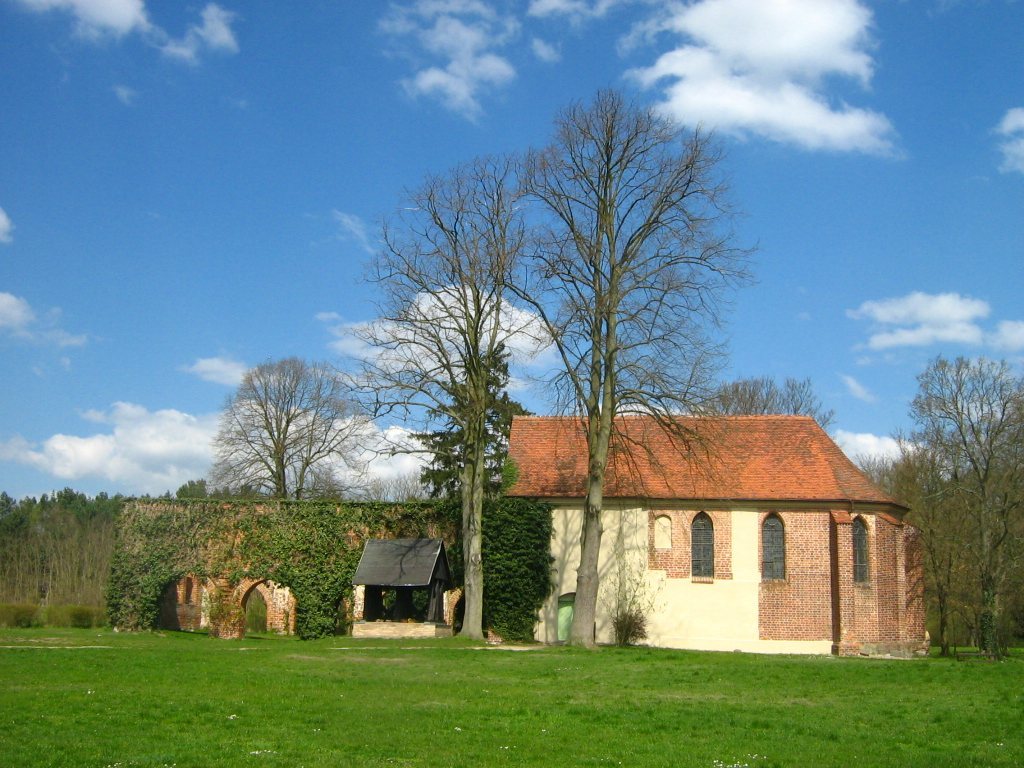
The principal surviving structure is the brick abbey church, planned as a cross-shaped basilica, a church with a long central body and side aisles. Its austere, archaic design drew on the brick Gothic of Lehnin. The surviving remains include the western ruin, the altered eastern end, a partly preserved brewery, and part of the former western enclosure wall.
Abbey church
The church was constructed in two phases. The early work, begun shortly after 1300, included the main body of the church, its cross-arms, a sacristy, and probably two chapel extensions. The eastern end may initially have had an apse, a temporary choir, or a temporary chapel. In the mid-14th century, builders added a five-sided choir over older foundations. The church may have been built with the involvement of the workshop at Chorin.
The central part of the main body probably had a flat roof, while its two side aisles were vaulted. The possible chapels stood beyond the cross-arms, on either side of the choir. At the south, the cross-arm aligned with the outer wall of the southern aisle. The sacristy, a room for clergy and church furnishings, probably stood beside it and linked the church to the cloister buildings to the south. Its position and form were unusual among later Cistercian buildings in the region.
The western part survives as a ruin. Its two long side walls each retain four round-arched openings, while the west wall has three narrow windows whose upper ends have been lost. Excavations in 1938 established that the original floor lay almost a metre below the later level, a difference that changes how massive the surviving walls appear. In 1858, the western ruin still had a thatched roof and was used as a barn; its openings had been blocked or closed with gates.
The church’s eastern part survives in altered form. A wall separates the crossing, where the main body and cross-arms meet, and the choir from the western ruin. In 1663, this eastern portion was adapted as a Lutheran parish church and continued in use as the village church. A bell tower, probably built in the 17th century on the foundation of the possible southern chapel, collapsed in the early 19th century.
Former brewery
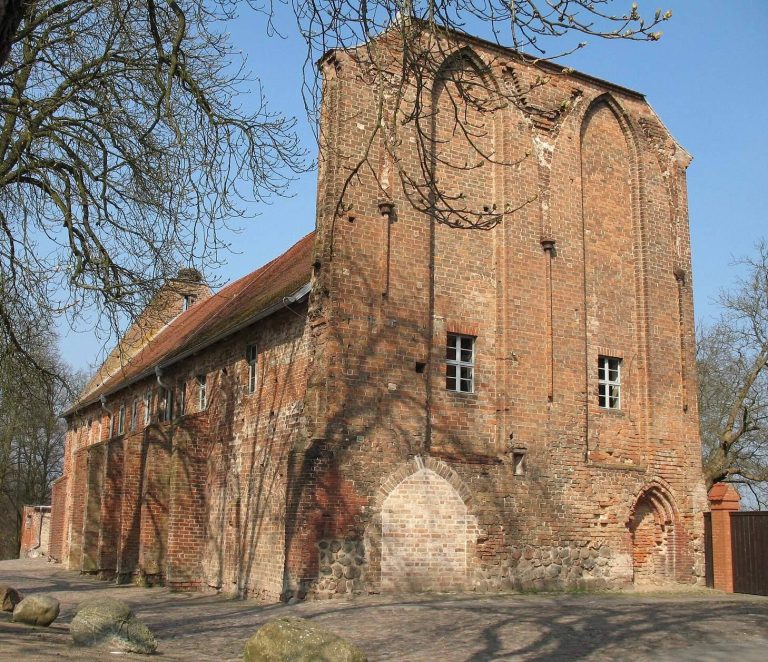
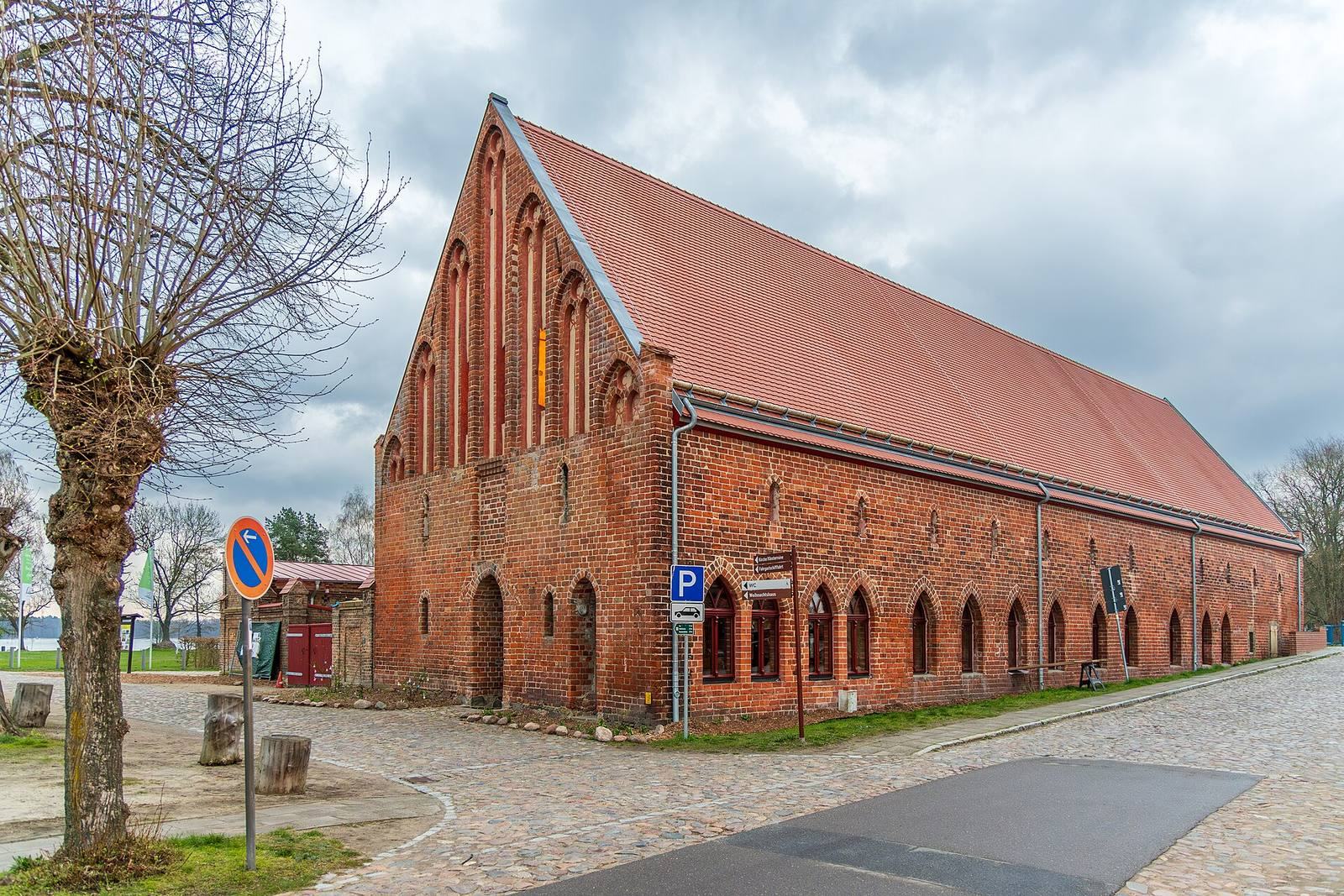
The late-14th-century brewery is the abbey’s only surviving economic building, although it is only partly preserved. Built of red brick, it has a simply shaped blind gable, a plain gable face without openings. It served as a granary in 1858 and later as a residence. In 1945, demolition of a nearby bridge caused its southeast gable to collapse. A deliberately set fire in 2010 destroyed the building down to its enclosing walls. Roof restoration began in 2016 with work to stabilize the historically important gable.
Enclosure and grounds
A fragment of the former western enclosure wall survives. Made of granite, it contains a passage bounded by two brick piers. Its length has remained unchanged since at least the early 19th century, indicating that most of the wall had already been removed by then. The park around the former abbey contains white hornbeams and large-leaved lindens.