Zehdenick Abbey: A Medieval Cistercian Nunnery in Germany
Site at a Glance
- Rating
- 4.5
- Popularity
- Low
- Country
- Germany
- Primary era
- Medieval
- External website
- Open
- Eras represented
- Medieval, Early Modern
- Civilizations
- Holy Roman Empire, Kingdom of Prussia, Margraviate of Brandenburg
- Site type
- Religious
- Remains
- Monastery
On this page13 sections
History
Zehdenick Abbey is a former Cistercian nunnery in Zehdenick, Germany, founded around 1250 during the medieval period. Its exact foundation year is uncertain because the original charter has not survived, but Pope Alexander IV confirmed the foundation in 1254. The abbey grew around a pilgrimage associated with an alleged host miracle and later became a powerful landholder in Brandenburg.
Foundation and pilgrimage
A foundation legend transmitted by the Brandenburg chronicler Andreas Angelus in 1598 links the abbey to an alleged miracle in 1249. According to the story, an innkeeper buried a consecrated host beneath a beer barrel. After the host was recovered, blood allegedly emerged from the ground. The blood was taken to the church altar, while a chapel was built at the place where the event was said to have occurred. The resulting pilgrimage helped establish Zehdenick as a pilgrimage centre.
The legend associates Bishop Rutger of Brandenburg with the pilgrims and names the Margraves Otto III and Johann I of Brandenburg and their sister Matilda, Duchess of Brunswick-Lüneburg, in connection with the foundation. The margraves and Matilda were said to have supported the abbey both to serve the growing pilgrimage and to strengthen Ascanian authority in the recently acquired Uckermark. The Ascanians were a princely dynasty whose Brandenburg branch was consolidating its power in the region.
The first community consisted of twelve nuns, who moved into the completed dormitory in 1252. Bishop Otto of Brandenburg supported further building in 1255 by granting an indulgence, a formal remission of temporal punishment for sin associated with specified religious acts or donations. Archbishop Erich of Magdeburg granted another indulgence in 1287 to visitors and benefactors of the abbey church.
Religious and administrative development
Zehdenick belonged to the Cistercian tradition, a Western Christian monastic order shaped by Benedictine practice, communal religious life, liturgical discipline, and agricultural self-sufficiency. The nunnery was not incorporated into the order’s formal organizational structure. A document from 1348 also described it as a Benedictine nunnery. Its original dedication was to the Virgin Mary and Saint George, while the dedication to the Holy Cross is known from 1409. In that year Antipope Alexander V placed the abbey under his special protection.
The abbey also exercised local ecclesiastical authority. In 1289 Bishop Heidenreich confirmed the provost’s synodal jurisdiction over villages belonging to the abbey, a right previously granted by Bishop Otto. Synodal jurisdiction was church authority over religious communities or clergy within a defined area.
Growth of the abbey estate
Through purchases, grants, and other medieval transactions, Zehdenick became a wealthy landholder. By the Reformation, it held sixteen villages and two deserted field districts outright, possessed partial interests in two additional villages, and controlled fishing rights in several lakes. Its rights also included church patronage in a number of settlements, the patronage of Zehdenick’s castle chapel, two altars in the town’s Marienkirche, and two altars in the George Chapel. Church patronage gave the abbey specified authority over church appointments and revenues.
The estate included revenues or holdings in Ahrensfelde, Beiersdorf, Dallgow, Dyrotz, Fahrland, Groß Schönebeck, Lindenberg, Nassenheide, Röddelin, Schwanebeck, Wesendorf, and other settlements. The abbey held or administered places including Falkenthal, Germendorf, Großmutz, Großwoltersdorf, Gutengermendorf, Hammelspring, Hindenburg, Klein-Mutz, Klosterwalde, Krewelin, Manker, Röddelin, and Schwanebeck. It also claimed rights in Liebenwalde, Neulögow, Polzow, and Woltersdorf, although the claim to church patronage in Woltersdorf may have resulted from confusion with Großwoltersdorf.
Several transactions illustrate how this estate developed. The abbey received two holdings in Schwanebeck in 1257 and sixteen holdings in Klein-Mutz in 1288. In 1309 it acquired the waters and associated rights of the Great Lankesee and Kuhwallsee, and in 1323 it purchased Großmutz. Röddelin was acquired in 1384, while the deserted field districts of Beutel and Densow and probably the already deserted Polzow were acquired in 1393.
Water rights and milling revenues were also important. In 1340 the abbey bought the Zehdenick town mill from Margrave Ludwig I for 100 marks of Brandenburg silver. It had received an annual grain rent from the mill since 1281, and that rent was confirmed in 1452. In 1348 Ludwig I transferred several lakes to the abbey for 36 marks of Brandenburg silver, while Count Otto of Fürstenberg granted it half of the Tornowsee.
The abbey’s lake rights included the Tornowsee, now called the Great Wentowsee, as well as Baalensee, the Great and Little Dölch Lakes, Salchowsee, Huwenowsee, and an unnamed lake between Baumgarten and Glambeck, probably the Glambecksee or a lake that has nearly vanished. Grain revenues and other rights were also sold, confirmed, or transferred in Dallgow, Dyrotz, Fahrland, Groß Schönebeck, Lindenberg, Nassenheide, and Zehdenick.
Reformation and later history
In April or May 1541, as the Reformation reached Brandenburg, the nunnery was dissolved and converted into a secular foundation for noblewomen. The Reformation was the sixteenth-century religious movement that led Brandenburg and other German territories to adopt Protestant institutions and transform or dissolve Catholic monasteries. In the new foundation, women could live under a religiously influenced communal rule without taking monastic vows. Visitors found about fifty nuns still present.
The Brandenburg rulers took over the abbey’s estates and initially entrusted them to their court marshal Adam von Trott as administrator and captain. In 1551 the elector reclaimed the estates. Adam von Trott received the possessions of the secularized Himmelpfort Abbey in compensation, first as an electoral official and from 1557 as hereditary holder. The Zehdenick estates passed to the Amt Zehdenick, a territorial administrative office that also controlled admission to the foundation and provided for its residents.
Most of the abbey buildings were destroyed during the Thirty Years’ War, the European conflict of 1618 to 1648 that caused extensive military destruction across much of the Holy Roman Empire. The foundation continued despite the damage, with approximately seven noblewomen in residence. It survived until 1945 and was placed under the Evangelical Church of Berlin-Brandenburg in 1946.
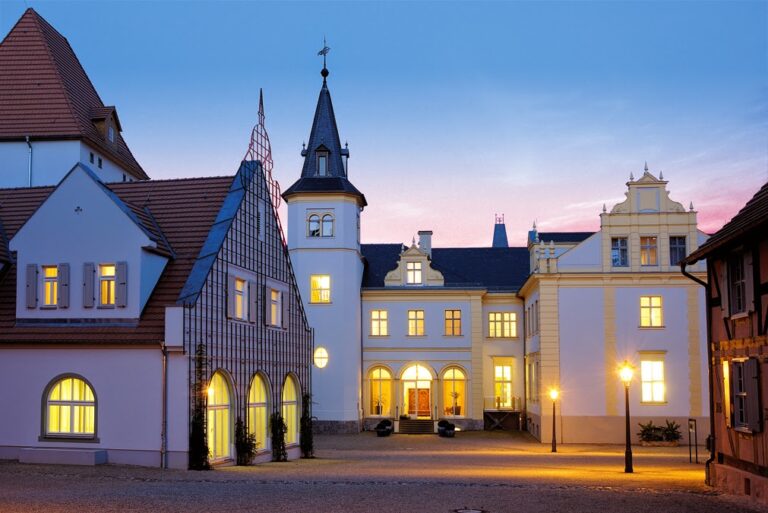
The former foundation is now administered by the Evangelical Church of Berlin-Brandenburg-Schlesische Oberlausitz. The premises provide accommodation for people associated with the church and support religious, community, and cultural activities, including family and marriage counselling, the Zehdenick branch of the Evangelical Brass-Music Service in Germany, and a gallery operated by the Kulturlandschaft Brandenburg-Nord society.
Remains
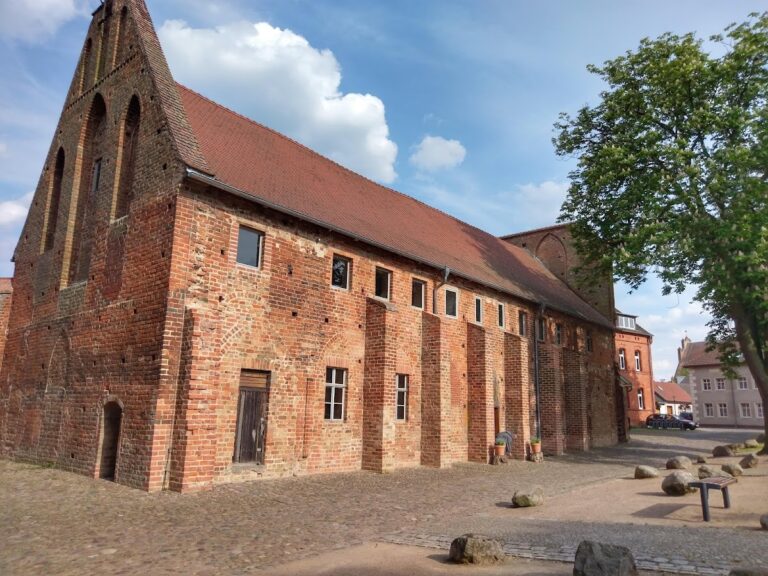
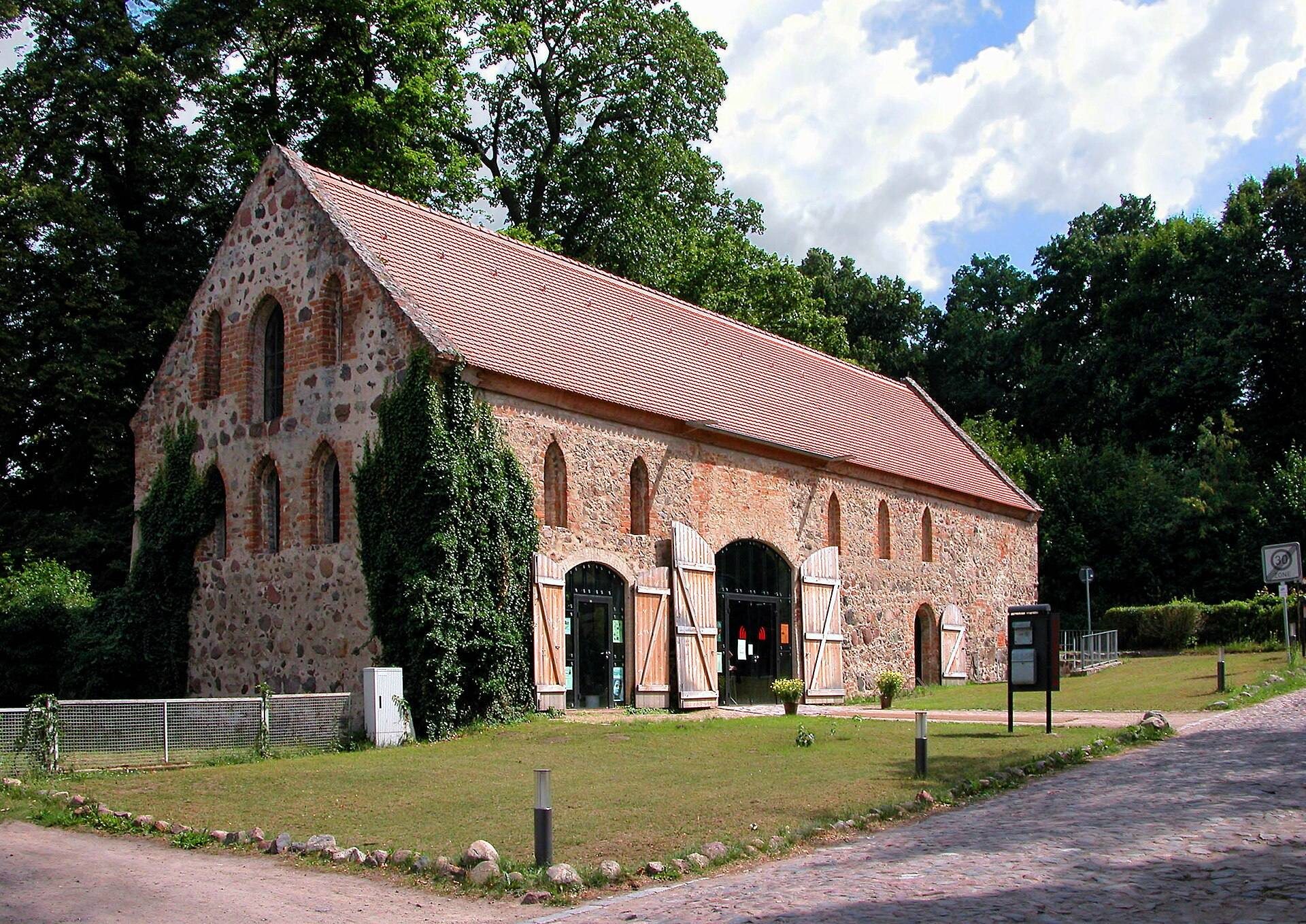
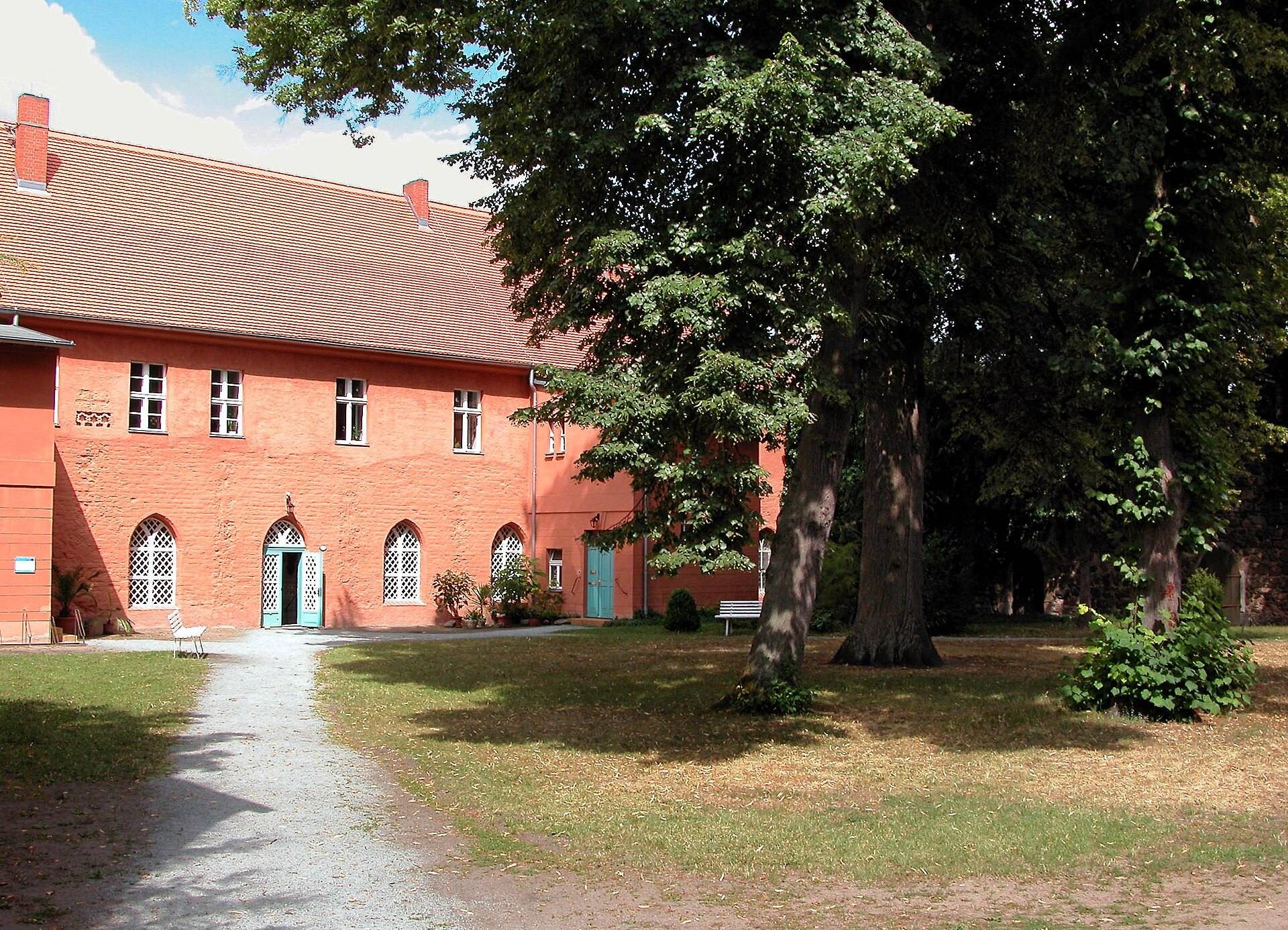
The surviving complex consists of the exterior walls of the dormitory, the north and west wings, parts of the cloister, and the building known as the abbey barn. Together these elements preserve parts of the former conventual arrangement, while the ruined church walls and later adaptations reflect the destruction and changing use of the foundation.
Conventual buildings
Dormitory and cloister
The dormitory survives as a ruin, with its external walls still standing. It formed part of the medieval residential complex occupied by the nuns after 1252. The cloister survives only in part, preserving a fragment of the circulation and communal space that connected the principal buildings.
North and west wings
The north and west wings remain as parts of the former abbey complex. The north wing was adapted as residential accommodation for the approximately seven women who continued to live in the secular foundation after the destruction of much of the site during the Thirty Years’ War. Two vaulted rooms survive within the north wing and are used for community and cultural purposes.
Abbey barn
The building called the abbey barn originally served several functions, including an infirmary, a school, and lodging for pilgrims. Its later use as a gallery forms part of the continuing religious and cultural life of the former abbey premises.
Church and surviving objects
Abbey church
The abbey church was rebuilt in 1768. Lightning struck the building in 1801, causing a fire, after which the church was demolished except for parts of its exterior walls. These surviving wall remains preserve the outline of a building that had already undergone major reconstruction in the eighteenth century.
Zehdenick Altar Cloth
One of the two vaulted rooms in the north wing houses a copy of the Zehdenick Altar Cloth. The original was made around 1300 and is held by the Stiftung Stadtmuseum Berlin. The copy connects the surviving complex with an important medieval textile associated with the abbey.