Heraion of Samos: An Ancient Sanctuary of Hera
Site at a Glance
- Popularity
- Very High
- Country
- Greece
- Primary era
- Iron Age
- Eras represented
- Bronze Age, Iron Age, Classical
- Civilizations
- Ancient Greek, Roman
- Site type
- Religious
- Remains
- Sanctuary
On this page34 sections
History
The Heraion of Samos was a sanctuary dedicated to Hera, a major Greek goddess associated with marriage and queenship, near the ancient city of Samos in Greece. Its history extends from prehistoric settlement through Greek and Roman rule, with successive building projects reshaping the sanctuary over many centuries.
Early settlement and cult
People inhabited the area from about 2500 BC until the Ionian occupation. Ritual activity at the altar may have begun in the Late Mycenaean period, part of Late Bronze Age Greek culture. By the tenth or ninth century BC, an early Greek sacred precinct contained a room for worship and a wooden image of the goddess.
Samian tradition held that Hera was born beneath a chaste tree. At the annual festival called the Toneia, or “binding,” worshippers wrapped her image in the tree’s branches and carried it to the sea to be washed. The tree appeared on Samian coins in Roman times, and the writer Pausanias said it still grew within the sanctuary.
Archaic expansion
The sanctuary’s first temple was built in the eighth century BC. A new phase of construction began in the late seventh century BC, including the Hekatompedos II temple, the South Stoa, two colossal statues of nude youths, and the Sacred Way, which connected the sanctuary by land to the city. Around 600 BC, the road also changed the sanctuary’s principal approach, which had previously been from the sea.
Further expansion followed in the second quarter of the sixth century BC, with a monumental altar, the North and South Buildings, and the Rhoikos Temple. A later phase enlarged the North Building and began a still larger temple to replace the Rhoikos Temple. This building activity coincided with Samos’s rise as an Aegean power and reached its height under Polycrates, the island’s sixth-century ruler.
Rhoikos and Theodoros began building the Rhoikos Temple sometime between 600 and 570 BC, and it was completed around 560 BC. The structure was destroyed around 550 BC. An earthquake may have caused its collapse, or unstable marshy ground and inadequate foundations may have contributed. Much of its stone was reused in the Great Temple.
Work on the Great Temple began in the second half of the sixth century BC, when its main chamber foundations were laid. Foundations for its surrounding columns and entrance porch followed around 500 BC. Construction continued into Roman rule, but the temple was never finished. During the Roman period, the image of Hera was transferred to a smaller temple nearby.
Changing rule and later worship
Activity at the sanctuary almost stopped under Athenian domination during the Classical period, a later phase of ancient Greek history. It revived in the Hellenistic period, which followed Alexander the Great’s conquests, and continued under Roman rule. In the early first century AD, Strabo described the sanctuary’s artworks and shrines. He wrote that Mark Antony had removed three colossal statues by Myron that stood on one base. Augustus later returned the statues of Athena and Heracles to the base, while transferring the statue of Zeus to the Capitol in Rome and providing it with a small shrine.
The sanctuary was struck by an earthquake in 262 AD and sacked by the Heruli, a Germanic people active in late antiquity, in 267 AD. Worship of Hera ended in 391 AD, when imperial edicts prohibited pagan observance. A Christian church was built at the site in the fifth century. During the Byzantine period, the medieval Eastern Roman Empire, buildings from the sanctuary were quarried for their stone, and the site was gradually abandoned.
Exploration and archaeological work
The French traveler Joseph Pitton de Tournefort visited Samos in 1704 and published engravings of the ruins. Later drawings were made by D. R. Pocock and James Dallaway, while William Gell and Francis Bedford published accurate measurements in 1821. Early excavation efforts had limited results, partly because of disputes with landowners and the challenges of working in marshy, malaria-affected ground.
Paul Girard excavated the statue dedicated by Cheramyes in 1879. The Greek Archaeological Society of Athens undertook preliminary excavations in 1890–92. An agreement between Berlin museums and the society led to German archaeological work, including Theodor Wiegand’s 1910–14 campaign, which exposed the Great Temple’s foundations and evidence of earlier temples and altars. The German Archaeological Institute in Athens began sustained excavations in 1925. Work stopped during the Second World War and resumed in 1951; later campaigns uncovered Bronze Age remains and established a chronology for the sanctuary and its offerings.
In 1992, the Heraion was included with the nearby archaeological site of Pythagoreion in a UNESCO World Heritage inscription. The designation recognizes the sites’ architecture and the evidence they provide for Samos’s Archaic-period mercantile and naval power.
Remains
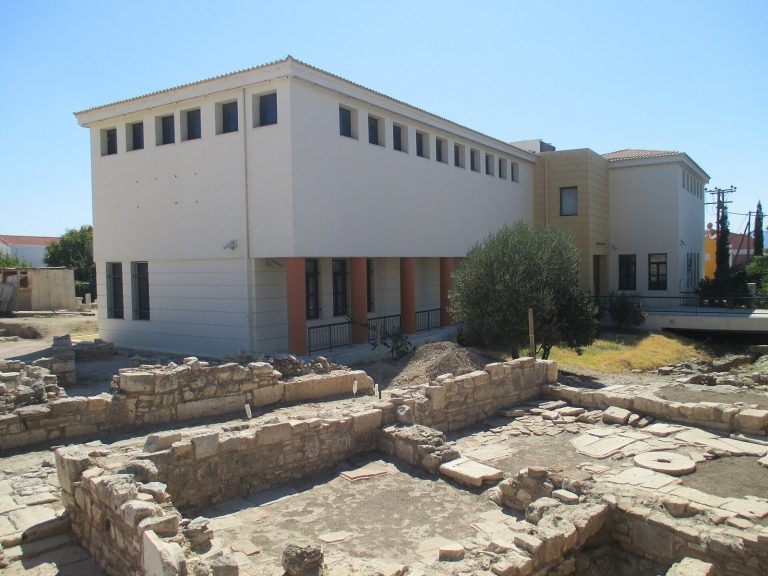
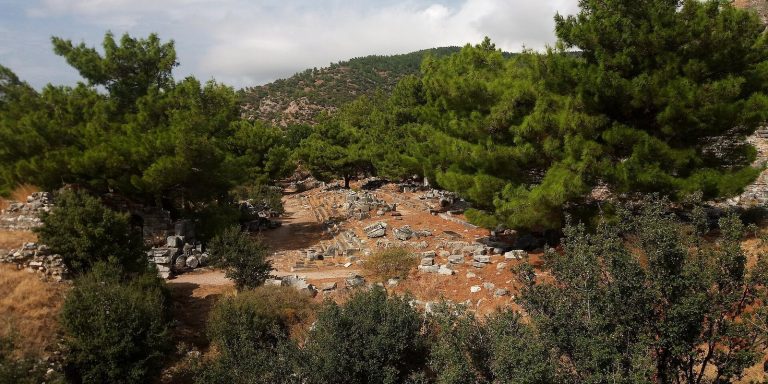
The sanctuary occupied a low, marshy basin of the Imbrasos River near its mouth, about six kilometres southwest of the ancient city of Samos. Hera’s altar stood at the centre of its religious layout, with successive temples to the west. Other temples, treasuries, covered colonnades, statues, and offerings occupied the wider precinct. The Sacred Way formed a major axis through the site.
Early structures
Bronze Age dwelling
Among the prehistoric remains is a large hall-centred dwelling of a type also found in Anatolia, the western peninsula of Asia largely corresponding to modern Turkey. It belongs to the settlement that occupied the area before the sanctuary’s later Greek building phases.
Early cult precinct
The early Greek sacred precinct, dating to the tenth or ninth century BC, included a room used for worship and a wooden image of Hera. These features mark an early phase of organised cult at the site.
Temples
Hekatompedos I
Hekatompedos I, the first monumental temple, was a long, narrow mudbrick building of the eighth century BC. A central line of columns supported its roof. A flood from the Imbrasos may have destroyed it around 660 BC.
Hekatompedos II
The late seventh-century BC rebuilding measured about 33 metres long and 6.5 metres wide. Its limestone walls replaced the earlier mudbrick, and its eastern end was open. Two rows of interior columns ran beside the long walls, leaving a clear sightline from the entrance to the cult image, which was set off the central axis to avoid the columns.
An eastern porch with columns and an outer colonnade are possible but uncertain features of the design. The building may have had a wooden outer colonnade. Clay plaques protected exposed timber and contributed to a type of decoration later used on temple roof fronts and friezes.
Rhoikos Temple
The Rhoikos Temple measured about 100 by 50 metres. A deep, roofed entrance porch led into a closed main chamber, and two rows of columns divided each space into three aisles. Two surrounding rows of columns enclosed the building, with 21 along each long side, ten at the rear, and eight at the front. The columns had rounded bases marked with horizontal fluting. Many shafts were unfluted, and early features of the Ionic architectural style were present.
Great Temple
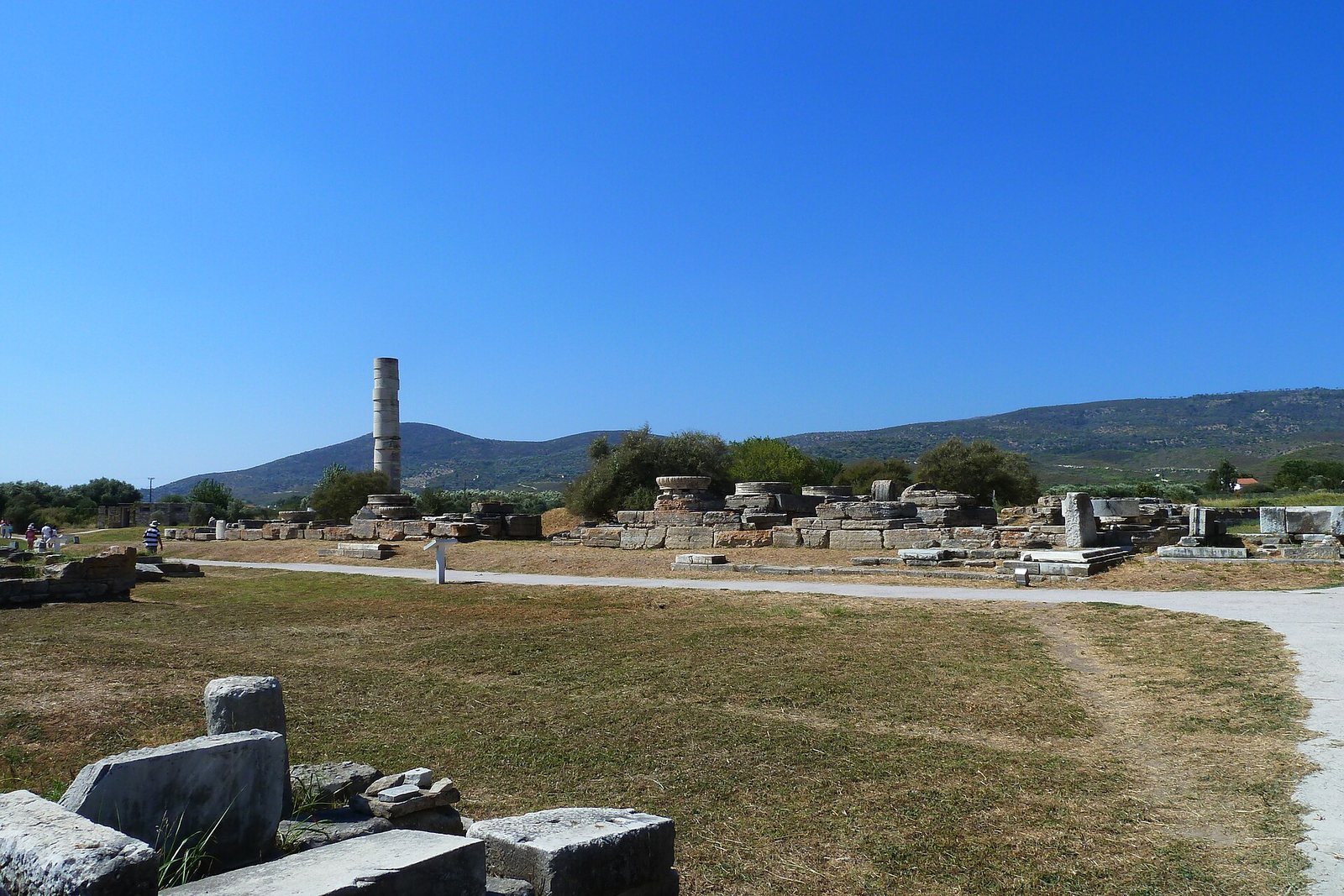
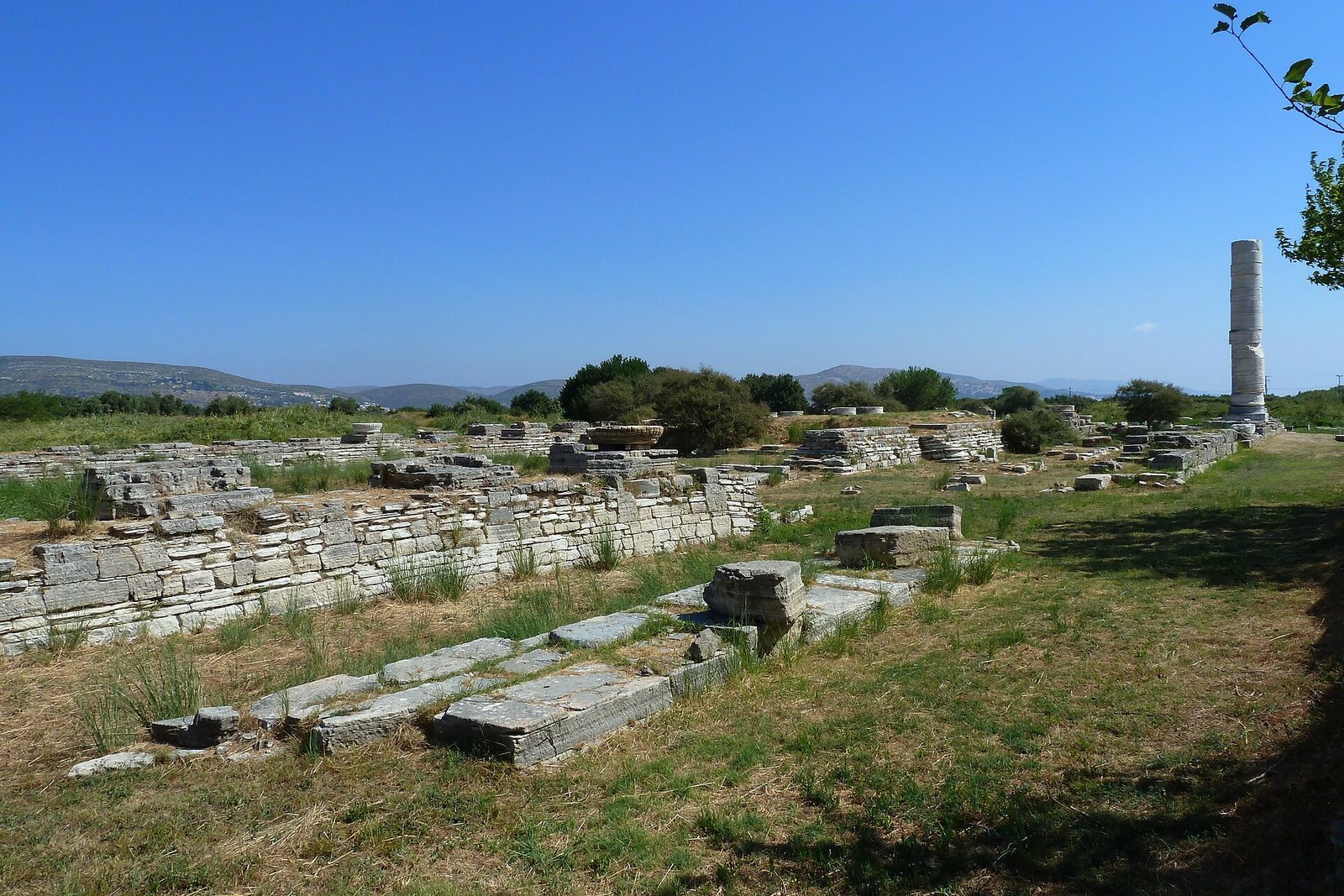
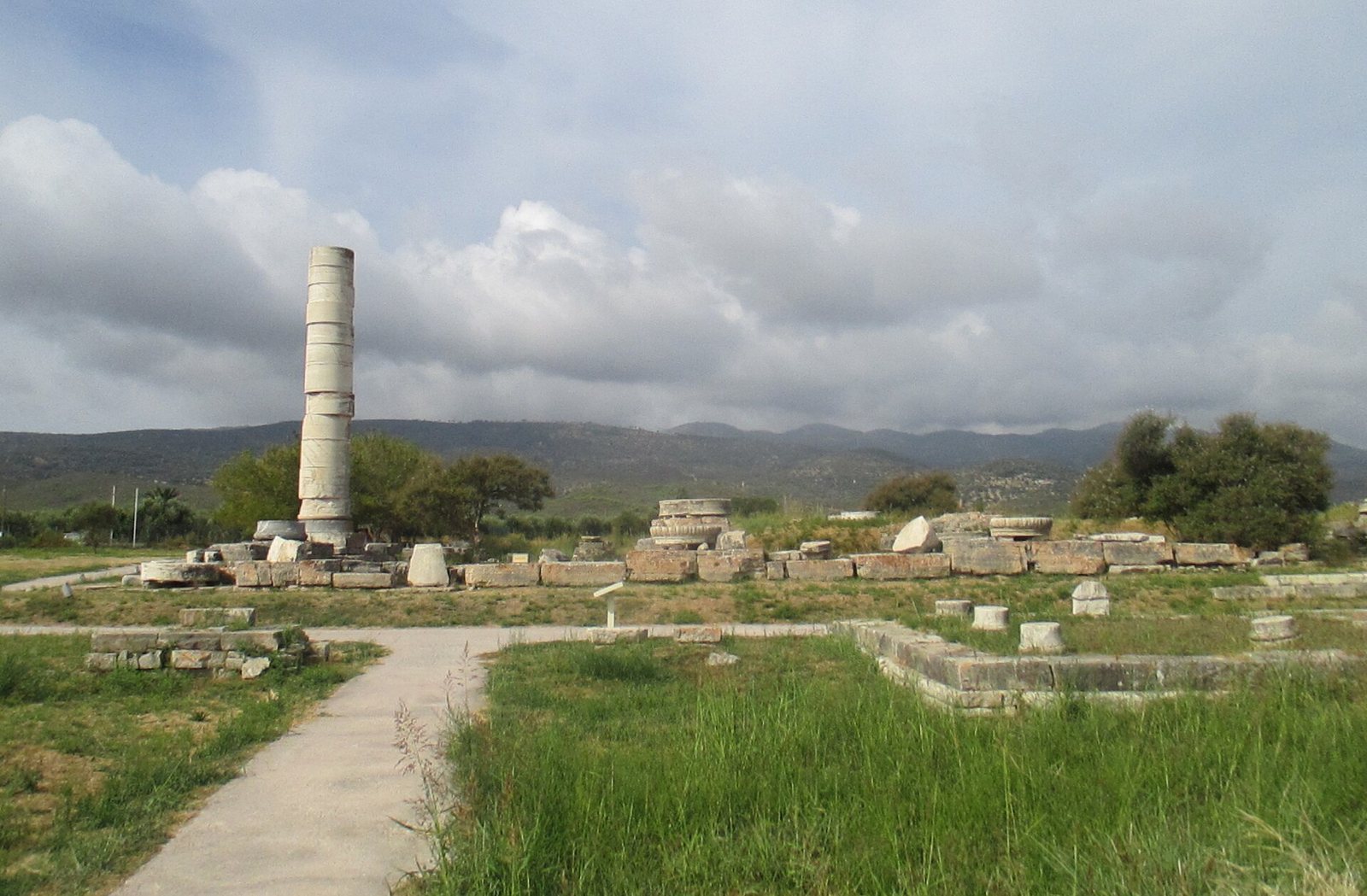
About 40 metres west of the Rhoikos Temple, the Great Temple had a plan measuring 55.2 by 108.6 metres, among the largest Greek temple plans. Its foundations belong to separate construction stages for the main chamber, the outer columns, and the entrance porch. The building remained unfinished. Its foundations and a column shaft survive; the shaft is thought to have served as a navigational marker for ships.
Roman temple
A smaller Roman temple stood east of the Great Temple and housed Hera’s cult image after its transfer from the larger sanctuary. The building was demolished in the fifth century AD, and its stone was reused in the Christian church.
Altar and processional route
Altar
The rectangular altar began as a rough stone structure measuring 2.5 by 1.25 metres, built in the ninth century BC. It was rebuilt seven times before reaching a monumental form in the sixth century BC, measuring about 35 metres from north to south, 16 metres from east to west, and 20 metres high. Steps covered its western side and led to a flat platform for sacrifices. A low wall enclosed the platform on the north, east, and south, and floral and animal reliefs decorated the altar wall and the wall’s upper edge. A sacred grove lay to the east. A stump once identified as Hera’s chaste tree was later shown by testing to be an unrelated juniper.
Sacred Way
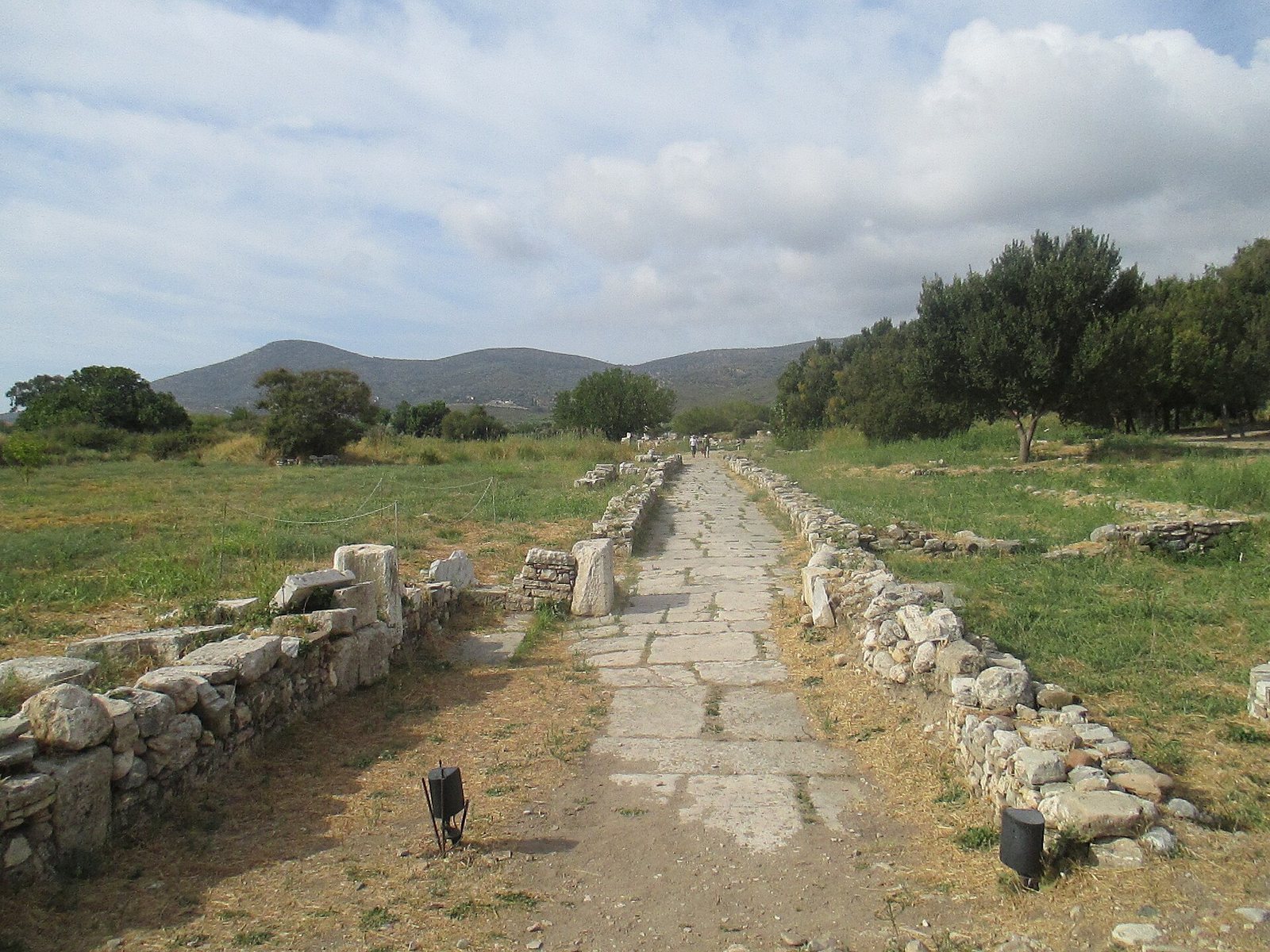
First laid out around 600 BC, the Sacred Way served religious processions, and offerings lined its route. Many sanctuary buildings followed its alignment. An earthen dam supported the road where it crossed the Imbrasos and diverted the river. Stone slabs repaved the route in the third century AD, and this paving remains visible. Before the road was built, the sanctuary’s main entrance faced southeast toward the sea; the road shifted the principal approach to the north.
Colonnades and other buildings
South Stoa
The South Stoa, a roofed colonnade built of mudbrick and wood in the late seventh century BC, was about 60 metres long and ran roughly northwest to southeast. Two rows of columns supported its roof, while interior walls divided the building into three equal sections. It was demolished in the mid-sixth century BC to make room for the South Building.
North Stoa
Built in the sixth century BC, the North Stoa may have replaced the South Stoa. It followed a similar model and scale, with part of the sanctuary wall serving as its rear wall. The two colonnades marked the precinct’s edges and provided shelter from the sun and a place for visitors to sleep.
North Building
The North Building’s first form, built in the mid-sixth century BC, measured 13.75 by 29 metres. It had an entrance porch on the south, a central row of columns, and a separate restricted inner room at the north, within an enclosed sacred area. Between 530 and 500 BC, an outer colonnade enlarged it to 25.8 by 41.2 metres. A roof tile bears the letters PO, which have been interpreted as indicating that Polycrates was personally responsible for the enlargement. The building’s purpose remains uncertain: although shaped like a temple, it appears to have lacked a related altar and may have served as the Samian state treasury.
South Building
The South Building was erected in the mid-sixth century BC on the site of the demolished South Stoa. It was built at about the same time as the North Building and followed a similar design.
Small temples
Foundations of two small temples dedicated to Hermes and Aphrodite have been identified north of the Great Temple.
Sculpture and inscribed dedications
Kouros of Samos
The statue known as the Kouros of Samos, a figure of a nude young man, was found beneath the Roman paving of the Sacred Way at the sanctuary’s northern end, close to its original position by the entrance. Erected around 580 BC, it is about three times life-size and among the largest known statues of its type. An inscription on its thigh names the dedicator as Isches, son of Rhesus. The statue is now displayed in the Samos Archaeological Museum.
Second temple statue
A similar colossal statue once stood beside Hekatompedos II. It was destroyed in the mid-sixth century BC, and fragments of it survive.
Cheramyes dedication
Around 560 BC, the aristocrat Cheramyes dedicated a group consisting of a statue of a nude young man and three statues of clothed young women. One of the female figures, now in the Louvre, is known as the Hera of Samos. It may represent a priestess rather than the goddess, possibly one associated with Cheramyes.
Geneleos group
The Geneleos group stood on one base along the Sacred Way and represented the dedicator’s family. An inscription identifies the seated mother as Phileia. The group also included a reclining father, a son, and three daughters; inscriptions identify two of the daughters as Philippe and Ornithe.
Offerings and excavated objects
Food and feasting
Animal remains indicate sacrifices of mostly adult cattle, as well as sheep, pigs, and a few deer. Pottery tableware and drinking cups, used at sacrificial feasts, have been found across the sanctuary. An important group dates to the early sixth century BC. Some pieces bear inscriptions interpreted as naming Hera; other letters may refer to public ownership, and the reading as Hera is disputed. Workshops that produced this pottery were located within the sanctuary.
Terracotta and ivory pomegranates and poppy pods found near the temple provided durable forms of offerings that otherwise consisted of perishable materials. Large quantities of pomegranate and poppy seeds were also recovered at the site.
Wooden offerings
Waterlogged soil preserved many Archaic-period wooden offerings, including carved sculpture and furniture, rough spoons, and about 40 curved objects usually measuring around 40 centimetres long. These objects have been interpreted as abstract depictions of boats, perhaps dedicated by shipowners or used in a particular ritual. A full-size ship’s hull from the late seventh century BC measured about 20 metres long. Miniature stools carved with horse images were also found.
Objects from abroad
Objects from Egypt and the Near East include ivory items, fragments of a crocodile skull, and a hartebeest skull. Other offerings include a stalactite, rock crystal, and two bronze figurines of Gula, a Babylonian healing goddess. The figurines may reflect an early Greek practice of identifying a foreign deity with a Greek one.
A bronze ornament worn on a horse’s forehead came from northern Syria and bears a late ninth-century BC inscription in Aramaic, a language widely used in the ancient Near East. It is the earliest known example of alphabetic writing found in Greece. Other offerings came from Cyprus, Phoenicia, Iran, and Urartu.
Later dedications
Honorific decrees and statues from the Hellenistic and Roman periods have been found across the sanctuary. Between six and thirteen figurines depict Isis nursing Horus, Egyptian deities commonly shown as mother and child. These finds point to an association between the cults of Hera and Isis during this later period.