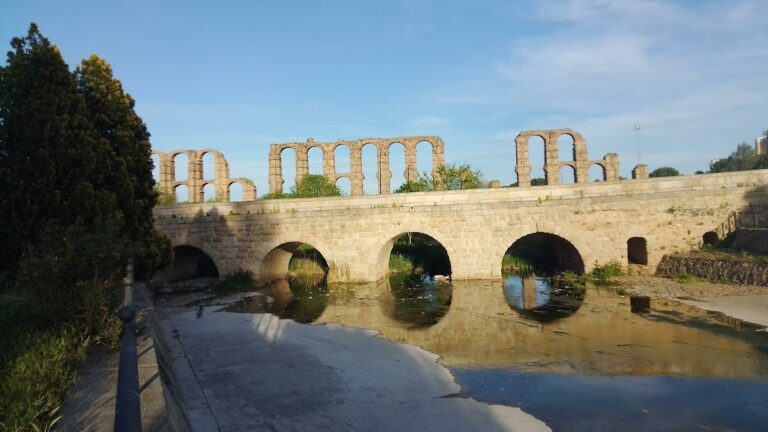
Cornalvo Dam: A Roman Water-Supply Work near Mérida


Site at a Glance
- Rating
- 4.7
- Popularity
- Very Low
- Country
- Spain
- Primary era
- Classical
- External website
- Open
- Eras represented
- Classical
- Civilizations
- Roman
- Site type
- Infrastructure
- Remains
- Dam
On this page7 sections
History
Roman construction and water supply
Cornalvo Dam is a Roman water-supply work in Spain, located near Mérida, that was built during the first or second century AD to serve Augusta Emerita, the Roman name for present-day Mérida and the capital of Lusitania. Lusitania was a Roman province covering much of present-day Portugal and parts of western Spain. The dam was constructed across the Albarregas as part of the hydraulic infrastructure supporting the Roman colonia, a settlement holding the legal status of a Roman colony.
The construction date is usually placed in the first or second century AD, although another proposed date is approximately AD 130, during the reign of Emperor Hadrian, who ruled from AD 117 to 138. An inscription refers to the Augustan period, the reign of Augustus from 27 BC to AD 14, but the structure appears to have been built later. Cornalvo Dam impounded the Albarregas and created a reservoir that continues to be used.
Heritage recognition
Cornalvo Dam was declared a national monument on 13 December 1912. It forms part of the Archaeological Ensemble of Mérida, which was inscribed on the UNESCO World Heritage List in 1993. Along with the nearby Proserpina Dam, it is regarded as an important surviving example of Roman water-management engineering.
Remains
Structure and water system
Main dam
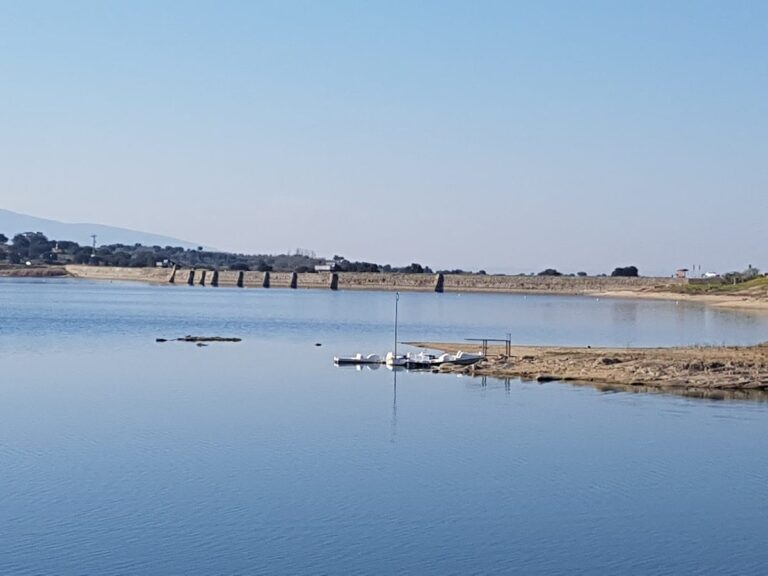
The dam stands in Badajoz Province, Extremadura, about 15 kilometres northeast of Mérida, across the Albarregas, a river within the Guadiana basin. It is a Roman gravity dam, a structure designed to resist retained water mainly through its own weight. The dam is approximately 28 metres high and 194 metres long, with a base about 26 metres wide.
Its construction combines an earth embankment, Roman concrete, and stone cladding on the upstream side, which faces the water. The upstream slope is arranged in terraces, giving the water-facing side a stepped form. The reservoir created by the dam has a stated capacity of 3 million cubic metres.
Intake tower
A separate intake tower stands in front of the dam. An intake tower regulates or draws water from a reservoir. The masonry of the tower is visibly different from that of the dam, indicating that the two structures were built using different construction methods.