Municipal Archaeological Museum of Cartagena: Archaeological Collections and the San Anton Necropolis


Site at a Glance
- Rating
- 4.6
- Popularity
- Low
- Country
- Spain
- Primary era
- Classical
- External website
- Open
- Eras represented
- Stone Age, Iron Age, Classical, Medieval, Modern
- Civilizations
- Ancient Greek, Byzantine, Carthaginian, Iberian, Roman
- Site type
- Museum
On this page12 sections
History
The Municipal Archaeological Museum of Cartagena in Cartagena, Spain, is a public institution founded on October 25, 1943, to acquire, conserve, study, and exhibit archaeological material from the municipality. Its first director was Antonio Beltrán Martínez. The museum forms part of the Regional Network of Museums of Murcia and preserves evidence of Cartagena’s long history, especially the Roman city of Carthago Nova, the ancient settlement corresponding to present-day Cartagena.
Collections before 1943
The museum grew from archaeological collections that the city had preserved for centuries, particularly Roman inscriptions kept since the late sixteenth century. Its institutional predecessor included the Mineralogical and Antiquities Museum, founded in 1883 by the Royal Economic Society of Friends of the Country of Cartagena. That institution held material mainly from the Cartagena-La Union mining district, linking the development of local collecting with the area’s mining history.
Growth and relocation
The new municipal museum first occupied the ground floor of the building now used by the Royal Economic Society of Friends of the Country on Calle del Aire. Increasing collections soon required more space, and in 1945 the museum moved to a building on the former Calle Baños del Carmen, now Plaza de Juan XXIII.
The San Anton Necropolis museum
The discovery of the San Anton Necropolis in 1967 led director Pedro San Martín to propose a museum built around the cemetery so it could remain in situ, meaning in its original archaeological location. The city council acquired the land and financed the adaptation works. After substantial delays, the new museum opened in 1982. Continuing excavations in Cartagena’s historic center, beneath which lies ancient Carthago Nova, continue to provide the museum with artifacts and information about the city’s development.
Remains
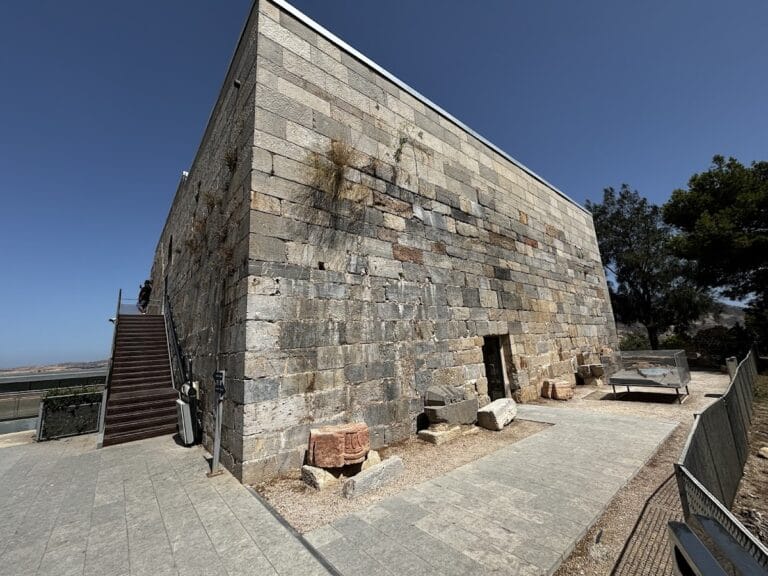
The present museum building was constructed around the San Anton Necropolis and opened in 1982. The necropolis, an organized burial area, occupies the center of the permanent exhibition and is visible from several points along the museum route. The building’s exhibition plan is arranged for teaching and interpretation: the first floor presents objects in chronological order, while the second uses a thematic arrangement based on archaeological sites and exhibitions. Workrooms, a library, workshops, and photographic and restoration laboratories form part of the associated facilities.
Chronological collections
Prehistoric and Punic material
The collections extend from the Middle Paleolithic to almost the present day. Among the earliest objects is a possible human phalanx bone dated to approximately 1.2 million years ago. A Punic votive object, or offering dedicated to a deity or deposited in fulfillment of a vow, takes the form of a cauldron and dates from the third century BC. The museum also holds an Iberian oenochoe, an ancient jug generally used for pouring wine.
Greek and Hellenistic objects
A Hellenistic earring from the second century BC was found beneath Cartagena’s Roman amphitheater. The collection also includes Greek kraters, large vessels traditionally used for mixing wine and water, from the Iberian settlement of Los Nietos. One krater shows a procession honoring Apollo, a major Greek god associated with prophecy, music, and healing, while another depicts a Dionysian banquet connected with the imagery and rituals of Dionysus.
Roman collections
Public buildings and sculpture
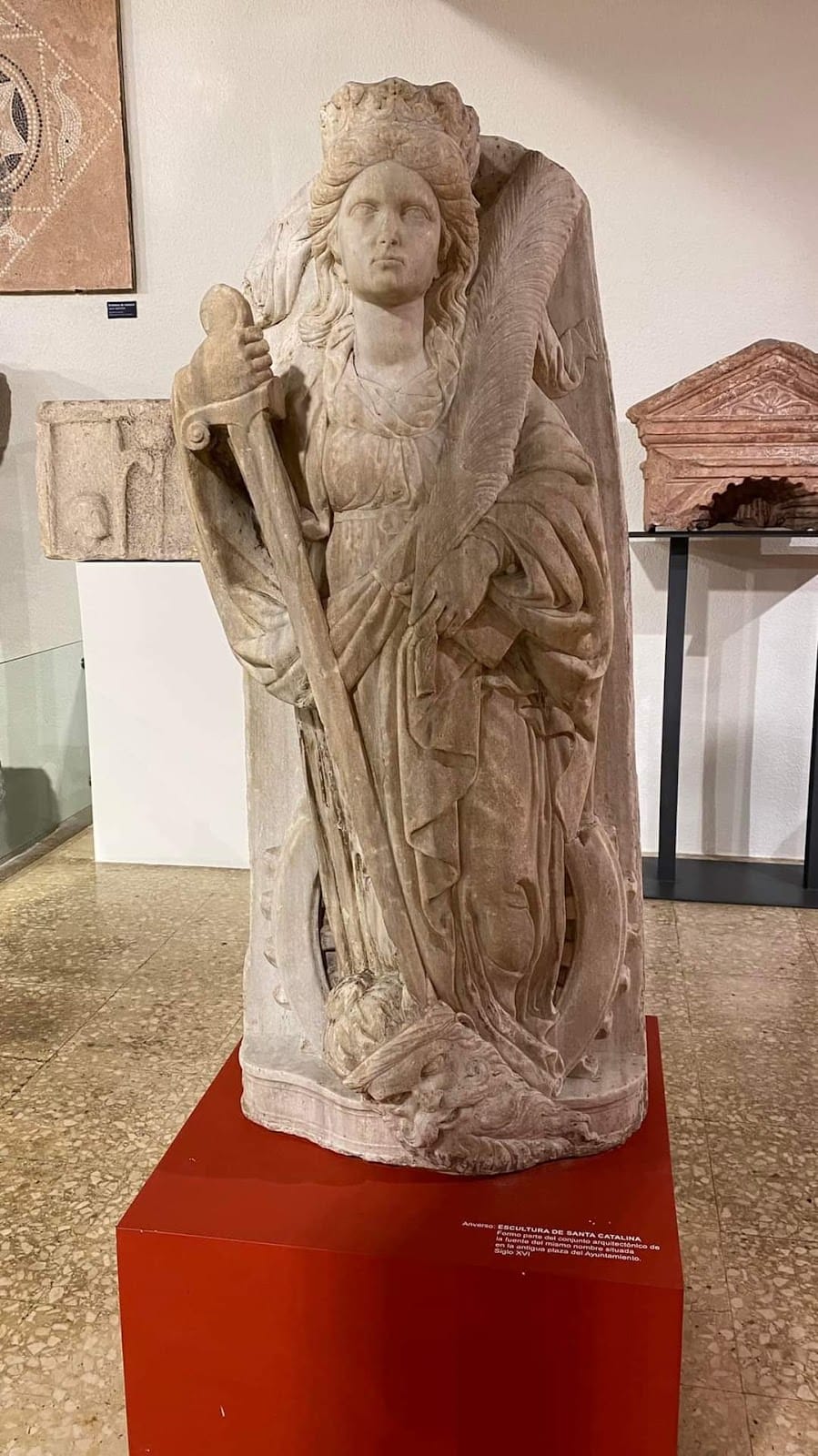
Roman-period material is the most numerous and most prominently displayed part of the collection. Objects from Cartagena’s Roman theater include a Corinthian capital, the ornamented upper section of a column in the Corinthian order. Material from the Roman forum, a public civic space for political, commercial, legal, and religious activities, includes a figure of a young person wearing a chlamys, a short cloak used in the Greek and Hellenistic worlds, together with a child’s head and a caryatid, a sculpted female figure serving as architectural support.
Domestic and mining material
The Roman holdings also include a wall painting from the Domus of Salvius, a Roman urban house associated with an affluent household. Mining and commercial activity is represented by lead ingots from the mines of Carthago Nova, a basket made from Roman ropes from the mines, and Roman tools used in mining. Latin inscriptions, ceramics, architectural and sculptural elements, construction materials, and objects connected with trade extend this picture of Roman life and production.
Later archaeological material
Later collections include a Byzantine tombstone associated with Comenciolo, a Byzantine military commander, and a Byzantine oil lamp. Byzantine material belongs to the culture of the Eastern Roman Empire, which continued after the fall of the Western Roman Empire.