Castle of La Atalaya: A Strategic Fortress of Cartagena


Site at a Glance
- Rating
- 4.6
- Popularity
- Low
- Country
- Spain
- Primary era
- Early Modern
- External website
- Open
- Eras represented
- Early Modern
- Civilizations
- Spanish
- Site type
- Military
- Remains
- Fort
On this page9 sections
History
Castle of La Atalaya, also called the Fort of La Atalaya, is an eighteenth-century fortress in Cartagena, Spain, built as part of the city’s military defenses during the reign of Charles III. Its definitive construction took place between March 1773 and June 1778 in the eclectic neoclassical style of the French-influenced Spanish school. From its position above Cartagena, the fort was intended to prevent enemy landings and protect the Military Arsenal and the Castle of Galeras.
Medieval Watchpoint and Early Fortifications
The strategic value of Monte Atalaya was recognized in the Late Middle Ages, when Cartagena’s municipal council established a lookout post there. Its purpose was to warn the city of possible pirate attacks and attacks by allies of the Nasrid Kingdom of Granada, the last Muslim-ruled state in the Iberian Peninsula, which lasted until 1492.
The lower slopes of the mountain may also have been the setting of the Battle of Santa Monica. In that encounter, a force of 1,800 Ottoman corsairs landed at La Algameca to launch a surprise attack on Cartagena, but was defeated by Luis Fajardo de la Cueva, Marquis of Los Vélez. Fajardo was a Spanish nobleman and military commander.
Serious efforts to establish a fort on the summit began in 1706, during the War of the Spanish Succession, an early-eighteenth-century conflict over the Spanish crown between supporters of Archduke Charles and Philip of Anjou. Cartagena was then occupied by English forces acting for Archduke Charles of Austria, who sought to secure the position in the hostile Kingdom of Murcia. Two forts were built at strategic points, preparing the way for the later construction of La Atalaya and the Castle of San Julián, which defended the harbor entrance.
Construction under Charles III
Pedro Martín-Paredes Cermeño designed the definitive fort in 1766 as part of a broader improvement to Cartagena’s military defenses. The program followed the city’s designation in 1726 as capital of the Mediterranean Maritime Department. Construction began in March 1773 and ended in June 1778, with the works directed according to the instructions of the Count of Aranda, a Spanish aristocrat and military officer who held high governmental office.
The completed fort guarded against renewed enemy landings at La Algameca and helped protect the Military Arsenal and the Castle of Galeras, constructed during the same period. Its later history connected the site not only with coastal defense but also with some of the most troubled episodes in Cartagena’s modern past.
The Cantonal Rebellion
Castle of La Atalaya played a role in the siege of Cartagena during the Cantonal Rebellion, a federalist uprising in Spain in 1873 and 1874 in which Cartagena became a major insurgent stronghold. During the siege, the fortress was renamed the “Castle of Death.” On the night of 9 January 1874, while the besieging army subjected Cartagena to intense bombardment, members of the cantonal garrison secretly met the opposing forces and surrendered the fortification.
Attempts by the cantonal leader Antonete Gálvez to recapture the castle were rejected. The loss of the position helped precipitate Cartagena’s capitulation.
Prison and Detention Uses
During the Spanish Civil War, Cartagena remained under Republican control, and the castle was used by the Military Information Service, a Republican wartime intelligence and security organization, as a secret detention and interrogation center. Prisoners, including José Ladiñán López, Mamerto Melgarejo Cánovas, and José Romero Font, were violently interrogated for evidence of support for the insurgent side.
The castle retained a penitentiary role after the war. Between April and November 1939, its facilities formed part of the concentration-camp complex operated in Cartagena during the Francoist repression.
Later Ownership and Heritage Protection
The Ministry of the Army transferred the property to the Ministry of Finance during the 1960s. Ownership passed to Cartagena City Council in May 2016, after a prolonged period in which the castle received no effective use or care and suffered serious deterioration.
The castle was declared an Asset of Cultural Interest and a monument within Spain’s historical heritage on 7 August 1997. It was added to Hispania Nostra’s Red List of heritage at risk in June 2014. Associations including Adepa and Aforca, together with residents of the nearby La Concepción district, promoted efforts to prevent further abandonment, although these initiatives had not received an institutional response.
Remains
Summit Fortress and Defensive Works
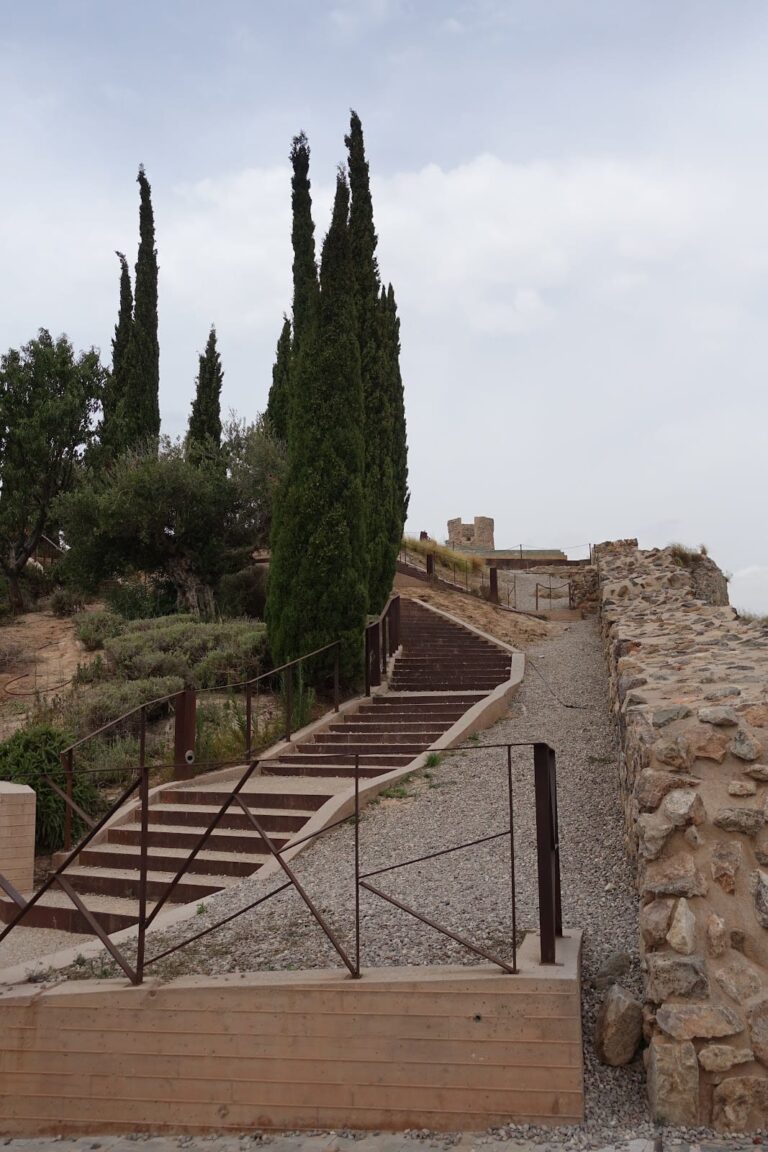
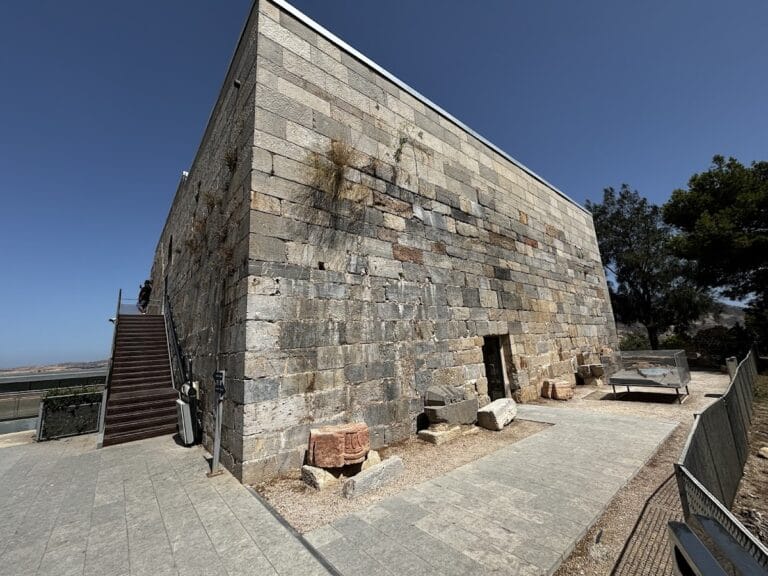
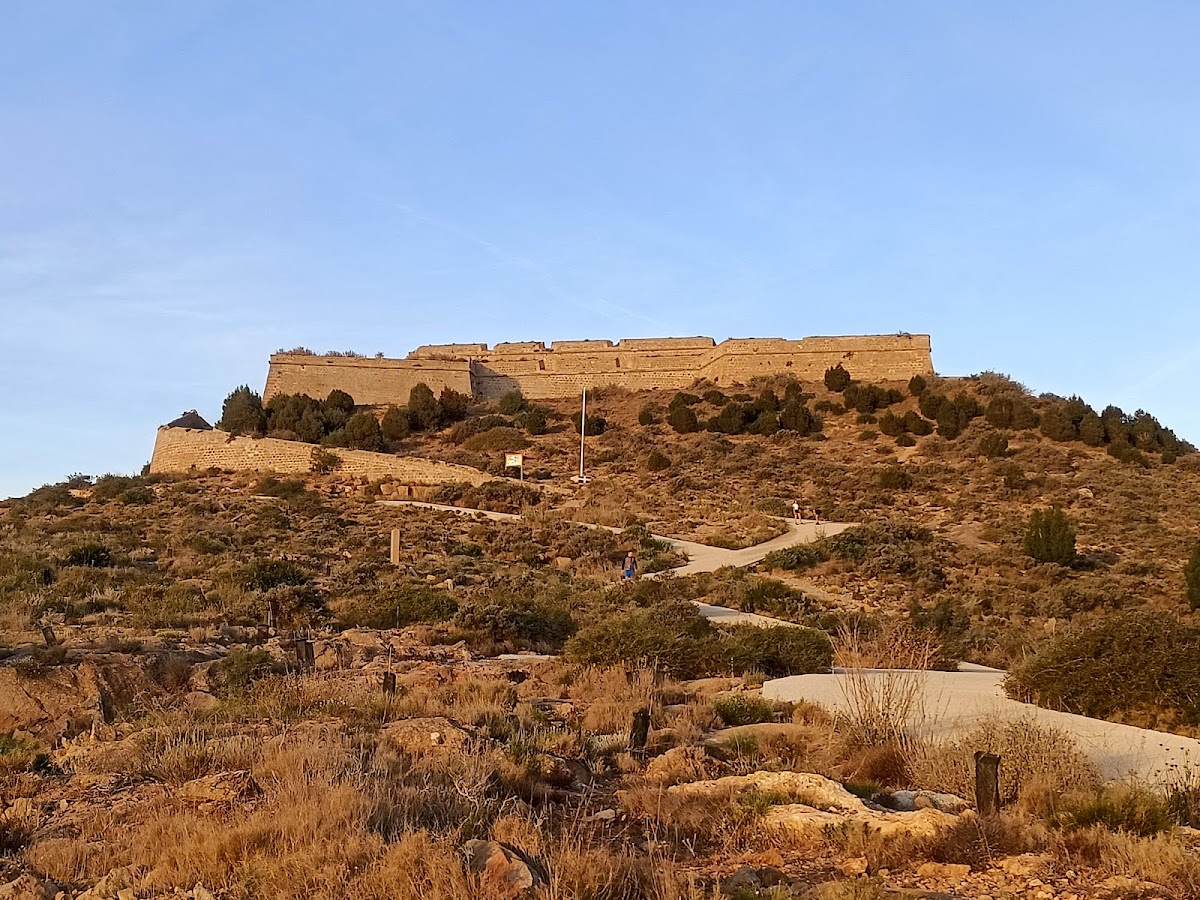
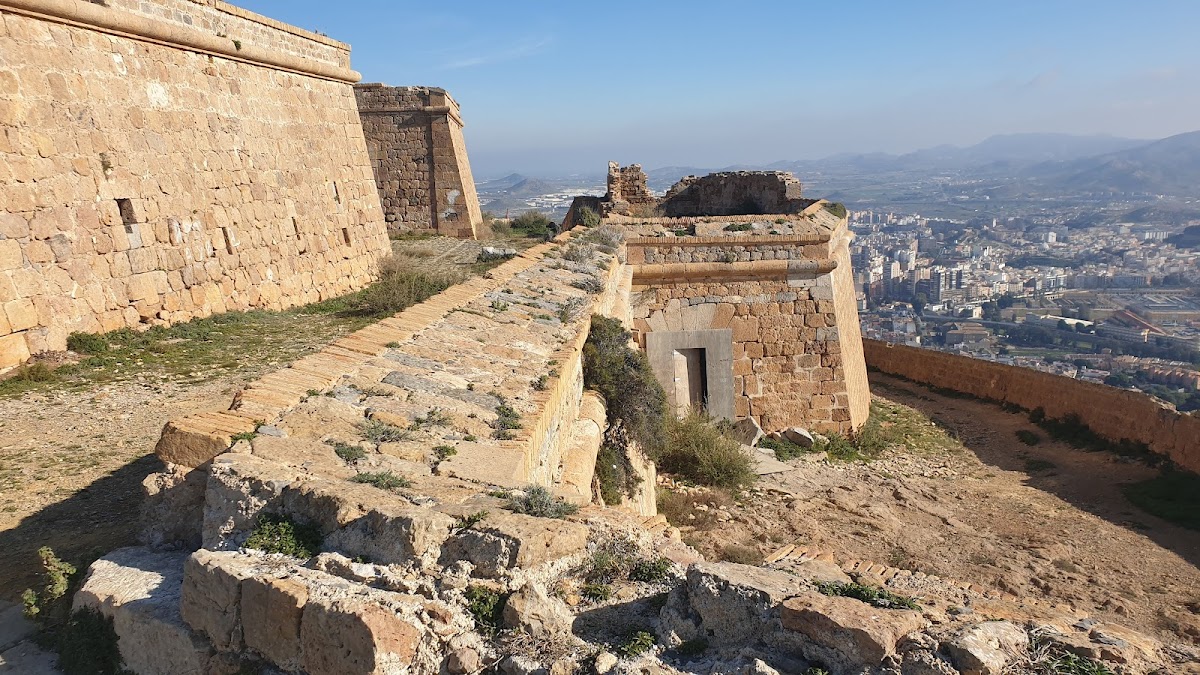
The fortress occupies the summit of Monte Atalaya in the Sierra de Pelayo, at approximately 242 metres above sea level. Its plan is an isosceles trapezoid, built in an eclectic neoclassical style associated with the French-influenced Spanish school. Five bastions, projecting fortifications designed to provide flanking fire along the defensive walls, stand at the vertices, while an additional bastion occupies the southern side.
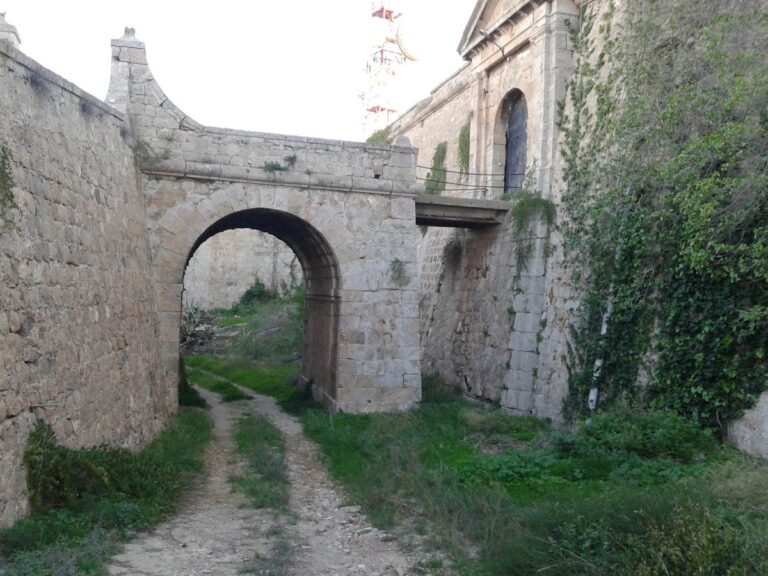
A moat surrounds the fortress, accompanied by a counterscarp, the outer slope or retaining edge on the far side of a moat, and an enclosing fence. The enclosure is interrupted only on the side facing the city. These defensive elements define the surviving fortress perimeter and reflect the site’s purpose as a position controlling the approaches to Cartagena.
Entrance and Interior
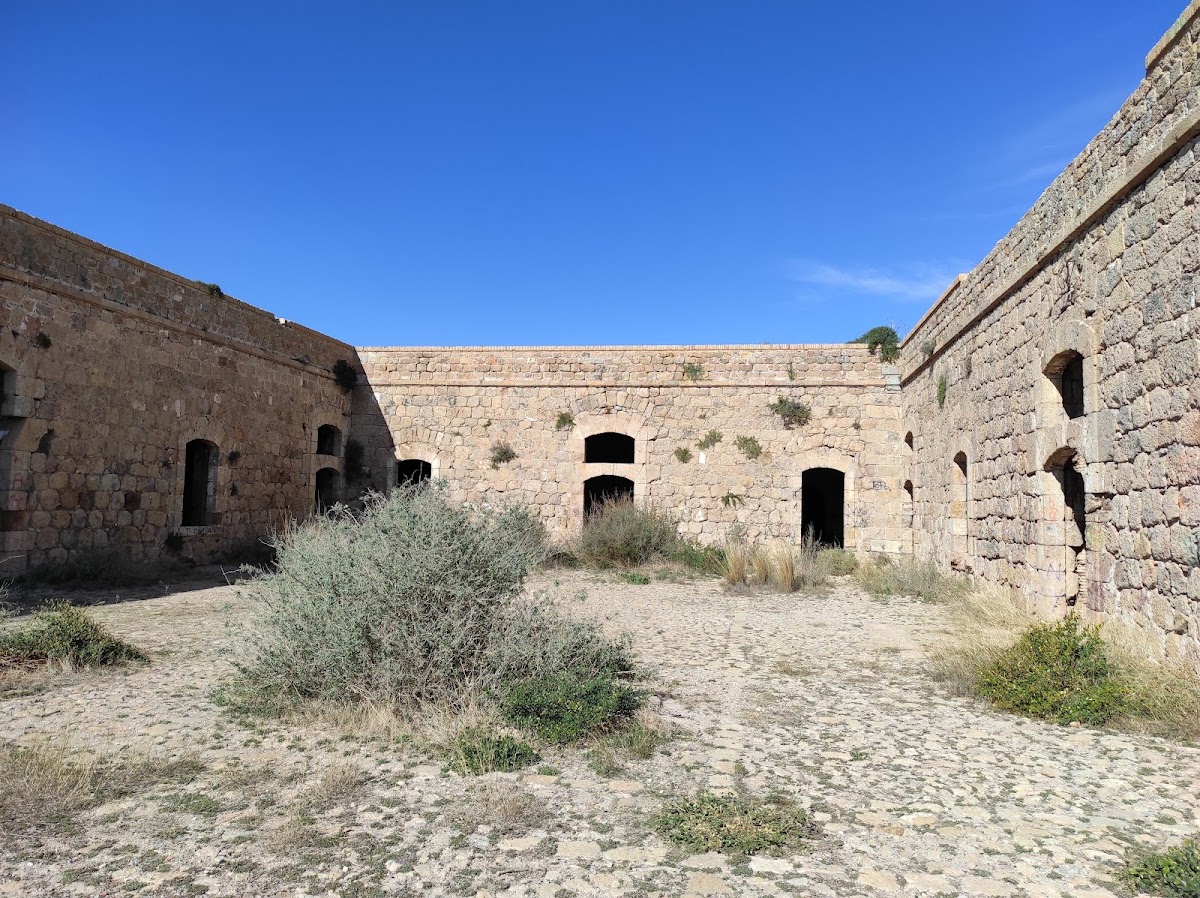
The entrance lies in the central bastion on the southern side. Beyond the gate is a vestibule, from which a drawbridge formerly led to the parade ground on the first level. The drawbridge has been lost, but the entrance arrangement preserves the connection between the outer defenses and the interior of the fort.
The first level contains vaulted rooms that housed the garrison, crenellations that protected artillerymen from enemy fire, and a cistern. A spiral staircase formerly connected this level with the roof terrace, although the staircase has also been lost.