Catacombs of Saint Sebastian: An Ancient Christian Cemetery in Rome


Site at a Glance
- Rating
- 4.6
- Popularity
- Medium
- Country
- Italy
- Primary era
- Classical
- External website
- Open
- Eras represented
- Classical, Medieval
- Civilizations
- Roman
- Site type
- Burial
- Remains
- Catacomb
On this page20 sections
History
The Catacombs of Saint Sebastian are an underground cemetery in Rome, Italy, along the ancient Via Appia. The site developed from a Roman pozzolan mine, a quarry for volcanic ash used in mortar and concrete, and became a burial complex from the first century onward. It is among the few Christian burial sites that remained continuously accessible, although its original first level has been almost completely destroyed.
From mine to Roman cemetery
The area began as a pozzolan mine. After mining ended toward the close of the second century, the excavated ground was used first as a Roman pagan cemetery and later for Christian burials. Pagan funerary activity included simple graves for slaves and freedmen, as well as more monumental tombs. The word catacumbas, initially associated with this particular site, was eventually applied to underground burial places in general.
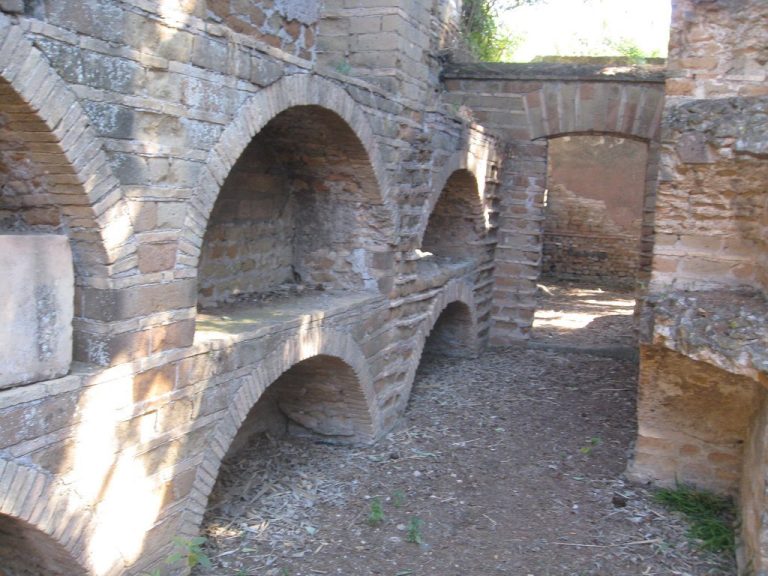
Funerary use had already begun in the first century, when columbaria were built beside a side road branching from the Via Appia. These structures contained rows of recessed compartments for cremation urns. During the second century, three large chambers were cut into the rock beside them. They were intended for cremation remains, although at least one was later altered for the burial of bodies.
The cemetery and the apostles
From the third century, the cemetery was known as in memoria apostolorum, meaning “in memory of the apostles.” The name referred to a period when relics attributed to Peter and Paul were associated with the site. The Depositio Martyrum, an early Christian calendar of martyr commemorations, associates Peter with the catacombs and Paul with the Via Ostiensis, the ancient road leading from Rome toward Ostia, on 29 June.
The fifth-century Martyrologium Hieronymianum, a late antique compilation of Christian martyr commemorations, preserves a tradition that both apostles were temporarily associated with the catacombs in 258, during the consulship of Tuscus and Bassus. The transfer of their relics to the site in the mid-third century and their return to their former locations at the beginning of the fourth century remain debated. Another tradition connects the choice of the Via Appia with the Quo Vadis episode, in which Peter is said to have encountered Christ while fleeing Rome during Nero’s persecution. This offers a possible explanation for the location, rather than an established historical fact.
Saint Sebastian and the other martyrs
Ancient traditions identify Saint Sebastian, Quirinus, and Eutychius with the cemetery. Their names appear in the seventh-century Notula oleorum, a catalogue associated with martyrs’ tombs. Early medieval pilgrim itineraries omit Eutychius because his tomb was difficult to reach.
The Depositio Martyrum places Saint Sebastian’s death and burial at the catacombs on 20 January. Saint Ambrose describes Sebastian as a man born in Milan who was martyred in Rome during the persecution associated with Diocletian, the Roman emperor from 284 to 305. A fifth-century Passio instead presents him as a soldier from Narbonne in Gaul, born to a Milanese family and killed in Rome under Diocletian.
Sebastian’s relics remained at the catacombs until the ninth century, when they were moved inside Rome’s walls. They were later returned to the Via Appia and are now kept in the Chapel of Saint Sebastian in the basilica above the cemetery. Quirinus, a bishop of Siscia in Roman Pannonia, had his relics brought to Rome by pilgrims from that region between the fourth and fifth centuries.
Little is known about Eutychius beyond his tomb. Twentieth-century excavations found the tomb in an unstable part of the catacombs. Pope Damasus I, bishop of Rome from 366 to 384, composed a poem dedicated to Eutychius, and the inscription is displayed at the entrance to the basilica.
Development of the burial complex
The cemetery expanded through several phases. Galleries were excavated beside the circular open-pit area known as the piazzola, while earlier mausoleums were later used for Christian burials, as shown by their Christian imagery. Around the middle of the third century, the piazzola was filled to form a raised embankment. A triclia, a covered dining and meeting space for funerary commemoration, a marble-faced shrine, and a covered room with a well were established on this higher ground.
During the first half of the fourth century, these spaces were buried beneath another embankment. A Constantinian basilica, a large Christian church associated with Emperor Constantine’s building programme, was then constructed above them. Its earlier form was associated with the Basilica Apostolorum, or Basilica of the Apostles, and later with Saint Sebastian. Numerous graves beneath the church and a mausoleum beside its exterior walls indicate its continuing burial function.
Additional Christian tombs were built around the basilica during the fourth and fifth centuries. Many were later excavated, and their sarcophagi, stone coffins often decorated with carved imagery, are displayed in the museum above the catacombs. Excavations from the late nineteenth century through the twentieth century reconstructed the site’s topographical and architectural history as a complex of three gallery levels, and also revealed numerous sarcophagi and the tomb of Eutychius. The basilica was rebuilt in 1933 over ancient remains.
Remains
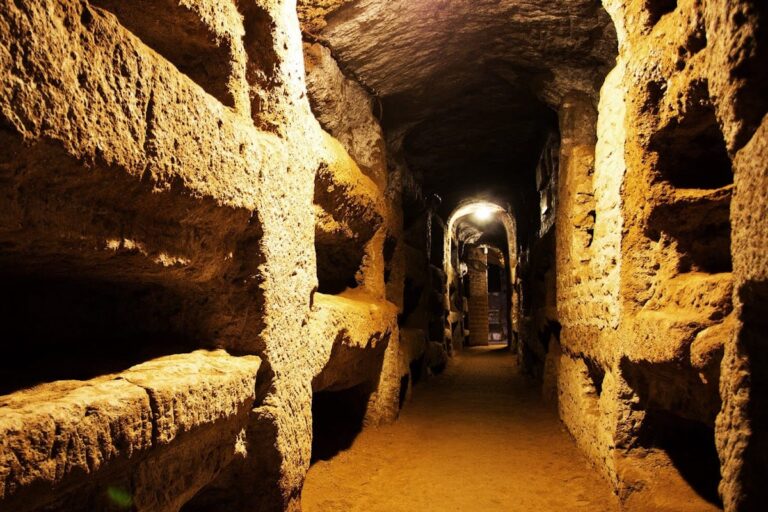
The surviving complex consists of underground burial galleries arranged on three levels, with tunnels, burial cubicles, chambers, and stairways connecting different areas. The former first of four floors has been almost entirely destroyed. The pozzolan mines that preceded the cemetery lay about ten metres above the floor of the Basilica of Saint Sebastian outside the Walls. Above the catacombs, the basilica and its surrounding burial area preserve architectural and decorative remains associated with early Christian art and architecture.
Early pagan burial areas
Columbaria beside the Via Appia
The first-century columbaria stood along a side road beside the Via Appia. Their connected rows of recesses held cremation urns, while two larger chambers at the western end were probably linked to a pagan funerary group. They belong to the cemetery’s earliest known phase, before the underground galleries developed into a Christian burial complex.
The mausoleums of the piazzola
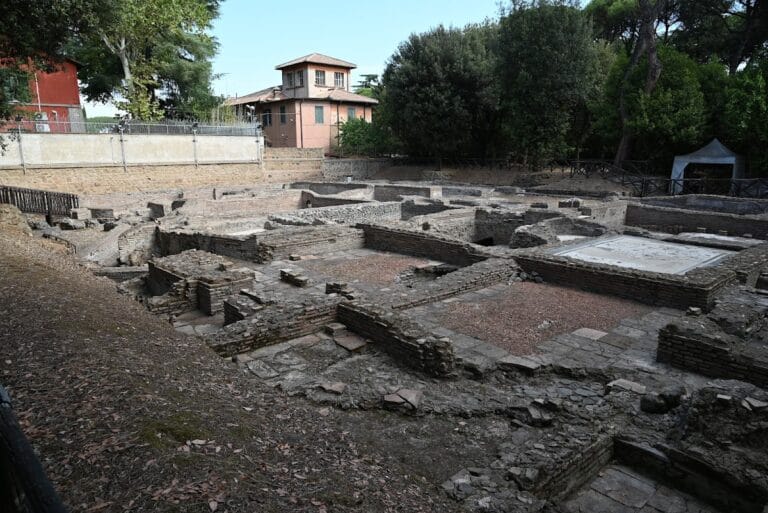
The circular piazzola was formed from an open-pit mine. Three mausoleums were cut into its walls during the second half of the second century. They were later reused, and anchors and fish painted in some of their spaces indicate Christian funerary use. The area was subsequently filled to create the raised embankment on which the commemorative buildings and later basilica were established.
Mausoleum of Marcus Clodius Hermes
The first mausoleum on the right has exterior paintings of funeral banquets and the exorcism of the Gerasene demoniac. An inscription names its owner as Marcus Clodius Hermes. Inside are graves and painted decoration, including a vault with a Gorgon’s head. The chamber was initially intended for cremation urns belonging to Hermes and his family, then adapted for the burial of bodies.
Mausoleum of Innocentiores
The Mausoleum of Innocentiores takes its name from the funerary association to which it belonged. Its vault is decorated with refined stucco. Recesses contain inscriptions written in Latin with Greek characters, together with a graffito bearing Ichthys, an early Christian fish symbol formed from the initials of the phrase “Jesus Christ, Son of God, Savior.”
Mausoleum of the Adze
The Mausoleum of the Adze is named for an adze shown on its exterior. Its decoration includes vine shoots emerging from kantharoi, handled vessels set on false columns. The imagery forms part of the varied decoration preserved among the earlier mausoleums around the cemetery’s open-pit area.
Commemorative spaces and apostolic associations
The triclia
The triclia was a covered porticoed hall used for commemorative meals and meetings connected with the dead. More than 600 graffiti invoking Peter and Paul survive on its walls in Latin and Greek. The inscriptions are displayed behind glass in the meeting area and preserve the site’s association with the two apostles.
The marble-faced shrine
A marble-faced aedicule, a small shrine-like architectural structure, stood on the raised level near the triclia. Archaeologists consider it a possible place where the relics attributed to Peter and Paul were kept during their temporary transfer to the catacombs. A covered room beside these monuments contained a well used to draw water.
The basilica and underground galleries
Basilica structures
Within the right nave of the former basilica are arches connected with the church’s middle nave. The arches were walled up in the thirteenth century. The same area exposes the exterior of the apse of the Chapel of Relics. Whole and fragmentary sarcophagi, mostly dating from the fourth century, were found during excavations and assembled in the basilica area above the catacombs.
Access to the burial galleries
A staircase leads from the basilica to the tunnels and their burial cubicles. The Cubiculum of Jonah contains paintings from the end of the fourth century showing four scenes from the prophet’s life. Near the simple tomb associated with Saint Sebastian are paintings of an ox and a donkey, imagery connected with the Nativity of Christ and intended to identify the burial place.
Crypt of Saint Sebastian
The restored Crypt of Saint Sebastian contains an altar that replaced an earlier one, whose base remains visible. It also holds a bust of Saint Sebastian attributed to Gian Lorenzo Bernini, the leading Italian sculptor and architect of the seventeenth-century Baroque period. Beneath a landing near the crypt is a cavity in the sandstone that may have contributed to the cemetery’s association with the name ad catacumbas.
Tomb of Eutychius
An inscribed poem dedicated to Eutychius is displayed at the entrance of the basilica. His tomb was found during twentieth-century excavation in an unstable area of the catacombs. Its precise location within the complex remains uncertain because the area where it may lie was sealed by earth at an early date.