Trajan’s Column, Rome: A Roman Monument to the Dacian Wars


Site at a Glance
- Rating
- 4.8
- Popularity
- Medium
- Country
- Italy
- Primary era
- Classical
- External website
- Open
- Eras represented
- Classical, Early Modern
- Civilizations
- Papal States, Roman
- Site type
- Civic
- Remains
- Monument
On this page15 sections
History
Trajan’s Column is a Roman monument in Italy commemorating Emperor Trajan’s conquest of Dacia during the Dacian Wars of 101–102 and 105–106. Completed and dedicated on 12 May 113, it formed part of Trajan’s Forum and combined a public memorial with a funerary purpose. The emperor Trajan, who ruled from 98 to 117, was traditionally regarded as one of Rome’s most successful military rulers. Dacia was a kingdom north of the lower Danube, broadly corresponding to parts of modern Romania and neighboring regions.
Construction and Imperial Commemoration
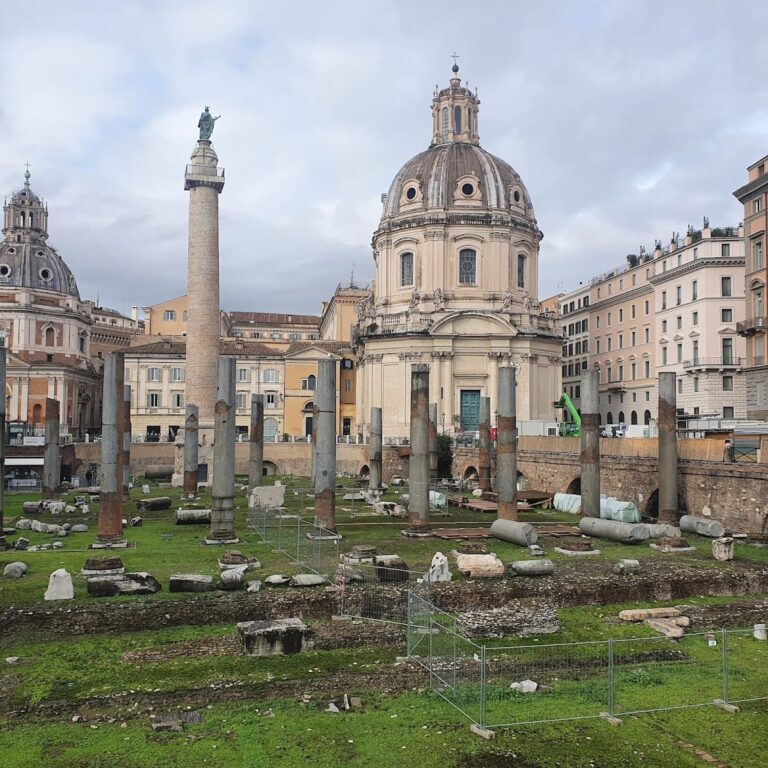
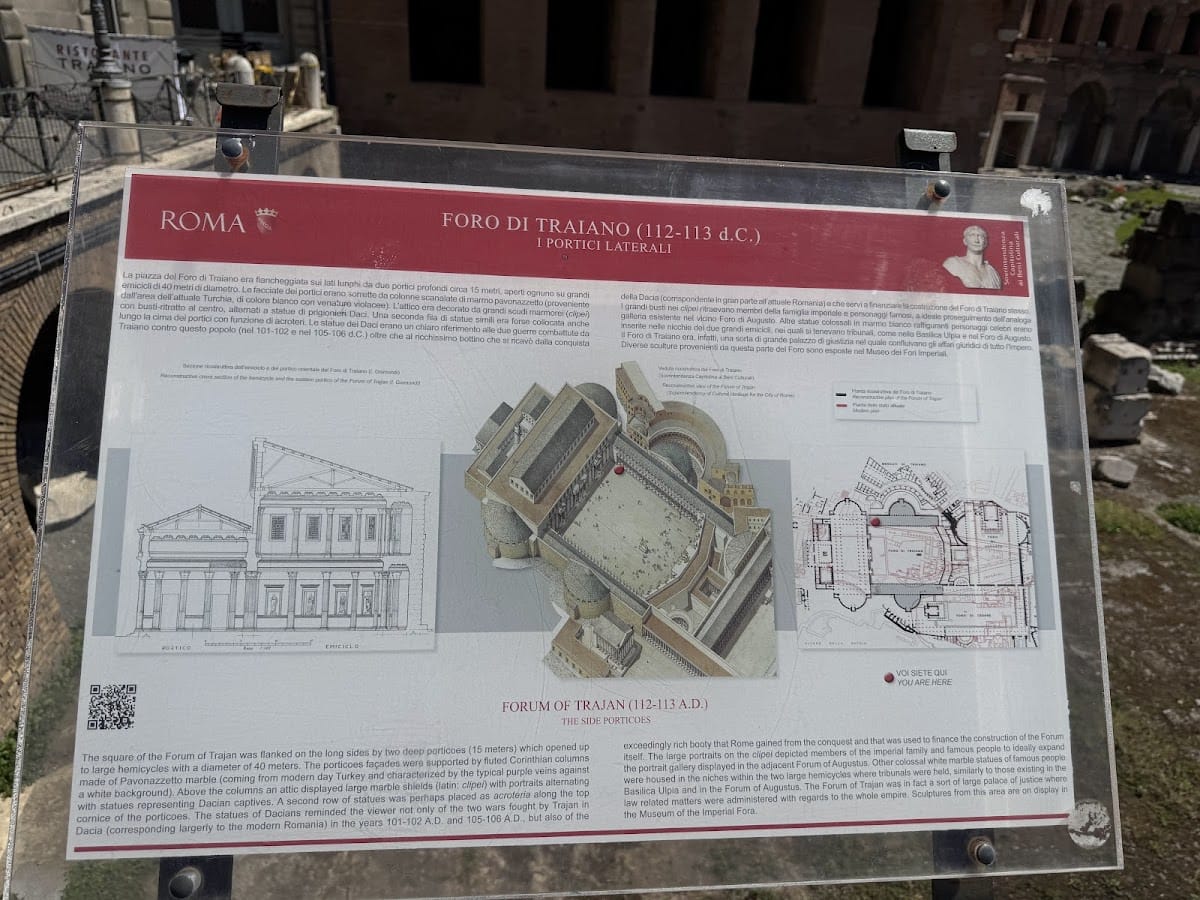
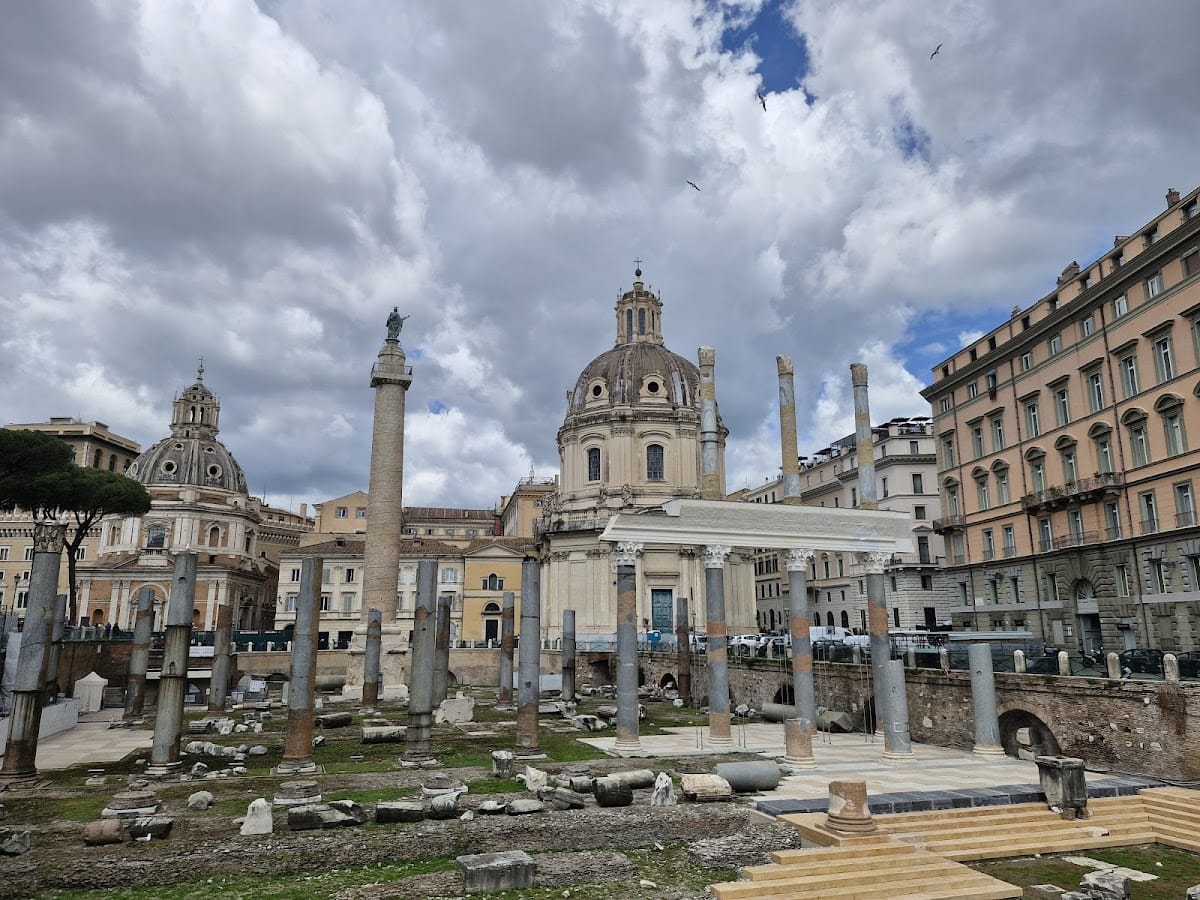
The column was probably erected under the supervision of Apollodorus of Damascus, a major architect associated with Trajan’s building program, and at the order of the Roman Senate. It stood in a narrow court behind the Basilica Ulpia, between two presumed libraries, one connected with Latin texts and the other with Greek texts. Double loggias and probably raised platforms on the surrounding buildings may have allowed viewers to examine the relief more closely.
The inscription on the pedestal states that the monument marked the height of the mountain and ground removed to create Trajan’s Forum. This practical statement gave the column a further connection to the emperor’s urban building project. After Trajan’s death in 117, the chamber in its base held his ashes and those of his wife, Plotina, in golden urns.
Medieval and Early Modern History
Trajan’s Column remained standing after the other structures of the forum fell into ruin. In 1162, a medieval Senate document declared it public property and prohibited damage to the monument. A small church called San Niccolò de Columna stood, or probably stood, at its foot. It is recorded from 1032, together with an oratory at the summit, although both may have originated in the eighth or ninth century. The church was probably removed during preparations for the visit of Charles V to Rome in 1546.
During the sixteenth century, private buildings around the column were demolished and the buried part of the pedestal was partly exposed. In 1587, during the pontificate of Sixtus V, Domenico Fontana installed a bronze statue of Saint Peter on the summit and enclosed the monument with a wall or railing. This statue remains in place. It replaced the original bronze statue of Trajan, which disappeared during the Middle Ages.
Excavation and Later Influence
During the French occupation of Rome, General François René Jean de Pommereul considered removing the column and sending it to France. Transport costs and opposition from the Papal administration prevented the plan. Napoleon’s Column Vendôme in Paris, erected in 1810 after the Battle of Austerlitz, was later modeled on Trajan’s Column.
The area around the pedestal was repeatedly cleaned and reorganized, and excavations began in the early nineteenth century. Plaster casts of the relief were made during the nineteenth and twentieth centuries. Acid pollution has made some details on the casts easier to read than on the original marble. The monument’s preservation has allowed its sculpted narrative to remain central to the interpretation of Trajan’s wars.
The Narrative of the Dacian Wars
The relief was probably based partly on Trajan’s lost prose account of the campaigns, the Dacica, and perhaps also on the artist’s direct experience of the events. Its narrative presents the Roman army as disciplined and effective, while also showing ceremonies, supply movements, construction, diplomacy, and landscapes. The result combines a documentary character with a clear propagandistic purpose.
The lower half of the frieze represents the first campaign of 101–102, while the upper half covers the second campaign of 105–106. Between them stands an allegorical figure of Victory writing on a shield between two trophies. The sequence includes the Roman crossing of the Danube, the movement of troops and supplies, councils of war, addresses to soldiers, sacrifices, the construction of camps and bridges, battles, sieges, diplomatic missions, and the surrender of Dacian leaders.
Later episodes show the assault and capture of Sarmizegetusa, the removal of the Dacian royal treasure, the death of King Decebalus, and the deportation of Dacian families. Other scenes include the torture of Roman prisoners by Dacian women, a speech by Decebalus, the poisoning of Dacian leaders, the presentation of Decebalus’s head to Trajan, the king’s suicide, and the capture of his sons. These episodes give the monument a strongly Roman interpretation of the conflict.
Trajan appears approximately fifty-nine times. He leads troops, supervises camp construction, performs sacrifices, addresses soldiers in the adlocutio, a formal speech by a commander to his troops, directs combat, receives the submission of defeated peoples, and witnesses executions. His portrayal emphasizes command, judgment, and military competence rather than supernatural qualities. The personified Danube is the principal symbolic figure, shown as a bearded river deity emerging from the water and inviting the Roman army to cross.
The frieze is attributed to an otherwise unknown artist conventionally called the “Master of Trajan’s Deeds,” who probably directed the overall design with the assistance of a workshop. His identity remains uncertain, and there is no secure basis for identifying him with Apollodorus of Damascus or with the later sculptor Marcus Ulpius Orestes. The monument represented an unprecedented development in Roman historical relief. Its form influenced the Column of Marcus Aurelius in Rome, columns erected in late antiquity at Constantinople, and later monuments including the Column of Alexander and the Column Vendôme.
Remains
Column and Pedestal
Marble Shaft and Base
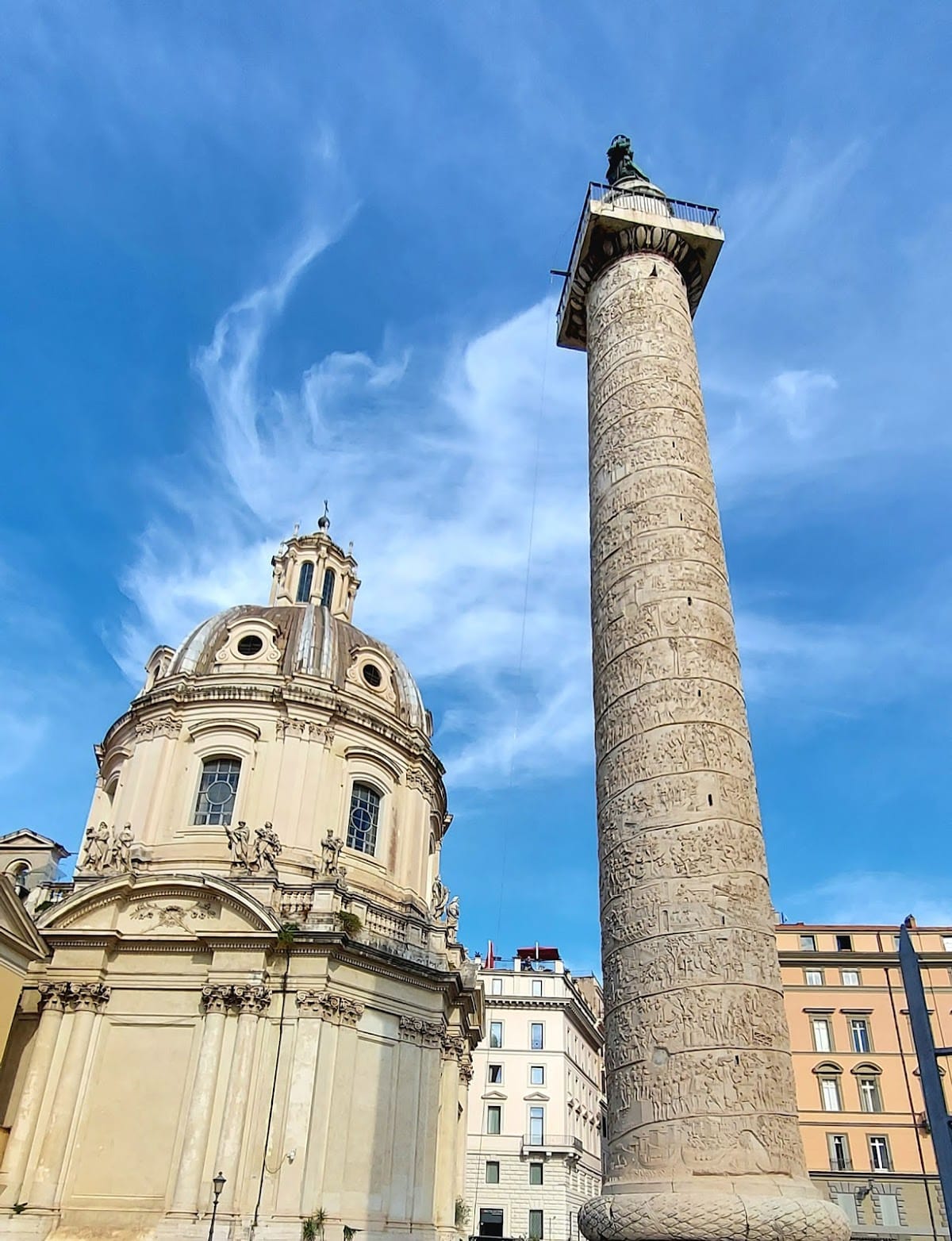
The freestanding column now stands largely isolated from the architectural setting of Trajan’s Forum. Including the pedestal and summit statue, it is approximately 39.86 metres high. The column proper rises about 29.78 metres, almost exactly 100 Roman feet, and its shaft is approximately 3.83 metres in diameter. The structure is hollow and made from colossal Carrara marble blocks fitted together with great precision. The heaviest blocks weighed about 40 tonnes, while the capital, the uppermost part of a column, weighed approximately 53.3 tonnes.
The column uses an adapted Tuscan order. Fluting runs beneath the spiral frieze on the upper shaft, the capital carries an egg-shaped molding, and the base has a crown-like form resting on a plinth, the supporting slab beneath a base. The high pedestal is decorated on three sides with piles of weapons in very low relief. Four eagles at its corners support a laurel garland.
Pedestal Inscription and Funerary Chamber
On the side facing the Basilica Ulpia, a large monumental inscription is supported by figures of Victories. It records the dedication by the Roman Senate and people and explains that the column demonstrated the height of the ground removed for the construction of the forum. The text uses Capitalis Monumentalis, or Roman square capitals, a formal inscriptional style whose carefully proportioned letters later influenced Western typography.
A doorway beneath the inscription opens into a chamber within the pedestal. This chamber held the ashes of Trajan and Plotina in golden urns. The funerary use of the base connected the emperor’s military commemoration with his burial within the monument he had raised in the center of his forum.
Spiral Staircase and Summit
Internal Stairway
A spiral staircase of 185 steps rises through the hollow marble shaft to the summit platform. Forty-three window slits illuminate the ascent. The staircase was carved into several marble blocks, probably before or during their installation, and makes a complete turn in fourteen steps. The joints remain accurately fitted, and the column leans by less than half a degree despite earthquakes.
Summit Statue
Trajan originally stood as a bronze statue on the summit. In 1587, the ancient figure was replaced by a bronze statue of Saint Peter, installed during the pontificate of Sixtus V. The summit statue forms part of the monument’s present height and gives the column a later religious association while the shaft below continues to preserve its imperial Roman narrative.
Helical Relief
Composition and Technique
The continuous helical, or spiral, frieze extends for approximately 190–200 metres and winds around the shaft about twenty-three times. It contains roughly 100–150 scenes and approximately 2,500 figures. The sculpted band increases in height from about 0.89–1 metre at the bottom to about 1.2–1.25 metres at the top, compensating for the effects of perspective. According to the numbering established by Salomon Reinach, the relief consists of 114 panels of equal width. Panels 1–57 depict the first campaign, panel 58 shows Victory writing the Res gestae, meaning “deeds accomplished,” and panels 59–114 depict the second campaign.
The carving is deliberately shallow so that the relief does not disrupt the column’s architectural outline. Some forms are cut almost in negative relief and strengthened by deeply drilled contour lines. Irregular edges and the low carving suggest the appearance of a painted textile band wrapped around the shaft. The frieze originally had extensive polychromy, probably including names of places and people, while small bronze weapons such as swords and spears were attached to the hands of some figures.
Military and Landscape Scenes
The scenes contain carefully rendered rocks, trees, rivers, bridges, forts, camps, ships, weapons, armor, and other military equipment. Landscapes and buildings are sometimes shown from above or in an inverted perspective, and their scale can differ from that of the human figures. Approximately thirty-seven individually stylized tree types appear in the relief, along with details such as a ballista, or catapult.
Twelve episodes show marching or the transfer of troops, while seventeen detailed scenes depict camp or infrastructure construction. Bridges, fortifications, ships, river crossings, sacrifices, sieges, assaults with ladders and war machines, palisades, burning settlements, and the fortified Dacian capital of Sarmizegetusa all contribute to the unfolding account. The combination of specific environmental details and sequential action makes the relief refer to particular places and events rather than generalized battle imagery.
The sculptural style combines low-relief historical narration with naturalistic figures, varied poses, dynamic battle compositions, and detailed landscapes. Deeply drilled outlines and the treatment of fallen bodies reflect Hellenistic artistic techniques, while the orderly sequence and emphasis on Roman military organization are characteristically Roman. Together, the physical form and the narrative make Trajan’s Column both an architectural monument and a sustained visual account of the Dacian campaigns.