Capitoline Museums: Rome’s Civic Museum Complex


Site at a Glance
- Rating
- 4.7
- Popularity
- High
- Country
- Italy
- Primary era
- Early Modern
- External website
- Open
- Eras represented
- Iron Age, Classical, Medieval, Early Modern, Modern
- Civilizations
- Papal States, Roman
- Site type
- Civic
- Remains
- Palace
On this page23 sections
History
The Capitoline Museums are Rome’s principal civic museum complex in Italy, located on the Capitoline Hill in the historic centre of Rome. Their collection began in 1471, when Pope Sixtus IV returned important ancient bronzes from the Lateran to the Roman people. The gesture was presented as the restitution of Rome’s ancient heritage, and the museums later developed into a public institution devoted to the city’s art, archaeology, and civic history.
The foundation of the collection
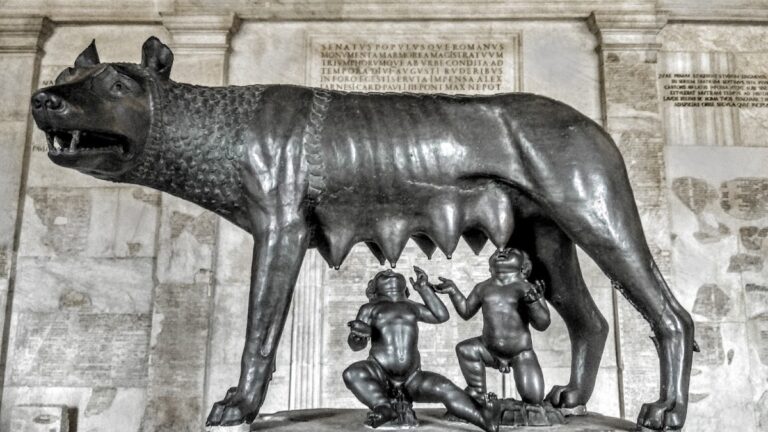
The first group of bronzes included the Capitoline Wolf, the Camillus, the Boy with Thorn, and fragments of a colossal statue of Domitian. They were installed on the Capitoline, where the Wolf replaced a sculpture of a lion attacking a horse and became a symbol of Rome. Their placement connected the memory of imperial Rome with the temporal authority of the papacy, while also asserting papal control over the Capitoline Hill, one of Rome’s historic seven hills and an ancient religious and political centre associated especially with the Temple of Jupiter Capitolinus.
Sixtus IV selected the hill because it was dominated by the Palazzo Senatorio, which had been constructed above the remains of the ancient Tabularium. The Tabularium was a Roman archival building or archival complex associated with records on bronze tablets, although the precise extent and function of the surviving structure remain uncertain. During the late fifteenth and sixteenth centuries, ancient sculptures increasingly came to the Capitoline. This reflected a growing interest in studying and collecting Rome’s antiquity, rather than simply reusing ancient materials.
The collections expanded through further papal gifts and municipal acquisitions. Among the additions were the gilded Hercules from the Forum Boarium, two colossal river-god statues from the Baths of Constantine, three relief panels from a monument to Marcus Aurelius, the Capitoline Fasti, the Capitoline Brutus, and the bronze law known as the Lex de imperio Vespasiani, which defined powers granted to the emperor Vespasian. In 1566 Pope Pius V also transferred sculptures from the Vatican Belvedere to the Capitoline.
Michelangelo and the Capitoline square
In 1537 Pope Paul III ordered the equestrian statue of Marcus Aurelius to be moved to the Capitoline and commissioned Michelangelo Buonarroti to redesign the square. Michelangelo, the leading Italian Renaissance artist and architect responsible for the new plan, created the trapezoidal Piazza del Campidoglio and gave its buildings a more unified appearance. The project involved the Palazzo Senatorio, the Palazzo dei Conservatori, and the later Palazzo Nuovo, as well as the arrangement of important sculptures in the piazza. Work continued for more than a century.
The Palazzo Nuovo was begun in 1603 and completed in 1663. With the development of the museum complex, medieval, Renaissance, and Baroque works joined the Roman antiquities. The Capitoline therefore became not only a repository of ancient sculpture but also a civic setting in which different periods of Rome’s artistic history were assembled.
The creation of a public museum
Pope Clement XII opened the museums to the public in 1734. They are widely regarded as among the oldest public museums, conceived as a place where art could be viewed by everyone rather than remaining accessible only to private owners. In the same period, Clement XII acquired the collection of Cardinal Alessandro Albani. Pope Benedict XIV established the Capitoline Art Gallery from the Sacchetti and Pio collections, while Cardinal Silvio Valenti Gonzaga helped shape its development.
More than 180 paintings were acquired from the Sacchetti family in 1748. Further works entered through purchases, bequests, and donations, including the Cini donation of 1880. The gallery has been under the jurisdiction of the Municipality of Rome since 1847. Its holdings include paintings by Caravaggio, Titian, Peter Paul Rubens, Annibale Carracci, Guido Reni, Guercino, Mattia Preti, Pietro da Cortona, Domenichino, Giovanni Lanfranco, Dosso Dossi, Garofalo, and Diego Velázquez.
The Egyptian collection also grew during the eighteenth century. In 1714 Pope Clement XI donated five statues found near Porta Salaria. From 1838, however, most of the Egyptian sculptures were transferred to the Vatican, and the Capitoline museums consequently lost much of this part of their holdings.
War, restitution, and changing collections
During the French occupation and the Napoleonic period, the Treaty of Tolentino required important works from Rome to be transferred to the Louvre. The Boy with Thorn, Capitoline Brutus, Dying Gaul, Capitoline Venus, and other works returned in 1815 through recovery efforts associated with Antonio Canova and the settlements that followed Napoleon’s defeat. Some works, including the Sarcophagus of the Muses, remained in the Louvre.
The transfer of the capital of the Kingdom of Italy to Rome in 1870 brought extensive urban construction and archaeological discoveries. Finds from excavations in the city and its suburban gardens were collected in a municipal archaeological storehouse, later known as the Antiquarium of the Caelian, and were gradually displayed in the Capitoline Museums. The collections consequently moved from an antiquarian emphasis toward a more archaeological presentation, in which objects were grouped with greater attention to their historical and physical contexts.
Rodolfo Lanciani reorganized the collections in 1903 according to stricter museum-display principles. Works were grouped by archaeological context, and the arrangement placed greater emphasis on historical interpretation than on the isolated aesthetic appreciation of masterpieces. Lanciani was also involved in recording excavations carried out as Rome was transformed into the capital of Italy.
Twentieth-century expansion
During the 1920s and 1930s, the complex was enlarged and modernized. Palazzo Caffarelli was incorporated, the Braccio Nuovo was created in 1936, and an underground connection between the Capitoline buildings was excavated. This passage later became the Lapidary Gallery. The expansion provided space for material recovered during urban excavations, particularly on the slopes of the Capitoline.
In 1957, the Palazzo dei Conservatori hosted the signing of the Treaties of Rome, which established the European Economic Community. In 1997, the former Centrale Montemartini, a thermoelectric plant in Rome’s Ostiense district, became a branch of the museums. Hundreds of sculptures were initially moved there after water infiltration and humidity closed the Lapidary Gallery and parts of the Palazzo dei Conservatori. The temporary exhibition became permanent, combining industrial archaeology with classical archaeology.
The Exedra of Marcus Aurelius was inaugurated in December 2005 in the former Roman Garden. Designed by Carlo Aymonino, it formed part of the wider Grand Capitole redevelopment, which also involved the Lapidary Gallery, Palazzo Caffarelli, the Capitoline coin collection, and the display of the foundations of the Temple of Capitoline Jupiter. In 2024, a full-scale reconstruction of the Colossus of Constantine, approximately 13 metres high, was installed in the gardens of Villa Caffarelli. It was based on technical analysis of the original fragments, together with literary and inscriptional evidence.
The Capitoline Museums continue to function as a civic museum complex with permanent collections and temporary exhibitions. Their principal historic buildings are the Palazzo dei Conservatori and Palazzo Nuovo, supplemented by museum spaces in Palazzo Caffarelli, the Tabularium, the Lapidary Gallery, and Centrale Montemartini.
Remains
The museums occupy the Palazzo dei Conservatori and Palazzo Nuovo on opposite sides of Michelangelo’s trapezoidal Piazza del Campidoglio. The Palazzo Senatorio and the remains of the Tabularium form the principal backdrop, while the Temple of Veiovis and other ancient structures are integrated into the underground and architectural setting. Together, the buildings preserve a layered arrangement in which Renaissance and Baroque architecture incorporates surviving elements of ancient Rome.
Palazzo dei Conservatori
Façade and civic apartments
The Palazzo dei Conservatori was erected in its present position under Pope Nicholas V as the seat of Rome’s elected Conservators, who administered the city with the Senator. Michelangelo redesigned the façade with tall Corinthian pilasters on large pedestals, an Ionic order supporting the portico vaults, and regularly spaced large windows. Guido Guidetti continued the work, and Giacomo della Porta completed it in 1568, adding a larger first-floor reception room and window. Interior changes included a monumental staircase and the redistribution of the Conservators’ Apartment, alterations that destroyed an earlier cycle of early sixteenth-century frescoes in rooms facing the piazza.
The Conservators’ Apartment consists of nine representative rooms associated with the city’s magistracy. Frescoes, stucco, carved ceilings, doors, and tapestries decorate the rooms, whose subjects include the foundation of Rome, the Republic, and the Punic Wars, drawing especially on Livy’s history.
Courtyard sculpture
The courtyard contains fragments of the Colossus of Constantine, including the head, hands, feet, and parts of the arms. The statue originally stood in the western apse of the Basilica of Maxentius and Constantine. It was probably an acrolith, a composite statue with stone flesh and other parts made from materials such as bronze or wood. The figure was supported by a wooden and brick structure and probably included gilded bronze elements. Its total height is estimated at about 12 metres, while the head measures 2.60 metres and one foot about 2 metres. Its date falls between approximately AD 313 and 324.
The same courtyard contains reliefs personifying Roman provinces from the Temple of Hadrian in Piazza di Pietra. Some were found in the late sixteenth century and others in 1883. The temple was probably begun in memory of the deified Vibia Sabina, Hadrian’s wife, and completed around AD 145 by Antoninus Pius.
Under Alessandro Specchi’s portico stand colossal Dacian statues in grey-brown marble from Trajan’s Forum. Pope Clement XI acquired them from the Cesi collection in 1720, and additional Dacian figures from the same collection are also displayed. Between them is a seated statue of the goddess Roma, about 3.10 metres high, probably from a first-century arch. Its form follows the type of Greek statues associated with Phidias.
Reliefs and ceremonial rooms
The staircase from the courtyard contains ancient Roman reliefs. Three panels installed on the Capitoline in 1515 belonged to a triumphal arch dedicated to Marcus Aurelius and were carved in AD 173 and 176. They show the submission of Germanic leaders, the emperor’s triumphal entry into Rome, and his sacrifice before the Temple of Jupiter. Three further panels concern Hadrian, depicting his arrival, an imperial distribution of food, and the apotheosis of Vibia Sabina. One came from Piazza Sciarra and two from the demolished Arch of Portugal.
Two nearly symmetrical opus sectile panels, a technique using pieces of coloured marble fitted into decorative designs, show a tiger attacking a calf. Made in the second quarter of the fourth century, they came from the Basilica of Junius Bassus on the Esquiline. Each measures approximately 1.24 by 1.84 metres.
The Hall of the Horatii and Curiatii was formerly the meeting place of the Public Council and remains a ceremonial room. Giuseppe Cesari’s frescoes depict the Horatii and Curiatii, the Sabine women, the discovery of the Wolf, and the battle between Romans and Veientes. The room also contains marble and bronze honorary statues of Pope Urban VIII by Gian Lorenzo Bernini and Pope Innocent X by Alessandro Algardi.
The Hall of the Captains contains frescoes by Tommaso Laureti, produced between 1586 and 1594. Their subjects include Mucius Scaevola and Porsenna, Horatius Cocles on the Sublician Bridge, the Justice of Brutus, and the Battle of Lake Regillus. Memorials and commemorative statues honour papal commanders including Alessandro Farnese, Marcantonio Colonna, Carlo Barberini, Tommaso Rospigliosi, and Gianfrancesco Aldobrandini.
The Hall of Hannibal preserves an early sixteenth-century fresco cycle dating to around 1516. Its scenes concern the Punic Wars, including Rome’s triumph over Sicily, Hannibal in Italy, negotiations between Lutatius Catulus and Hamilcar, and a naval battle traditionally identified with the Battle of the Aegadian Islands in 241 BC. The attribution of the principal fresco to Jacopo Ripanda has been questioned.
The Chapel is dedicated to the Virgin Mary and Saints Peter and Paul, the city’s patrons. Michele Alberti and Iacopo Rocchetti frescoed it between 1575 and 1578. Its altar, dismantled after 1870 and later reconstructed, has coloured-marble decoration and supports Marcello Venusti’s Madonna and Child between Saints Peter and Paul, painted in 1577 and 1578.
The Hall of Tapestries was designated in 1770 to house the papal canopy. Its tapestries were produced at the Pontifical Factory of San Michele a Ripa from designs by Domenico Corvi, with subjects based on works displayed at the Capitoline. An eighteenth-century blue and gilded hexagonal-coffered ceiling completes the room.
Bronzes, records, and decorative rooms
The Hall of Triumphs contains the Roman bronzes known as the Boy with Thorn, the Camillus, and the Capitoline Brutus. It also displays a bronze vase or crater bearing the name of Mithridates VI Eupator. The principal frescoes, commissioned from Michele Alberti and Iacopo Rocchetti in 1569, depict the triumph of Lucius Aemilius Paullus over Perseus of Macedon in 167 BC. Flaminio Boulanger made the wooden ceiling in 1568.
The Hall of the Wolf contains the Capitoline Fasti, including the Fasti consulares, lists of consuls from 483 to 19 BC, and the Fasti triumphales, lists of official triumphs from 753 to 19 BC. The marble fragments were found in the Roman Forum in the fifteenth century and reassembled according to a design associated with Michelangelo. The surviving wooden coffered ceiling dates from 1865.
The Hall of the Geese contains Bernini’s Medusa, a portrait of Michelangelo, small bronzes, a bronze vase decorated with the bust of Isis, an imperial-period bronze goose, and a table decorated with scenes from the life of Achilles. The room’s imagery relates to the traditional story that sacred geese of Juno Moneta warned Marcus Manlius during the Gallic siege of Rome in 390 BC. The Hall of the Eagles contains views of Rome, including Piazza del Campidoglio, a richly decorated wooden ceiling, and a small statue of Ephesian Artemis.
Archaeological galleries and the art collection
Castellani and Horti collections
The Castellani Rooms contain approximately 700 ceramic and other archaeological objects from Etruria, Latium Vetus, Magna Graecia, Campania, southern Italy, and Rome. Dating from the eighth to the fourth century BC, the material includes imported Greek ceramics and locally produced vessels, allowing artistic production in different parts of the ancient Mediterranean to be compared.
The Horti galleries present material from excavations in the suburban garden estates of Rome. The Horti Lamiani displays include alabaster flooring, coloured-stone decoration from a covered passage, the Esquiline Venus, Commodus represented as Hercules, a Diadoumenos, portraits, torsos, and statues of fauns and female figures. The Horti Tauriani and Vettiani galleries contain ornamental vessels, including examples with Bacchic scenes, and portraits of Hadrian, Vibia Sabina, and Matidia. Material from the Gardens of Maecenas includes a neo-Attic fountain, a caryatid, a figure of Eros or Thanatos, a statue of Hercules, and a mosaic of Orestes and Iphigenia dating from the second or third century.
Marcus Aurelius and the Capitoline temples
The Exedra of Marcus Aurelius is a glass-covered exhibition hall in the former Roman Garden. It houses the original equestrian statue of Marcus Aurelius after its late twentieth-century restoration, the gilded-bronze Hercules from the Forum Boarium, and fragments of the colossal bronze statue of Constantine. In the adjacent archaeological area, the foundations of the Temple of Capitoline Jupiter are displayed with material from sixth-century BC archaic temples excavated at Sant’Omobono and evidence of occupation on the Capitoline from the tenth century BC.
The original equestrian statue of Marcus Aurelius was moved indoors in 1990. A copy was installed at the centre of Piazza del Campidoglio in 1996. It reproduces the original volumes but not its gilding.
The Capitoline Wolf is traditionally regarded as an Etruscan sculpture of the fifth century BC, although some restorers have proposed a medieval date, possibly the twelfth century. The figures of Romulus and Remus were added in the fifteenth century and are attributed to Antonio del Pollaiolo. Other major works include the fourth-century Colossus of Constantine, the bronze Horse from Vicolo delle Palme, the medieval portrait of Charles I of Anjou by Arnolfo di Cambio dated 1277, the Capitoline Brutus, and the Boy with Thorn.
Capitoline Art Gallery
The Capitoline Art Gallery occupies the upper levels of the museum. Important works include Caravaggio’s The Fortune Teller and John the Baptist, Guercino’s Burial of Saint Petronilla, Titian’s Baptism of Christ, Rubens’s Romulus and Remus, and Velázquez’s Portrait of Juan de Córdoba. These paintings form the principal pinacoteca, or gallery devoted mainly to paintings, within the wider civic collection.
Palazzo Nuovo
Palazzo Nuovo was built in the seventeenth century, probably in two phases, under Girolamo Rainaldi and Carlo Rainaldi, who completed it in 1663. Its façade is attributed to Michelangelo and closely reproduces that of the Palazzo dei Conservatori, including the ground-floor portico. Its slightly oblique orientation completes the trapezoidal piazza. The original wood and gilded-stucco decoration survives, and the building has served museum purposes since the nineteenth century.
Courtyard and Egyptian monuments
The atrium has a portico with large statues, including Minerva and Faustina the Elder identified as Ceres, formerly associated with the Vatican Belvedere collection. The courtyard contains a fountain surmounted by the statue of Marforio, found in the sixteenth century in the Forum of Mars. Two mirror-image marble statues of Pan carrying baskets of fruit stand nearby. The so-called Satyrs of the Valley were probably used as male-shaped architectural supports in the Theatre of Pompey and date from the late Hellenistic period. The courtyard also contains a colossal statue of Mars from the Forum of Nerva and a group showing Polyphemus holding a young prisoner.
The Hall of Egyptian Monuments displays large granite sculptures behind a glass wall. They include a bell-shaped vessel from Hadrian’s Villa, a sphinx of Pharaoh Amasis of the Twenty-Sixth Dynasty, a crocodile, cynocephali, a hawk, and a scarab. The works came from an Egyptian pavilion in the Horti Sallustiani built under Hadrian. Most of the original Egyptian group was later transferred to the Vatican.
Inscriptions, mosaics, and sculpture galleries
The ground-floor rooms contain epigraphic monuments, fragments of post-Caesarian Roman calendars, the Fasti Minori, portraits of private Romans, the cinerary monument of T. Statilius Aper and Orcivia Anthis, and a sarcophagus with scenes from the life of Achilles.
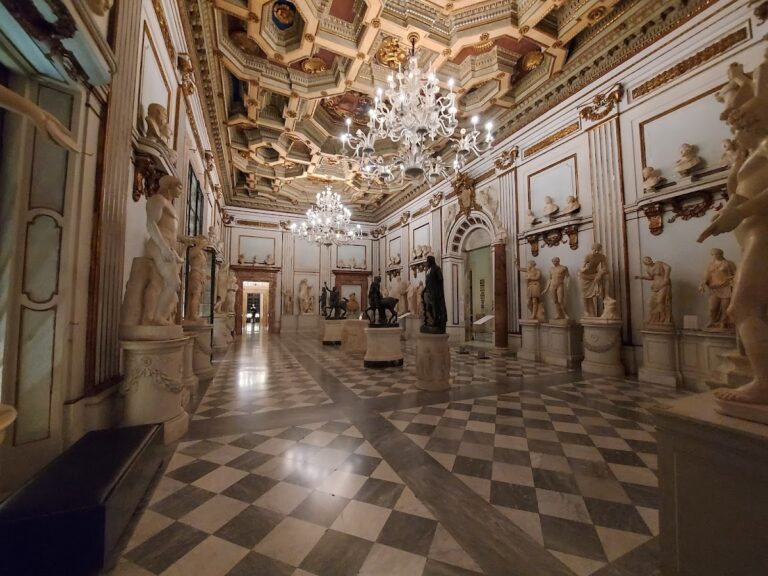
The long Gallery connects the exhibition rooms and contains roughly one hundred sculptures, portraits, reliefs, and inscriptions. Its eighteenth-century arrangement emphasizes architectural symmetry and ornamental effect. Works include a Roman copy of Hercules fighting the Hydra, a restored fragment of Hercules’s leg, Leda with the Swan, the Capitoline Discobolus or wounded warrior, Eros with the Bow, the Child Hercules strangling a serpent, and the Old Drunken Woman.
The Hall of the Doves takes its name from the Mosaic of the Doves, a floor mosaic found at Hadrian’s Villa and attributed to the Greek mosaicist Sosos of Pergamon. The room also contains the Mosaic of Theatrical Masks, portraits of Trajan and other Romans, funerary inscriptions, the Tabula Iliaca, the bronze of Ascoli, a bronze inscription dedicated to Septimius Severus, a senatorial decree concerning Asclepiades of Clazomenae, and a marble statue of a girl with a dove.
The Cabinet of Venus is a small polygonal room with the character of a fountain chamber, built around the Capitoline Venus. The statue is slightly larger than life at 1.93 metres, probably made of Parian marble, and shows Venus emerging from her bath in the Venus pudica type. It is a Roman copy of a form associated with Praxiteles.
The Hall of the Emperors contains 67 portrait busts, a seated female statue, eight reliefs, and an honorary inscription. The portraits are arranged chronologically on two levels of marble shelves, tracing Roman portraiture from the Republic to Late Antiquity. They include emperors from Augustus through Honorius and portraits of Livia, Plotina, Faustina the Elder, Faustina the Younger, and Julia Domna. A statue of Helena, the mother of Constantine, stands at the centre.
The Hall of the Philosophers contains 79 portraits, busts, and herms of ancient poets, philosophers, and rhetoricians. Among them are Homer, Pindar, Pythagoras, Socrates, Aeschylus, Sophocles, Euripides, Demosthenes, and Cicero.
The Salone is Palazzo Nuovo’s most monumental interior. Its great arched portal, designed by Filippo Barigioni, has two winged Victories. The room displays the Old and Young Centaurs from Hadrian’s Villa, imperial sculptures in bronze and marble, Asclepius, Apollo of the Omphalos, Hermes, Pothos restored as Apollo Citharoedus, Marcus Aurelius and Faustina the Younger, a young satyr, the Hare Hunter, Harpocrates, Athena Promachos, and other works.
The Hall of the Faun contains the Red Faun, discovered at Hadrian’s Villa in 1736, restored by Clemente Bianchi and Bartolomeo Cavaceppi, purchased in 1746, and placed in the room in 1817. The room also contains the bronze Lex de imperio Vespasiani, a first-century document whose text was cast rather than engraved, together with inscriptions, busts, and statues.
The Hall of the Galatian is centred on the Dying Gaul, a Roman copy of a third-century BC Greek bronze from the Attalid victory monument at Pergamon. Other works include the Wounded Amazon, Capitoline Antinous or Hermes-Antinous from Hadrian’s Villa, the Resting Satyr, the Rococo group Cupid and Psyche, and marble busts of Alexander the Great and Marcus Junius Brutus. The Wounded Amazon is slightly larger than life; its raised arm is a restoration and may originally have supported a spear.
Palazzo Caffarelli and underground galleries
Palazzo Caffarelli-Clementino
Palazzo Caffarelli-Clementino stands behind the Palazzo dei Conservatori on the southern slope of the Capitoline and became part of the museum complex in 2000. Its spaces include temporary-exhibition rooms, restored historic rooms, the Capitoline Medagliere, and the Hall of the Pediment.
The Capitoline Medagliere contains municipal coins, medals, and jewellery. Its nucleus derives from Ludovico Stanzani’s bequest of 1872 and was developed with the involvement of Augusto Castellani. The collection includes Roman and Byzantine gold coins, republican denarii, and the Via Alessandrina treasure, discovered in 1942 and consisting of approximately 17 kilograms of gold in coins and jewellery. It opened to the public in 2003.
The Hall of the Pediment contains a reconstruction of terracotta decorations from the pediment of a second-century BC Roman temple. The fragments were found in Via di San Gregorio and reassembled there in 2002.
Lapidary Gallery and Tabularium
The underground Lapidary Gallery was excavated beneath Piazza del Campidoglio in the 1930s to connect the Capitoline buildings. It displays approximately 130 Greco-Roman inscriptions, including a third-century offering to the goddess Caelestis for a safe journey, an altar dedicated to the Sun and Palmyrene gods, a dedication to Hadrian, and Roman funerary inscriptions.
The surviving base of the Tabularium is 73.60 metres long and is built from Aniene tuff and peperino blocks. It supports the Palazzo Senatorio. A 67-step staircase once connected it directly with the Roman Forum, but this access was blocked under Domitian when the Temple of Vespasian was built. The traditional identification of the structure as the state archive remains uncertain because the name derives from a Renaissance inscription referring to an archive, and the archive may have occupied only one or more rooms rather than the entire complex.
The underground Tabularium route includes the colossal statue of Veiovis, architectural elements from the Temples of Vespasian and Concordia, a marble relief of Marcus Curtius leaping into the chasm, and other Roman inscriptions and architectural fragments.
Centrale Montemartini
Centrale Montemartini occupies a former power station along the Via Ostiense. Its displays place the industrial fabric of the plant alongside approximately 400 Roman statues, inscriptions, and mosaics. The collection includes material from Roman gardens, remains of the Temple of Capitoline Jupiter, elements of the architectural complex of the Temple of Apollo Sosianus, and a mosaic from Santa Bibiana.