Tower of Hercules: An Ancient Roman Lighthouse in Spain



Site at a Glance
- Rating
- 4.7
- Popularity
- High
- Country
- Spain
- Primary era
- Classical
- External website
- Open
- Eras represented
- Classical, Early Modern
- Civilizations
- Roman, Spanish
- Site type
- Infrastructure
- Remains
- Lighthouse
On this page10 sections
History
The Tower of Hercules is a working Roman lighthouse in A Coruña, Spain, built in the early second century AD during the Roman period. It is the oldest known surviving Roman lighthouse and the only ancient Roman lighthouse still in active use. Standing on the Atlantic coast of Galicia, it formed part of the coastal infrastructure of Hispania Tarraconensis, a large Roman province whose roads, ports, and maritime installations supported movement and trade.
Brigantia and the Roman lighthouse
Before the Roman conquest, the northwestern Iberian region was associated with the Celtic kingdom of Brigantia. Its capital may have been at present-day Betanzos, although ancient Brigantia has also been identified with A Coruña, around 26 kilometres away. This uncertainty lies behind competing explanations for the name of A Coruña. One connects it with Clunia, a Celtic word associated with a meadow, while another derives it from the lighthouse itself.
In antiquity and the Middle Ages, the tower was known as the Farum Brigantium, or Lighthouse of Brigantium. It may have occupied the position of an earlier Phoenician watchtower. Roman control of Galicia during the first century AD was linked to the exploitation of natural resources, including the gold mines of Las Médulas, and to the supervision of Atlantic sea routes. Dio Cassius recorded Julius Caesar’s arrival at Brigantia, while Ptolemy described the settlement as a wealthy and important Galician port.
A lighthouse existed at the site by the first century AD. Its construction or rebuilding is generally placed in the early second century, perhaps during the reign of Emperor Trajan, around AD 98 to 117. Roman authorities established lighthouses along the Atlantic coast, where dangerous waters were later associated with the name Costa da Morte, meaning “Coast of Death.” An inscription at the base names Gaius Sevius Lupus of Aeminium, in Lusitania, present-day Coimbra, as the architect and dedicates the tower to Mars, the Roman god of war.
Late Roman and medieval transformations
After Roman withdrawal from Galicia in 407, the lighthouse continued to serve as a recognizable landmark. Paulus Orosius referred to the very tall lighthouse of Brigantia in Historia adversum Paganos, written around 415 to 417. He described it as a place from which Britain could be seen, a reference that reflects continuing maritime links between Galicia and Britain.
During the Middle Ages, the tower probably ceased to function as a lighthouse and was adapted as a fortification. Arab, Saxon, Viking, and Norman attacks disrupted regional commerce. In 844, a fleet of 150 Viking ships attacked Galicia and devastated Brigantia. King Ramiro I of Asturias halted the raid in the Battle of the Tower, after which the lighthouse was used for military purposes as coastal watchtowers were established. In 1015, another Scandinavian fleet, led by the future King Olaf Haraldsson of Norway, devastated Brigantia. The town and its lighthouse then entered a period of decline.
The Bay of Betanzos gradually filled with sediment and became unsuitable for large ships. In 1208, King Alfonso IX of León transferred the port to the nearby settlement of Crunia. As the new port expanded, the tower lost its former association with Brigantia and became known simply as the Lighthouse, the Castle, or the Old Castle.
Medieval naval itineraries connected with crusades to the Holy Land sometimes treated the lighthouse as a stopping place. Crusader fleets disembarked there before continuing overland to the shrine of Saint James the Greater at Santiago de Compostela, one of the principal destinations of the Way of Saint James, a network of Christian pilgrimage routes. Some medieval accounts also encouraged the mistaken belief that Julius Caesar had built the tower.
Legends and the name of Hercules
The tower acquired several foundation traditions. The Irish Book of Invasions, written around 1050, attributes the founding of Brigantium and the building of a tower to the Celtic king Breogán. In the story, his sons Ith and Mil sailed toward Ireland after seeing a distant northern land from the tower. A Galician text, Trezenzonii Solistitionis Insula Magna, written around 900 to 1000, tells how the monk Trezenzonius climbed the Tower of Brigantia, saw a distant country, and set out to explore it.
In the late thirteenth century, Alfonso X of Castile used a Greco-Roman legend in his Cronica General to give the tower a different origin. Hercules was said to have defeated the giant Geryon after three days of combat, erected the tower to commemorate the victory, and brought settlers from Galatia, an ancient region of central Anatolia. This story was promoted in Spain during the nineteenth and twentieth centuries and helped establish the modern name Tower of Hercules. Ramón Menéndez Pidal, a philologist, historian, and member of the Royal Spanish Academy, supported this interpretation.
Early modern repair and continuing use
Wars involving Spain, England, and Flanders reduced commercial activity during the early modern period and contributed to the tower’s deterioration. In 1682, the son of the Duke of Lerma commissioned the architect Amaro Antune to restore it and imposed a special levy on ships arriving at the port. Antune inserted a wooden staircase inside the tower and built two small turrets for signal fires. Galician authorities continued to petition the Spanish crown for further repairs during the seventeenth and eighteenth centuries.
José Andrés Cornide spent thirty years investigating the lighthouse and prepared an extensive restoration proposal. In 1788, Charles III ordered the repair. The work was completed in 1791 during the reign of Charles IV under the direction of the naval engineer Eustaquio Giannini. This intervention created the tower’s present external appearance while retaining its Roman core. Between 1799 and 1806, the lamp was replaced with a rotating light and its fuel changed from coal to oil. A platform was added around the tower in 1861, electricity was installed in 1927, and classrooms for Spain’s first school for lighthouse keepers occupied the building from 1849 to 1858.
Excavations beneath the tower in 1994 and 1995 revealed Roman and medieval material, including remains dating from the tenth to the twelfth centuries. They also provided evidence for an external wall around the tower that no longer survives. The Tower of Hercules is a Spanish National Monument and became a UNESCO World Heritage Site in 2009 under cultural criterion iii. The protected property also includes a small Roman building beside the lighthouse, a sculpture park, Iron Age rock art at Monte dos Bicos, and a Muslim cemetery.
Remains
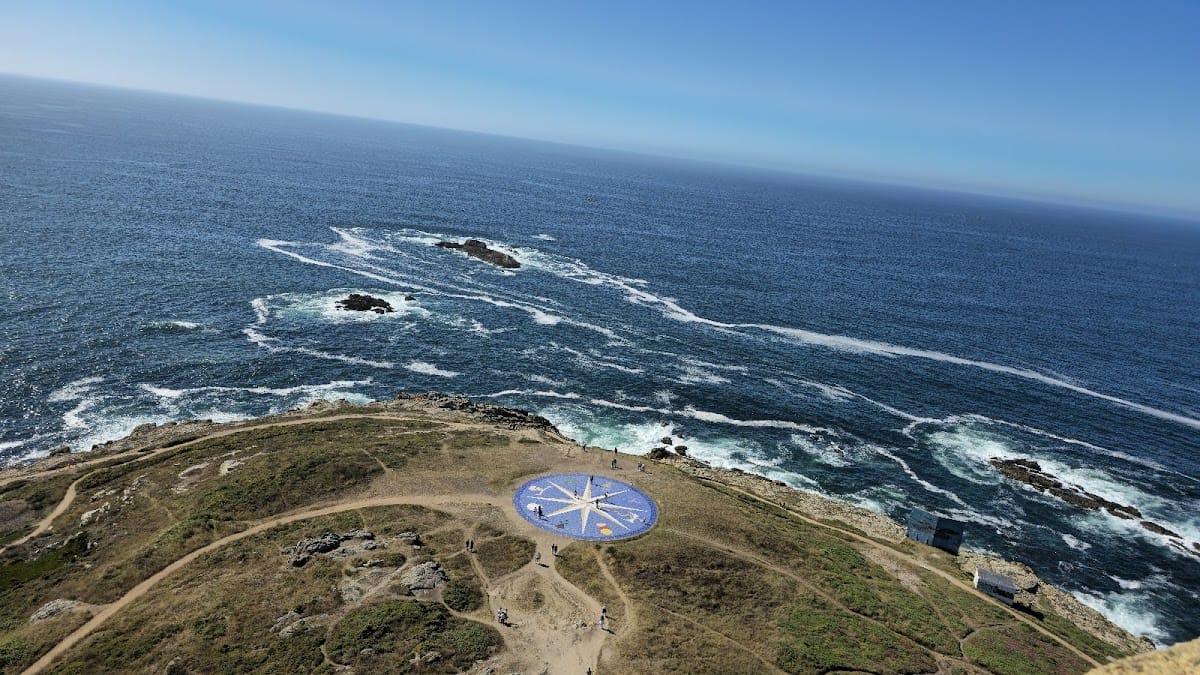
The lighthouse occupies a peninsula in northern A Coruña, where a rocky shore rises about 57 metres above the waters of the Bay of Betanzos. The tower itself is 55 metres high. Its surviving fabric combines a Roman square, prismatic structure with the external appearance created by the 1791 restoration. Granite walls, interior rooms, the trace of the former outer route, and the modern lighthouse installation together express the building’s long development.
The Roman tower and its restoration
Roman core
The original Roman tower was shorter and broader than the present building. It had a square base, two asymmetrically positioned exterior doors, irregularly placed windows, and a spiral route cut into the outer masonry. The outline of this route remains visible on the exterior. The Roman design may have drawn on the Lighthouse of Alexandria, also called the Pharos, and may have continued a Phoenician design tradition. The original upper level probably ended in a dome, while the external spiral ramp allowed movement around the structure.
The Roman core is approximately 34 metres high. Each of its three lower storeys contains four rooms. The granite walls are 2.15 metres thick, with an inner section measuring 155 centimetres and an outer facing 60 centimetres thick. Roman masonry remains visible inside the tower despite repeated repairs. At the base, a cornerstone carries an inscription attributing the work to Gaius Sevius Lupus and recording its dedication to Mars.
Eighteenth-century upper storey
Before the 1791 restoration, the two lower storeys were each 9.6 metres high and the third storey added 14.35 metres. The restoration replaced the earlier wooden staircase with a stone staircase and clad the Roman structure’s exterior walls. Diagonal bands were added to the facade at Cornide’s direction as reminders of the former outer ramp or staircase.
The fourth storey, added during the restoration, is 21 metres high and contains a two-level octagonal room. It replaced the former semicircular roof with a further level made of two octagonal sections. The resulting exterior gives the ancient core its present profile while retaining substantial Roman construction within it.
Associated archaeological features and representations
A small ancient Roman building stands directly beside the tower. The surrounding property also includes a sculpture park with works by Pablo Serrano and Francisco Leiro, a colossal statue of Breogán, Iron Age rock paintings at Monte dos Bicos, and a Muslim cemetery. Together these features extend the archaeological and cultural setting beyond the lighthouse itself.
The tower’s importance is also reflected in historical images and civic symbols. The earliest known representation of the Brigantian lighthouse appears in the Codex of Burgos de Osma, dated 1086, where it is shown in Galicia near Santiago Cathedral. A large world map made in England around 1300 depicts the tower with a lit signal near the endpoint of the Way of Saint James. The earliest known coat of arms of A Coruña, dated 1448, shows a lighthouse with a hanging lantern and two scallop shells. Later sixteenth-century and royal designs added further shells, a crowned head beneath the tower, an external ramp, and, in some versions, the Holy Grail of the Kingdom of Galicia.