Bunratty Castle: A Fifteenth-Century Tower House in Ireland


Site at a Glance
- Rating
- 4.6
- Popularity
- High
- Country
- Ireland
- Primary era
- Medieval
- External website
- Open
- Eras represented
- Medieval, Early Modern
- Civilizations
- Irish
- Site type
- Military
- Remains
- Castle
On this page12 sections
History
Bunratty Castle is a fifteenth-century fortified residence in Ireland, built in the Norman architectural tradition at Bunratty in County Clare. Its name means “mouth of the Ratty River,” referring to the waterway also known as the Owenogarney, which flows past the castle towards the Shannon Estuary. The site developed from earlier medieval fortifications and became an important centre of English and Gaelic Irish power in the region.
Early settlements and Anglo-Norman control
A Norse trading and military settlement may have occupied the wider area during the ninth or tenth century. The Annals of the Four Masters state that Brian Boru destroyed a Viking settlement here in 977. Local tradition places that settlement southwest of the present castle, while its precise location and relationship to Bunratty remain uncertain.
About 1250, Henry III of England granted the district of Tradraighe, also called Tradree, to Robert de Muscegros, an Anglo-Norman knight. After cutting about 200 trees in the royal forest at Cratloe in 1251, he may have used the timber for Bunratty’s first castle. This was probably a motte-and-bailey fortification, combining a raised mound for the stronghold with an enclosed courtyard, although its exact position is unknown. In 1253, Muscegros received permission to hold markets and an annual fair, helping Bunratty develop as a centre of early Anglo-Norman authority in southeastern Clare.
In 1276, Henry III granted the lands to Thomas de Clare, a descendant of Strongbow, the historical byname of Richard de Clare. Thomas built the first stone castle, which was occupied from about 1278 until 1318. By the late thirteenth century, the settlement had around 1,000 inhabitants, indicating the scale of the community that grew around the stronghold.
Destruction and rebuilding in the thirteenth and fourteenth centuries
The O’Brien clan captured and destroyed the stone castle in 1284 while Thomas de Clare was in England. After returning in 1287, Thomas rebuilt it and surrounded it with a defensive ditch, or fosse, about 130 metres long. The castle endured further attacks until 1318, when the de Clare forces were defeated at the Battle of Dysert O’Dea during the Irish Bruce Wars, conflicts connected with Edward Bruce’s campaign in Ireland and resistance to English rule. Thomas’s son, Richard de Clare, was killed in the battle.
Lady de Clare fled to Limerick after ordering Bunratty Castle and the town to be burned. The de Clare family did not return, and the remains of their castle eventually collapsed. Its stones were probably reused in local buildings.
Bunratty was occupied again during the fourteenth century because of its strategic value in protecting English-held Limerick and access through the Shannon Estuary. In 1353, Sir Thomas de Rokeby led an English campaign against the MacNamaras and MacCarthys, two prominent Gaelic Irish dynastic clans. A third castle was built at Bunratty, although its exact location is uncertain. In 1355, Edward III released Thomas Fitzjohn Fitzmaurice from prison after he had been accused of failing to hold Bunratty as its captain or governor. The third castle was captured by Irish forces soon after it was completed.
The present castle and the O’Brien residence
Construction of the present castle began in the fifteenth century, perhaps around 1450. The builder may have been Maccon Sioda MacNamara, chieftain of Clann Cuilein. After his death, his son Sean Finn continued the work and died in 1467.
About 1500, the O’Brien clan acquired Bunratty. Later associated with the Earls of Thomond, the family enlarged the castle and made it their principal residence, moving their seat from Ennis. In 1558, Thomas Radclyffe, Lord Lieutenant of Ireland, captured Bunratty from Donal O’Brien of Duagh and granted it to Donal’s nephew, Connor O’Brien.
Connor’s son, Donogh O’Brien, probably transferred the family residence from Clonroad in Ennis to Bunratty. He also improved the castle, including the installation of a new lead roof. Bunratty remained O’Brien property and was still the principal residence of the Earls of Thomond during the 1680s.
War, private ownership, and decline
During the Irish Confederate Wars, which followed the Irish rebellion of 1641 and involved Confederate, royalist, and Parliamentarian forces, Barnabas O’Brien allowed Lord Forbes, a commander serving the English Long Parliament, to occupy Bunratty in 1646. Barnabas then left for England and joined King Charles I.
The castle’s defenders were commanded by Rear-Admiral Penn. Holding Bunratty enabled the garrison to blockade maritime access to Confederate-held Limerick and the Shannon. Confederate forces eventually captured the castle after a long siege. Penn surrendered and was permitted to sail to Kinsale.
In 1712, Henry O’Brien, the eighth and last Earl of Thomond, sold Bunratty Castle and about 472 acres of surrounding land to Thomas Amory for £225 and an annual rent of £120. Amory later sold the property to Thomas Studdert, who moved into the castle around 1720.
The Studdert family later abandoned the castle and allowed it to deteriorate, choosing instead to live at Bunratty House, built in 1804. During part of the nineteenth century, the castle served as a barracks for the Royal Irish Constabulary. The family returned it to their use in 1894, when Captain Richard Studdert occupied it, but the roof of the Great Hall collapsed late in the century.
Restoration and public protection
In 1956, the seventh Viscount Gort purchased Bunratty Castle and restored it with assistance from the Office of Public Works, the Irish state body responsible for managing and conserving many national monuments and historic properties. The work included reroofing the building and prevented its further ruin. The castle opened to the public in 1960.
Bunratty Castle is a national monument of Ireland, listed under reference number 478. In 2023, ownership passed to Clare County Council as part of the transfer of Shannon Heritage’s tourism sites. The castle and its associated folk park remain connected with the interpretation of medieval and later history, including medieval-style banquets.
Remains
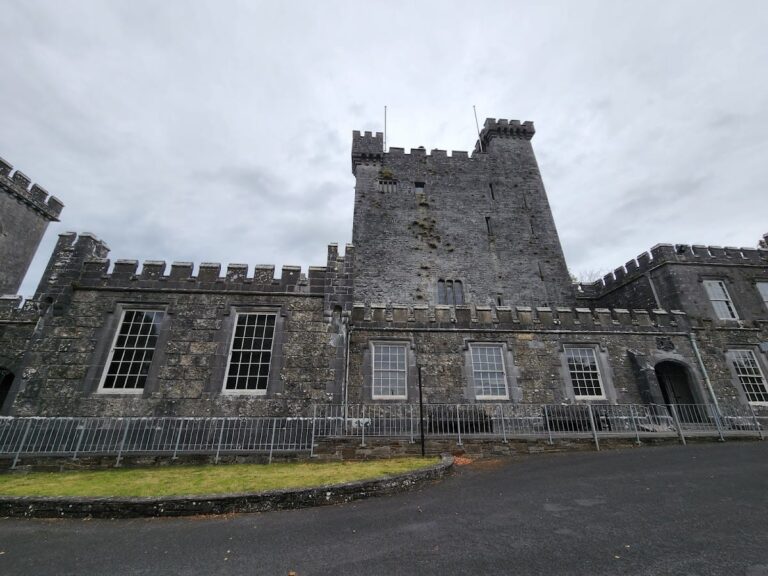
Bunratty Castle is a large fifteenth-century tower house, a fortified residential tower that combines domestic accommodation with defensive features. Its architecture belongs to the Norman tradition, a medieval building style that joined defensive forms with Romanesque features. The present building incorporates later changes made during its occupation by the O’Brien family, including the lead roof installed under Donogh O’Brien.
Earlier fortifications
Robert de Muscegros’s motte-and-bailey
The first castle associated with Robert de Muscegros may have used timber from roughly 200 trees cut in Cratloe’s royal forest in 1251. It was probably a motte-and-bailey, with a stronghold on a raised earthwork mound and an enclosed courtyard. Its exact location has not been established.
The de Clare stone castle
The second castle was a large single stone tower with lime-white walls. It stood near the river, on or close to the site of the present castle, and was rebuilt in 1287 with a fosse approximately 130 metres long. The structure later collapsed, and its stones were probably reused in local construction.
The fourteenth-century castle
A third castle was built in the 1350s during the renewed English interest in defending Limerick and the Shannon Estuary. Its position has not been securely located, although local tradition places it on the site later occupied by Bunratty Castle Hotel.
Interior collections and folk park
The present castle contains furniture, tapestries, paintings, and other works of art dating from approximately the seventeenth and eighteenth centuries. These interior furnishings belong to the later historical presentation of the tower house and complement its surviving fortified residential form.
The castle forms part of a folk park, an open-air museum presenting historic buildings, landscapes, and aspects of past rural life. The park comprises about 30 buildings, including Ardcroney Church, and provides a wider architectural setting for the castle.