Schwarzenberg Castle: A Medieval Territorial Fortress in Germany


Site at a Glance
- Rating
- 4.6
- Popularity
- Medium
- Country
- Germany
- Primary era
- Medieval
- External website
- Open
- Eras represented
- Medieval
- Civilizations
- Holy Roman Empire
- Site type
- Military
- Remains
- Castle
On this page9 sections
History
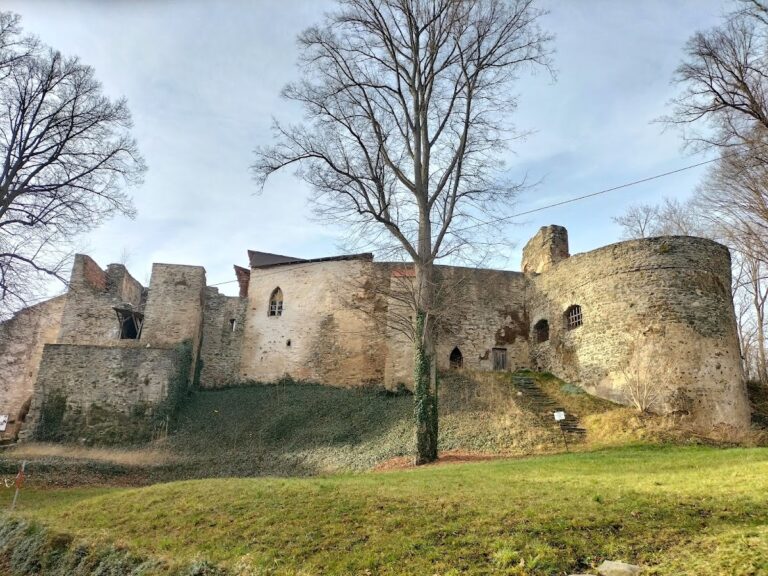
Schwarzenberg Castle is a ruined medieval hilltop fortress in Germany, above the Lenn Valley in Plettenberg, North Rhine-Westphalia. Built for the Counts of Mark at the beginning of the fourteenth century, it served as a military base and an administrative seat on the southern frontier of the County of Mark, a major territorial lordship in Westphalia.
Foundation on the Markian frontier
The castle emerged from the conflict between the Archbishops of Cologne, who were also territorial rulers, and the Counts of Mark and their allies. The recovery of Waldenburg by Archbishop Wigbold of Holte on 15 December 1300 created an urgent need to protect the southern Markian frontier. Lüdenscheid and Altena were considered too distant for that purpose.
Eberhard I, Count of Mark, allied himself with Count Ludwig of Arnsberg, apparently to secure consent for the new fortification. Eberhard also appears to have obtained confirmation of his fortification rights from King Albrecht. The two counts concluded an alliance for the planned castle on 11 July 1301, and construction began on 2 October under Rutger of Altena.
Although Schwarzenberg stood within sight of the Cologne-controlled frontier near Rönkhausen, the Archbishop of Cologne could not prevent its construction. The new stronghold restored a balance of power along the border. It became one of the major territorial castles of the County of Mark, alongside Mark, Altena, Wetter, and Blankenstein. Its importance, however, hindered the development of Plettenberg under the authority of the official responsible for the district.
Expansion and comital residence
In 1352, Eberhard’s successor, Engelbert III, destroyed the Arnsberg burghouse during a feud with Count Gottfried IV of Arnsberg. This gave Engelbert sole control of Schwarzenberg. The following year, he ordered his drost, a senior territorial official with administrative, judicial, fiscal, and military responsibilities, to enlarge and strengthen the castle. Engelbert also assigned Gerhard of Plettenberg responsibility for founding Neuenrade as a means of reinforcing Markian rule.
Engelbert III ruled from 1347 to 1391 and frequently stayed at Schwarzenberg. The castle therefore became a temporary residence and center of government. Its importance to the count is also reflected in his endowment of the castle chapel on 1 May 1385 with property at Gevern near Neuenrade. The provision suggests that the complex received generous and representative treatment during this period.
Pledges and changing control
During a feud between Count Adolf II of Cleves and Duke Adolf of Berg, Schwarzenberg passed to their ally Eberhard of Limburg around 1397. When the opposing parties reconciled in 1399, the pledge was redeemed with money advanced by the knight Wennemar Dücker. Dücker consequently received the offices of Lüdenscheid, Neustadt, and Schwarzenberg as pledges.
The castle changed hands again in the 1420s. In 1422 Duke Adolf of Cleves pledged Schwarzenberg and the parish of Plettenberg to Diderich van Hemmerde for 1,600 gulden. In 1423 his brother Gerhard pledged them to Duke Adolf of Berg. Schwarzenberg consequently remained outside Markian control for twenty-five years. Duke Adolf of Jülich-Berg appointed Wilhelm II of Nesselrode as the responsible official and ordered him to maintain a household of twenty people at the castle.
Heinrich Wrede briefly controlled Schwarzenberg before Heinrich Ovelacker took it over in 1425. Wrede had carried out building work on the defensive and residential complex. The castle then remained pledged to Hermann Ovelacker and his sons until Gerhard of Mark reacquired it in 1444.
In 1445 Schwarzenberg, together with Herscheid, Altena, Lüdenscheid, Neuenrade, and Hörde, passed to Archbishop Dietrich of Moers of Cologne. Gerhard of Mark redeemed it in 1447. In 1450 the castle was pledged for 1,500 gulden to the Markian official Wilhelm of Nesselrode. In 1456, Gerhard and his nephew, Duke Johann I of Cleves-Mark, allowed Evert of Mark, Gerhard’s illegitimate son, to redeem the castle and office. Evert received Schwarzenberg for life on the condition that he never sold it.
From neglected stronghold to family residence
In 1513 Duke Johann II of Cleves-Mark pledged the castle for a loan of 2,600 gold gulden to Heidenreich of Plettenberg. Schwarzenberg remained with Heidenreich’s descendants for 140 years, until Elector Friedrich Wilhelm of Brandenburg redeemed it. By the seventeenth century, the residential tower and castle chapel had become ruins. In 1661 Christoph of Plettenberg acquired the neglected castle together with its lands, rights, and revenues while serving as appointed drost.
The property later passed to the Plettenberg-Bodelschwingh line, founded in 1788 by Karl Wilhelm Georg of Plettenberg and his wife, Christine Luise of Bodelschwingh. The family lived at Schwarzenberg until about 1830 and created a Baroque garden in the former outer defensive zone, or zwinger. From 1836, the buildings provided accommodation for the forester Ludwig Vetter of Lenhausen and later for his son.
Fire and preservation
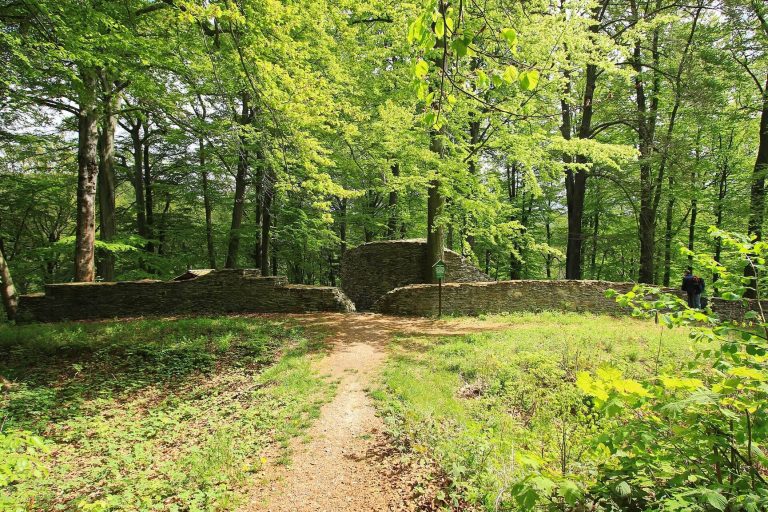
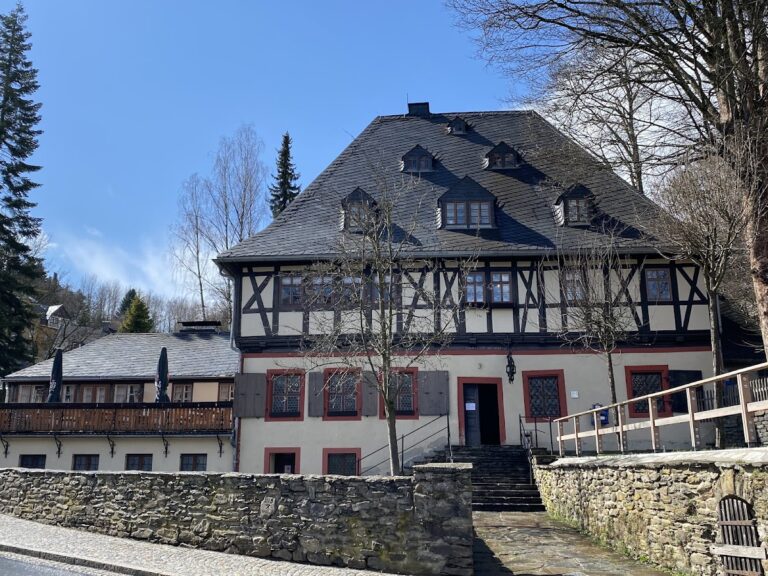
Lightning struck the castle on 13 June 1864 and caused a fire that destroyed its remaining residential buildings. Most of the standing walls had to be demolished because they threatened to collapse. Stone recovered from the ruins was reused to construct the surviving forester’s house below the castle.
Descendants of the Bodelschwingh-Plettenberg family, the zu Inn- und Knyphausen zu Bodelschwingh family, currently own the ruin. It has been maintained in its present condition since 1911.
Remains
Schwarzenberg Castle occupies a hilltop above the Lenn Valley. Its earliest complex centered on a bergfried, the principal defensive tower of a medieval German castle, with a well and the count’s house. The complex grew over time to include the Roisthaus, a smithy, a bakery, and a castle chapel. During the final construction phase in the fifteenth century, walls probably enclosed the core castle and formed an outer courtyard that incorporated the garden area later used for the Baroque garden.
Core castle structures
The surviving or identifiable fabric includes parts of the bergfried and the foundations of the drost’s house, the round ascent, the Elector’s house, and the bakery. The wider complex also included a gate, a watchtower, the Roisthaus, and other residential and defensive buildings. These remains represent the castle’s successive military, administrative, and residential functions, although the fire and subsequent demolition substantially reduced the standing fabric.
Well and bakery remains
The castle well reaches a depth of 26 metres. The Plettenberg marksmen’s society uncovered it between 1981 and 1985. An exterior toilet remains visible in the eastern side of the former bakery’s outer masonry, preserving a small but direct feature of the castle’s domestic infrastructure.