Schloss Ort: A Historic Island and Shore Castle Complex in Austria

Site at a Glance
- Rating
- 4.6
- Popularity
- Medium
- Country
- Austria
- Primary era
- Early Modern
- External website
- Open
- Eras represented
- Medieval, Early Modern
- Civilizations
- Habsburg, Holy Roman Empire
- Site type
- Domestic
- Remains
- Castle
On this page9 sections
History
Schloss Ort is a historic castle complex in Austria on Traunsee at Gmunden, comprising the island Seeschloss and the mainland Landschloss. The island castle, whose architecture combines late Gothic and Renaissance features, first appears in written records in 909 and is among the oldest buildings in the Salzkammergut.
Medieval origins and noble ownership
The island castle was mentioned again in 1053. Tradition attributes its foundation to Hartnid von Ort, a descendant of the Bavarian count Aribo II. The von Ort family were Styrian ministerials, medieval noble or administrative retainers who held land and office in service to a higher lord. They controlled the castle from the tenth century until 1244, when the family’s last representative was imprisoned and deprived of his hereditary possessions.
After 1244, Schloss Ort passed through several owners. In 1483 it came into the possession of the Habsburg Emperor Friedrich III. The Habsburgs were the dynasty that ruled the Austrian lands and, for much of this period, supplied the Holy Roman Emperors. Friedrich III transformed the island fortress into a luxurious residence. Gmunden, enriched by the salt trade, acquired the complex late in the sixteenth century, but the municipality sold it back in 1603 because the cost of maintaining it was too high. The castle then returned to the Habsburg domain under Emperor Rudolf II.
The Upper Austrian Peasant War
In 1620, during the financial pressures of the Thirty Years’ War, Upper Austria was pledged to Bavaria. This major European conflict, fought from 1618 to 1648 amid religious, dynastic, and territorial struggles, brought Bavarian control to the region. The Bavarian administration granted Schloss Ort to Adam, Count of Herberstorff, the governor of Upper Austria. He made it his country residence and administrative base.
Herberstorff’s severe taxation helped provoke the Upper Austrian Peasant War. On 15 May 1625, he lured 36 suspected rebel leaders to negotiations near Frankenburg. There they were forced to cast lots in pairs to determine who would live, an episode remembered as the Frankenburger Würfelspiele. In 1626, about 5,000 peasants defeated a Bavarian-Austrian army, attacked noble properties in Gmunden, and captured Schloss Ort. They looted and largely burned the island castle, although rain prevented the destruction of every building. The peasant forces were decisively defeated near Pinsdorf on 15 November 1626.
Rebuilding and Habsburg administration
After Herberstorff died on 11 September 1629, the castle passed to his wife, Maria Salome. She sold it in 1634 to her son-in-law Johann Warmund, who became Imperial Count of Preysing in 1645. The estate was raised to a county in 1637. The island castle was rebuilt in its present form in 1634, while the Landschloss was constructed separately between 1626 and 1629 on the site of the former farm and service buildings.
After 1690, the complex once again belonged to the Habsburg rulers. An appointed administrator governed both castles and the surrounding territory under the direct authority of the salt official in Gmunden. From the fifteenth century until 1848, Schloss Ort also exercised high judicial authority over the surrounding area, except within Gmunden’s city walls. The island castle served as a prison for important state offenders.
Aristocratic exile and twentieth-century use
In 1867, Leopold II of Tuscany bought the island castle and gave it to his son, Archduke Johann Salvator of Austria-Tuscany. Over the following three decades, the grand dukes of Tuscany acquired the entire Ort estate and established an exile residence there.
Johann Salvator renounced his aristocratic titles and adopted the name Johann Orth. He married the actress Milli Stubel in a morganatic marriage, a union in which a partner of lower social rank and the couple’s children normally did not receive the higher-ranking spouse’s dynastic titles or inheritance. In March 1890, Johann Orth sailed with her aboard the three-masted yacht St. Margaret. The vessel failed to reach Valparaiso after rounding Cape Horn, and Johann Orth was reported missing. He was declared dead in 1911, after which the castles returned to Emperor Franz Joseph I.
The imperial forestry administration acquired the estate in 1915. After the First World War, in 1918, ownership passed to the federal forests. The Landschloss served as a military hospital during the war, then became a state forestry school and later a seminar and congress center. That use continued until 2018, when the forestry training institution was moved to Traunkirchen.
Public ownership and modern cultural identity
The Seeschloss was offered for sale in 1988 and acquired by the municipality of Gmunden in 1995. It was subsequently renovated and restored. The island castle now contains a restaurant and hosts cultural events. Schloss Ort was also used as a filming location for the 1973 comedy Blau blüht der Enzian and as the setting and exterior location of the television series Schlosshotel Orth, which ran from 1996 to 2004 and comprised 144 episodes. Despite the series title, the castle itself contains a restaurant and wine bar rather than a hotel.
Remains
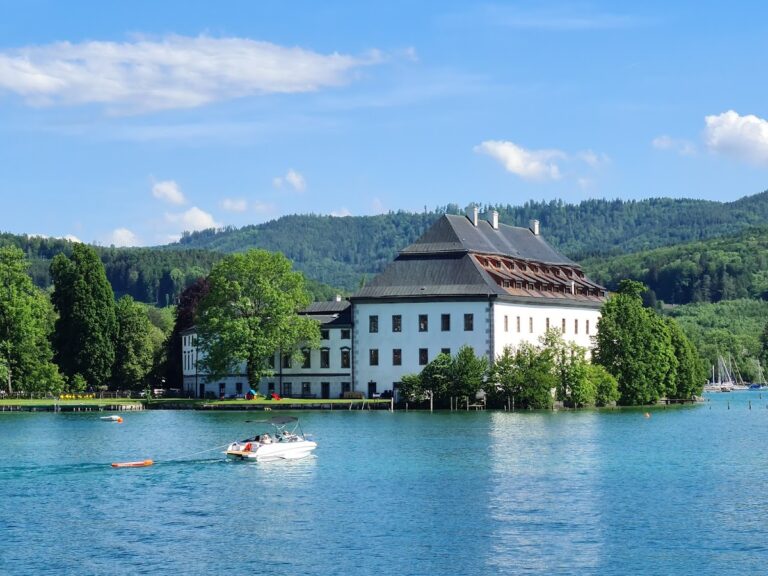
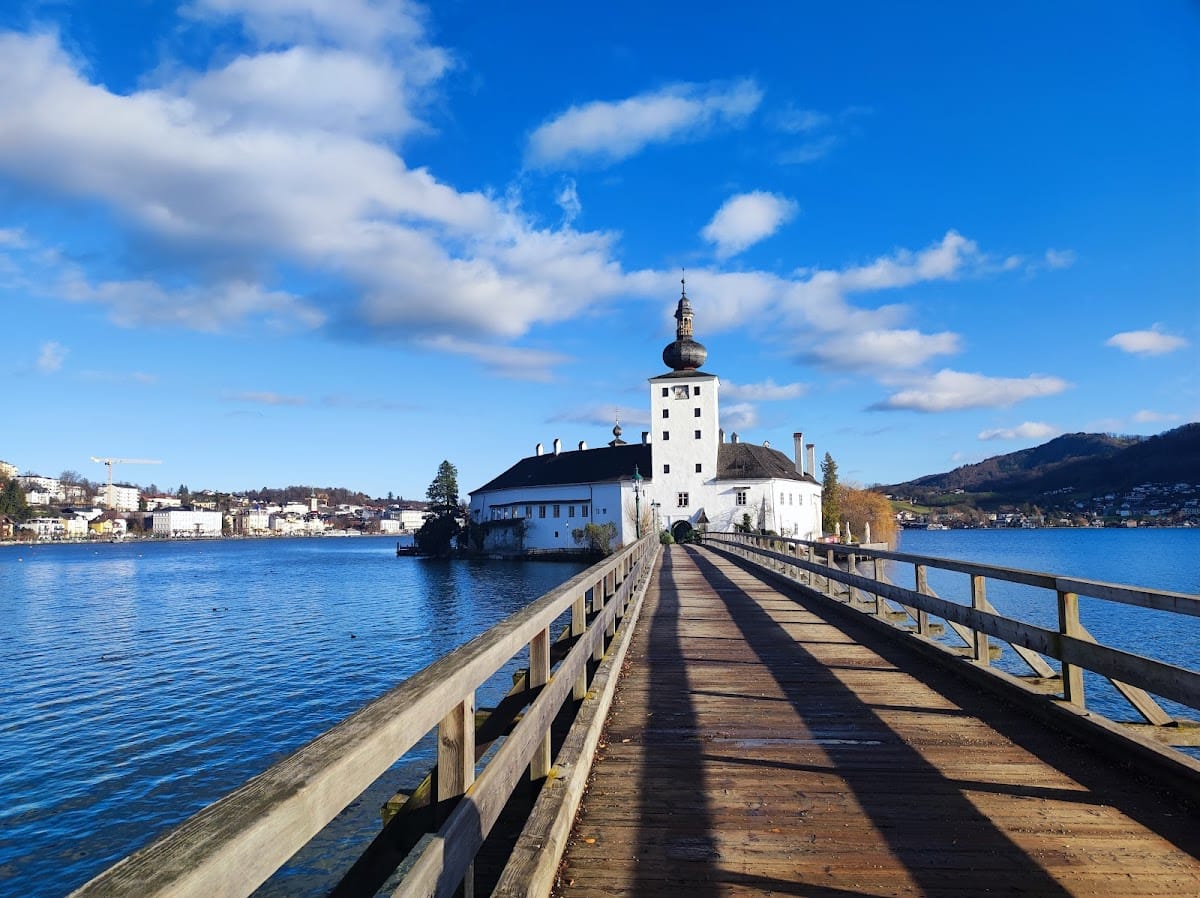
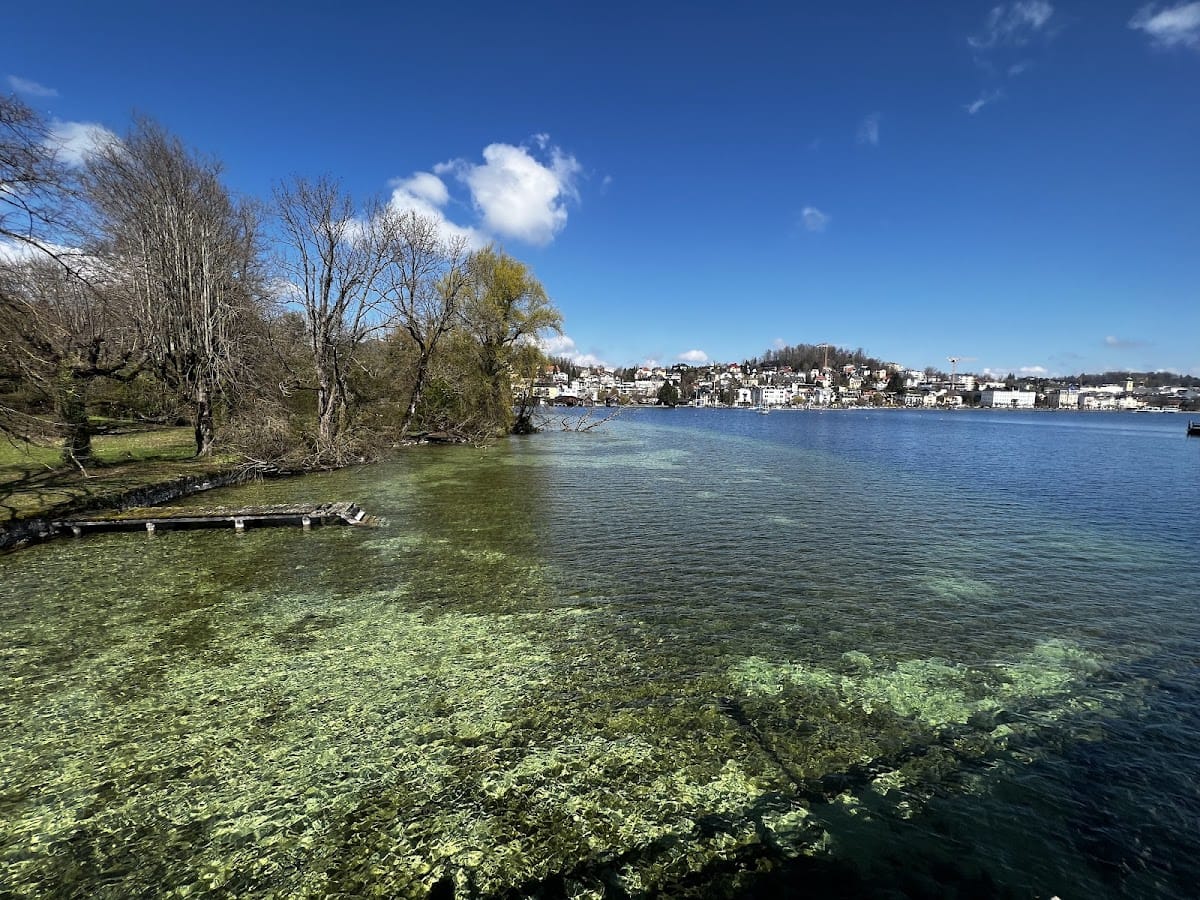
Schloss Ort occupies two connected parts on Traunsee. The Seeschloss stands on an island and is linked to the shore by a bridge, while the Landschloss forms a separate square group on the mainland. The island complex uses stone and brick and combines late Gothic elements with Renaissance architecture. West of the Seeschloss, the silted zone of Orter Bay forms a protected natural area.
Seeschloss on the island
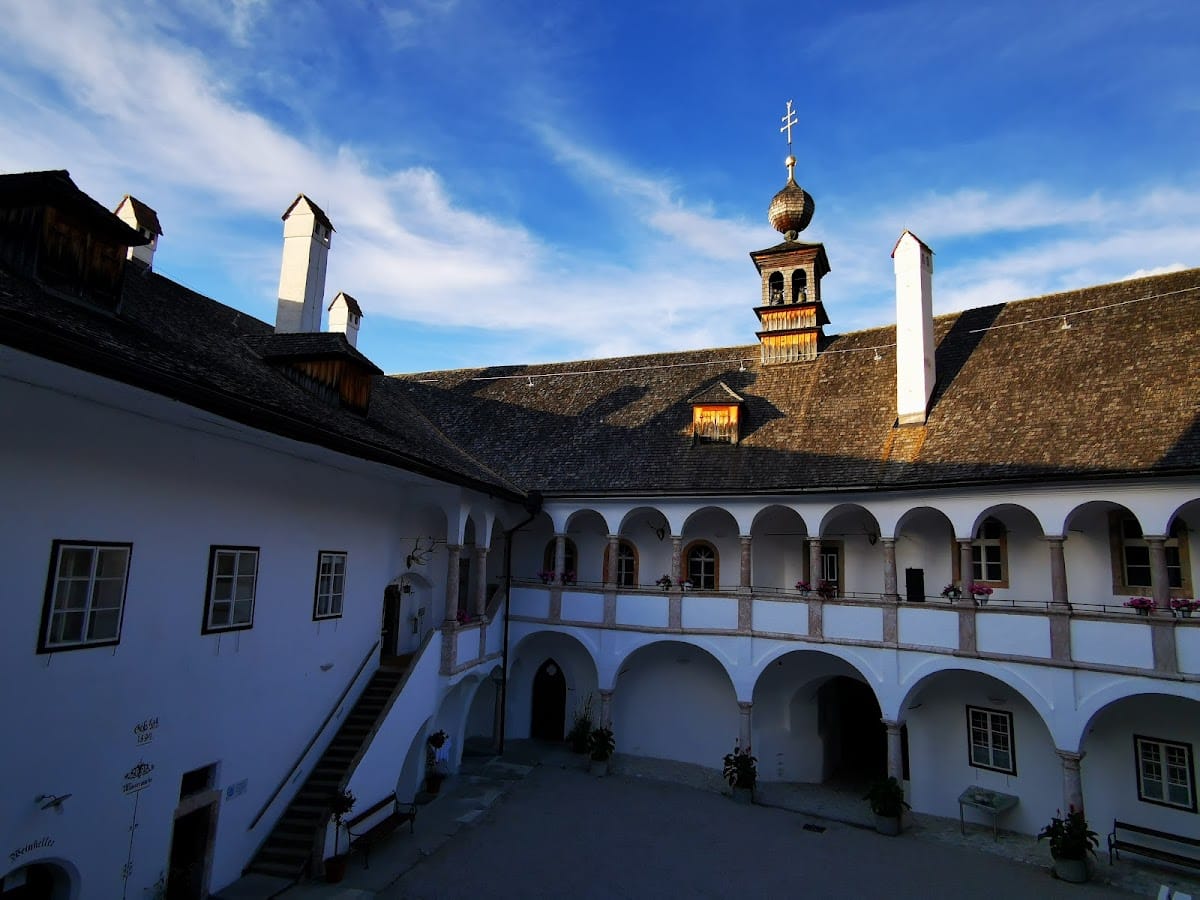
The original island fortress was enclosed by a moat and an additional outer wall. Its surviving plan is irregular and arranged around a triangular courtyard. Two-storey arcaded galleries run along two sides, and a late Gothic external staircase provides one of the complex’s characteristic architectural features. The Seeschloss contains a palas, the principal residential building of a medieval or early modern castle, as well as a heraldic hall, a chapel erected in 1634 and dedicated to St. James the Elder, a hunger tower, prison cells, and a museum.
Three of the original four prison cells survive. A clock mechanism dating from 1634 remains in operation and must be wound by hand each day. Together with the chapel, residential spaces, galleries, and defensive features, these elements reflect the island castle’s transformation from fortress to residence and its later administrative and penal functions.
Landschloss on the shore
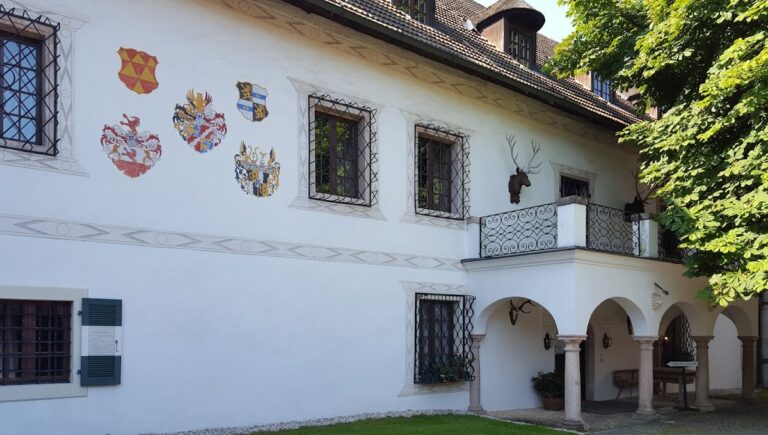
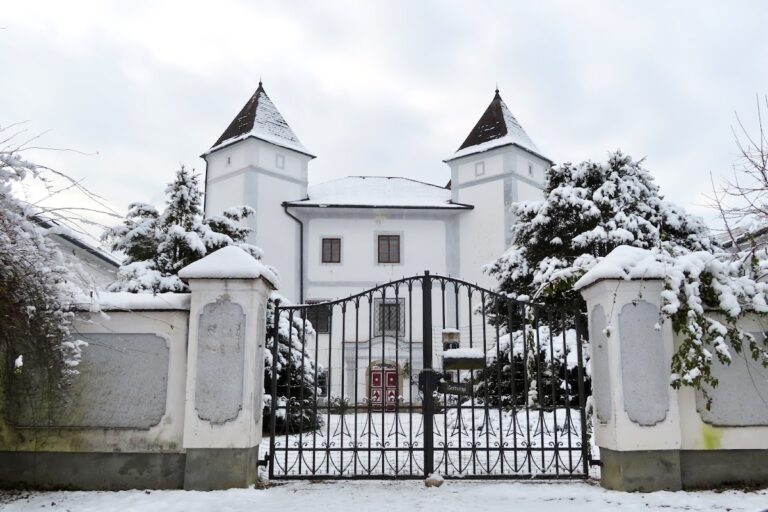
The Landschloss is a square group of buildings surrounding a square courtyard. Four corner towers define the structure, each topped by an onion-shaped dome. The outer sides retain wrought-iron window baskets from the first half of the seventeenth century, while heraldic emblems of former owners are displayed in the courtyard.
A Rococo fountain dated 1777 stands in the courtyard. Rococo was an eighteenth-century decorative style characterized by delicate ornament, curved forms, and elaborate lightness. The grand hall has a painted wooden coffered ceiling made between 1604 and 1612 and transferred from Schloss Scharnstein. Large paintings from the First International Hunting Exhibition in Vienna in 1910 decorate the walls, and the stucco frames around the doors and fireplaces date from the Landschloss’s construction period.