Schloss Egg: A Medieval Water Castle in Bavaria
Site at a Glance
- Rating
- 4.6
- Popularity
- Low
- Country
- Germany
- Primary era
- Medieval
- External website
- Open
- Eras represented
- Medieval, Modern
- Civilizations
- Duchy of Bavaria, German, Holy Roman Empire
- Site type
- Military
- Remains
- Castle
On this page22 sections
History
Schloss Egg is a medieval water castle in Bernried, Germany, whose origins lie in the eleventh century in the Mettenbach valley. First recorded in 1103 as the seat of Thiemo de Ekke, it served successive noble families, Bavarian rulers, and ecclesiastical owners before receiving a romantic medieval appearance in the nineteenth century. The core of the castle and its surrounding moat survive as an architectural and archaeological monument.
Origins and Bavarian Rule
Egg began as a fortified residence protected by surrounding water. Timber analysis carried out in 2003 placed the age of the castle tower at approximately 850 to 900 years, supporting the early medieval origins of the complex. The Ecker family initially served the Counts of Bogen. After that line became extinct in 1242, the Eckers entered the service of the Bavarian dukes.
In 1403, Egg passed to the Fraunberger family, rulers of the County of Haag. They sold the complex in 1427 to Duke Henry the Rich for 8,000 Hungarian gold ducats. The Bavarian dukes then appointed custodians or pledged the castle to wealthy followers. Those associated with Egg included Kaspar Hautzendorfer of Hauzendorf, Parzival of Aichperg in 1448, the knight Jörg of Seiboltsdorf in 1458, Count Sebastian I of Ortenburg from 1476 to 1483, Hanns Dachsperg of Aschperg in 1508, and Ott the Zengl of Thonstein in 1518.
The Nothafft, Pinzenauer, and Maxlrain Families
Through a pledge, Egg passed in 1520 to Albrecht Nothafft of Wernberg at Aholming. His wife, Euphemia, daughter of Georg of Preysing, issued inheritance documents for Egg’s properties on behalf of their minor son, Onophrius. Onophrius served as a page at the court of King Ferdinand in Vienna, but died there in 1529 at the age of eleven.
Euphemia later married Ludwig Pinzenauer of Pienzenau, court marshal at Landshut. In 1534 he described himself as lord of Falkenstein and Egg and served as vice-governor in Straubing. His daughter Veronika married Wolf Dietrich of Maxlrain in 1547. In a feudal document from 1551, Wolf Dietrich called himself holder of the lordship of Egg and baron of Waldberg. Tobias Wieser was recorded as Egg’s custodian in 1578.
The Keckh Period and Destruction in 1633
Duke Wilhelm V redeemed Egg in 1581 and sold it on 4 February of that year to his councillor and chamberlain Karl Keckh, also written Köck. Karl’s son Friedrich held Egg from 1593 to 1604, together with Loham, Wildenforst, and Findelstein. In 1604 he transferred the castle benefice to Metten Abbey under Abbot Johannes Nablas. A benefice was a church endowment that provided income to a cleric in return for specified religious duties. Friedrich’s successor Rudolf held Egg from 1606 to 1636 and styled himself lord of Egg, Loham, and Wildenforst.
Swedish forces reached Egg on 28 November 1633 during the Thirty Years’ War, the European conflict that brought extensive military destruction and religious-political upheaval in the seventeenth century. They devastated the complex and set the castle on fire. Rudolf withdrew to Findelstein near Deggendorf, which the Swedish forces reached on 14 December and whose town they plundered. Under Ernst Keckh, who held Egg from 1636 to 1648, Loham was separated from the estate and assigned to Rudolf’s widow, Regina Keckh. Ernst was the last Keckh holder of Egg, which was sold to Count Franz of Spaur in 1648.
From the Spaur Family to the Armansbergs
Franz of Spaur served as chamberlain to an Austrian archduke. Through his wife Helena, daughter of the last Tanberg, Georg of Offenberg, he also acquired Offenberg. Their heiress Catharina married Baron David of Wagner, who held Egg from 1660 to 1698. He later styled himself Baron of Sarentheim and, from 1687, Count of Sarentheim.
After David’s death, Egg passed to his brother-in-law, Count Anton Sebastian of Montfort. He sold it on 11 July 1709 for 42,000 gulden to Alexander Ignaz of Schrenk. The Schrenk family held Egg from 1709 to 1751. Alexander Ignaz had acquired Loham and Mariaposching in 1673, had been raised to the baronial rank by Elector Max Emanuel, served as custodian of Diessenstein, and owned Notzing and Vilsessing. He supported the Habsburgs during the War of the Spanish Succession, a conflict over the Spanish throne that involved the major European powers. He died on 27 November 1716.
His son Franz Adam Ignatz was a Bavarian electoral chamberlain and custodian of Diessenstein from 1715. He died aged twenty-seven on 25 July 1724. His marriage to Anna Jolanda of Kriestorff produced no children, so Egg and Loham passed to his mother, Maria Magdalena of Schrenk, née of Neuching. In 1752, Maria Magdalena’s second son-in-law, Johann Anton Joseph Baron of Armansberg of Schönberg, inherited or purchased Egg and Loham. The Armansberg family retained Egg until 1859.
Nineteenth-Century Remodelling
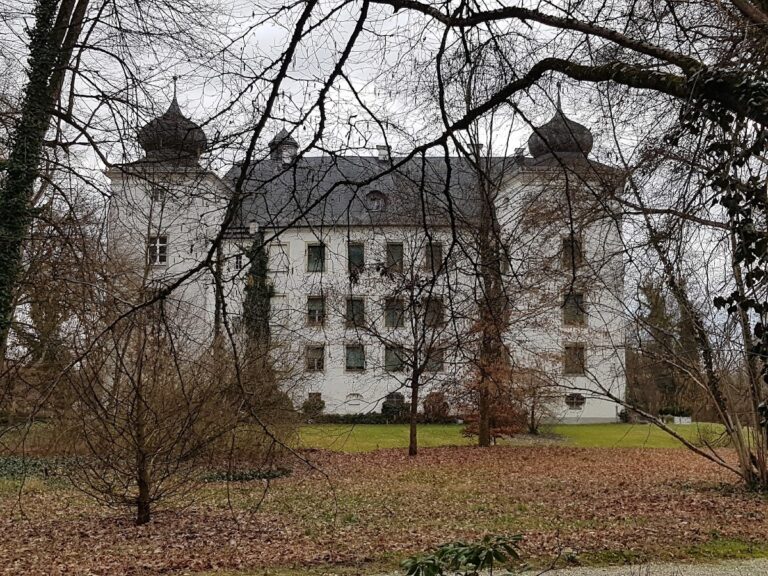
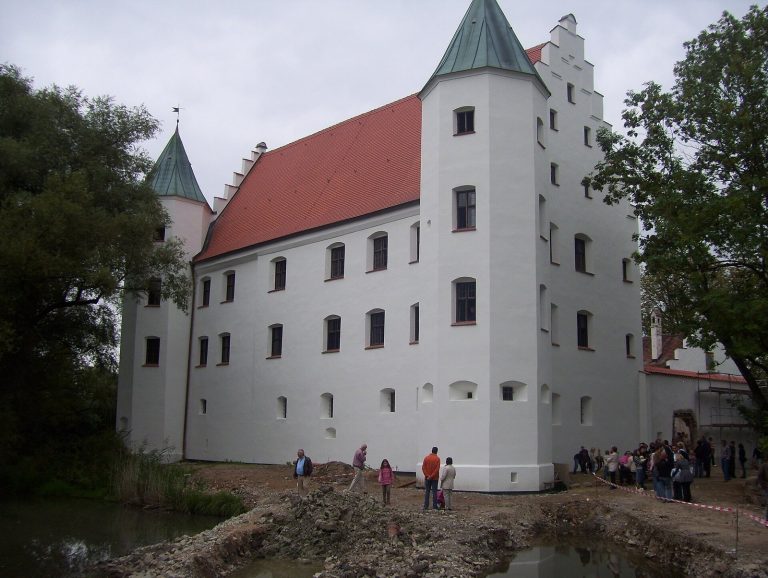
Count Joseph Ludwig of Armansperg romantically remodelled Schloss Egg around 1840 and spent his final years there. The renovation of 1838 to 1842 was carried out under his direction by the Regensburg architect Ludwig Foltz. Former agricultural and brewery buildings were demolished, while the castle acquired medievalising gables, platforms, pointed turrets, and other defensive-looking features. The work transformed the appearance of the older water castle without removing its medieval core.
Joseph Ludwig’s wife was Theresia of Weichs, and they had four daughters. Their daughter Sophia Carolina Antonia Maria Clara was born in Augsburg in 1819 and died at Egg in 1868. She married the Moldavian grand boyar Demetrius of Cantacuzenos. After her mother’s death in 1859, Sophia inherited the paternal estates. Following Sophia’s death, Egg and Loham were divided. Her son Alexander received Egg, while Konstantin received Loham.
Alexander sold Egg to Baron Karl of Eichthal on 1 May 1871 and moved to Munich. His daughter Minka Alexandra was buried in the crypt beneath the castle chapel. Baron Carl senior of Eichthal, who also held Hohenburg, enlarged Egg’s brewery and agricultural estate and expanded the castle. In 1876 he transferred the property to his son, Baron Carl junior of Eichthal of Offenberg.
Later Ownership and Heritage Protection
The heirs sold Schloss Egg to Adolf Count of Hohenthal and Bergen on 15 October 1882. The estate remained with the Hohenthal family until 1931, when Metten Abbey acquired it. Metten Abbey is a Benedictine monastery whose monks had long been connected with Egg’s benefice. In 1939, the manufacturer and consul of China Joseph Maximilian Hartl purchased the castle without its agricultural lands. Schloss Egg remains in the possession of his family.
The castle is listed as an architectural monument under Bavarian monument number D-2-71-116-14. It is also registered as an archaeological monument under D-2-7143-0001, covering buried medieval and early-modern remains in the area of the former castle site and castle. These protections recognize both the standing complex and the archaeological layers beneath it.
The Castle Benefice
Peter I the Ecker established the castle benefice in connection with the foundation of the chapel. The lord of the castle held the right of presentation, meaning the patron possessed the legal right to nominate the benefice holder. During the Reformation, a shortage of secular priests led Conventuals from Metten Abbey, professed members of a religious community, to perform the benefice’s duties for a fee.
Under Friedrich Keckh, the benefice became the subject of a dispute because he failed to present a priest despite being urged to do so by Johann of the Palatinate, bishop of Regensburg. On 5 July 1595, the bishop appointed the priest Kilian Rankh, but the castle lord refused to pay him. Before the case was decided, Rankh transferred his rights to the abbot of Metten on 15 September 1604 after obtaining a position at St. Emmeram Abbey in Regensburg.
The benefice remained connected with Metten Abbey until the secularization of 1803, when the state confiscated the endowment as part of the property of the dissolved abbey. Secularization here refers to the early nineteenth-century seizure of ecclesiastical property by the state. Josef Ludwig of Armansperg petitioned for restitution in 1821, and the benefice lands were returned in 1825. The Regensburg Ordinariate canonically re-established the benefice on 25 November 1828.
Johann Nepomuck Visino became the first restored benefice holder, serving from 1838 to 1842. His successor Ignat Beer served from 1843 to 1873 and was also a skilled painter and draughtsman. A benefice house was built beside the road from Metten to Neuhausen in 1838 because the former residence had been demolished in 1594. A five-hundredth-anniversary celebration for the foundation of the benefice took place at the Feast of Saints Peter and Paul in 1849, with the pontifical mass celebrated by Abbot Gregor of Metten.
Remains
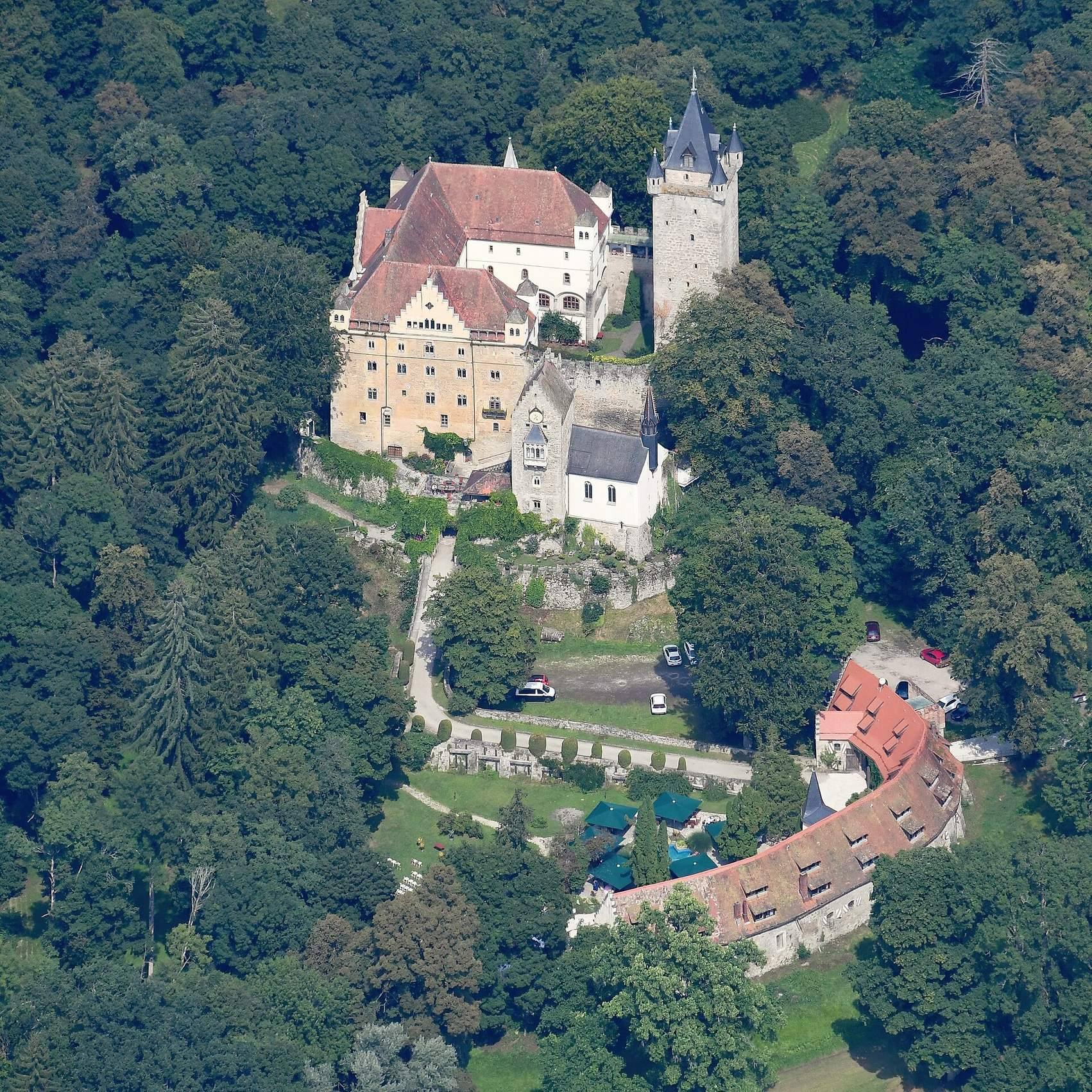
Schloss Egg retains the central medieval complex within its former water moat. The site occupies the valley of the Mettenbach and preserves the arrangement of a lowland castle divided into an inner stronghold and an outer work. Broad water ditches enclosed the two-part complex, while a separate ditch divided the inner stronghold from the outer area. The nineteenth-century remodelling altered the approach and added defensive-looking details that give the castle its present romantic medieval character.
Approach and Courtyards
Bridge and Entrance
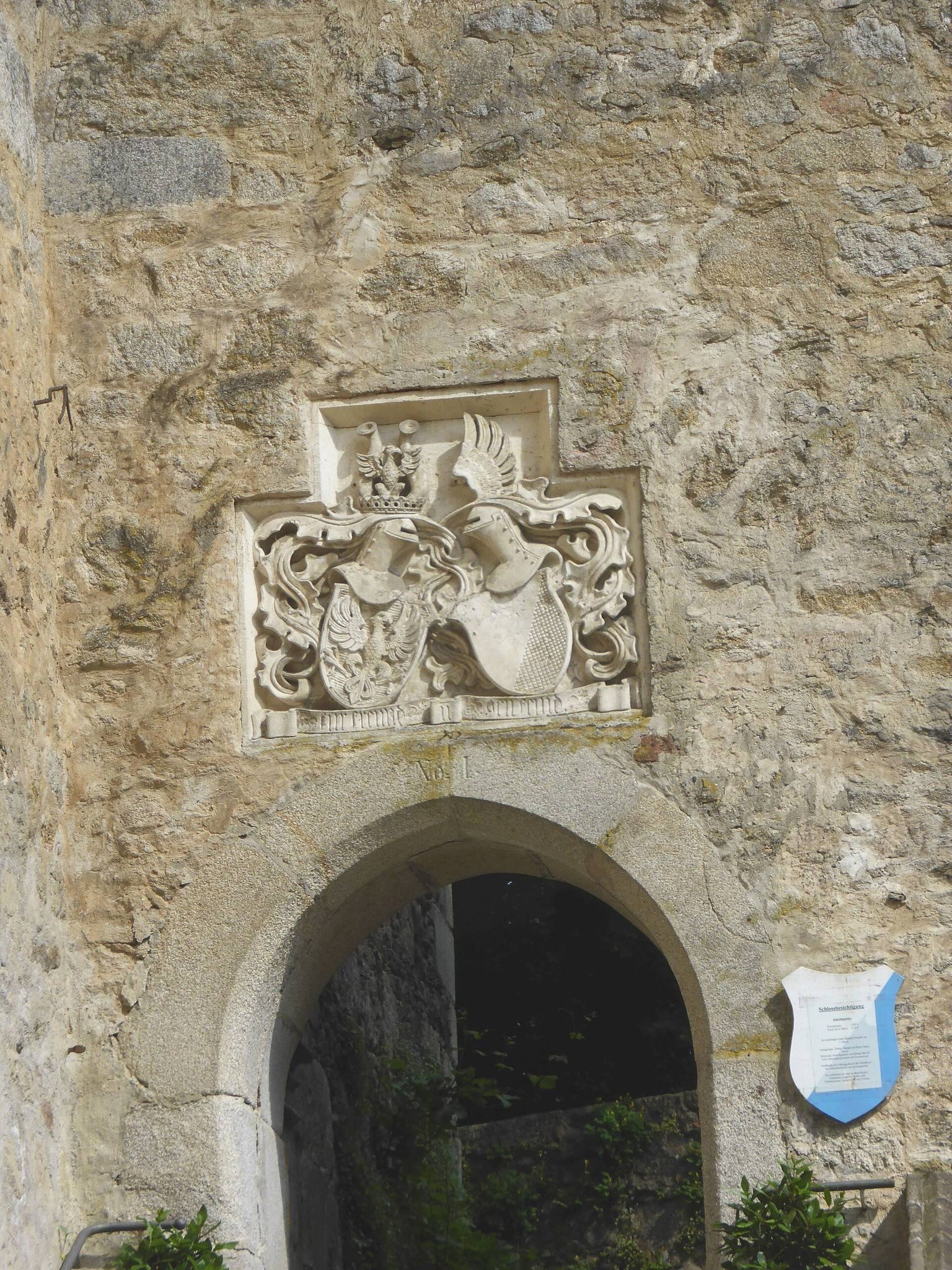
The original wooden bridge was demolished in 1839 and replaced by a bridge carried on several stone arches. A twenty-four-step staircase, built in 1840, leads from the outer courtyard to the main castle. Above the castle gate is an alliance coat of arms belonging to the Egger and Armansberg families. The original access route was moved during the nineteenth-century work, forming part of the redesigned approach to the complex.
Outer and Main Courtyards
The outer courtyard contains the Marienbrunnen, a twelve-metre-deep well lined with ashlar blocks. Beyond another archway in the former second ring wall lies the main castle courtyard. The surviving enclosing walls, moat, courtyards, and entrances preserve the physical relationship between the outer work and the central castle.
The Hungerturm and Water Features
Hungerturm
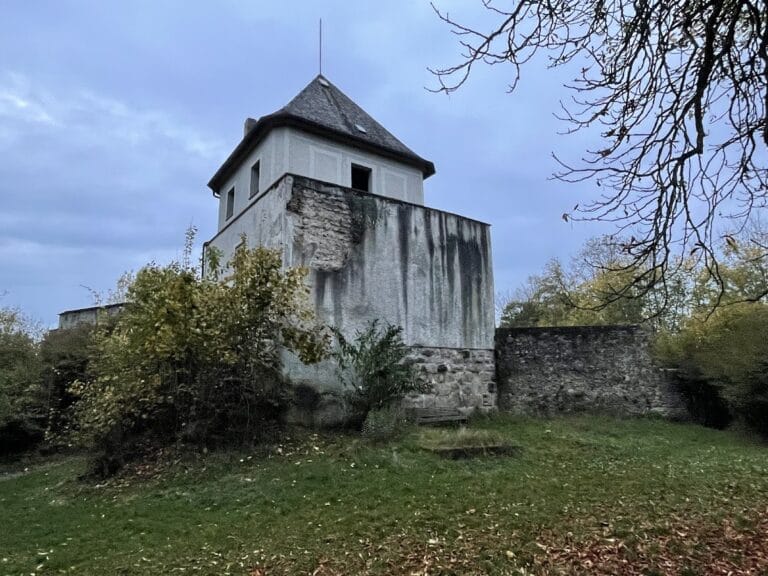
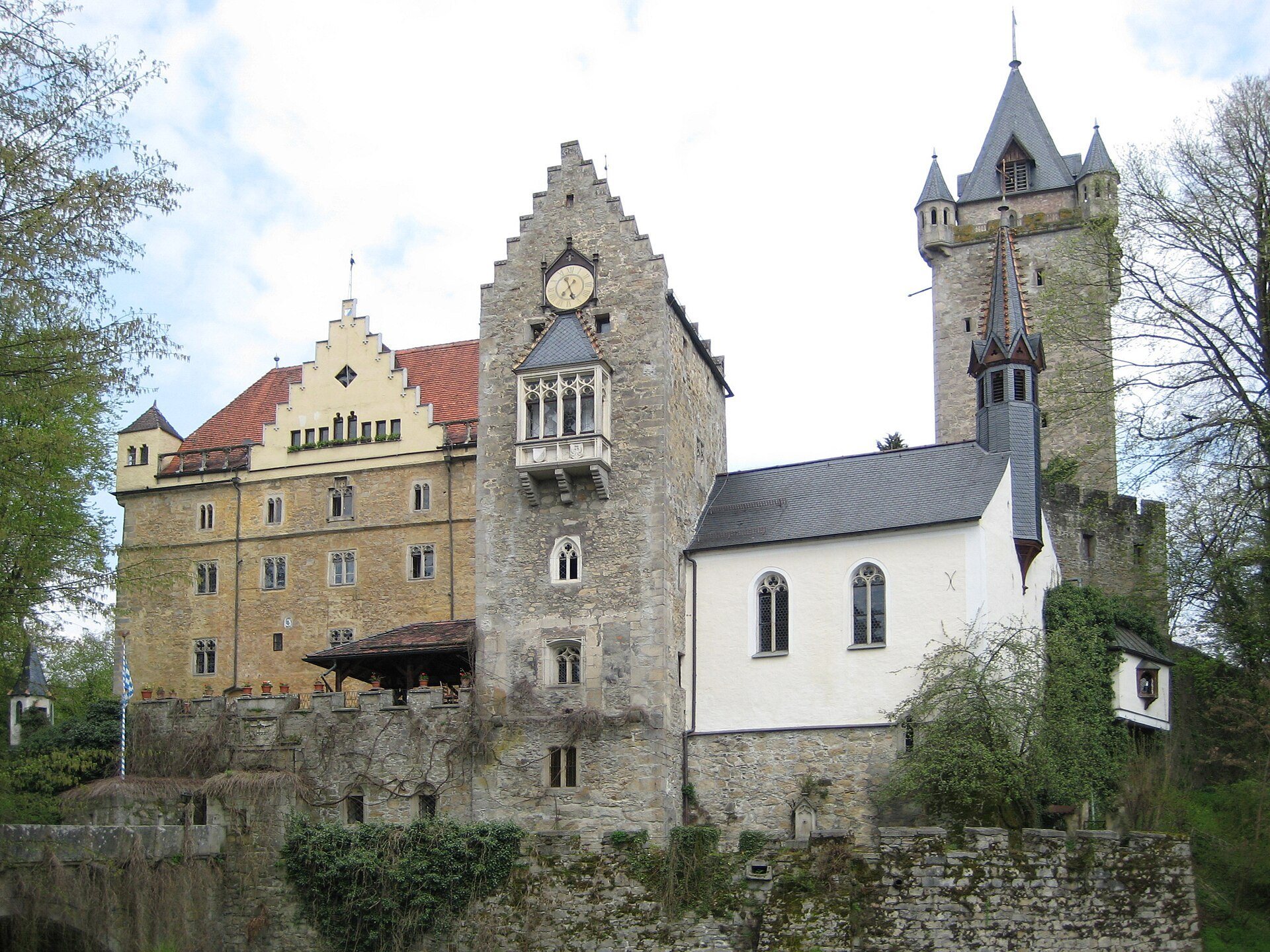
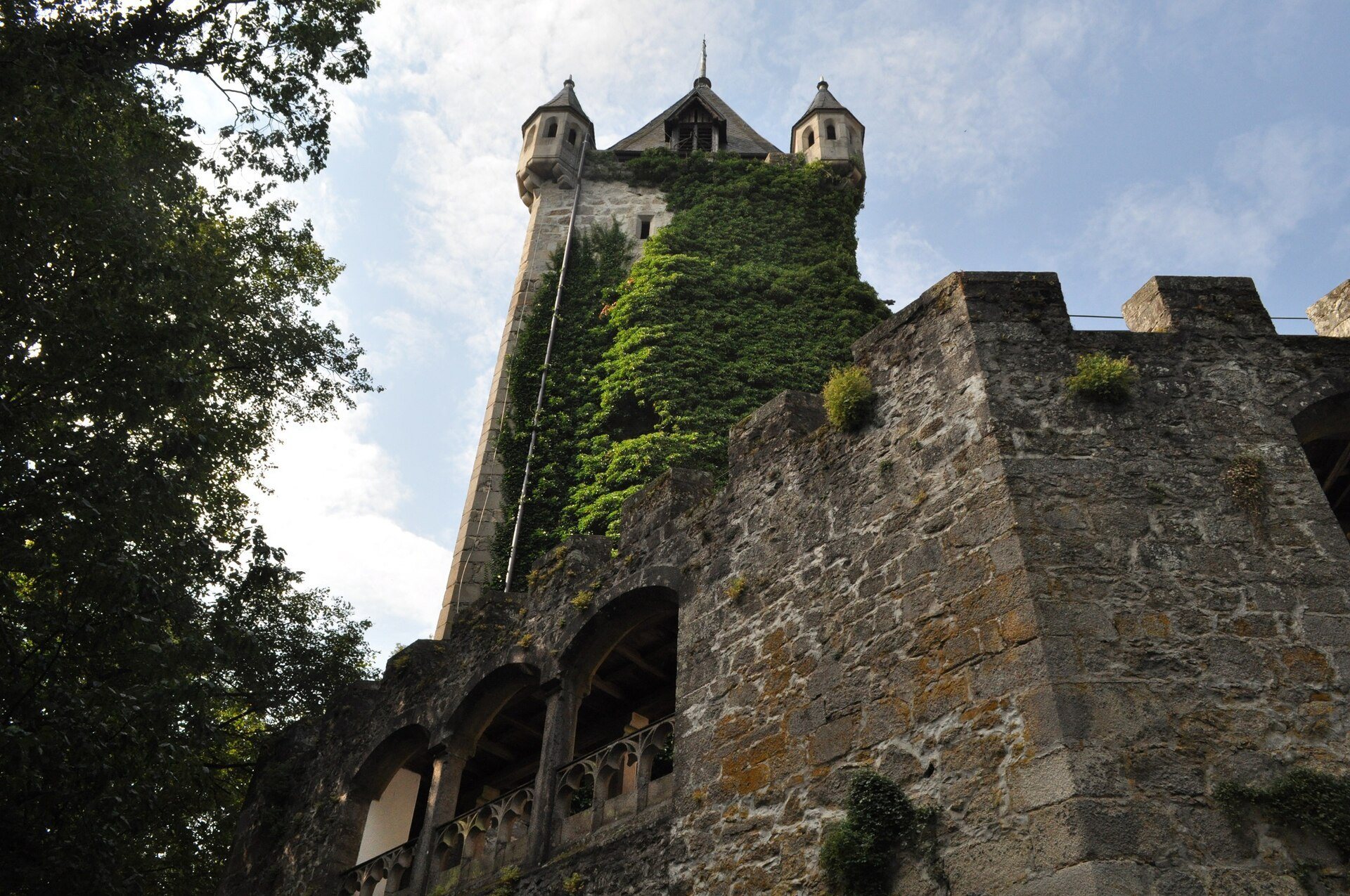
The main courtyard contains the 45-metre-high Hungerturm. A cast-steel bell acquired by Baron Eichthal in 1872 hangs in the tower. It bears the letters “B.V.G.” and was consecrated by Abbot Utto Lang of Metten. The bell formerly warned the inhabitants of Egg about fires. Count Armansberg added a gallery with four turrets around the tower, rising to a central main spire.
Count Armansberg also had two cartloads of human bones removed from the dungeon in the lower part of the tower and reburied in the cemetery at Berg near Metten. Until the end of the nineteenth century, visitors were shown the board and rope hoist once used to lower condemned prisoners into the dungeon.
Underground Chamber
Beneath the great hall, with access from the main cellar, lies a self-contained underground passage or chamber known as an Erdstall. The builders, date, and purpose of this underground space remain uncertain.
Fountains
A well stands on the south side of the Hungerturm. Its column supports a fully armoured knight, a statue made by Ludwig Foltz. The figure is considered, on the basis of the coat of arms, to represent a member of the Armansperg family. On the north side of the tower, the Fish Fountain receives water from the knight fountain.
Castle Buildings and Interiors
Exterior Additions
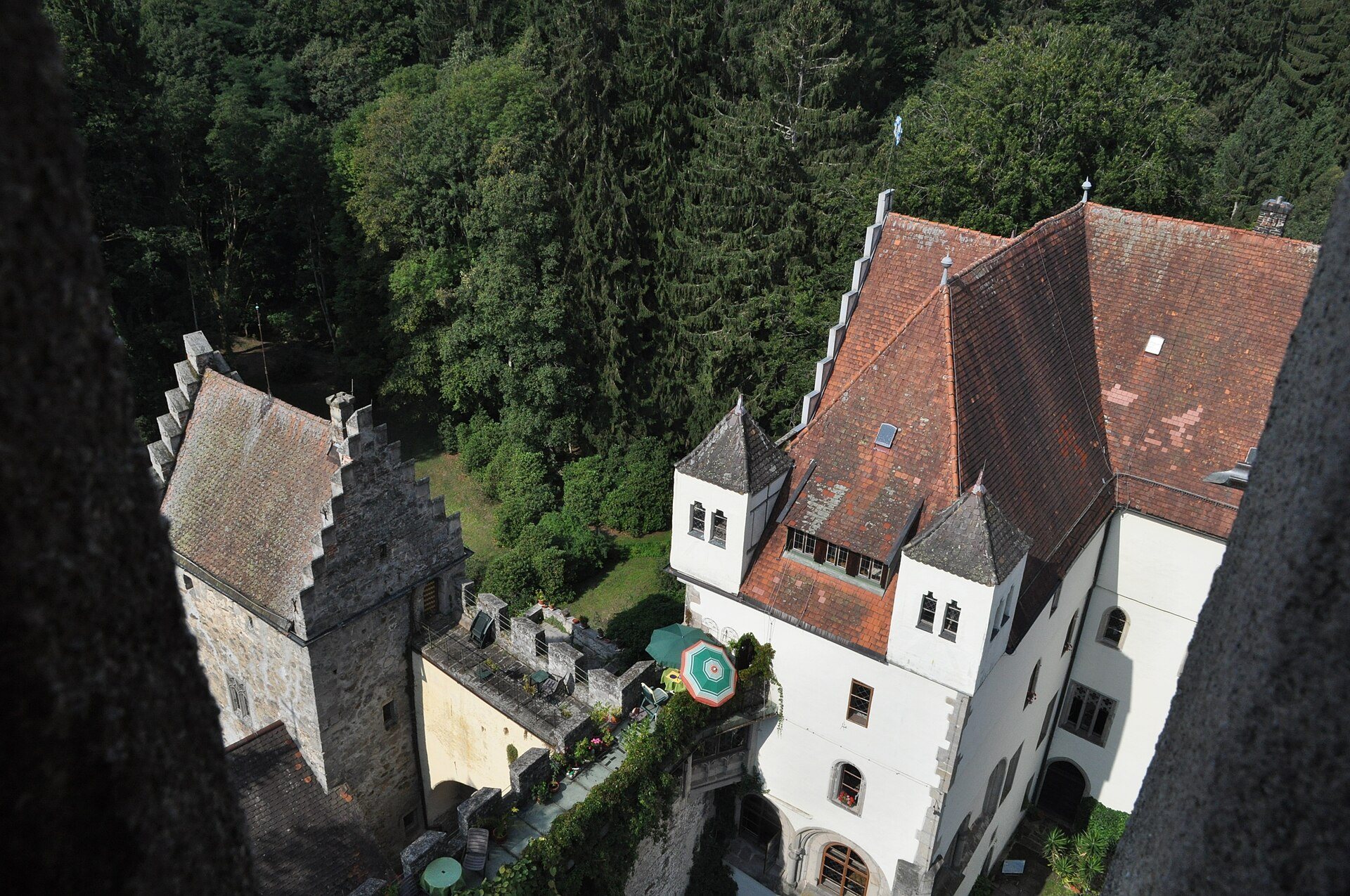
The castle building has double window frames and a series of nineteenth-century additions. The southern front gable with its three towers dates from 1840. The western front and the oriel on the north wing date from 1841. These elements belong to the Gothic Revival, a nineteenth-century movement that reintroduced forms associated with medieval Gothic architecture.
Rooms and Decorative Work
The rooms contain individually designed tiled stoves. The fireplaces have not been lit since the early 1970s because of fire-safety concerns. The first floor contains several knight statues, including one identified by its coat of arms as an Ecker. At the entrance to the dining room, two standard-bearer figures represent Count Armansberg and Prince Cantacuzene.
The nineteenth-century interiors include wood panelling by the Passau cabinetmaker Köhler, stucco work by the Viotty brothers of Munich, and paintings by Conti of Munich and by Then and Christoph Stephan of Passau. Banqueting rooms and salons furnished in their original nineteenth-century style survive within the castle. King Maximilian II Joseph stayed in these rooms twice in 1849.
Castle Chapel and Crypt
Chapel Structure
The castle chapel is built into the southern ring wall and connected with the outer tower. Its chapel tower contains a bell dated 1400 with the inscription “Mary, help us.” Founded by Peter I the Ecker, the chapel derives in basic form from the fourteenth century and is dedicated to the Virgin Mary. Georg the Frauenberger enlarged it in 1412 and added a second altar.
Before the nineteenth-century remodelling, the chapel contained a high altar and additional altars dedicated to Saint Anne and Saint John. Under Ludwig Foltz, its interior was redesigned in the Gothic Revival style. The high altar is made of Regensburg limestone. Symbols of the four Evangelists, Matthew, Mark, Luke, and John, are incorporated into its base around the wooden tabernacle, the altar structure that houses consecrated Eucharistic elements. Figures of the Apostles Peter and Paul flank the high altar painting.
Crypt
The two side altars and the organ were removed during the renovation, while the pews, gallery, and communion rail were newly introduced. A descent to the crypt lies beneath the altar predella, the lower base of the altarpiece. The crypt contains the burials of Josef Felix of Armansperg, who died in 1820, Sophie, Princess of Cantacuzene, who died in 1868, and Minka Cantacuzene, who died in 1863 at the age of one and a half.