Herstmonceux Castle: A Fifteenth-Century Fortified House in England


Site at a Glance
- Rating
- 4.5
- Popularity
- Medium
- Country
- United Kingdom
- Primary era
- Medieval
- External website
- Open
- Eras represented
- Medieval, Modern
- Civilizations
- British, English
- Site type
- Domestic
- Remains
- Castle
On this page9 sections
History
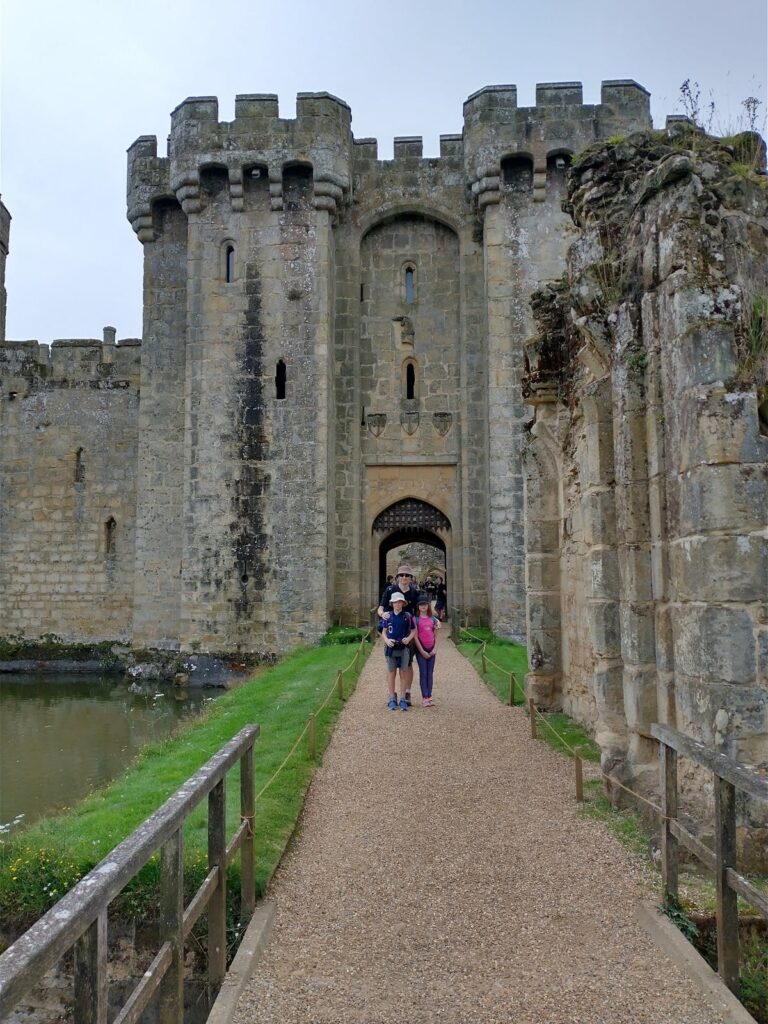
Herstmonceux Castle is a fifteenth-century brick-built fortified house in the United Kingdom, near Herstmonceux in East Sussex. Built in England with bricks made from local clay by builders from Flanders, it follows a deliberately archaic castle style intended more for imposing appearance and residential comfort than for strong military defence. It is among the oldest significant brick buildings still standing in England.
Origins of Herstmonceux
The settlement of Herst first appears in the Domesday Book of 1086, the extensive survey of landholding and resources commissioned by William the Conqueror after the Norman Conquest. The survey records Wilbert holding the manor as a tenant of one of William’s close supporters. By the late twelfth century, the family associated with the manor had gained considerable status.
Around that time, Idonea de Herst married the Norman nobleman Ingelram de Monceux. The manor became known as the “Herst of the Monceux”, a name that gradually developed into Herstmonceux. The estate passed to the Fiennes family through the marriage of Maud de Monceux to Sir John Fiennes, beginning a long association between the family and the manor.
The Fiennes castle
Sir Roger Fiennes, a descendant of this marriage, served as Treasurer of the Household to Henry VI. This senior royal office managed financial administration and expenditure within the king’s household. In 1441, Roger began constructing the present castle on the site of the earlier manor house. The initial work cost £3,800, and construction continued after his death in 1449 under his son, Sir Richard Fiennes.
The building was a fortified house, meaning an aristocratic residence that incorporated defensive features without necessarily functioning as a major military fortress. Its brick construction was unusual for a major English building of the period. The choice of material and the castle’s scale gave the Fiennes family a residence suited to their position while also creating a structure with a strongly medieval appearance.
Loss of the estate and eighteenth-century ruin
In 1541, Sir Thomas Fiennes, Lord Dacre, was convicted of murder and of illegally taking the king’s deer. The charges followed a poaching incident on a neighbouring estate in which a gamekeeper was killed. Fiennes was hanged as a commoner, and Henry VIII temporarily confiscated the Herstmonceux estate. The property later returned to the Fiennes family during the reign of one of Henry’s children.
The Fiennes heir sold the estate in 1708 to George Naylor, a lawyer of Lincoln’s Inn, for £38,215. Ownership then passed through the Naylor and Hare families to Robert Hare-Naylor. Following the advice of the architect Samuel Wyatt, Hare-Naylor converted the castle into a picturesque ruin. In 1776 and 1777, he demolished the interior while leaving the exterior walls standing. Materials and furnishings from the castle were used in enlarging his residence.
Before or during the dismantling, Thomas Lennard, Baron Dacre, commissioned James Lambert of Lewes to document the castle, its rooms, and its grounds. The surviving exterior therefore remained a visible record of the medieval building, while the castle itself stayed in ruin until the twentieth century.
Restoration and institutional use
The estate passed through several private owners after the eighteenth century, including Thomas Read Kemp in 1807, John Gillon in 1819, and Herbert Barrett Curteis in 1846. Lieutenant-Colonel Claude Lowther acquired it in 1911 and began a radical restoration in 1913, intending to turn the ruin back into a residence. The work was completed for Sir Paul Latham in 1933 under the architect Walter Godfrey.
Godfrey’s restoration made one major alteration to the medieval plan by combining its four internal courtyards into one large courtyard. The completed work is regarded as the high point of his architectural career and was described by the architectural critic Nikolaus Pevsner as exemplary. The castle’s current interiors largely date from this restoration and include architectural antiques from England and France.
In 1946, the Admiralty acquired the estate for the Royal Greenwich Observatory. Founded by Charles II at Greenwich in 1675, the observatory was Britain’s principal state astronomical observatory. It moved to Herstmonceux because the growth of London had worsened observing conditions. The observatory’s relocation was completed in 1957, and it operated at Herstmonceux until 1988, when it moved to Cambridge.
In the 1970s, the 100-inch Isaac Newton Telescope was transferred to La Palma in the Canary Islands, while the instruments of the Equatorial Group remained at Herstmonceux. The estate passed from the Admiralty to the Science Research Council in 1965. This British government research body supported scientific research and institutions, including the Royal Greenwich Observatory.
Queen’s University and Bader College
After a 1989 acquisition by James Developments and transfer to Guinness Mahon Bank, the estate was acquired for Queen’s University at Kingston, Ontario, in 1993 as a gift from Alfred and Isabel Bader. Following extensive renovation, Queen’s International Study Centre opened in 1994. It was renamed the Bader International Study Centre in 2009 and Bader College in 2022.
Bader College has used the castle as an international study centre, with programmes including undergraduate study in arts, science, and commerce, as well as postgraduate study in public international law and international business law. The college suspended operations and future admissions on 13 November 2023 pending structural remediation after engineering investigations.
The castle is a scheduled monument, a nationally protected archaeological or historic site in England, and a Grade I listed building. The parks and gardens of Herstmonceux Castle and Place are registered at Grade II*, while the Herstmonceux Science Centre is a Grade II* listed building. The site also continues to be associated with historically themed medieval events, including an annual festival in August. In 2025, the Royal Horticultural Society recognised the castle’s hardy water-lily collection as the National Collection for Nymphaea.
Remains
The castle and grounds
Herstmonceux Castle retains the exterior walls of the medieval structure, built of brick made from local clay. Its form combines the appearance of a castle with the requirements of a substantial residence. Bridges lie to the north and south, a causeway extends to the west, and moat-retaining walls remain associated with the building. A walled garden lies north of the castle, while the wider estate contains the parks and gardens of Herstmonceux Castle and Place.
The present interior reflects the restoration carried out between 1913 and 1933 rather than the medieval arrangement in full. The four original internal courtyards were combined into one large courtyard, and architectural antiques from England and France were incorporated into the restored residence. The exterior walls preserve the principal surviving fabric of the fifteenth-century castle.
The former Royal Greenwich Observatory
The former observatory complex in the castle grounds includes the six domes of the Equatorial Group, identified as Domes A, B, C, D, E, and F, along with the separate dome built for the Isaac Newton Telescope. The observatory structures were erected after the Admiralty acquired the estate, and the relocation from Greenwich was completed in 1957.
The Equatorial Group domes now form the Observatory Science Centre, a science museum, observatory, and planetarium. Dome A contains the 30-inch Thompson reflecting telescope, while Dome B houses the 36-inch Yapp reflecting telescope. Dome C contains a 34-inch Hewitt camera, Dome D a 13-inch astrographic refractor, Dome E a 26-inch Thompson refractor, and Dome F a 38-inch Schmidt telescope.
The empty dome constructed for the 100-inch, or 254-centimetre, Isaac Newton Telescope remains in the grounds. The Observatory Science Centre maintains the listed observatory complex, which had deteriorated before its tenancy. Together, the domes and surviving telescope structures preserve the physical setting of the observatory’s period at Herstmonceux.