Forchtenstein Castle: A Medieval Fortress and Esterházy Treasury in Austria


Site at a Glance
- Rating
- 4.7
- Popularity
- Medium
- Country
- Austria
- Primary era
- Early Modern
- External website
- Open
- Eras represented
- Medieval, Early Modern
- Civilizations
- Habsburg, Hungarian
- Site type
- Military
- Remains
- Castle
On this page18 sections
History
Forchtenstein Castle is a late-medieval fortress in Austria, situated above the settlement of Forchtenstein and the Wulka Valley in northern Burgenland. The present complex originated around 1320, when the Counts of Mattersdorf built a new stronghold after their original castle in present-day Mattersburg had been destroyed. The castle later became the principal treasury and archive of the Esterházy family, whose military, political, and artistic ambitions shaped its transformation from a medieval fortress into a Baroque residence and dynastic repository.
Medieval Origins
Local tradition places a castle on the site as early as the twelfth century. Its elevated position may have helped protect a nearby strategic trade route between the Danube region and the Mediterranean. An 1187 document mentions a person associated with Forchtenstein, providing an early written connection with the place.
The Counts of Mattersdorf established the present castle around 1320 on a rocky height above the Wulka Valley. Their family later adopted the name Forchtenstein. The family’s coat of arms survives on a Gothic vault keystone in the castle tower, linking the later complex with its medieval builders.
Habsburg Administration
When the Mattersdorf-Forchtenstein line ended in the male line around 1450, the castle passed into the administration of the Habsburgs, a major European ruling dynasty whose Austrian possessions included territories in present-day Austria and Hungary. The Habsburg administration retained Forchtenstein for approximately 170 years. During this period, the castle was pledged to aristocratic families including the Counts of Weißpriach and Hardegg, and it later came into the possession of Archduke Albrecht VI. For a short time, it formed part of a small Habsburg principality. Little alteration took place during this phase.
The Esterházy Transformation
Forchtenstein entered the history of the Esterházy family in 1622. After Nikolaus Esterházy had pledged his possession of Munkács to Gábor Bethlen, Emperor Ferdinand II transferred Forchtenstein and Eisenstadt to Nikolaus in recognition of the family’s loyalty to the Habsburgs and the Roman Catholic Church. The Esterházy family received the title of count, and in 1626 Forchtenstein became Nikolaus’s hereditary possession.
Nikolaus found a deteriorated medieval fortress and initiated a major reconstruction rather than a simple repair. Contracts were concluded in 1630–1634 and from 1643 onward. The work was first directed by the Viennese master builder Simone Retacco and later by Domenico Carlone. The Ottoman Empire, whose military expansion had made the defence of Central Europe a pressing concern, helped create the strategic setting for this strengthening of the castle.
Nikolaus, who became palatine of Hungary in 1625, appointed Carlone in 1643 to construct a kitchen, chapel, and new living quarters while enlarging the outer defensive ring. A palatine was the monarch’s principal deputy in the Kingdom of Hungary. Carlone was also able to use earlier plans prepared for Forchtenstein by his relative Battista Carlone. Other Italian builders and craftsmen involved in the works included Ambrosius Petruzzy, Pietro Maino Maderno, and Mathias Lorentisch.
Princely Residence and Baroque Development
After Nikolaus’s death, his son Ladislaus continued the building program. Ladislaus died young in a battle against the Turks in 1652, after which Nikolaus’s younger son, Paul I Esterházy, carried the expansion forward during the second half of the seventeenth century. Following the completion of the Esterházy residence in Eisenstadt in 1672, work at Forchtenstein continued. Paul received the princely title in 1687 and was the first member of the family born at the castle.
Under Paul I, Forchtenstein became a more luxurious residence and acquired a strongly Baroque character. Baroque art and architecture favored elaborate decoration, dramatic presentation, and displays of dynastic and religious authority. Plans associated with Domenico Carlone guided the work, which combined military strength with artistic and representational ambitions. Murals, sculptures, and collecting all contributed to the castle’s new princely identity.
Treasury, Archive, and Museum
After Paul I died in 1713, Forchtenstein’s principal function changed. As the Ottoman military threat to the region diminished after 1683, the Esterházy family moved its main residence to the more accessible palace in Eisenstadt. Forchtenstein instead became a secure repository for the family treasury, military equipment, war booty, archives, and collections.
During the eighteenth century, the castle held the Esterházy family’s principal treasury and archive. In the 1770s, the princely master builder Johann Ferdinand Mödlhammer directed work that raised and renovated the roof structure and repaired the interiors. During the period of the Congress of Vienna, Forchtenstein was among the earliest museums in the Habsburg Empire.
The Baroque chapel was restored in 1887 by Franz Storno in the historicist style of the period. Throughout the nineteenth century, Forchtenstein remained the principal princely residence even as the wealthy Esterházy family acquired and built additional palaces.
Twentieth-Century Changes and Preservation
In 1919, during the Hungarian Soviet Republic, state officials confiscated approximately 280 objects from the Esterházy treasury at Forchtenstein and transported them to Budapest. They remain there as museum exhibits. After the Soviet republic ended, Hungary and the Esterházy family concluded a loan agreement concerning the objects, and the Esterházy Private Foundation has sought their return.
The division of the Esterházy estates into Hungarian and Austrian parts in 1921 also divided the family archives. Economic archive material remained at Forchtenstein and in Eisenstadt, while other archival material was transferred through Sopron and Eszterháza to the Hungarian State Archives in Budapest.
The secret treasury rooms remained undisturbed during the Nazi annexation of Austria in 1938 and the Allied occupation of the castle after the Second World War. During the twentieth and early twenty-first centuries, maintenance and restoration affected the roof and walls. The Esterházy Private Foundation now owns Forchtenstein, which functions as a museum presenting the family’s history and collections. An annual theatrical festival was held at the castle from 1954 to 1983.
Remains
Hilltop Fortress and Defensive Works
Rocky Summit and Tower
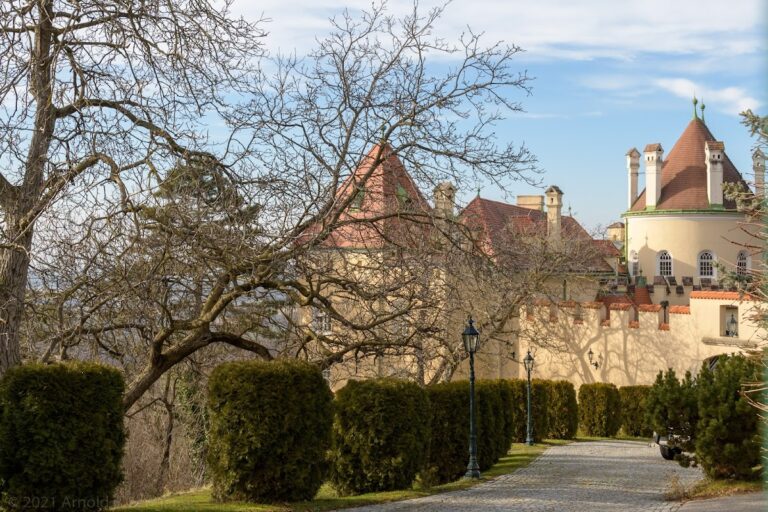
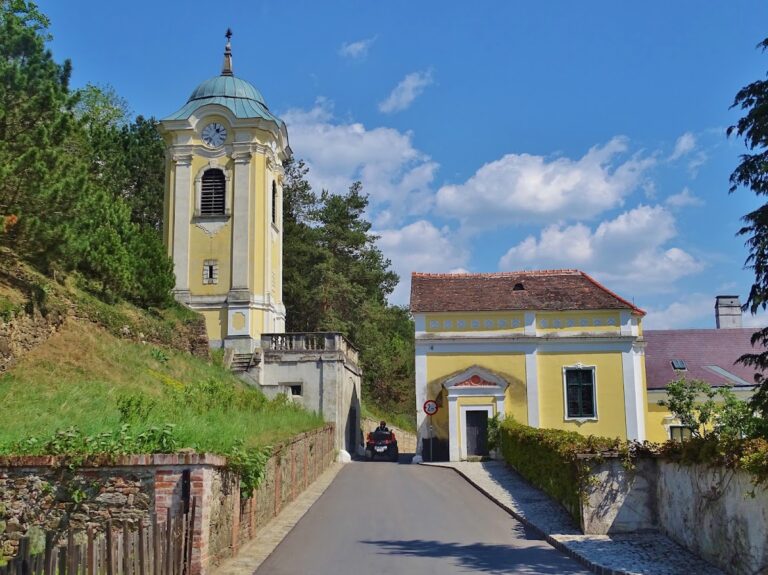
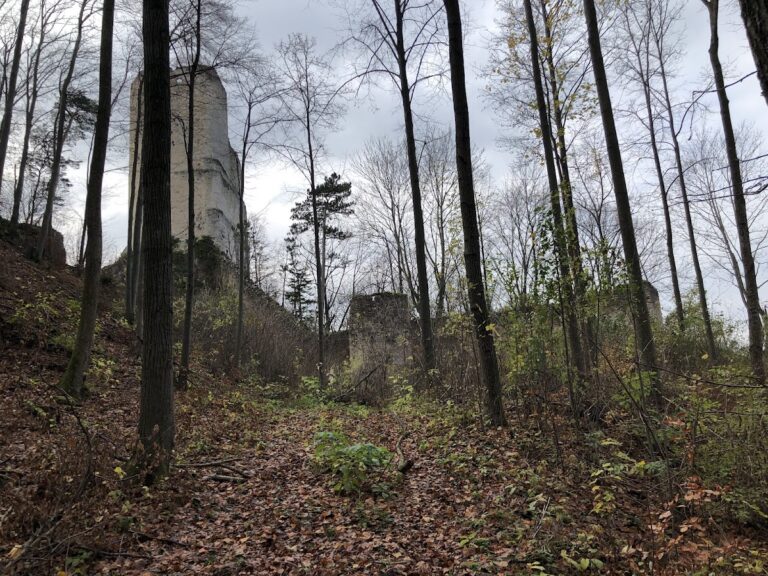
Forchtenstein stands on the summit of a high rocky hill, described as dolomite rock in the foothills of the Rosalia Mountains, southwest of Mattersburg and above the Wulka Valley. The medieval fortress used this elevated position for observation over the valley and surrounding landscape. Its earliest major structure included a roughly 50-metre-high bergfried, the principal tower of a medieval German-speaking castle, used for defence, observation, and refuge rather than as the main residence. The tower rises above the rest of the complex and contains the Gothic-vault keystone bearing the Mattersdorf family arms.
Walls, Bastions, and Gate
The present castle retains a multi-level defensive system of walls, bastions, and towers. Entry is through the only gate in the western part of the complex, whose approach formerly included a drawbridge. The seventeenth-century reconstruction added new walls, towers, bastions, and an expanded outer fortification belt. Stone and brick form the principal building materials. Durable Kaiserstein limestone was used for major architectural elements, fountains, and cannonballs, with cut blocks transported in special carts drawn by six oxen.
Residential and Ceremonial Spaces
Chapel and Living Quarters
The seventeenth-century rebuilding added a kitchen, chapel, and new living quarters to the fortified complex. These spaces formed part of the transition from a purely medieval stronghold to a residence capable of expressing the Esterházy family’s princely status. The Baroque chapel, restored in 1887 by Franz Storno in the historicist style, remains among the surviving interiors. The complex also retains museum rooms, courtyards, fountains, and a historically vaulted cellar.
Murals and Sculpture
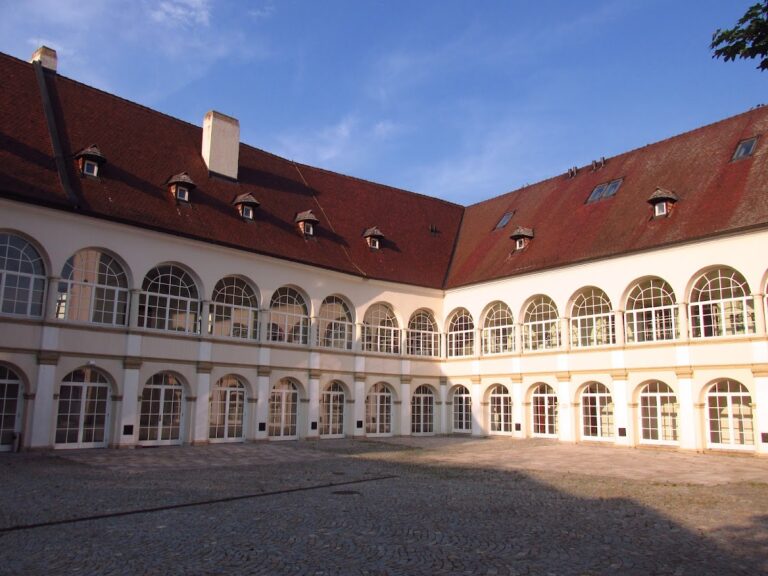
Paul I’s expansion added political and genealogical murals to the courtyard. The paintings are described as the largest group of their kind north of the Alps. Interior rooms contain decorative and allegorical wall paintings, while religious sculptures decorate the entrance portals. A Baroque equestrian statue represents Paul I. The castle also contained a crocodile more than two metres long, displayed alongside the murals and statue as part of the visual presentation of the patron’s authority, status, and political rank.
Collections and Treasury
Family Gallery and Arms Collection
The Baroque family gallery contains life-size portraits, including an image of Vlad III Tepes, later widely known as Count Dracula. The gallery is described as the largest of its type in Central Europe. The Esterházy private arms collection is likewise described as one of the largest of its kind. Together with the portraits and painted interiors, these collections connected the castle’s physical setting with the family’s dynastic presentation.
Chamber of Treasures and Curiosities
The treasury, also called a chamber of treasures and curiosities, was reached through a secret, secured passage. Its door required two different keys, one held by the prince and the other by the treasurer. The rooms held clocks, Renaissance Augsburg automata, stone-cut vessels, ivory works, Hungarian costumes and jewellery, silver furniture, and collections concerning flora, fauna, ethnography, art, and science. A chamber of curiosities was an early modern collection of unusual, valuable, natural, artistic, and scientific objects. Original cabinets with glass panels survive as part of the treasury’s furnishings, and the rooms are described as Europe’s last Baroque art and curiosity cabinet in its original location.
Arsenal and Archive
The castle arsenal housed military equipment belonging to Esterházy troops as well as objects taken as booty during campaigns. The private arsenal is described as the largest in Europe in private ownership. Archival material also remains within the complex, preserving part of the administrative and dynastic collections associated with Forchtenstein. The historic cellar vault has been maintained, and a wooden viewing path has been added alongside the restored fabric.
Nearby sites