Pampa Grande: A Moche Regional Center in Northern Peru
Site at a Glance
- Rating
- 4.3
- Popularity
- Very Low
- Country
- Peru
- Primary era
- Medieval
- Eras represented
- Medieval
- Civilizations
- Moche
- Site type
- City
On this page17 sections
History
Pampa Grande is an archaeological settlement in the Lambayeque Valley of northern Peru, on the south bank of the Chancay-Lambayeque River. Built and expanded by the Moche, an ancient Andean culture known for adobe ceremonial centers, irrigated agriculture, and finely made ceramics, it became a major regional center and probably the last Moche capital during Phase V, around AD 600 to 750.
Early occupation and Moche development
The earliest cultural connections at Pampa Grande reach back to the Cupisnique and Chavín traditions, early Andean cultures associated with religious imagery, monumental building, and skilled metalwork. A funerary bundle exposed by a flood in 1925 contained seven gold jaguar figurines. Later classified as Chavinoid and dated to approximately 1000 BC, the figurines were removed from the site and are now held in museums in Virginia, Chicago, New York, Hamburg, Munich, and Montreal.
The settlement’s broader sequence includes Moche I activity around 300 to 200 BC and Moche II through IV from approximately 100 BC to AD 500. Evidence from these early phases is limited because later construction and occupation probably disturbed or covered much of it. During Moche V, around AD 600 to 700, Pampa Grande expanded rapidly and acquired a much larger political and economic role.
New buildings, including a large ceremonial complex, were laid out around AD 600 and constructed within a relatively short period. The settlement eventually covered more than 400 hectares and may have supported approximately 15,000 people from varied social and occupational groups. Communities from the Zaña, Chancay, La Leche, Jayanca, and Motupe areas appear to have been drawn into its sphere. One interpretation proposes that the elite of Sipán relocated to Pampa Grande, helping establish it as the principal urban center of the north coast.
Urban administration and regional economy
Pampa Grande stood near the neck of the Lambayeque Valley, where control of water and movement toward the adjacent highlands were strategically important. Irrigation supported intensified farming, while recurring droughts may have encouraged the concentration of population, the organization of specialized labor, and the development of bureaucratic administration.
Rural communities cultivated beans, maize, squash, sweet potatoes, peanuts, chili peppers, gourds, cotton, and algarrobo. Storage areas contained plant remains that may have been used for medicine or animal fodder. Stone adzes, grinding stones, and handstones supported agricultural and food-processing work. Small quantities of copper included fishing-net weights, needles, and fishhooks.
The urban economy combined elite-sponsored workshops with production carried out by households. Craftspeople made ceramics, metalwork, textiles, beads, ornaments, figurines, and objects from spondylus, a large marine shell valued for ornaments, ritual objects, and exchange. Chicha, a fermented maize drink, was also produced. Tribute relationships linked household production to elite redistribution, although the extent of external tribute is uncertain.
Elite households had greater access to traded foods and high-quality goods, including white-tailed deer, sea lion, coca leaves, fruit, shellfish, chili peppers, and polychrome vessels associated with the Wari sphere. Most animal remains came from domesticated llamas, alpacas, guinea pigs, dogs, and other animals, while fish, shellfish, sea lions, deer, and additional wild species supplemented the diet.
Religion and social organization
Social distinctions were expressed through household size, construction quality, privacy walls, patios, living space, and the distribution of artifacts. Some interpretations divide society into four relatively distinct classes. Another view sees less rigid boundaries, with differences partly reflecting the topography of separate sectors.
Religious life included public and private ceremonies at the huacas, sacred places or monuments in the ancient Andes. At Pampa Grande, these were chiefly large earthen pyramids that combined ceremonial platforms, elite spaces, and areas connected with public ritual. Domestic ceremonies took place in patios, while ancestor worship linked family descent with ritual authority and inherited wealth. Amulets and figurines from household contexts may have been used in shamanistic practices, involving ritual healing and mediation with supernatural forces.
Abandonment and later occupation
Pampa Grande was abandoned shortly after AD 700 or around AD 750. Thick layers of water-borne sand and silt covered floor surfaces, possibly during one major flood or several floods. Burned domestic buildings, roofing, maize, and beans indicate that fire and abandonment may have occurred at roughly the same time, although the order of events remains uncertain.
Proposed explanations include severe flooding, an external attack by Wari forces, and internal unrest caused by environmental stress, economic instability, and an overextended redistributive system. Widespread burning supports an interpretation involving violent internal disruption, while some adobe units were not burned and many artifacts remained intact. Wari or Tiahuanaco occupation followed the abandonment. Tiahuanaco was a major Andean cultural and political tradition centered near Lake Titicaca, while Wari influence spread from the highlands into northern Peru during the Middle Horizon.
Later Chimú activity took place in the surrounding region, followed by an Inca presence from approximately 1476 until the early sixteenth century. Very little Inca pottery or other Inca material has been found at Pampa Grande. The site was recognized as a Cultural Heritage site of the Nation of Peru. Excavations from 1973 to 1975, followed by later research beginning with dissertation work in 2004 and investigations by Peru’s Ministry of Culture, have examined the settlement and its changing interpretation.
Remains
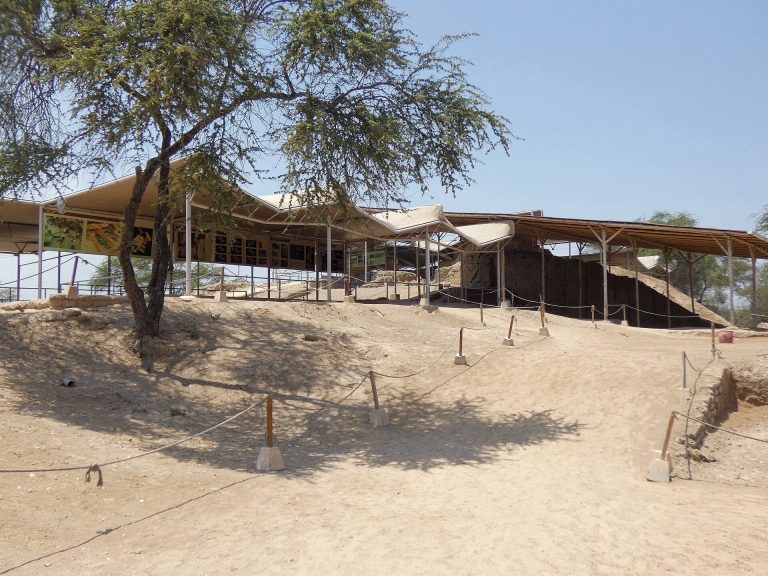
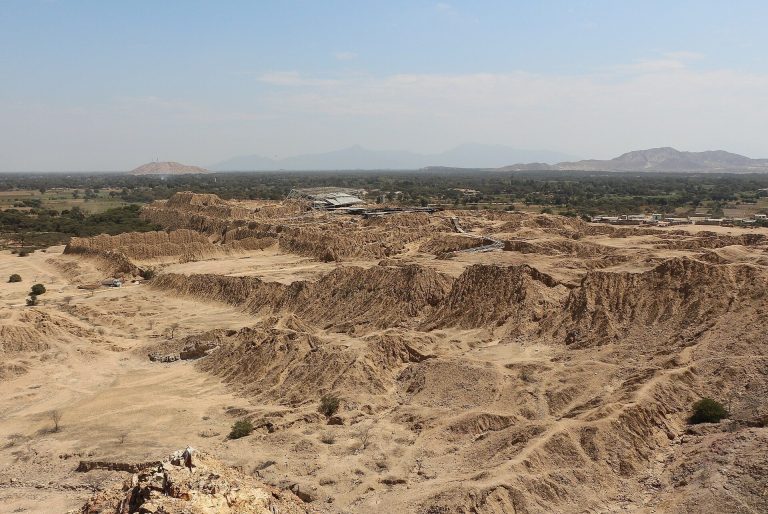
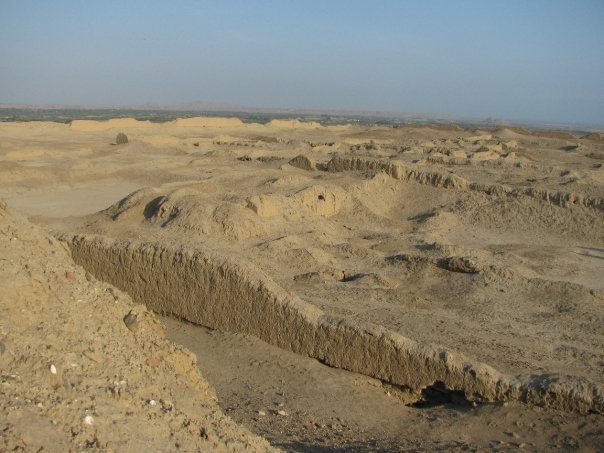
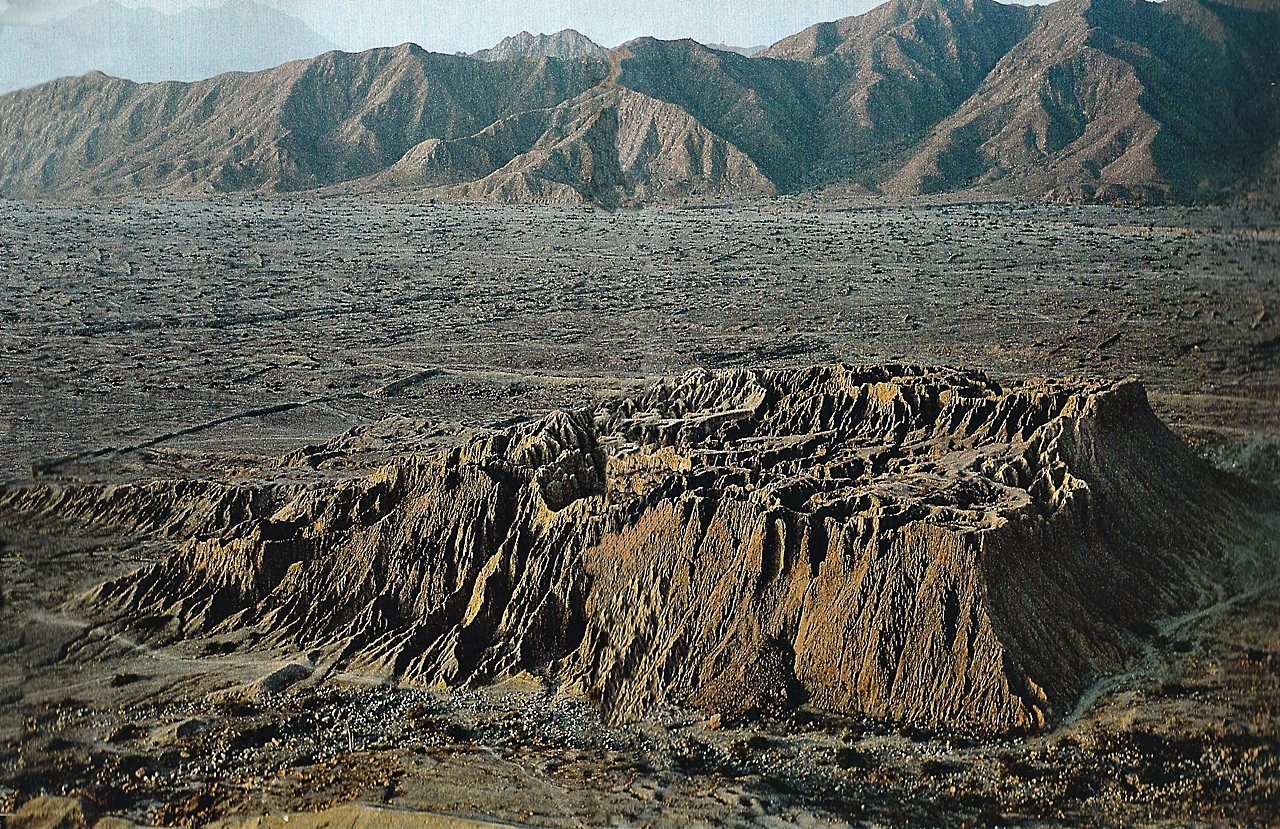
Pampa Grande covers approximately 450 hectares at about 145 meters above sea level, at the base of Cerro de los Gentiles and opposite La Puntilla. Its buildings were constructed mainly from adobe, with quadrangular stone used in foundations and selected masonry. The settlement was organized into monumental and residential areas, with two broad sectors containing pyramids, elite residences, workshops, storage facilities, patios, and smaller urban compounds. Natural erosion has heavily damaged the principal pyramid and other structures.
Monumental architecture
Huaca Grande
Huaca Grande, also called Huaca Fortaleza or La Capilla, is the largest pyramid at Pampa Grande. It occupies a rectangular complex measuring approximately 650 by 400 meters and rose through six height levels to about 40 meters. The structure is described as the tallest man-made earthen structure in South America and as the tallest ceremonial platform in Peru. Major collapses caused by natural processes have altered its original form.
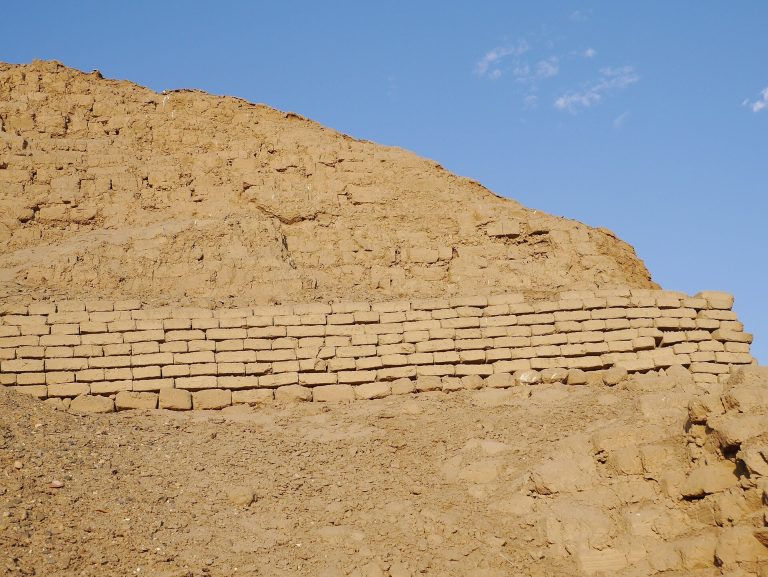
The pyramid was built largely from large adobe bricks and incorporated platforms above public plazas, upper rooms, and spaces associated with elite residence and ritual. Spacious rooms contained concentrations of luxury foods and valuable goods, indicating their use by ruling households. Smaller rooms within the complex probably accommodated servants and supported living or cooking activities.
Mural paintings decorated both the lower exterior surfaces visible from public areas and the upper terraces. The first terrace displayed repeated red and orange reptile figures resembling iguanas. Their purpose and symbolic meaning remain uncertain, but they formed part of the visual program of the ceremonial complex.
Huacas and ritual enclosures
Other huacas stood throughout the settlement. These earthen pyramids supported ceremonial platforms and were associated with public plazas, elite spaces, and domestic or private ritual. Enclosures around the pyramids were connected by narrow corridors and organized around patios or plazas. They accommodated craft production, storage, domestic activity, and possibly household ceremonies.
Pottery imagery from the settlement includes waves, stair-like forms, ritual runners, battling deities, iguana figures, and the wrinkled-faced figure known as Wrinkle Face. The wave-and-stair design has been interpreted either as a reference to marine life or as an abbreviated form of serpent or catfish imagery found at other Moche sites. It has also been linked to a possible ceremonial Temple of the Stairway and Wave, perhaps associated with ritual sacrifice, although that interpretation remains uncertain.
Residential and productive areas
Northern Piedmont
The Northern Piedmont contained elite residences, ceremonial architecture, workshops, storage facilities, and Huaca Fortaleza. Elite compounds used better materials and workmanship than commoner housing. They had durable foundations and walls, higher privacy walls, additional patios, and more living space. Their arrangement reflects differences in household resources and access to controlled areas.
Southern Piedmont
The Southern Piedmont consisted of small urban complexes separated by perimeter walls. Each was associated with a huaca and patios, creating residential settings that also supported domestic production and ritual activity. Earlier household units contained several structures with different functions, while later units more often had an internally divided, apartment-like arrangement.
Workshops and storage
Excavated workshops produced ceramics, metalwork, textiles, spondylus objects, and chicha. Some elite-sponsored workshops had controlled access and little evidence of habitation, while household workshops were more loosely supervised. Storage systems supported both specialist production and the redistribution of food and manufactured goods.
Construction relied on locally available sun-dried adobe bricks and quadrangular stone. Mortar included earth with an exterior clay layer, as well as mud mixed with fragments of ordinary ceramics. Some walls used core-and-veneer masonry, a technique in which a rough rubble core was covered with carefully shaped stone facing. Large stones used in elite residences and huacas came from nearby sources and were apparently transported with camelids before being cut to size.
Artifacts, burials, and craft production
Ceramics and imagery
Domestic pottery included large storage vessels, cooking vessels with short or absent necks, jars, bowls, plates, dippers, single-spout and handled bottles, floreros, and stirrup-spout bottles. A stirrup-spout bottle has a looped spout shaped like a stirrup, a form characteristic of ancient Andean pottery. Many vessels were mass-produced in molds during the later Moche phases. Painted stirrup-spout vessels and highly polished blackware bowls occurred in higher-status contexts.
Face-neck jars, often molded with human or animal faces, were widespread storage vessels and generally associated with lower-status households. Other pottery carried detailed fineline painting, three-dimensional figures, geometric patterns, bird-with-bowl imagery, and scenes involving deities. The wrinkled-faced figure called Wrinkle Face appears as a snarling face with deep wrinkles, large round eyes, and fangs. It may represent a deity or religious-political figure and is sometimes shown fighting supernatural beings or appearing in burial scenes, but its exact identity remains uncertain.
Burials and tools
Burials were generally placed inside domestic compounds or workshops. Associated objects included spindle whorls, threading weights, copper plates and knives, ceramics, and occasional gold and silver items. These combinations relate burial goods to occupation and social status. Two potters buried in a pottery workshop showed rheumatism and arthritis consistent with long-term pottery production.
Agricultural equipment included bifacially flaked stone adzes hafted to wooden handles, large grinding stones, and smaller handstones. Excavated animal remains include marine shells, fish, camelids, guinea pigs, dogs, iguanas, llamas, alpacas, rodents, and other species. Mold production extended to stirrup-spout bottles, figurines, rattles, whistles, trumpets, and some storage vessels, showing both organized specialist manufacture and household production.
The gold jaguar figurines
The seven gold jaguar figurines found in the flood-exposed funerary bundle are among the most notable objects associated with Pampa Grande. Their Chavinoid classification and approximate date of 1000 BC place them well before the settlement’s late Moche expansion. They were removed from the complex after their discovery and are now displayed in museums in Virginia, Chicago, New York, Hamburg, Munich, and Montreal.