Pacatnamu: A Moche and Chimu Ceremonial and Administrative Complex in Peru
Site at a Glance
- Rating
- 4.4
- Popularity
- Very Low
- Country
- Peru
- Primary era
- Medieval
- Eras represented
- Medieval
- Civilizations
- Chimú, Moche
- Site type
- Religious
- Remains
- Sanctuary
On this page15 sections
History
Pacatnamu is an archaeological complex near the mouth of the Jequetepeque Valley on Peru’s northern coast, developed by Moche communities from about AD 600 and later occupied during the Chimu period. Its adobe architecture, ceremonial spaces, burials, and extensive walls reflect changing religious, administrative, and social practices, while Lambayeque influence is also associated with the site. Earlier activity may reach the Formative period, but the beginning of occupation remains uncertain.
Moche occupation
The earliest clearly defined phase is identified through Moche ceramics and is placed around AD 600, at the end of Moche IV or the beginning of Moche V. Another interpretation places the origins of the site earlier. During this period, ceremonial architecture was built at Pacatnamu, which functioned as a ceremonial and probably administrative center. It also had political and possibly military roles, although no written evidence identifies a ruler, centralized government, standing army, or battle at the site.
Moche ceramics from Pacatnamu show influence from the Huari, or Wari, a highland Andean state whose cultural reach extended into parts of the coast. Textiles and burial customs nevertheless remained distinctly Moche. Excavations in funerary contexts also recovered Gallinazo-style face-neck vessels alongside Moche ceramics, indicating that the two ceramic traditions were present together during the pre-Huari occupation.
Moche occupation ended around AD 900, when a new ceramic form appeared. A further break around AD 1050 separates the Moche and Chimu phases. This interval was associated with extensive flooding and major changes in artifact types. The evidence indicates a substantial transformation rather than an uninterrupted continuation of the earlier occupation.
Chimu expansion and later use
A large population returned to Pacatnamu around AD 1100 to 1150 during the Chimu phase. The Chimu, a powerful northern coastal state whose principal center was Chan Chan, introduced new ceramic and textile styles, brick types, and architectural forms. They also constructed major walls, partly for defense and partly to expand and control the settlement. An unfinished wall on the northern side may represent an abandoned effort to enlarge the occupied area.
The main Chimu occupation ended around AD 1370. A smaller population may have remained for a time, and later visitors may have carried out limited ceremonies. By the Inca conquest of the northern coast around AD 1470, Pacatnamu was probably empty and largely ruined. Offerings continued during the early colonial period, after which the site ceased to serve its earlier purposes.
Pedro Cieza de León visited Pacatnamu in 1548 and found its buildings already in ruins. A tradition recorded by Antonio de la Calancha in 1638 connected the name with a mythical being and with a warrior who conquered the Jequetepeque Valley and ruled it as a tributary of the Great Chimú. This tradition belongs to the later historical memory of the site rather than providing evidence for a named ruler during its ancient occupation.
Society, ritual, and investigation
Pacatnamu has often been interpreted as a major ceremonial and pilgrimage center for the Jequetepeque Valley. The limited presence of ceramics from the wider valley and the local character of the burials have also led to the view that it primarily served local ceremonial and administrative purposes. Its elite appear to have consisted of administrative and ritual specialists separated from subsistence production and connected to a larger Moche or Chimu political system.
Elite authorities controlled textile production to a considerable degree, while fishing households generally lived outside the walls and combined fishing, shellfish gathering, plant collection, and agriculture. Other specialized activities included brick making, bead production, copper working, textile manufacture, storage, and food preparation. Llamas were important in daily life and ritual activity. Black vultures had religious significance, and their bones frequently occur with mass burials connected with ritual killings.
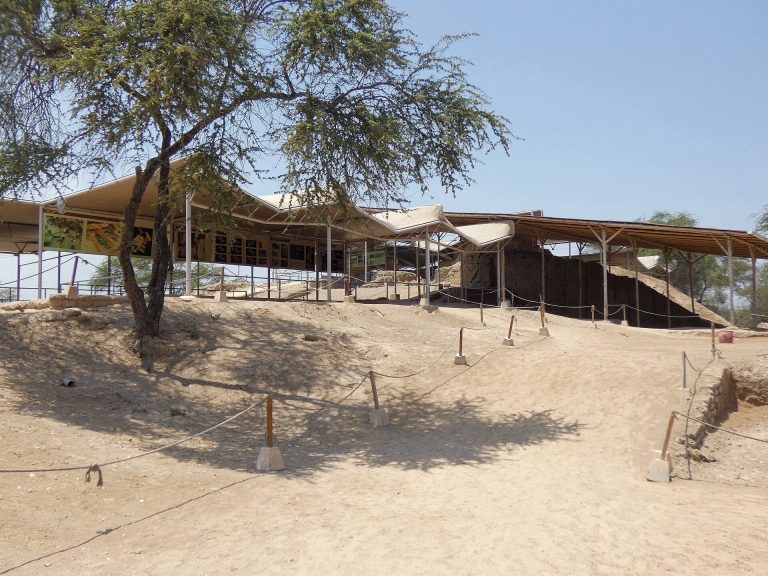
Pacatnamu had no documented writing system or surviving written records. Textiles depicting rituals and ceremonies therefore provide important evidence for religious and social practices, although they do not identify the people represented. An offering ritual discovered in the Huaca 1 complex in 1984 contained ceramics, human and camelid bone, metal, textiles, shell, and organic residue. The room had been burned after the objects were deposited. A similar assemblage was found at Dos Cabezas in 1995. The ritual may relate to the wider Andean practice of burning offerings for deities, but no specific Pacatnamu deity has been identified.
Brief exploration began in the late nineteenth century, followed by more systematic study in 1925. Alfred Kroeber prepared sketches of part of the principal architecture and published the first scientific study in 1930. Heinrich Ubbelohde-Doering excavated at the site in 1937 to 1939, 1952 to 1953, and 1962 to 1963. Wolfgang and Gisela Hecker participated in the final campaign and produced a general map and detailed architectural plans. Richard Keatinge conducted an extensive surface survey in 1974.
Excavations authorized in 1983 for the Museum of Cultural History at the University of California, Los Angeles, recovered hundreds of artifacts and established a chronology of occupation. Pacatnamu is recognized as Cultural Heritage of the Nation of Peru, and its archaeological remains cover approximately 92 hectares.
Remains
Setting and overall layout
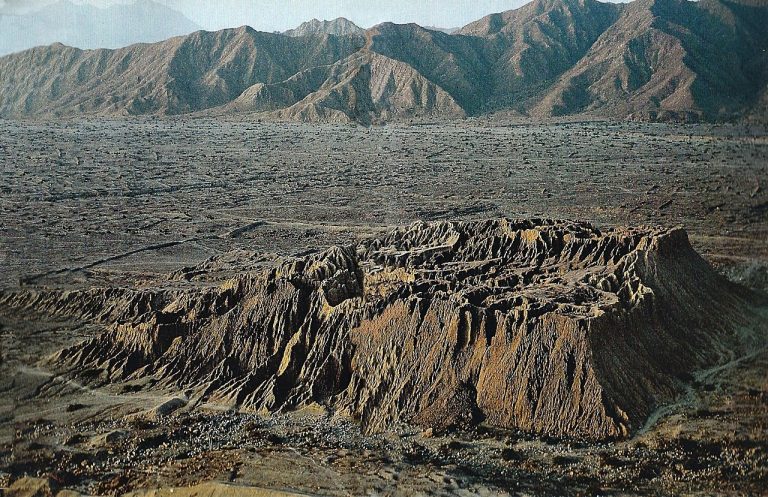
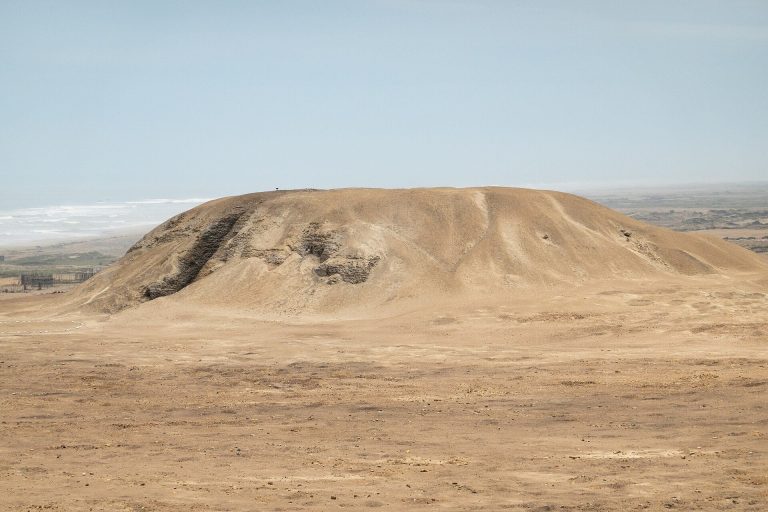
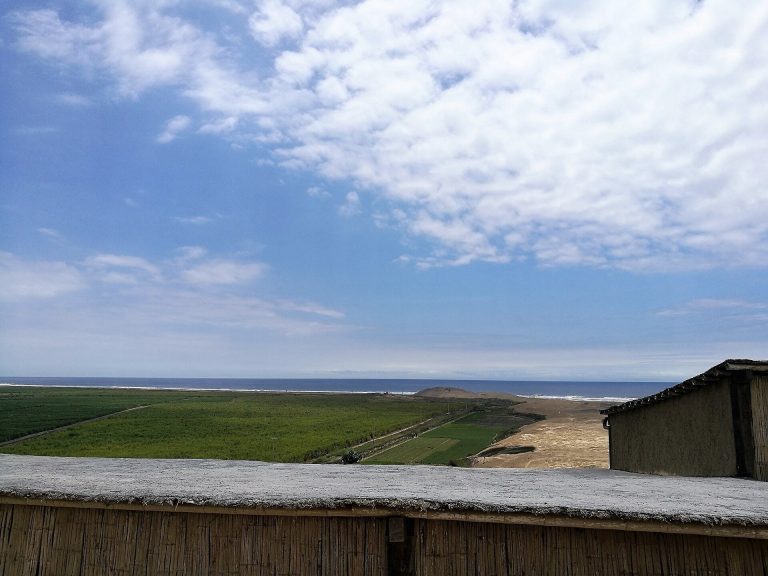
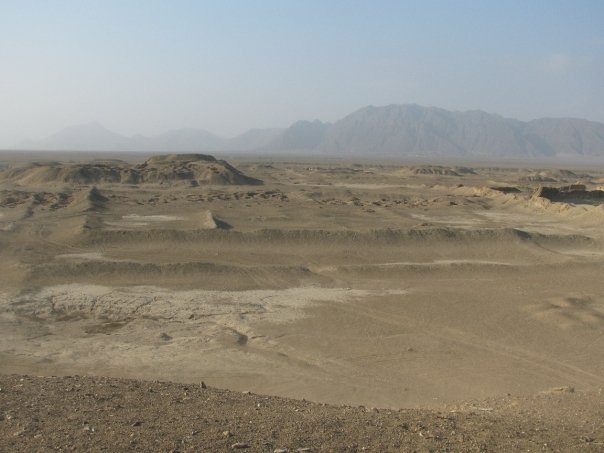
Pacatnamu occupies the summit of a small peninsula near the right bank of the Jequetepeque River and the Pacific Ocean. Rocky cliffs protect two sides, while a human-made wall protects the third. The complex lies in a dry coastal environment with little precipitation, a mild climate, and occasional high humidity. Its adobe remains include approximately 50 rectangular truncated pyramids, ceremonial terraces, residential compounds, plazas, storage areas, and cemeteries.
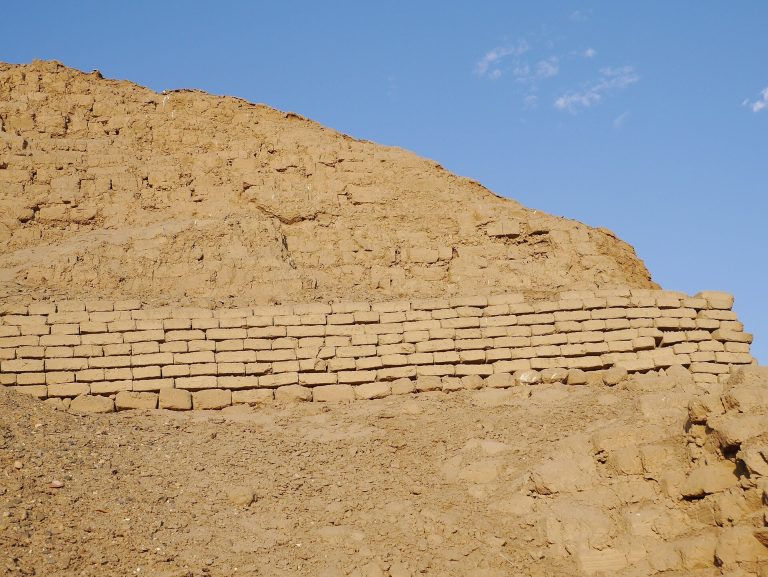
The buildings and walls were made chiefly from adobe, meaning sun-dried earthen brick or compacted earth, and from large earthen bricks. Brick construction, wall forms, ceramics, textiles, and architectural changes distinguish the Moche and Chimu phases. The arrangement of buildings emphasizes controlled movement and restricted access. Right-hand entrances and passageways are generally more elaborate and accessible, leading toward monumental, ceremonial, or administrative spaces. Left-hand routes are more obstructed by debris and lead toward domestic, storage, and food-preparation areas.
Walls and ceremonial architecture
Enclosing walls
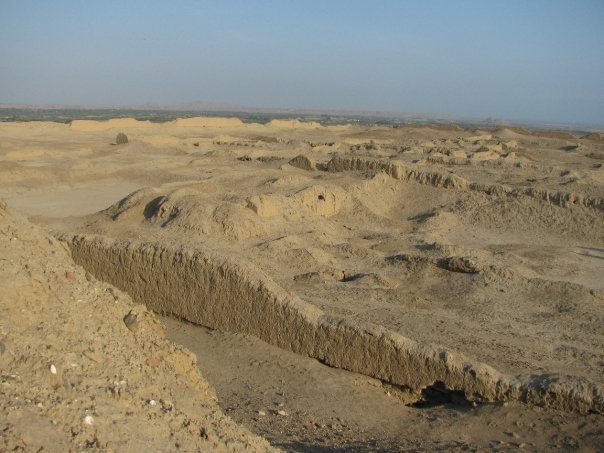
Three large adobe walls stand in the northern and southern parts of the complex and in other sectors near the cemetery. The wider wall system includes numerous doorways and an unfinished northern section. Its functions may have included defense, restricting access, organizing movement, and extending the occupied area. The contrast between monumental spaces and less elaborate structures, together with differences in artifact quality, reflects marked social distinctions between elite and common populations.
Huaca 1
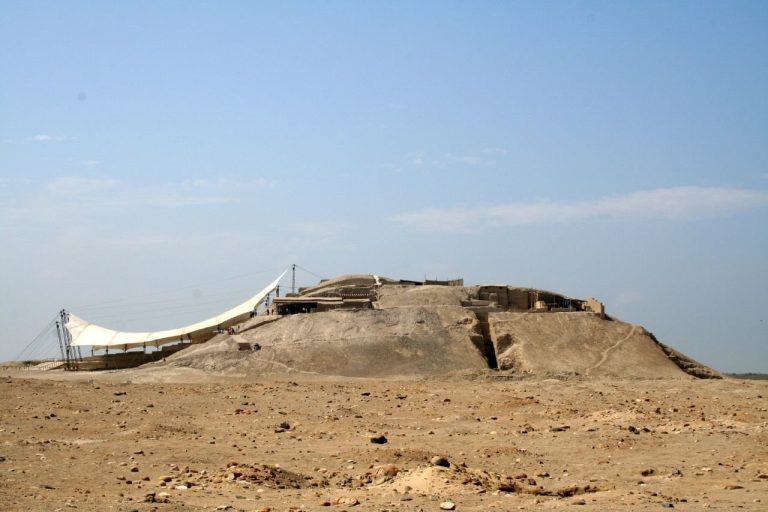
Huaca 1 is the largest pyramid and a monumental compound in the central part of Pacatnamu. It rises about 20 meters and measures approximately 60 meters on each side at its base. High surrounding walls conceal the mound from outside and may have restricted access or limited visibility during ceremonies. The complex contains an offering room in which two connected rooms were empty, while the ritual room held ceramics, human and camelid bones, metal, textiles, shell, and organic residue. Burning followed the deposition of these materials.
Huaca 31
Huaca 31 and its associated structures form another important architectural group. Graves to the north include burials interpreted as those of high-status individuals. During the Late Intermediate Period, elite burials were arranged around the structure, adding a funerary dimension to this part of the complex.
Burials and ritual remains
Mass burial near Huaca 1
Near the entrance to Huaca 1, a mass burial contains 14 mutilated young men, each approximately 14 years old. They were placed in three deposits made at different times. Many had multiple stab wounds to the chest and back, apparently inflicted by several people. Their selection and treatment may indicate ritual killing, a small conflict, or punishment, but the precise explanation remains uncertain.
Burials and offerings
Burials generally contain textiles, ceramics, copper, gourds, animal remains, and other offerings. Some individuals were placed near ceremonial buildings, while others were buried within Huaca 1. Gourds held organic materials including maize and quinoa and occur more often than ceramics in the graves. Animal remains include llamas, fish, guinea pigs, and birds. Most animal deposits are partial, although one burial contained a complete llama skeleton. Copper objects occur in burials regardless of the individual’s age or sex.
A Moche IV burial contained an adult woman who may have been a priestess. She lay in a cane sarcophagus with juvenile camelids near her head and feet, accompanied by additional offerings. Bodies were sometimes placed in cane coffins or sarcophagi. Hands and feet were often wrapped in yarn, faces were commonly covered with cloth, and clothing sometimes survived. Women and girls were often found with braided hair, although the evidence does not establish whether this practice applied to every burial.
Textiles and human remains
Textiles occur in all or nearly all burials. Fine weaving commonly used wool yarn, while grave textiles include cotton and wool wefts, supplementary-weft float patterns, and plain weave. Preservation and quality vary, with the finest examples associated with higher-status people. Men generally have more textile material than women. Textile designs frequently show llamas, black vultures, and ritual scenes, while differences in weaving quality and complexity may have marked status or ceremonial role.
The burial population shows physical stress in the form of age-related degeneration in the hips, knees, shoulders, and elbows, along with dental disease, tooth loss, and healed and unhealed fractures. Other remains include a severe stabilized spinal injury in a middle-aged woman, an extensive injury near an adult man’s left eye, and two probable benign cartilaginous tumors, one in a young man’s femur and another in a man’s left thumb.
Productive and residential spaces
Many compounds contain evidence of textile production or textile use, and other buildings were used for brick making, storage, food preparation, or related activities. Large courtyards and passageways repeatedly follow the right-left arrangement found elsewhere at the site. This organization placed more formal and restricted spaces alongside domestic and productive areas, showing that Pacatnamu combined religious and administrative functions with ordinary residential work.
Wind-blown sand continually encroaches on Pacatnamu and has deformed its pyramids, walls, and other remains. The surviving architecture, burials, textiles, and offering deposits preserve evidence for the site’s changing Moche and Chimu occupations and for the ritual and administrative activities carried out within its adobe compounds.