Deir el-Medina: An Ancient Egyptian Workmen’s Village
Site at a Glance
- Rating
- 4.7
- Popularity
- Low
- Country
- Egypt
- Primary era
- Bronze Age
- Eras represented
- Bronze Age, Iron Age, Classical
- Civilizations
- Egyptian, Ptolemaic
- Site type
- City
On this page15 sections
History
Deir el-Medina is an ancient Egyptian workmen’s village on the west bank of the Nile opposite modern Luxor, Egypt. Built during the New Kingdom, the period of Egyptian imperial power from approximately 1550 to 1080 BC, it housed the specialists who constructed and decorated royal tombs and nearby funerary temples. The settlement was known in antiquity as Set Maat, meaning “Place of Truth,” and its inhabitants were called the “Servants in the Place of Truth.”
Foundation and royal service
The earliest datable remains belong to the reign of Thutmose I, approximately 1506 to 1493 BC. The village developed during the Eighteenth, Nineteenth, and Twentieth Dynasties and reached its mature form during the Ramesside Period, when kings named Ramesses ruled Egypt. Its secluded position helped protect the locations of royal tombs in the Valley of the Kings and nearby funerary temples.
Deir el-Medina’s residents included stone-cutters, plasterers, water-carriers, decorators, administrators, and other specialists. Egyptians lived alongside Nubians and Asiatics. The tomb workers were divided into left and right gangs, each working on one side of a tomb and supervised by a foreman. They were salaried state employees whose rations could reach about three times the income of agricultural labourers. Their positions were prestigious and usually hereditary, with parents training children to follow the same occupations.
The working cycle normally consisted of eight days of labour followed by two days of rest, with up to six further days of leave each month for illness, family concerns, marital disputes, or a hangover. Including religious festivals, more than one-third of the year was free from work during the reign of Merneptah, approximately 1213 to 1203 BC. Workers used some of this time to prepare their own tombs, drawing on the skills that made them among the most accomplished builders and decorators in the Theban necropolis.
Community life and institutions
The settlement’s nearly four centuries of occupation preserve unusually detailed evidence for ancient community life. A substantial proportion of its residents, including women, possessed at least basic literacy. Letters, legal records, transactions, prayers, love songs, magical texts, and literary passages describe family relationships, prices, exchanges, work arrangements, and personal concerns.
Marriage among Egyptian inhabitants was generally monogamous, although separation, divorce, and remarriage occurred. Families commonly had six or seven children, and some had as many as ten. One case concerns Merymaat, who sought a divorce because of the conduct of her mother-in-law. The records also describe enslaved women who served as surrogate mothers and later gained higher status and freedom.
Women cared for children and prepared bread, while state-provided servants helped with grain grinding and laundry. Egyptian law allowed women to own property. A wife retained one-third of marital goods, and after divorce or her husband’s death that share belonged to her. If she died first, it passed to her heirs rather than to her husband. Brewing was normally supervised by the Mistress of the House.
The inhabitants were free citizens rather than slaves. Their local court included a foreman, deputies, craftsmen, and a court scribe. It handled civil disputes and some criminal cases, including failures to pay for goods or services. Proceedings could continue for years, and one dispute involving the chief of police lasted eleven years. The Medjay, an Egyptian policing and security force, maintained order and controlled access to the royal tombs.
A well-known case involved Paneb, the son of an overseer, who was accused of tomb robbery, adultery, and disturbing the community. The outcome is unknown, although records mention the execution of a head of workmen during this period. Divine oracles also played a role in personal and judicial matters. Questions were presented orally or in writing before a divine image carried by priests, and the image’s movement was interpreted as a favourable or unfavourable answer. Oracles could determine guilt, demand restitution and punishment, and were believed capable of causing illness or blindness or granting cures.
Religion and medicine
The community maintained between sixteen and eighteen sacred spaces. State gods were worshipped alongside local and personal deities. Hathor, a goddess associated with motherhood, sexuality, music, joy, and funerary protection, received particular attention, as did Ptah, a creator god and patron of craftsmen, and Ramesses II. Ptah, Resheph, Thoth, and Seshat were linked with crafts, writing, knowledge, and record-keeping.
Women especially venerated Hathor, Taweret, and Bes during pregnancy. Taweret protected pregnancy and childbirth, while Bes was associated with household protection and family well-being. Residents also turned to Renenutet and Meretseger for food and protection. Meretseger, whose name means “She Who Loves Silence,” was a local Theban goddess connected with the western necropolis and its sacred landscape.
Amenhotep I and his mother, Queen Ahmose-Nefertari, remained revered as protectors of the village for generations. Amenhotep became the focus of a funerary cult as “Amenhotep of the Town,” while Ahmose-Nefertari was worshipped as “Mistress of the Sky” and “Lady of the West.” Village elders served as priests during the annual Festival of Amenhotep I. Residents dedicated prayers and votive offerings to particular gods, using upright inscribed stones called stelae to express remorse, gratitude, or appeals for mercy. Dream interpretation was also common, and a dream book in the library of the scribe Kenhirkhopeshef was already old when it was used.
Medical care combined examination, treatment, prayer, and magic. A physician assessed patients and prescribed remedies, while a “scorpion charmer” specialised in magical cures for scorpion bites. Magical treatments circulated among workers, whereas written prescriptions were less common and complex medicines appear to have been prepared by physicians themselves.
Strikes, insecurity, and abandonment
Around the twenty-fifth year of Ramesses III, approximately 1170 BC, delayed rations led the tomb workers to put down their tools and protest. They complained that eighteen days had passed that month without receiving their grain and that they had been forced to buy food themselves. Negotiations brought them back to work, but further strikes followed. The regular grain supply was restored during the remaining years of Ramesses III. Later workers distrusted officials who supported the authorities and selected their own representatives. Additional protests occurred under Ramesses IX and Ramesses X.
After the reign of Ramesses IV, approximately 1155 to 1149 BC, insecurity, unreliable grain supplies, work stoppages, and tomb robbery increased. Robbers often tunnelled into tombs from the rear so that the seals at the main entrances remained intact. Fences and some bribed officials helped conceal the crimes. The Abbott Papyrus describes an investigation in which officials tortured a known robber and tried to use him as a scapegoat. The vizier forced him to identify the target, but the robber led investigators to an unfinished tomb and falsely claimed that it belonged to Isis. The recovered funerary goods were placed in the royal treasury.
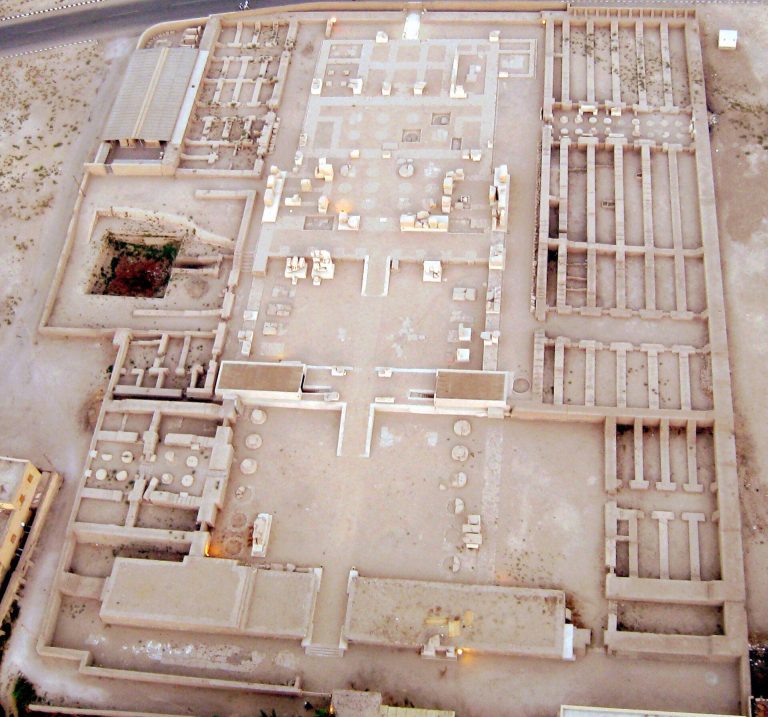
The village was abandoned around 1110 to 1080 BC, during the reign of Ramesses XI, amid increasing tomb robbery, attacks by Libyans, and instability connected with civil conflict. In the Ptolemaic period, a temple dedicated to Hathor was built over an earlier shrine to the goddess. During the Christian period, the temple became a monastery dedicated to Saint Isidorus the Martyr, giving the site its Arabic name, Deir el-Medina, or “Monastery of the City.”
Rediscovery and interpretation
A substantial group of papyri was found near the village in the 1840s, and further objects were recovered during the nineteenth century. Ernesto Schiaparelli led the first major organised excavations from 1905 to 1909, uncovering large quantities of ostraca, potsherds and limestone flakes used as writing surfaces. A French expedition directed by Bernard Bruyère excavated the village, dump, and cemetery from 1922 to 1951. Around half of the recovered papyri are thought to have been removed without the knowledge or authorisation of the excavation leadership.
Approximately 5,000 ostraca were found in a well near the village. They record commerce, religion, literature, work, and personal affairs. Jaroslav Černý, a member of Bruyère’s team, studied Deir el-Medina for almost fifty years until his death in 1970. He identified many inhabitants and reconstructed aspects of their lives. The peak above the village was renamed Mont Cernabru in recognition of the work of Černý and Bruyère. Deir el-Medina forms part of the UNESCO World Heritage property Ancient Thebes with its Necropolis, designated in 1979.
Remains
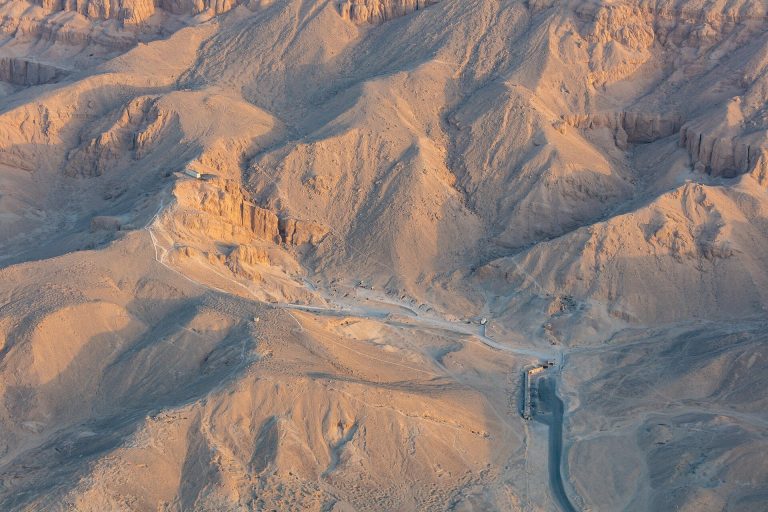
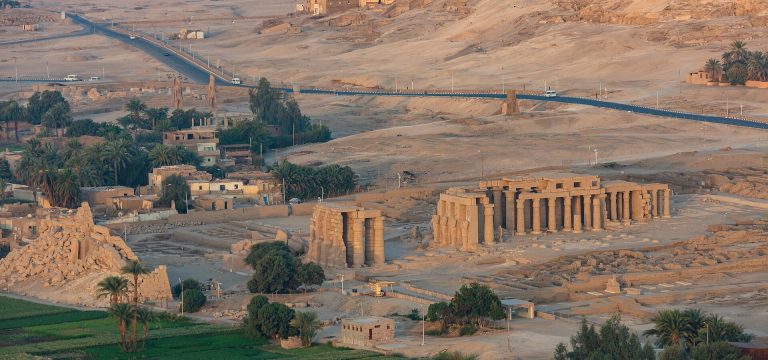
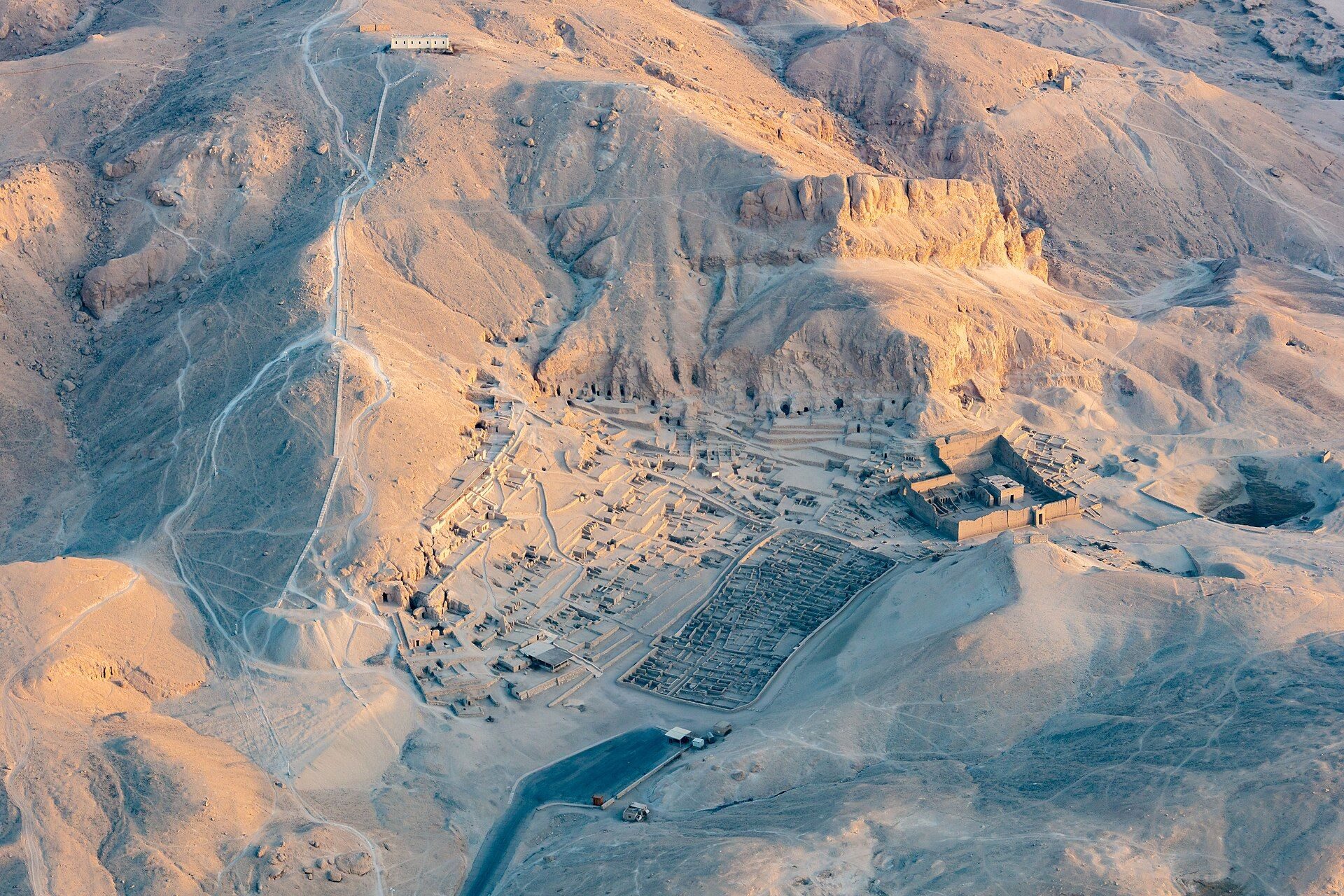
Deir el-Medina lies within a small natural amphitheatre on the west bank of the Nile. The Valley of the Kings is to the north, funerary temples lie to the east and southeast, and the Valley of the Queens is to the west. Paths connected these areas and could be walked relatively easily. The settlement followed the narrow valley’s shape, with barren hills around it and Gurnet Murai hill to the north, which blocked the cooling breeze and the view towards the fertile Nile valley.
Village houses and streets
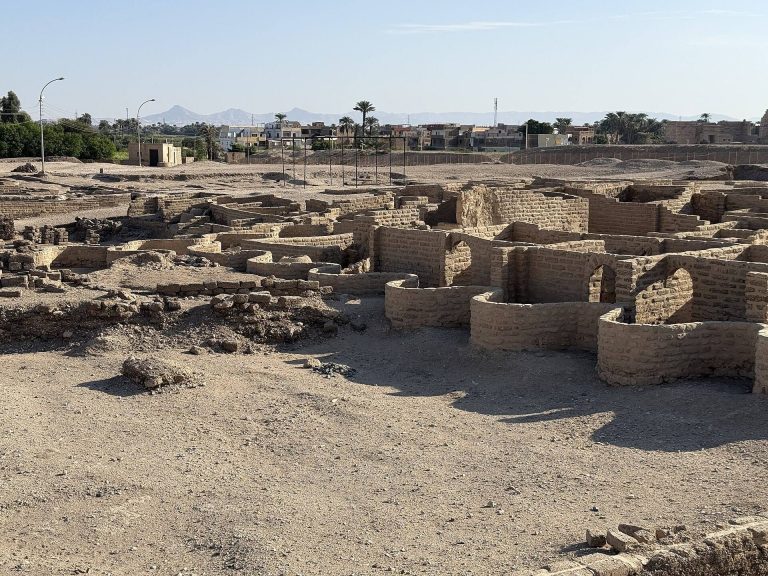
At its height, the settlement contained approximately sixty-eight houses covering about 5,600 square metres. A narrow road ran through the village, probably beneath a covering intended to shield residents from the intense sunlight and heat. Houses varied in size but averaged about 70 square metres. Builders set mudbrick walls on stone foundations, coated them with mud, and whitewashed their exterior surfaces. Some internal walls were whitewashed to a height of about one metre.
A typical house contained four or five rooms, including an entrance, a principal living room, two smaller rooms, and a kitchen with a cellar and stairs to the roof. High-set windows reduced exposure to the sun. A wooden front door may have carried the occupant’s name. The main room generally held a stepped mudbrick platform that may have served as a household shrine or a birthing bed. Nearly all houses contained wall niches for statues and small altars.
Private tombs and the workers’ camp
Private tombs
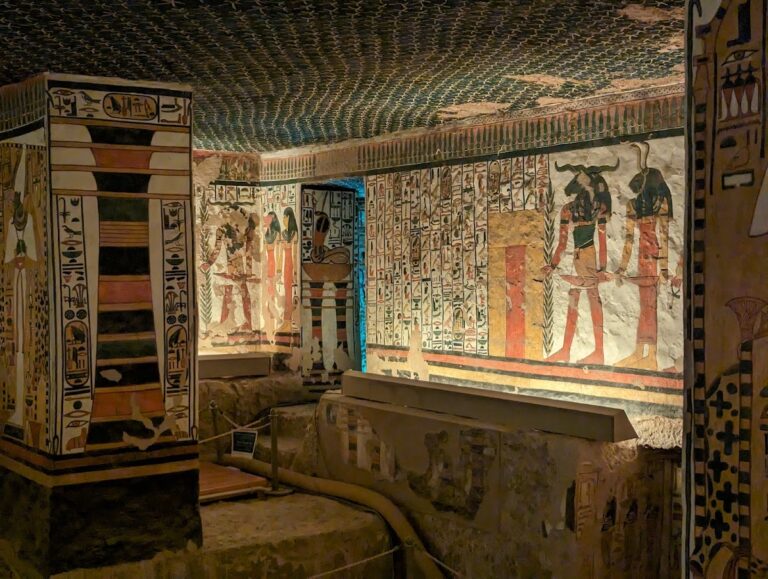
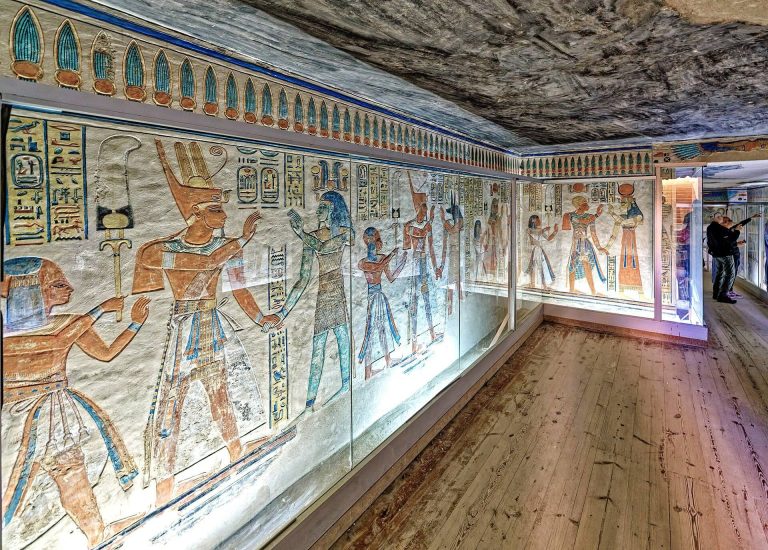
The community’s private tombs had small chapels above underground, rock-cut burial chambers and were marked by small pyramids. Their interiors were painted. The builders’ specialised knowledge of excavation and decoration produced some of the most accomplished tombs on the west bank.
Overnight camp
When work on royal tombs continued late, artisans stayed overnight in a camp overlooking the Mortuary Temple of Hatshepsut, built during her reign from approximately 1479 to 1458 BC. Cooked meals were brought from the village, while water-carriers supplied water from the main well, which stood about a thirty-minute walk away.
Temple and religious features
Hathor temple
The Ptolemaic temple dedicated to Hathor occupied the site of an earlier shrine to the goddess. It was later converted into a Christian monastery dedicated to Saint Isidorus the Martyr. The temple’s later forms preserve the changing religious use of the settlement after the village itself had been abandoned.
Stelae and household worship
Household and community worship is represented by statues, altars, sacred spaces, votive stelae, and written prayers. A votive stela dedicated to Hathor by Nefersenut shows him and one of his sons kneeling before the goddess in human form while presenting offerings. Other stelae contain petitions to deities, including appeals to Meretseger for relief from pain and prayers to Ptah and Amun.
Written and archaeological remains
Excavations exposed the settlement, its dump, and its cemetery. Papyri, medical ostraca, legal and administrative documents, religious texts, literary works, and records of commerce and exchange illuminate the community’s work and beliefs. The ostraca from the nearby well, together with the surviving objects and texts, also preserve evidence for dream interpretation, magical practices, medical treatment, local religious spaces, and the written and oral records used by the inhabitants.