Burg Sommeregg: A Medieval Hill Castle and Territorial Court in Austria


Site at a Glance
- Rating
- 4.5
- Popularity
- Medium
- Country
- Austria
- Primary era
- Medieval
- External website
- Open
- Eras represented
- Medieval
- Civilizations
- Habsburg, Holy Roman Empire
- Site type
- Military
- Remains
- Castle
On this page8 sections
History
Burg Sommeregg is a medieval hill castle in Austria, near Seeboden am Millstätter See in Carinthia. Probably existing by 1187, it became the seat of the lords and burgraves of Sommeregg and of a territorial court that remained there until 1652. The surrounding hill may have served as a refuge much earlier, since a flanged axe found near Treffling has been attributed to the Urnfield culture, a Late Bronze Age tradition associated with cremation burials and urn cemeteries.
Origins and the Ortenburg connection
The castle was long associated with a first written mention from 1237, when Count Wilhelm of Malta was thought to have granted an Ortolf of Sommeregg estates near Lake Millstatt and below the castle. It is now considered likely that the stronghold already existed in 1187, when Witemarus of Sommeregg appeared in a document issued by Neustift Abbey in Tyrol.
The Sommeregg family served the Counts of Ortenburg as ministeriales, members of the medieval service nobility who held office and property in return for service. As burgraves, they governed and defended the castle for the Ortenburg counts. From 1338 to 1344, members of the family held both the burgrave and castellan offices, the latter involving the practical management and defense of the castle. The stronghold also hosted an important dynastic agreement when Count Albert of Gorizia and Euphemia of Ortenburg-Hardegg signed their marriage contract there on 29 May 1275.
Several burgraves followed in the later fourteenth and early fifteenth centuries, including Otto von Treffen in 1344, Kunz der Fleck in 1373 and 1374, Hans Steierberger from 1377 to 1395, Hans Malteiner and Liebhart von Katsch in 1406, Christoph Hallecker in 1410 and 1411, and Jörg von Hallegg, also called Hallecker, before 1442.
The territorial court and the Graben family
When the male line of the Counts of Ortenburg ended in 1418, their lordship passed to the Counts of Celje, a major noble house whose possessions included territories connected with Upper Carinthia. In 1442, the Sommeregg territorial court became independent of the County of Ortenburg. A territorial court exercised judicial authority over a defined district, and this change raised the standing of the Sommeregg lordship.
Andreas von Graben, a Styrian nobleman and captain of Ortenburg Castle and its county, acquired Sommeregg as an hereditary fief through his marriage to Barbara von Hallegg, the daughter of burgrave Jörg von Hallegg. An hereditary fief was land or jurisdiction that could pass to the holder’s heirs. Count Frederick II of Celje confirmed Andreas’s rights. Andreas made the castle his family residence and developed Treffling Church as a representative burial church for the Graben family.
The court’s jurisdiction covered a district extending south to Lake Millstatt and the Seebach, west to the Lieser, north to the Pleßnitzgraben, and east to the Tschiernock and the Tangerner Bach. It included peasants belonging to Sommeregg as well as to the lordships of Gmünd, Spittal an der Drau, Millstatt, the parish of Lieseregg, and several smaller estates. After the Counts of Celje became extinct and the Habsburgs acquired the Ortenburg possessions in 1456, the Graben family’s fief was confirmed. By this period, Sommeregg had its own territorial and high criminal court, with authority over serious offenses that could carry the death penalty.
Destruction, rebuilding, and changing ownership
In 1487, during the conflict between King Matthias Corvinus of Hungary and the Austrian Habsburgs, Hungarian forces captured and destroyed Sommeregg. Virgil von Graben, Andreas’s son and a later burgrave, rebuilt the castle. His marriage to Dorothea Arnold, born Herbst of Herbstenburg, was regarded as illegitimate, preventing their sons, including Lukas von Graben zum Stein, from inheriting his estates. Virgil’s brothers Ernst and Wolfgang Andreas therefore succeeded him as burgraves. After Ernst died without a male heir in 1513, his heiress Rosina von Graben secured confirmation of the fief from Emperor Maximilian I.
In 1534, administration passed to Rosina’s son, Hans Joachim von Rain zu Sommeregg, of the Bavarian noble family of Rain. He had returned his interests to Bavaria and sold the lordship on the Millstätter Berg to Christoph Khevenhüller of Aichelberg in 1550. The Khevenhüllers, who also used the designation of Aichelberg at Landskron and Sommeregg, held the castle and lordship until 1628. Mathes Heidenreich and Kristoph Heidenreich administered Sommeregg during the second half of the sixteenth century.
On 4 May 1628, the Khevenhüllers sold the castle and lordship to the merchant Hans Wittmann for 110,000 gulden. Wittmann remained the owner until 1651, when the property passed to Countess Katharina of Lodron. In 1652, Sommeregg ceased to be a Habsburg territorial fief and became the private property of the Lodron family. Georg Franz Ebenhoch von Hocheneben administered it for the Lodrons from around 1700, and the family retained ownership until 1932.
Decline, restoration, and later use
The abolition of peasant obligations in 1848 ended Sommeregg’s role as the centre of a manorial estate. The loss of dues and services contributed to the castle’s deterioration, although it remained inhabited. Storms severely damaged the roof in 1933 and 1935.
In 1969, Elfi and Andreas Egger acquired the nearly ruined castle from Baroness Rosenberg de la Marre. They renovated and restored it and established a restaurant there. The Egger family sold Sommeregg to the Riegler family in 1992. The privately owned site now contains a restaurant and a torture museum.
A witch trial connected with Sommeregg began in the seventeenth century. In 1653, Kaspar Haintz, known as the “weather-maker” of Matzelsdorf, was beheaded at Gmünd in Carinthia after affirmatively answering 114 questions under torture. Since 1997, Sommeregg has also hosted annual knight games for three weeks in August in a purpose-built medieval village. Its museum, supported by Amnesty International, presents the history of torture and opposes its use as a means of obtaining “truth.”
Remains
Castle structure and setting
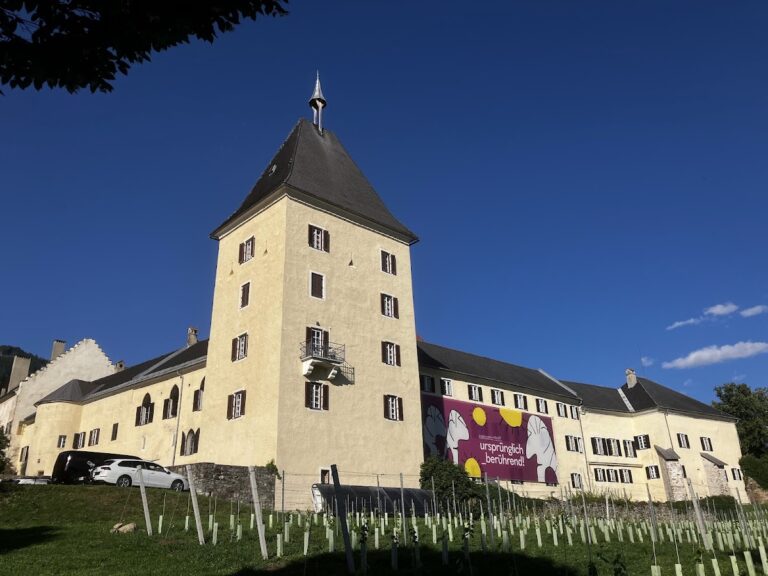
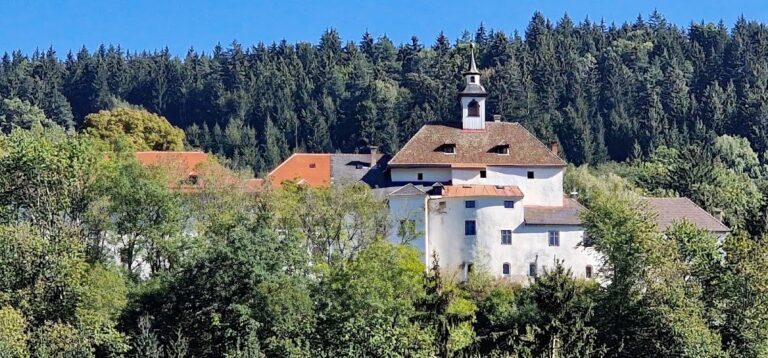
Burg Sommeregg stands on a rounded elevation characteristic of the Millstätter Mountains, in the foothills of the Nock Mountains, at approximately 749 metres above sea level. The surviving castle reflects the rebuilding that followed the destruction of 1487. It has an irregular ground plan and an irregular overall arrangement, while a round tower remains as the visible reminder of the earlier stronghold.
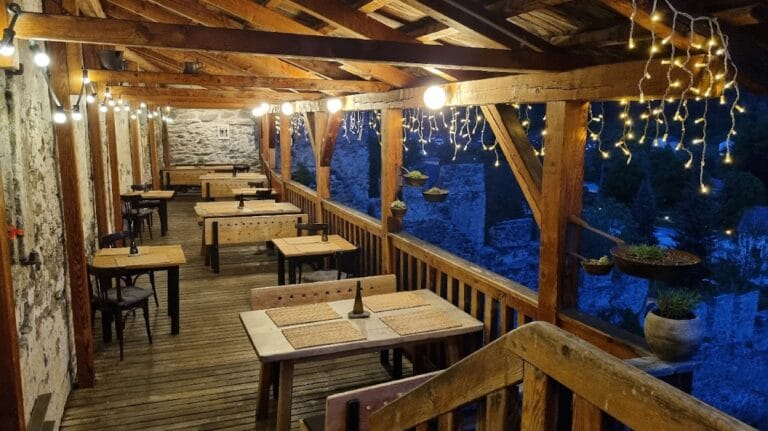
The castle retains substantial historic fabric, although it had deteriorated to an almost ruinous condition before restoration began in 1969. The work preserved the surviving structure and allowed the building to continue in use. The lower storey and terraces accommodate the restaurant, while the upper storey contains the torture museum.
Torture museum and upper platform
The museum contains approximately 70 faithfully reconstructed replicas of instruments associated with medieval and Inquisition-era torture. The Inquisition consisted of church tribunals established to investigate and prosecute perceived religious deviation. Among the displayed objects are thumbscrews, stretching racks, Spanish boots, nail chairs, and pillories. Their presentation forms part of the museum’s wider account of torture and its rejection as a method for obtaining truth.
A wooden exterior staircase leads from the museum roof area to a viewing platform. In clear conditions, the platform provides a broad outlook reaching as far as the Dobratsch and the Karawanks to the southeast.