Red Bank Battlefield: Site of a Revolutionary War Battle
Site at a Glance
- Rating
- 4.7
- Popularity
- Medium
- Country
- United States
- Primary era
- Early Modern
- External website
- Open
- Eras represented
- Early Modern
- Civilizations
- British
- Site type
- Military
- Remains
- Fort
On this page11 sections
History
Red Bank Battlefield in National Park, New Jersey, United States, preserves the site of the Battle of Red Bank, fought on October 22, 1777, during the American Revolutionary War. In that conflict, the Thirteen Colonies fought against British rule between 1775 and 1783. About 500 American soldiers faced approximately 2,000 British and Hessian troops, the German soldiers hired by or serving alongside the British.
Fort Mercer and the Battle of Red Bank
Fort Mercer formed part of a defensive system with Fort Mifflin, positioned on opposite sides of the Delaware River. Together, the forts blocked British use of the river for transportation. They delayed British operations, although both were eventually destroyed or abandoned. Fort Mercer took its name from Brigadier General Hugh Mercer, a Scottish-born Continental Army officer who had been mortally wounded at the Battle of Princeton on January 3, 1777.
The fighting at Red Bank brought together troops with different experiences and backgrounds. Colonel Christopher Greene, a Continental Army officer, commanded the 1st Rhode Island Regiment, also known as Varnum’s Regiment, the 9th Continental Regiment, the Black Regiment, the Rhode Island Regiment, and Olney’s Battalion. Its ranks included free African Americans, enslaved people, and Native Americans. Enslaved soldiers were to receive freedom after the war, with compensation paid to their enslavers. A historical marker at the battlefield commemorates the African Americans who served in the regiment.
People and later recognition
Ann Cooper Whitall remained in the Whitall House during the battle and cared for wounded soldiers. This service gave her the epithet “Heroine of Red Bank.” Hessian Colonel Carl von Donop, who commanded troops serving with the British, died during the battle. His remains were buried on the grounds, where a memorial commemorates the fallen Hessian leader.
Red Bank Battlefield is part of the Gloucester County park system. It was added to the U.S. National Register of Historic Places on October 31, 1972, designated a U.S. National Historic Landmark on November 28, 1972, and listed on the New Jersey Register of Historic Places on August 16, 1979.
In June 2022, a mass grave containing the remains of 15 Hessian soldiers was discovered at the northern end of the park, on land acquired by Gloucester County in 2020. Historians, archaeologists, forensic anthropologists, and the New Jersey State Police Forensic Anthropology Unit analyzed the remains.
Remains
The battlefield lies along the Delaware River, and erosion has reduced the historic ground area along the riverbank. Surviving features include portions of Fort Mercer, the Whitall House, period artillery, river defenses, recovered cannonballs, and monuments associated with the battle and its participants. The park is described as covering 44 acres, approximately 180,000 square meters, while the historic-site record gives an area of 20 acres, or 8.1 hectares.
Fort Mercer defenses and artillery
Fort Mercer ditch
The principal surviving feature of Fort Mercer is the ditch that surrounded its former earthworks. The ditch preserves the outline of the fortifications and helps define the position of the former defensive work beside the Delaware River.
Period cannons
Period cannons are displayed around the former fortifications and along the riverbank. Four of them were raised from the wrecks of the British warship HMS Augusta and the British sloop HMS Merlin. Three American cannons facing the Whitall House were found buried on the site in 1935.
River defenses
Near the Whitall House, a preserved section of chevaux-de-frise, a defensive obstacle made from projecting spikes or beams, represents the underwater river defenses associated with Fort Mercer and Fort Mifflin. Cannonballs recovered from the battlefield are displayed nearby.
Whitall House and commemorative structures
James and Ann Whitall House
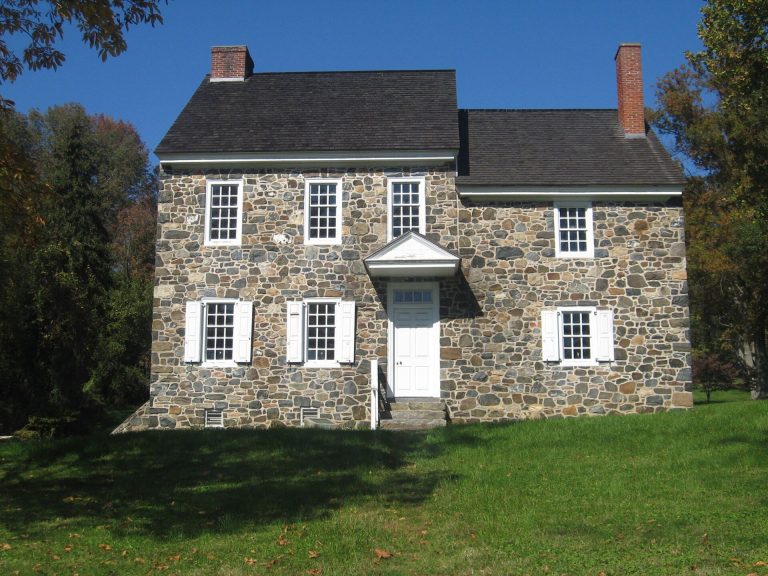
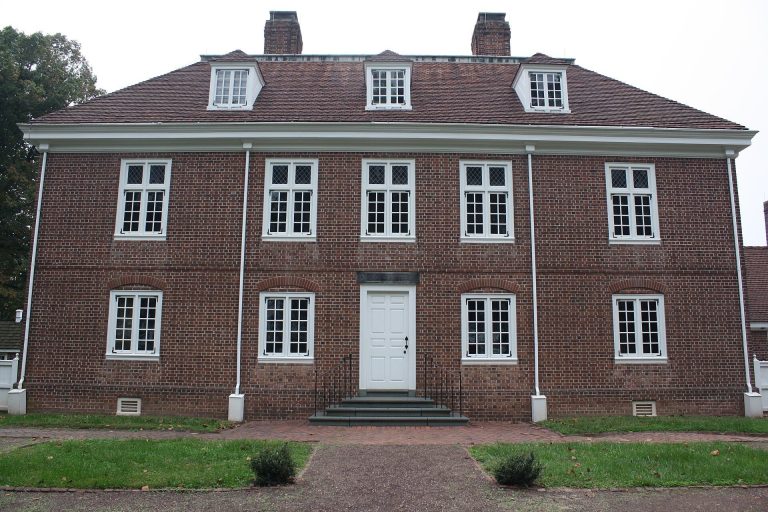
The James and Ann Whitall House stands just outside Fort Mercer’s works. James Whitall Sr. built the brick-and-stone house in 1748 in the Georgian architectural style, an eighteenth-century tradition characterized by formal proportions and symmetrical design. The house was damaged during the battle and used as a field hospital for some of the wounded. The Historic American Buildings Survey, a U.S. federal program that records historically important buildings through drawings, photographs, and written descriptions, documented the house in 1936.
Battle monuments
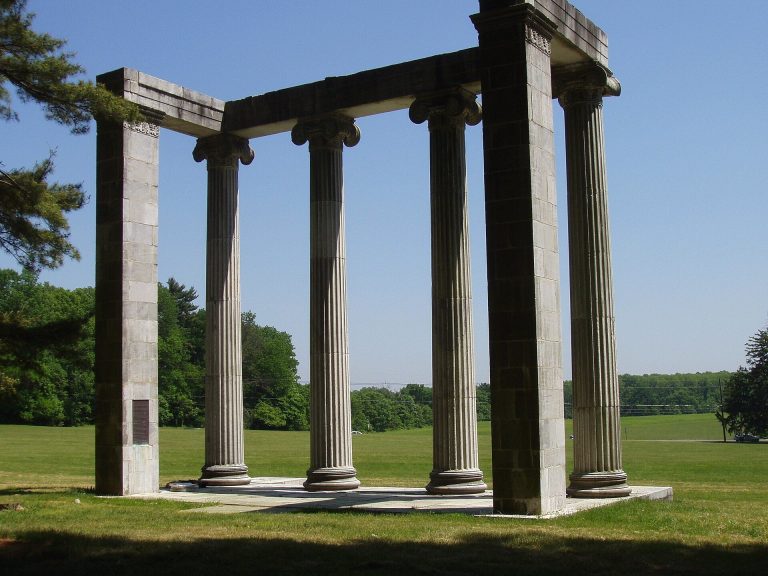
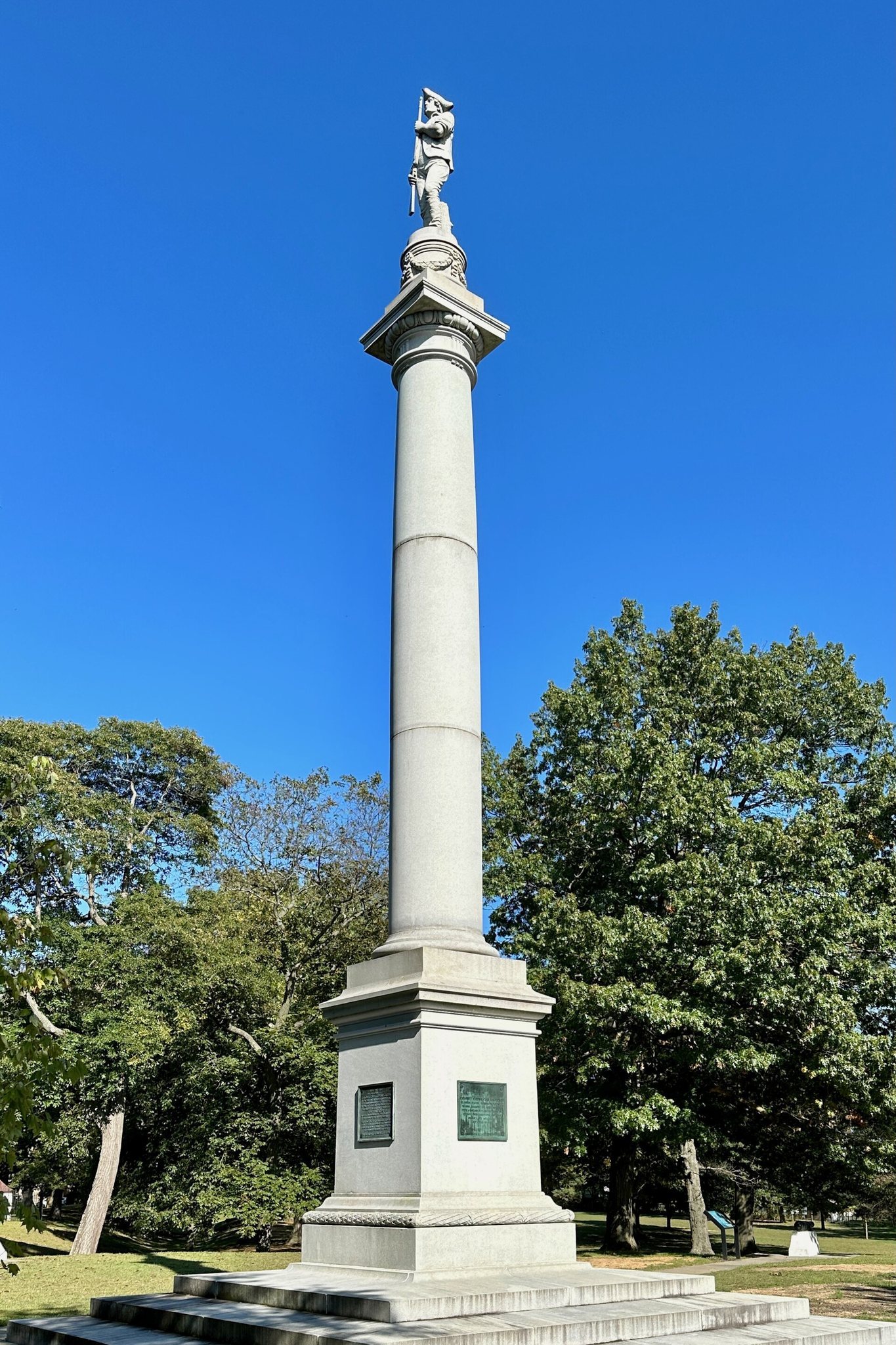
Monuments across the battlefield commemorate important participants and the battle itself. One honors Colonel Christopher Greene, commander of the 1st Rhode Island Regiment, while another memorializes the fallen Hessian leader Carl von Donop. The 75-foot, or 23-meter, Battle of Red Bank Monument was dedicated in 1906.