Independence Hall: Pennsylvania State House and Birthplace of American Independence
Site at a Glance
- Rating
- 4.7
- Popularity
- Medium
- Country
- United States
- Primary era
- Early Modern
- External website
- Open
- Eras represented
- Early Modern, Modern
- Civilizations
- British
- Site type
- Civic
On this page14 sections
History
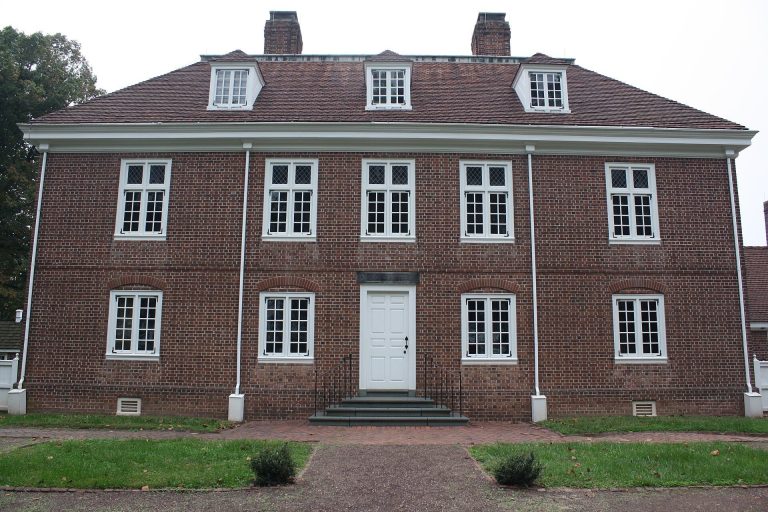
Independence Hall, originally the Pennsylvania State House, stands at 520 Chestnut Street in Philadelphia, United States. Built by the colonial government of Pennsylvania between 1732 and 1753, it is a red-brick Georgian building designed by Edmund Woolley and Andrew Hamilton. It served as the seat of Pennsylvania’s government before becoming the principal meeting place of the Continental Congress and the Constitutional Convention.
Building the Pennsylvania State House
Plans for a permanent state house emerged in spring 1729, when approximately £2,000 was committed to the project. Thomas Lawrence, John Kearsley, and Andrew Hamilton were appointed to choose a site, obtain plans, and arrange construction. Hamilton and William Allen acquired lots on Chestnut Street by October 1730. Kearsley had favored High Street, now Market Street, while Hamilton supported Chestnut Street. On August 14, 1733, the Provincial Assembly approved Hamilton’s plans, confirmed the site between Fifth and Sixth Streets, and placed him in charge of the work.
Edmund Woolley constructed the building for the Pennsylvania colonial legislature. Funding arrived as money became available, so construction proceeded in stages until 1753. The Pennsylvania State House served the colonial government from 1732 to 1799.
The Revolution and Independence
The Second Continental Congress, the representative body of the thirteen British North American colonies during the American Revolution, made the State House its principal meeting place from May 10, 1775, until March 1, 1781. Wartime evacuations interrupted its sessions. During the British occupation of Philadelphia, Congress met in Baltimore from December 1776 to February 1777. After another evacuation in 1777, it met in Lancaster and York before returning to Philadelphia in July 1778.
On June 14, 1775, delegates meeting in the Assembly Room established the Continental Army and appointed George Washington commander in chief. On July 26, Congress appointed Benjamin Franklin as the first postmaster general of the institution that later became the United States Post Office Department.
Congress voted for independence from Britain on July 2, 1776. Two days later, it formally adopted and signed the Declaration of Independence in the building. The declaration was then read publicly in the area now called Independence Square. Its 56 signatures include the prominent signature of John Hancock, the Massachusetts revolutionary who was president of the Continental Congress.
Confederation and Constitution
Under the Articles of Confederation, the first constitutional framework of the United States, the Congress of the Confederation met in the State House from March 1, 1781, to June 21, 1783. The Pennsylvania Mutiny of 1783, in which soldiers demanded action over unpaid wages and related grievances, prompted Congress to leave Philadelphia. It subsequently met in Princeton and other cities.
Twelve states sent delegates to the Constitutional Convention held in the Pennsylvania State House from May 25 to September 17, 1787. Rhode Island did not send a delegation. Rather than simply revise the Articles of Confederation, the delegates secretly drafted a new Constitution. The document was completed on September 17, 1787, and took effect on March 4, 1789.
After the Residence Act of 1790 made Philadelphia the temporary national capital for ten years, Congress returned to the city on December 6, 1790. It met in adjacent Congress Hall until the federal government moved to Washington, D.C., in 1800. The building served as Pennsylvania’s State House until 1799 and was renamed Independence Hall in 1824, when it hosted the Marquis de Lafayette.
Changing uses and public memory
Independence Hall became a museum from 1802 to 1827, when Charles Willson Peale operated a collection of natural-history specimens and portraits of prominent Americans, including a mastodon skeleton. It also had municipal uses from 1818 to 1895. Pennsylvania sold the State House to the City of Philadelphia in early 1816, and the deed was transferred more than two years later. Philadelphia has owned the building, its associated structures, and its grounds since that time.
Abraham Lincoln’s funeral procession stopped at Independence Hall on April 22 and 23, 1865. His body and the coffin of his son Willie lay in state in the Assembly Room in the east wing, guarded by 27 naval and military officers. More than 300,000 mourners viewed Lincoln’s body before the funeral train left for New York on April 24.
On June 17, 1915, former president William Howard Taft presided over the convention that formed the League to Enforce Peace. The organization proposed an international body whose members would act together through economic and military measures against aggressors and would codify international law. Tomáš Masaryk proclaimed Czechoslovak independence from the steps of Independence Hall on October 26, 1918. National Freedom Day has been observed there since 1942, and John F. Kennedy delivered an address at the building on July 4, 1962. Annual gay-rights demonstrations took place outside it on July 4 from 1965 to 1969.
Preservation and continuing associations
Independence National Historical Park was established by an act of Congress in 1948 to preserve places associated with the American Revolution, including Independence Hall. Research and archaeological work connected with the park’s restoration helped establish influential approaches to historic preservation and contributed to the revitalization of historic Philadelphia. Independence Hall became part of the park and was designated a contributing property in the U.S. National Historic Landmark District in 1966. UNESCO inscribed it as a World Heritage Site in 1979 under criterion vi, recognizing its direct association with the Declaration of Independence, the Constitution, and ideas of exceptional importance to humanity.
The building hosted a joint meeting of Congress on July 16, 1987, commemorating the bicentennial of the Connecticut Compromise. The 1989 film A More Perfect Union, about the Constitutional Convention, was filmed largely inside Independence Hall. The National Park Service manages the building. Security measures were strengthened after the September 11, 2001, attacks, and a proposed fence was replaced in 2007 by movable bollards and chains.
Heavy visitation, air pollution, acid rain, nearby urban development, and water accumulation in Independence Square have challenged the building’s preservation. Drainage improvements have been undertaken to reduce risks to the foundation. Independence Hall has also served as a model for exhibition and civic buildings, including the Pennsylvania Building at the 1893 World’s Columbian Exposition and the 1907 Jamestown Exposition, the Pennsylvania Pavilion at the 1939 New York World’s Fair, and later structures inspired by its design.
Remains
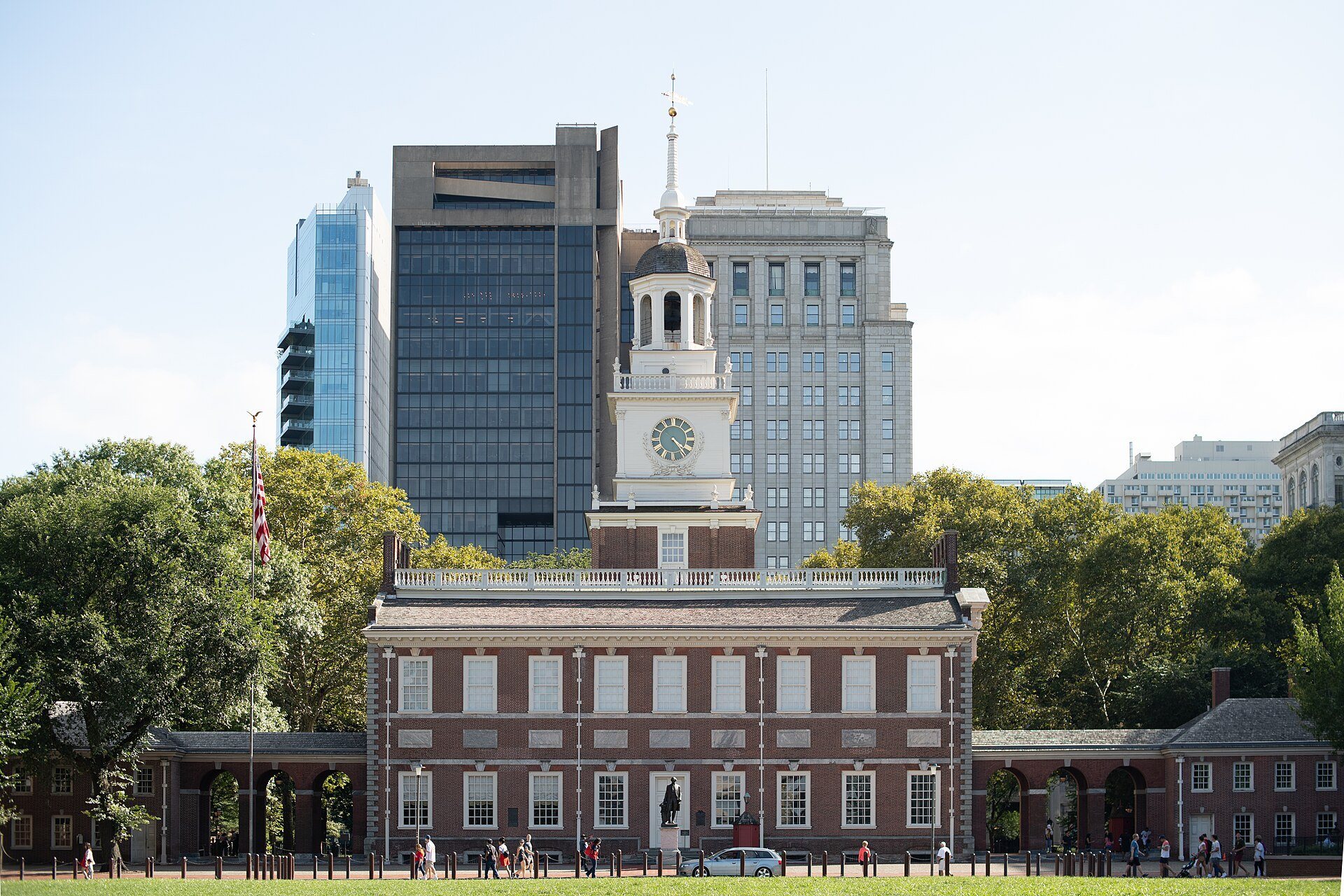
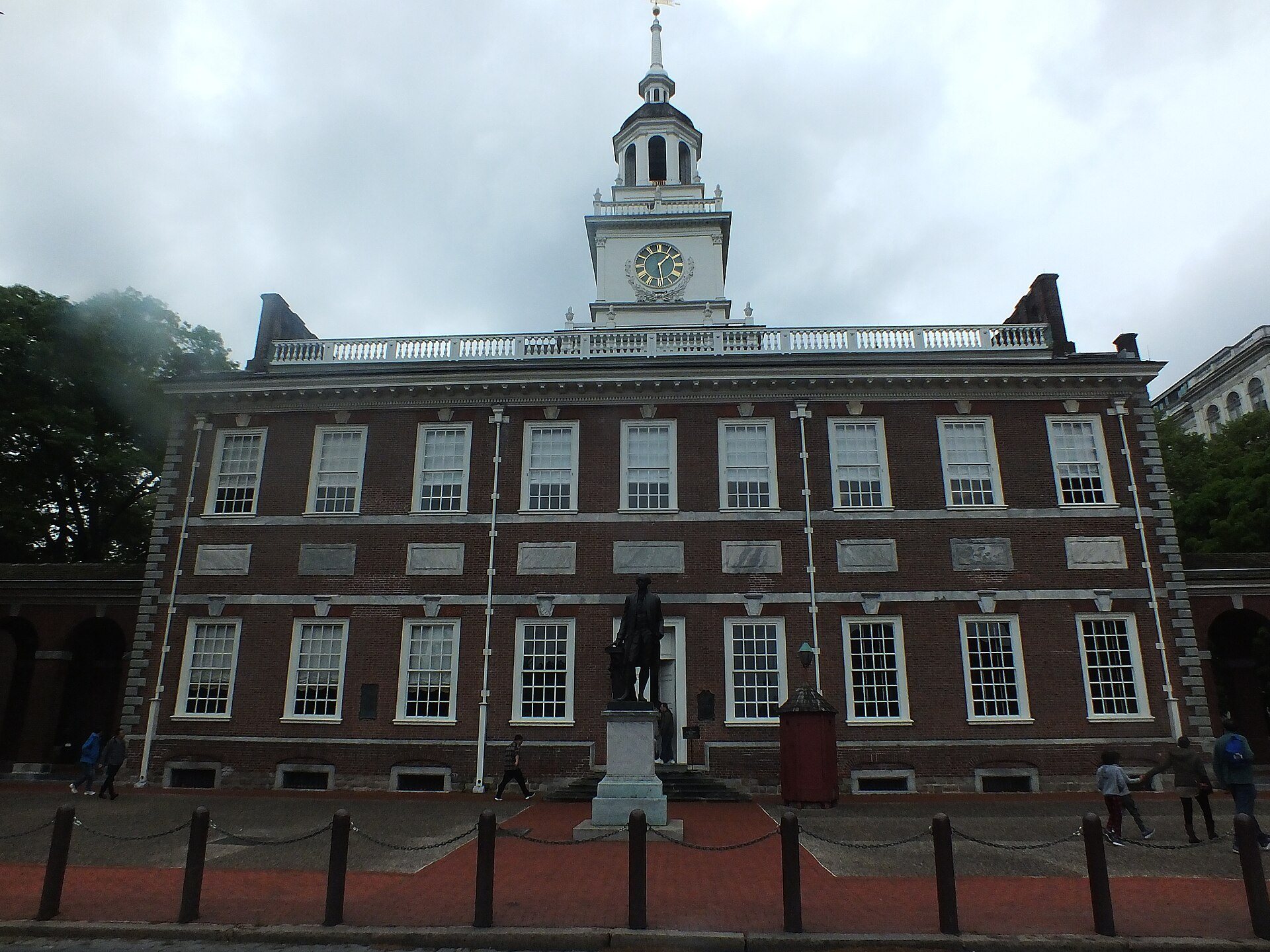
Independence Hall occupies the south side of Chestnut Street between Fifth and Sixth Streets. The site was originally a slightly sloping, vegetation-covered area on the city’s outskirts and had previously been used as a camp by American Indians. The surviving complex is a red-brick Georgian composition with a central block, a belltower and steeple, two wings, and arcaded hyphens, or connecting passages articulated by arches. The steeple rises 168 feet 7 1/4 inches, approximately 51.391 meters, above the ground.
Central building and public rooms
Structure and later reconstruction
The foundation rests in sandy clay and was made with rubble stone and lime mortar. Wooden girders and beams formed the interior frame and roof trusses, reinforced with joints, iron plates, and pins. The outer shell consists of hard-fired brick approximately 22 to 23 inches thick. The central block’s outer shell remains original, while the wings, hyphens, steeple, and much of the interior were reconstructed or substantially altered.
The original wings and connecting passages were demolished in 1812 and replaced with larger buildings designed by Robert Mills. In 1898, the Mills wings were removed and replaced with reconstructions of the original wings. William Strickland’s more elaborate 1828 steeple was retained, and the north entrance was rebuilt during the same period. Old City Hall adjoins the building to the east and Congress Hall to the west. Together with Independence Hall, they occupy the block known as Independence Square. Philosophical Hall, the former home of the American Philosophical Society, is also on the block, while Independence Mall and the Liberty Bell Center lie to the north.
Assembly Room
The Assembly Room is the principal interior associated with the signing of the Declaration of Independence and the Constitution. Its wood paneling, furnishings, plaster, paint, ceiling, cornice, floor structure, doors, windows, fireplace openings, and other details were altered repeatedly. The restoration used surviving architectural evidence, receipts, books, diaries, letters, and an eighteenth-century painting of Congress voting for independence. Paint layers were scraped to identify earlier colors, eighteenth-century wrought-iron nails were examined, and the original brick walls, woodwork, floor joints, openings, paneling dimensions, and cornice were recorded.
Furnishings were completed in 1955, and the restoration ended in 1965 with interventions designed to remain distinguishable, compatible, and reversible. The present interior is principally a mid-twentieth-century National Park Service reconstruction intended to restore the public rooms to an eighteenth-century appearance. The second-floor Governor’s Council Chamber contains period furnishings and a musical tall-case clock made by Peter Stretch around 1740.
Tower, clocks, and bells
Steeple and clocks
The original wooden steeple had deteriorated and become dangerously weak by 1773. It was removed in 1781, and the brick tower was temporarily covered with a hipped roof. William Strickland designed a replacement steeple in 1828. The tower and steeple retain much of their original wood and brick, but the historic timber structure required later stabilization. A steel tower was installed internally in the twentieth century after core sampling and nondestructive stress testing.
Isaac Norris commissioned the original State House clock from Thomas Stretch, son of clockmaker Peter Stretch. Thomas Stretch installed a giant clock at the west end in 1753. It had a 40-foot limestone base, a 14-foot wooden case, and a clock face carved by Samuel Harding. Rods connected its east and west dials to a movement in the building’s center. The clock was removed around 1830.
Isaiah Lukens designed and installed another clock in 1828. It ran for eight days, had four copper dials on each side measuring eight feet in diameter, and powered a 4,000-pound bell made by John Wilbank. The Lukens clock remained in the building until 1877. A replica of the Thomas Stretch clock was installed in summer 1973. The colonial legislature’s acquisition of the original clock and bell was closely associated with its acquisition of the Liberty Bell.
Liberty Bell and Centennial Bell
The lowest chamber of the original wooden steeple was the Liberty Bell’s first location. After the steeple was removed in the 1780s, the bell was lowered into the highest chamber of the brick tower, where it remained until the 1850s. Recognizable by its crack, the Liberty Bell was displayed on the ground floor from the 1850s until 1976. It is now displayed across the street in the Liberty Bell Center. The Centennial Bell, made for Philadelphia’s 1876 Centennial Exposition, hangs in the cupola of the 1828 steeple.
Conservation and commemorative imagery
Water infiltration and exposure to weather caused decay in the tower’s wood, rust in iron components, and other deterioration. Repairs from 2010 to 2012 restored or replaced damaged masonry, wood, nails, window sashes, doors, frames, roof shingles, flashing, lighting protection, clock glass, copper urns, and supporting weathervane structures while retaining as much original material as possible. Conservation of the north facade in 2017 and 2018 included repointing brick and stone masonry, repairing stone fractures, cleaning with specialized poultices, limited replacement with compatible stone, lead flashing at window keystones, and replacement of iron cramps in the north entrance steps with molten lead.
Independence Hall appears on the reverse of the United States $100 bill, the 1975 to 1976 Kennedy half dollar, and other commemorative issues. The Assembly Room appears on the reverse of the United States two-dollar bill, based on John Trumbull’s painting of the Declaration of Independence.