Beijing Ancient Observatory: A Ming and Qing Astronomical Observatory
Site at a Glance
- Rating
- 4.5
- Popularity
- Very Low
- Country
- China
- Primary era
- Medieval
- Eras represented
- Medieval, Early Modern, Modern
- Civilizations
- Chinese
- Site type
- Civic
On this page9 sections
History
Beijing Ancient Observatory is a Ming Chinese astronomical observatory in Dongcheng District, Beijing, China, completed in 1442 in the Ming dynasty. Built on the southeastern corner tower and adjoining walls of Yuan Dadu, the former capital founded under Mongol rule, it became a national center for observing the heavens and preparing calendars.
Early observatories in Beijing
Beijing’s earliest recorded observatory was established in 1127 under the Jin dynasty. Called the Houtai, it belonged to the Directorate of Astronomy, the imperial institution responsible for observation, calendar calculation, and related technical work. Its instruments had been transferred from the Northern Song observatory at Kaifeng, although the exact location of the Jin observatory remains disputed.
In 1279, during the Yuan dynasty, an Astronomical Observatory was established near the present site. Its work was associated with the astronomers Wang Xun and Guo Shoujing and with Kublai Khan’s effort to correct an inaccurate calendar. The Yuan observatory stood at the site now occupied by the Chinese Academy of Social Sciences, west of Beijing Ancient Observatory. Copies of its instruments are represented in the present observatory’s courtyard.
Construction of the Ming observatory
At the beginning of the Ming dynasty, the former Beijing observatory was dismantled and its instruments were moved to a new observatory at Jiming Mountain in Nanjing. After the capital returned to Beijing in 1421, the Directorate of Astronomy remained in Nanjing. A temporary Beijing office operated from the former Yuan Astronomical Bureau site, while observers made naked-eye observations from the city wall at Qihua Gate. A palace observatory was built inside the imperial palace in 1424.
In 1437, craftsmen traveled to Nanjing to copy the earlier instruments in wood. The copies were then brought back to Beijing, where bronze versions were cast. An armillary sphere, a framework of rings representing celestial coordinates, together with a simplified armilla, a gnomon, and a celestial globe, was completed in 1439. The present observatory was completed in 1442, and these instruments were installed there.
Between 1442 and 1446, subsidiary buildings were constructed west of the platform. They included Ziwei Hall, eastern and western side halls, and the Sundial and Gnomon Hall. This courtyard served as an external office of the Directorate of Astronomy, where observations were processed and calendars were compiled. A separate observatory was built near the Altar of Land and Grain in 1455 as a reference point.
In 1523, a wind pole bearing 28 iron bands was erected on the platform to represent the 28 lunar mansions, the traditional division of the apparent path of the Moon and other celestial bodies into 28 sections. A celestial sphere and a simplified armilla were also installed, and major repairs took place during the Jiajing era.
Qing transformation
After the Qing conquest of China in 1644, the Observatory of Stars was renamed the Observatory and placed under the Directorate of Astronomy. Its location and administrative organization remained essentially unchanged, while observations at Jiming Mountain soon ceased. The remaining Nanjing equipment was transferred to Beijing in 1668, although some pieces were later melted down to make new instruments.
In 1669, Ferdinand Verbiest, a Flemish Jesuit astronomer and mathematician serving the Qing court, proposed replacing the observatory’s instruments. Completed in 1673, the new group included a celestial globe, equatorial and ecliptic armillary instruments, an altazimuth instrument, a quadrant, and a sextant. These instruments used a 360-degree circle and a sexagesimal system, replacing the Ming instruments’ division of the circle into 360.25 degrees. The older Ming instruments were moved below the observatory platform.
In 1715, a combined altazimuth and quadrant instrument was produced under the supervision of Kilian Stumpf. Its installation required changes to the platform arrangement and an eastern extension of the observatory’s northern section. After an inspection by the Qianlong Emperor, a large armillary instrument known as the Equinoctial Armilla was cast in 1754. The southeastern side of the observatory was extended 5 metres eastward to accommodate it.
In 1771, two celestial globes cast during the Zhengtong and Chenghua eras were melted down and recast as two bronze lions. The observatory thus continued to change as its instruments were replaced, rearranged, or repurposed under Qing administration.
War, meteorology, and institutional change
During the Eight-Nation Alliance’s invasion of Beijing in 1900, French forces seized the equatorial and ecliptic armillary instruments, the quadrant, the altazimuth instrument, and the Ming simplified armilla. They placed these objects in the French diplomatic compound. German forces took the Ming armillary sphere, the Qing celestial globe, the Equinoctial Armilla, the altazimuth instrument, and the sextant to the New Palace at Potsdam. The French-held instruments returned in 1902, while the German-held instruments were returned to Beijing in 1921.
In 1905, a smaller altazimuth instrument and a half-sized celestial globe were installed so that observations could continue after the loss of the original instruments. Meteorological observations made at the observatory between 1724 and 1902 form the earliest and most complete surviving meteorological record of their kind.
The Beiyang government, the Republican government based in Beijing from 1912 to 1928, established the Central Observatory at the site in November 1912. A meteorological section followed in 1913, and the institution undertook weather observations, forecasting, and geomagnetic measurements.
In 1929, the Central Observatory became the National Astronomical Exhibition Hall and ceased astronomical observations. Its meteorological section became the Beiping Weather Observation Office, which was rebuilt as the Beiping Meteorological Observatory in 1930. During the Japanese occupation it was renamed the North China Meteorological Observatory. After Japan’s defeat, it briefly regained its earlier name and was then renamed again, while continuing surface and upper-air observations and short-term forecasting.
Protection and museum use
During the early 1930s, Ming instruments including the armillary sphere, simplified armilla, clepsydra, gnomon, water clock, smaller altazimuth instrument, and half-sized celestial globe were transferred to the Purple Mountain Observatory in Nanjing to protect them from seizure by Japanese forces. The observatory retained the Qing instruments.
After the establishment of the People’s Republic of China, the North China Meteorological Observatory was taken over by the meteorological bureau of the Central People’s Government’s People’s Revolutionary Military Commission. In 1956, the Beijing Planetarium assumed responsibility for the site and opened it as the Exhibition Hall of Ancient Chinese Astronomical Instruments.
From 1959, the complex was successively used as offices by a municipal supply station, a municipal science association kindergarten, and the Central Science and Technology Museum. The exhibits were then accessible only to scientific workers. In 1967, a planned Beijing subway tunnel was rerouted after Premier Zhou Enlai ordered that it should not pass beneath the observatory.
The site returned to the Beijing Planetarium in 1978. Heavy rain caused the northeastern corner to collapse on 17 August 1979. Repairs hollowed out the observatory’s interior and converted it into a two-storey exhibition hall, while the subsidiary buildings, including Ziwei Hall, were also adapted for exhibitions. Ziwei Hall underwent major structural repairs in 1982 and was restored again in 2003. More than 170 areas of damage were identified in the instruments during the 1990s, and the Qing instruments were repaired in 1995 after a technical assessment and conservation plan.
Beijing Ancient Observatory became a Beijing Municipal Cultural Relics Protection Unit in 1979 and a National Key Cultural Relics Protection Unit in 1982. Its exhibition halls reopened to the public in 1983, and the site continues to operate as a museum affiliated with the Beijing Planetarium.
Remains
Observatory platform
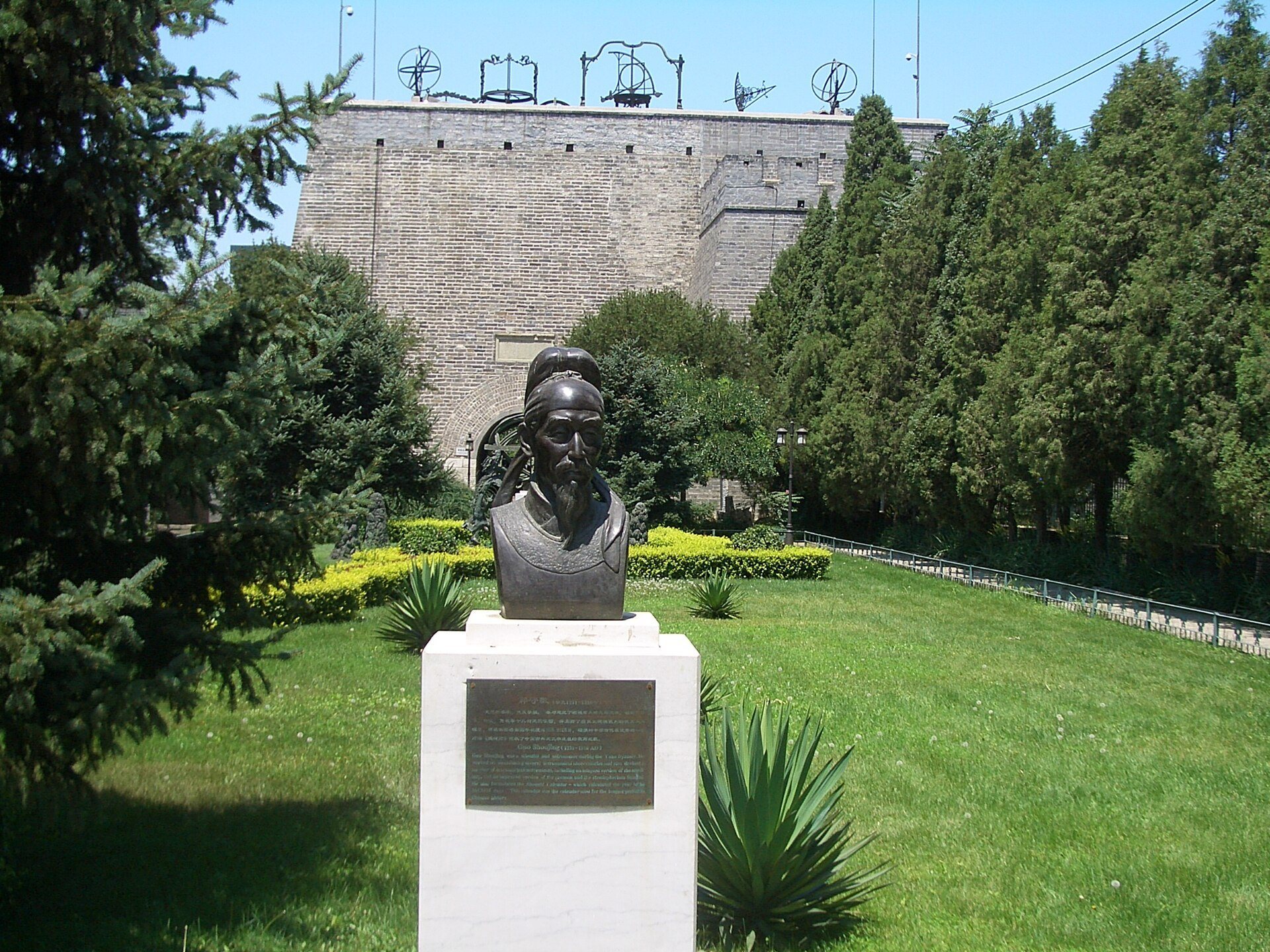
The site covers nearly 10,000 square metres and contains approximately 3,800 square metres of building area. Its principal structure is a grey-brick, castle-like platform that formed part of the old Beijing city wall. The elevated platform measures approximately 24 metres from east to west, 20 metres from north to south, and 14 metres in height. Its south, west, and north sides carry large bronze astronomical instruments, all of which are Qing in date.
From southeast to northwest, the platform instruments are an equatorial theodolite, a sextant, an altazimuth theodolite, an altazimuth instrument, an ecliptic theodolite, a celestial globe, a quadrant, and the Equinoctial Armilla. The 1744 new armillary sphere, made by the Jesuits Ignatius Kögler and August de Hallerstein, measures equatorial coordinates and the rising and setting times of celestial bodies. It has two right-ascension circles for differential measurement, adjustment screws, and replaceable components where its bearings wear.
The 1673 quadrant measures the altitude, or zenith distance, of celestial bodies. The 1673 celestial globe represents the stars and allows their positions and rising and setting times to be read. The 1673 ecliptic armillary instrument uses two rotating bronze disks to measure the ecliptic coordinates of the Sun, Moon, and planets. The 1673 altazimuth instrument and the 1715 theodolite by Kilian Stumpf measure altitude and azimuth, while the 1673 sextant measures angles between celestial bodies, including the apparent diameters of the Sun and Moon.
The 1673 equatorial armillary instrument measures the equatorial coordinates of stars. The elevated tower itself also functioned as a gnomon, a vertical device that determines solar altitude or the time of noon from the position of its shadow. The bronze instruments were designed for naked-eye positional observations rather than telescopic observation.
Western courtyard buildings
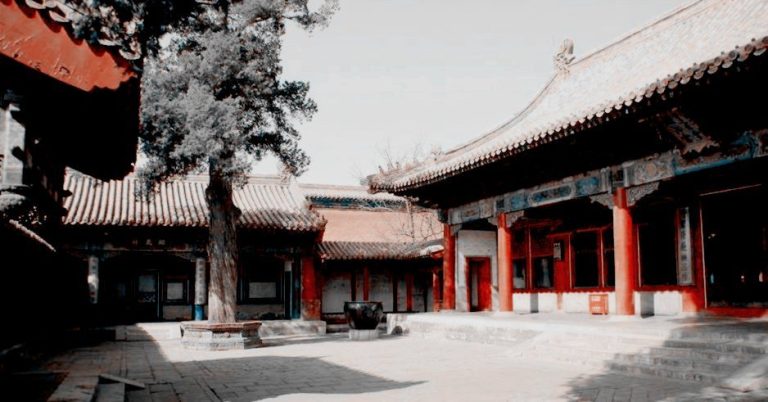
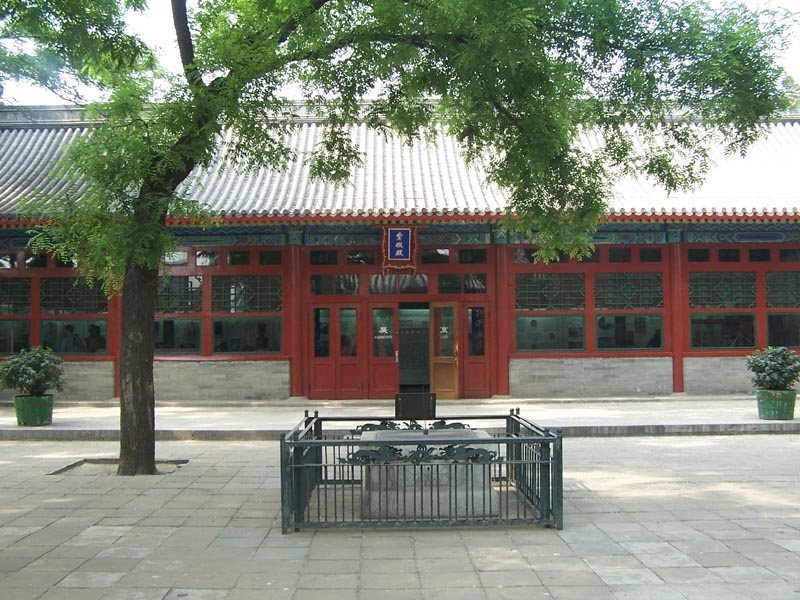
West of the platform is a courtyard complex containing Ziwei Hall, the Water Clock Hall, and the Sundial and Gnomon Hall. Ziwei Hall is the principal building. It faces south, has three bays, a raised-ridge roof, and grey cylindrical roof tiles, with a side hall on each side. The Water Clock Hall occupies a small room east of Ziwei Hall, while the three-bay Sundial and Gnomon Hall stands to its southeast.
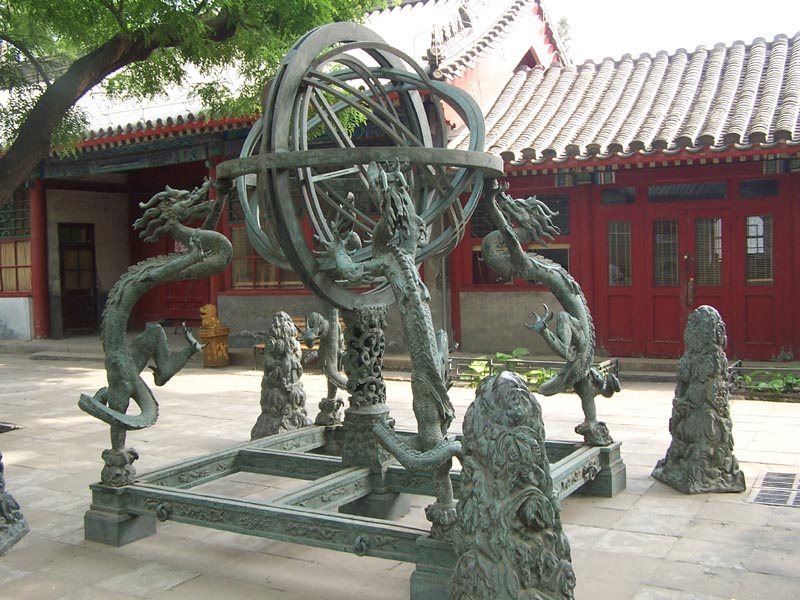
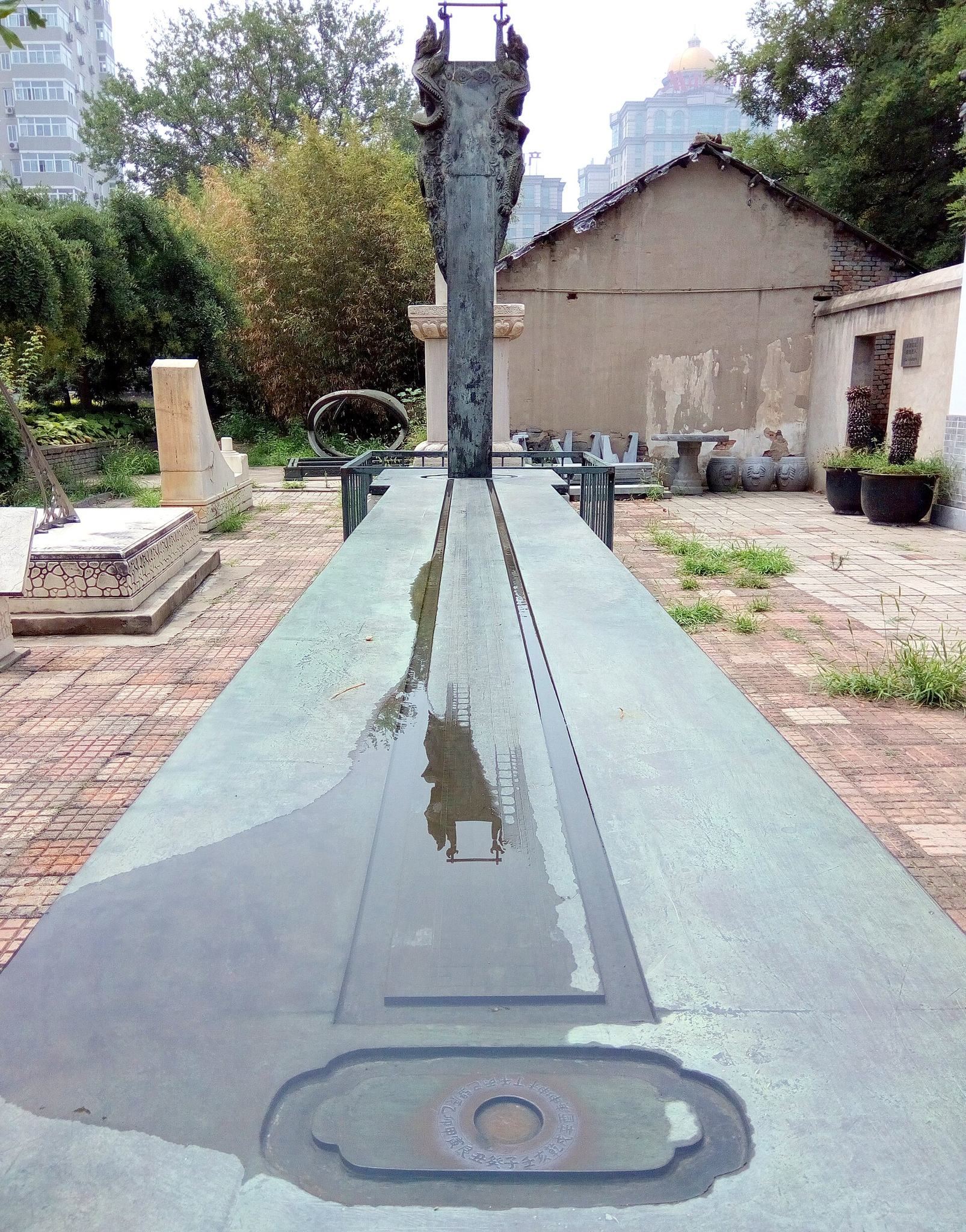
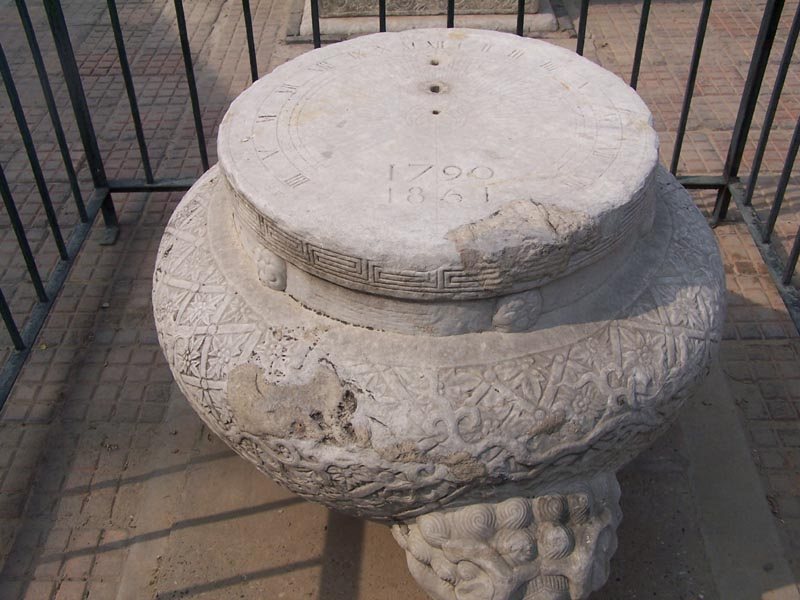
A Ming armillary sphere stands to the left of Ziwei Hall, and a Ming simplified armilla stands to its right. The courtyard also contains representations of earlier instruments, including a large armillary sphere completed in 1439, a one-third-scale copy of Guo Shoujing’s simplified armilla of 1276, a Ming gnomon, a Ming equatorial sundial, and a Yuan-period square coordinate measuring table with a gnomon attributed to Guo Shoujing. The armillary-sphere copies and the gnomon reproduce water-filled leveling basins or channels used for precise horizontal alignment.
The original Ming instruments represented by these copies are held at the Purple Mountain Observatory and, in some cases, the Nanjing Museum. Two additional armillary spheres in the garden south of the observatory tower remain operational.