Wongaksa Pagoda: A Joseon-Dynasty Marble Pagoda in Seoul
Site at a Glance
- Rating
- 4.3
- Popularity
- Very Low
- Country
- South Korea
- Primary era
- Medieval
- External website
- Open
- Eras represented
- Medieval, Modern
- Civilizations
- Joseon
- Site type
- Religious
- Remains
- Pagoda
On this page8 sections
History
Foundation in the early Joseon period
Wongaksa Pagoda is a ten-storey marble Buddhist monument in Seoul, South Korea, built during the early Joseon period in 1467. King Sejo commissioned it in the thirteenth year of his reign as part of Wongaksa Temple, which he had founded two years earlier on the site of the older Goryeo-period Heungboksa Temple. The Joseon dynasty ruled Korea from 1392 to 1910 and was strongly influenced by Confucianism, although Buddhism continued to shape important monuments such as this pagoda.
The temple’s name came from the Buddhist Sutra of Perfect Enlightenment. Wongaksa was intended to produce copies of the sutra and to acknowledge Sejo’s authority. A consecration ceremony placed sacred texts, lotus-related symbols, and relics inside the pagoda. An inscription near its upper section records the construction date, providing a direct link between the surviving monument and the royal foundation of the temple.
The pagoda was modelled on Gyeongcheonsa Pagoda, a ten-storey monument erected at Gyeongcheonsa Temple in 1348 during the preceding Goryeo period. The two pagodas share a comparable structure and exceptionally detailed carving. Gyeongcheonsa Pagoda is now housed at the National Museum of Korea, while Wongaksa Pagoda remained connected with its original temple site and its later urban setting.
Closure of the temple and damage
Around 1504, during the tenth year of Yeonsangun’s reign, Wongaksa Temple was closed and converted into a kisaeng house, an establishment for professionally trained female entertainers who performed music, dance, and other arts. Under King Jungjong, who succeeded Yeonsangun in 1506, the former temple was converted into government offices. Monks associated with Wongaksa were expelled, and Buddhist images and other contents were transferred to Hwaamsa Temple.
Around 1507, the queen commissioned a proposed restoration of the pagoda, but strong opposition prevented its completion. By about 1512, private houses had been built within and around the former temple precinct. A fire between 1556 and 1565 damaged the pagoda and surrounding houses. During the Imjin War, the Japanese invasion of Korea that began in 1592 and continued through the 1590s, the three upper storeys were dismantled and placed on the ground at the foot of the monument.
The pagoda and a commemorative stele became the only major remains of Wongaksa Temple to survive. The former temple site was later occupied by ordinary houses, while the damaged pagoda continued to mark the earlier Buddhist complex.
Rediscovery and public preservation
In 1897, John McLeavy Brown, an Irish financial adviser to King Gojong, received authorization to transform the area around the pagoda into Seoul’s first public park. The park was known as Pagoda Park during the 1919 March First Movement and is now called Tapgol Park. The pagoda was placed at its present location within the park in 1946.
The three upper storeys were recovered in 1946 and put back in position in 1947 by American military engineers. James Scarth Gale published the first detailed English description of the monument and a translation of its commemorative inscription in 1915. His work helped establish the accepted dating of the pagoda and its relationship to Gyeongcheonsa Pagoda.
Wongaksa Pagoda was designated National Treasure No. 2 of South Korea in 1962. A National Treasure is a high-level cultural-heritage designation for monuments and objects judged to possess exceptional historical, artistic, or cultural value. The pagoda is regarded as one of the finest examples of Joseon-period pagoda art and is described as the only surviving pagoda of its period.
Remains
Form and construction
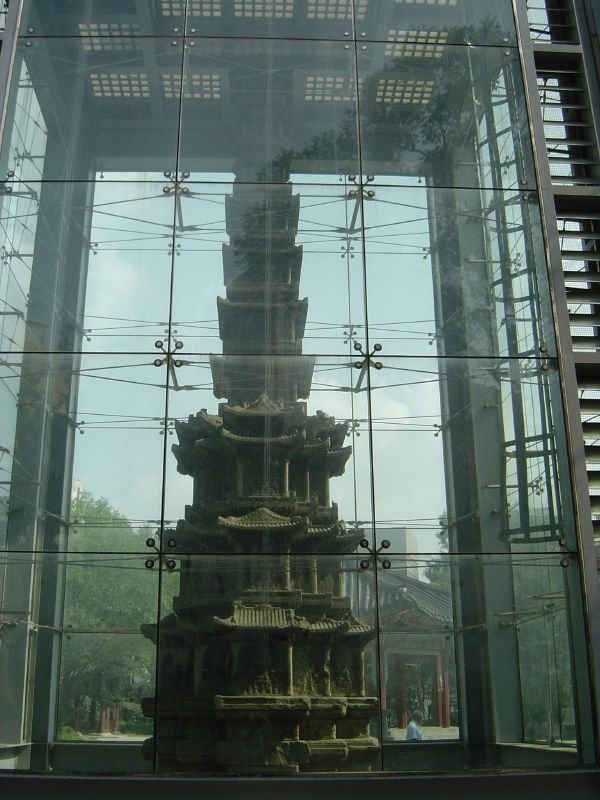
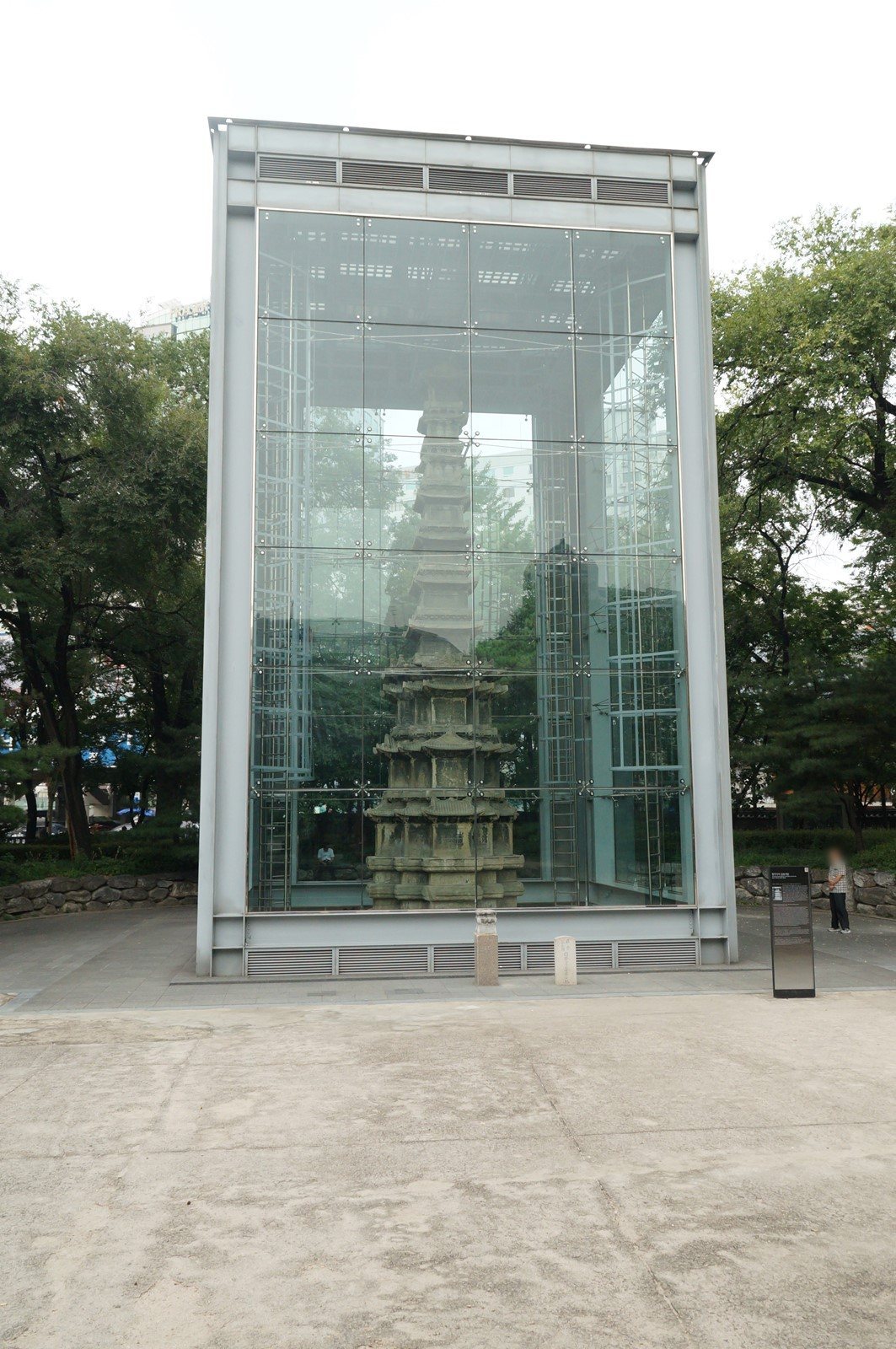
Wongaksa Pagoda rises approximately 12 metres and is built from marble, an unusual choice in Korea, where locally abundant granite was more commonly used for pagodas. It stands on a three-tiered pedestal. The lower three storeys are larger and form the monument’s base, while the seven upper storeys are smaller and square in plan. Viewed from above, the lower section has a polygonal form resembling the Chinese character “ya.”
Although made of stone, the pagoda imitates a wooden structure. Carved brackets, pillars, separate roof sections, and curved roof forms suggest the construction of a traditional wooden pagoda. The surfaces combine white and grey marble, allowing the architectural details and carved ornament to remain distinct across the ten storeys.
Carved decoration
Each storey carries finely carved decoration. The imagery includes dragons, lions, phoenixes, lotus flowers, Buddhas, Bodhisattvas, and the Four Heavenly Kings. Bodhisattvas are Buddhist figures who seek enlightenment while remaining connected with the world to aid other beings. The Four Heavenly Kings are guardian deities associated with protection of the cardinal directions.
The carving also reproduces elements of a traditional Korean wooden house, including columns, ceilings, and other decorative supports. Together with the curved roofs and bracket forms, these details give the marble monument the appearance of a wooden building translated into stone. An inscription in the upper part records its construction in 1467.
Condition and conservation
More than five centuries of exposure caused structural cracks, microcracks, surface flaking, and erosion. Chemical deterioration also affected the roof sections through corrosion. Rectangular iron structures were installed around the sides and corners to reinforce the monument while allowing water to pass. These supports were restored in 2013, when diagonal roofs were also added to the upper sections.
In 1999, the Seoul government enclosed the pagoda within a protective glass structure. The enclosure protects the marble from weathering, including acid rain. A thorough cleaning from 2005 to 2008 removed accumulated dust from the surface, and systematic damage analyses have been conducted since 2014. By 2026, experts were considering whether the protective enclosure could be removed or otherwise modified.