Qingjing Mosque: A Song-Dynasty Mosque in Quanzhou
Site at a Glance
- Rating
- 4.4
- Popularity
- Very Low
- Country
- China
- Primary era
- Medieval
- Eras represented
- Medieval, Early Modern
- Civilizations
- Yuan
- Site type
- Religious
- Remains
- Mosque
On this page10 sections
History
Qingjing Mosque is a historic mosque in Quanzhou, China, constructed in 1009 or 1010 during the Song dynasty in a blend of Islamic and Southern Fujian architectural traditions. It is among the oldest surviving mosques in China and reflects the city’s long connection with Muslim merchants and scholars who traveled through the maritime networks of the Indian Ocean.
Foundation in the Song period
Quanzhou developed as an international maritime-trade center because of its position between Fujian and the Jin River. Arab and Persian merchants formed communities along China’s southeastern coast, bringing Islam to Quanzhou during the Tang dynasty. These communities supported the later construction and use of the mosque.
An Arabic foundation inscription identifies the mosque’s original name as the Mosque of al-Ashab, meaning the Mosque of the Companions. The name Qingjing became associated with the site after a foundation inscription from another mosque, once located near Quanzhou’s southern gate, was transferred here when that building was destroyed. The mosque is also known as the Ashab Mosque, Masjid al-Ashab, and Shengyousi Mosque.
Worship and trade under the Song and Yuan
During the Song and Yuan dynasties, Qingjing Mosque served as a principal place of worship and a social gathering point for Quanzhou’s Muslim community. It also linked local worshippers with merchants and scholars moving through the Indian Ocean trade network. After the Mongol conquest established the Yuan dynasty, Quanzhou remained a major international port, and visitors from Arabia, Persia, and Southeast Asia continued to use the mosque for congregational worship and meetings.
Natural disasters damaged the complex in 1310. A major Yuan-period renovation or rebuilding was associated with Ahmad ibn Muhammad al-Qudsi, also known as Rukn Haji al-Shirazi, a merchant from Shiraz. Two stone tablets east of the entrance record additional reconstruction during the Yuan and Ming dynasties. Repairs and additions in the Ming and Qing periods introduced new boundary walls and altered Mingshan Hall.
Later changes and protection
Ming restrictions on maritime trade reduced Quanzhou’s foreign merchant population, but the mosque continued to function as a place of worship. Records connected with the Yongle Emperor, a Ming ruler who reigned from 1402 to 1424, indicate imperial protection for the mosque and the local Muslim community.
In 1761, a typhoon destroyed the roof of Fengtian Temple. Afterward, the principal prayer function moved to Mingshan Hall. Archaeological work in the late 1980s uncovered Song-period pottery and traces of Yuan-period wooden construction. Tombstones and grave monuments found during construction projects near Quanzhou in the 1950s were temporarily kept at the mosque before being transferred to the Quanzhou Maritime Museum.
Qingjing Mosque became a major cultural heritage site under national-level protection in 1961. In 2021, it was included within the UNESCO World Heritage property “Quanzhou: Emporium of the World in Song-Yuan China,” recognizing its place in the historical landscape of maritime exchange and religious life.
Remains
The surviving complex occupies approximately 2,500 square metres and combines Islamic building forms with Minnan traditions from southern Fujian. The principal remains include a stone entrance at the southeast corner of the original prayer hall and Mingshan Prayer Hall at the northwest corner. The site’s plan preserves relationships between an Islamic prayer complex, a monumental entrance, and buildings shaped by local materials and climate-conscious design.
Entrance and prayer halls
Stone entrance
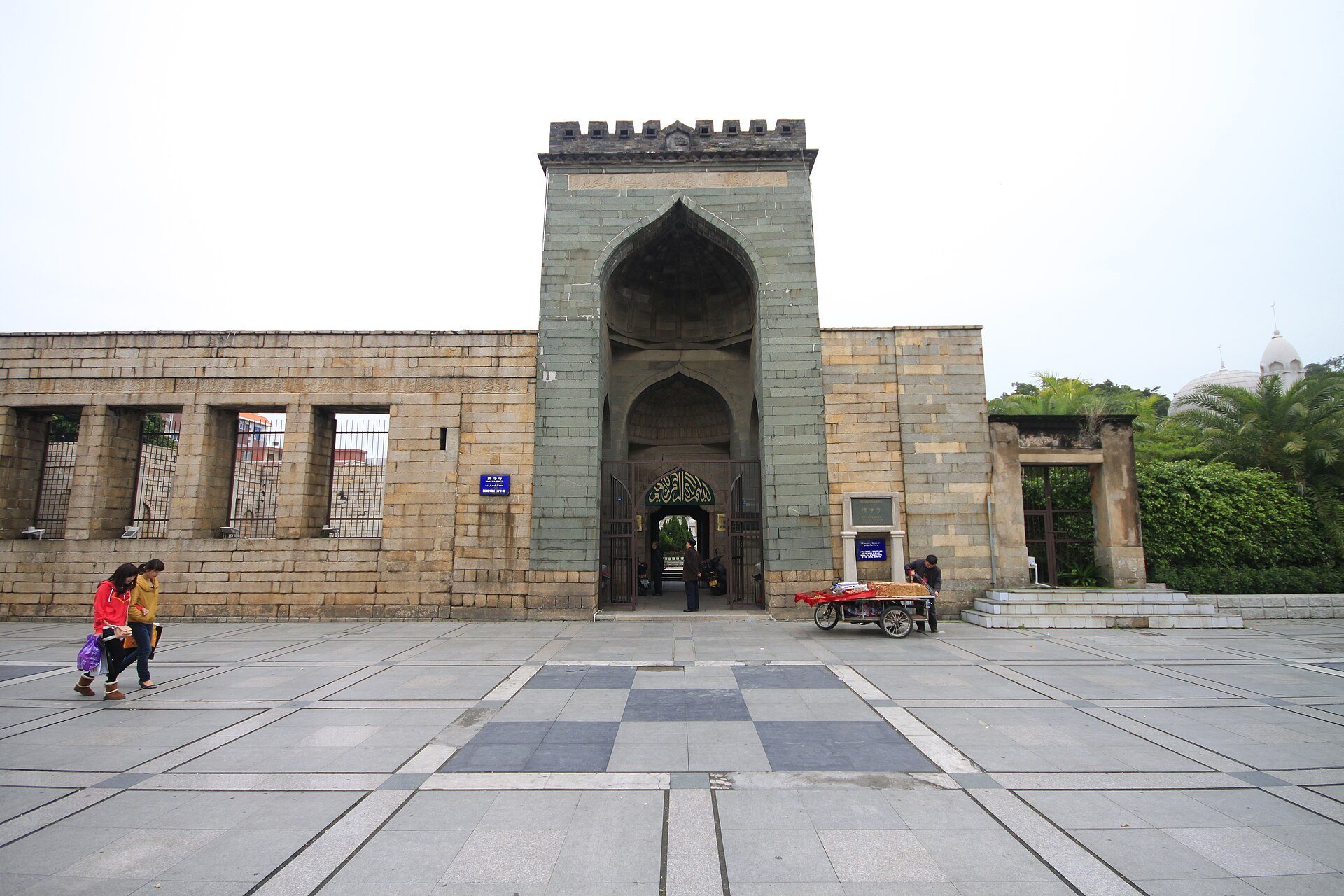
The entrance is built from diabase and white granite and is the only known stone mosque entrance on mainland China. Facing south, it has a symmetrical arrangement associated with traditional Chinese religious architecture. Its passage contains three connected vaulted and arched sections, each less than 5 metres in diameter.
The structure resembles an Iranian-style iwan, a large vaulted space open on one side, although its lower rear wall opens toward the former prayer hall. Lotus reliefs decorate the domed interior, while the design also incorporates influences associated with Chinese caisson ceilings. Crenellations surround a platform at the top of the entrance tower. This platform was used to observe the moon and determine the beginning of Ramadan.
Fengtian Hall
Fengtian Hall was the original prayer hall. Its rectangular plan measured approximately 30 by 27 metres, and twelve stone columns arranged in three rows supported the roof. The street-facing side retains a granite wall with eight large, non-arched windows. This open arrangement allowed views between the hall and the street, and the mosque may have extended into the area now occupied by the street during the eleventh to fourteenth centuries.
The east wall preserves an indentation understood as the remains of a mihrab, the recessed feature that indicates the direction of prayer toward Mecca. Several blind mihrab niches flank the principal niche and contain Qur’anic verses. The prayer area also preserves Qur’anic inscriptions in Thuluth script. The street-facing wall and the surrounding pishtaq arches, monumental arched portals associated with important buildings, are distinctive elements of the surviving complex.
Mingshan Prayer Hall
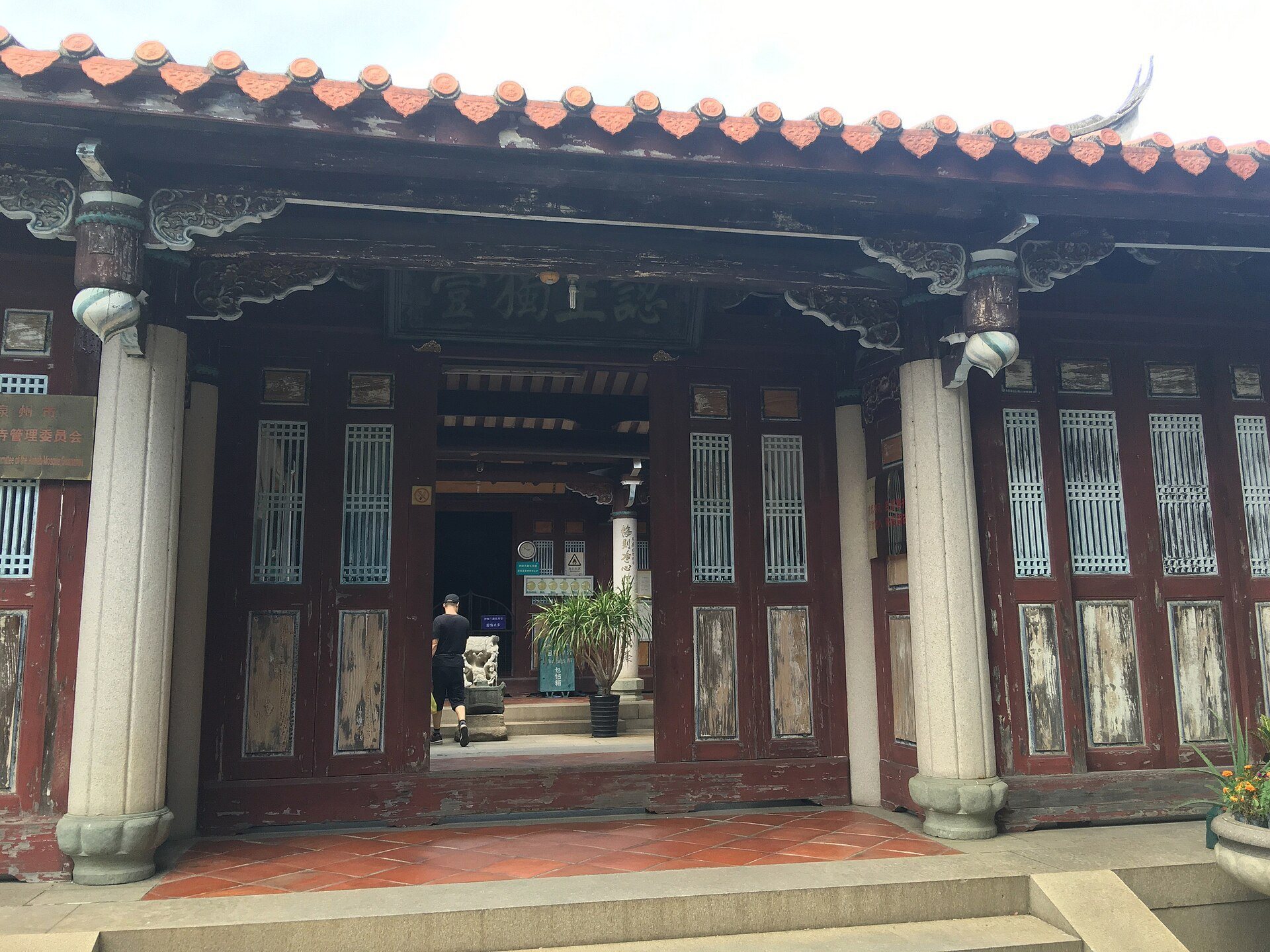
Mingshan Prayer Hall stands at the northwest corner of the complex and reflects Southern Fujian building practice. The hall surrounds a central courtyard and has open doors to the north, south, and east, allowing ventilation and helping regulate interior temperature.
Its outer walls are made of red brick and raw earth. These materials provide thermal insulation and resistance to moisture, linking the hall’s construction to local environmental conditions. Mingshan Hall became the principal prayer space after the roof of Fengtian Temple was destroyed by a typhoon in 1761.
Inscriptions and archaeological evidence
Inscriptions provide evidence for the mosque’s changing identity and repeated rebuilding. The Arabic foundation text preserves the original name Mosque of al-Ashab, while commemorative tablets record reconstruction during the Yuan and Ming periods. Arabic inscriptions appear in Kufic and Thuluth, established styles of monumental calligraphy. An inscription band on the facade contains verses from Surah al-Insan.
Excavated Song-period pottery and traces of Yuan-period wooden construction add material evidence for the mosque’s early phases. Tombstones and grave monuments once stored at the site were later moved to the Quanzhou Maritime Museum. The overall arrangement of Fengtian Hall and the mosque has been compared with hypostyle mosque layouts, in which a prayer hall roof is supported by numerous columns, associated with Abbasid-period buildings such as the Great Mosque of Samarra and the Great Mosque of Kairouan.