Sarkhej Roza: A Sufi Mosque-and-Tomb Complex in Gujarat
Site at a Glance
- Rating
- 4.5
- Popularity
- Low
- Country
- India
- Primary era
- Medieval
- External website
- Open
- Eras represented
- Medieval, Early Modern
- Civilizations
- Mughal
- Site type
- Religious
- Remains
- Tomb
On this page14 sections
History
Sarkhej Roza is a Sufi mosque-and-tomb complex in Makarba, about 7 kilometres southwest of Ahmedabad in Gujarat, India. Built under the Gujarat Sultanate, its principal development began in 1445 and continued through the fifteenth century in an Indo-Saracenic style that combined Persian Islamic influences with Indian Hindu and Jain features. A roza is a Muslim tomb complex or mausoleum, and Sarkhej became an important centre of Sufi culture associated with the revered saint Shaikh Ahmed Khattu Ganj Bakhsh.
Sarkhej and Shaikh Ahmed Khattu
Shaikh Ahmed Khattu Ganj Bakhsh, also known as Ahmad Khattu Maghribi Ganj Bakhsh, was born into a noble family in Delhi in 1336. After becoming separated from his family in a dust storm, he was adopted by the Maghribi Sufi Baba Ishaq in Khattu, Rajasthan. The Maghribi order was a Sufi lineage linked with the western Islamic world, especially the Maghreb. Ahmed later travelled through Arabia, Iraq, and Iran. During Timur’s attack on Delhi, he was captured and released and, according to the historian Badauni, persuaded Timur to spare the city.
At the request of Zafar Khan, Ahmed settled in Gujarat and began living at Sarkhej. He became a friend and adviser of Sultan Ahmad Shah I, the founder of Ahmedabad and a ruler of the Gujarat Sultanate. On the saint’s advice, Ahmad Shah established his capital on the banks of the Sabarmati River, a few miles from Sarkhej. Ahmed retired to Sarkhej late in life and died there in 1445.
Royal expansion and later history
Muhammad Shah II began Ahmed’s tomb in 1445, and his son, Qutbuddin Ahmad Shah II, completed it in 1451. Sultan Mahmud Begada later favoured Sarkhej and greatly enlarged the complex. He excavated the large Sarkhej Lake, constructed a palace at its southwestern corner, and established a mausoleum opposite Ganj Bakhsh’s tomb for himself and his family.
The complex originally covered about 29 hectares and was surrounded by elaborate gardens. Later settlement reduced the garden area and brought the site to about 14 hectares. Sarkhej was renowned for indigo production in the seventeenth century, and the Dutch established a factory in the village in 1620. In 1584, Abdul Rahim Khan-i-Khana laid out Fatehwadi, or Victory Garden, to commemorate his defeat of Muzaffar Shah III, the last ruler of the Gujarat Sultanate.
The architecture is credited to the Persian brothers Azam Khan and Muazzam Khan, who were buried in a tomb near Vasna in Ahmedabad. Sarkhej brought together religious, royal, and public functions. Its mosque and courtyard formed a religious setting, its tombs and palace expressed royal connections, and its large tank, platforms, and pavilions served ordinary users. In the twentieth century, the architect and urban theorist Le Corbusier compared the layout with the Acropolis of Athens, giving rise to the description “Acropolis of Ahmedabad.” Sarkhej Roza is a Monument of National Importance.
Remains
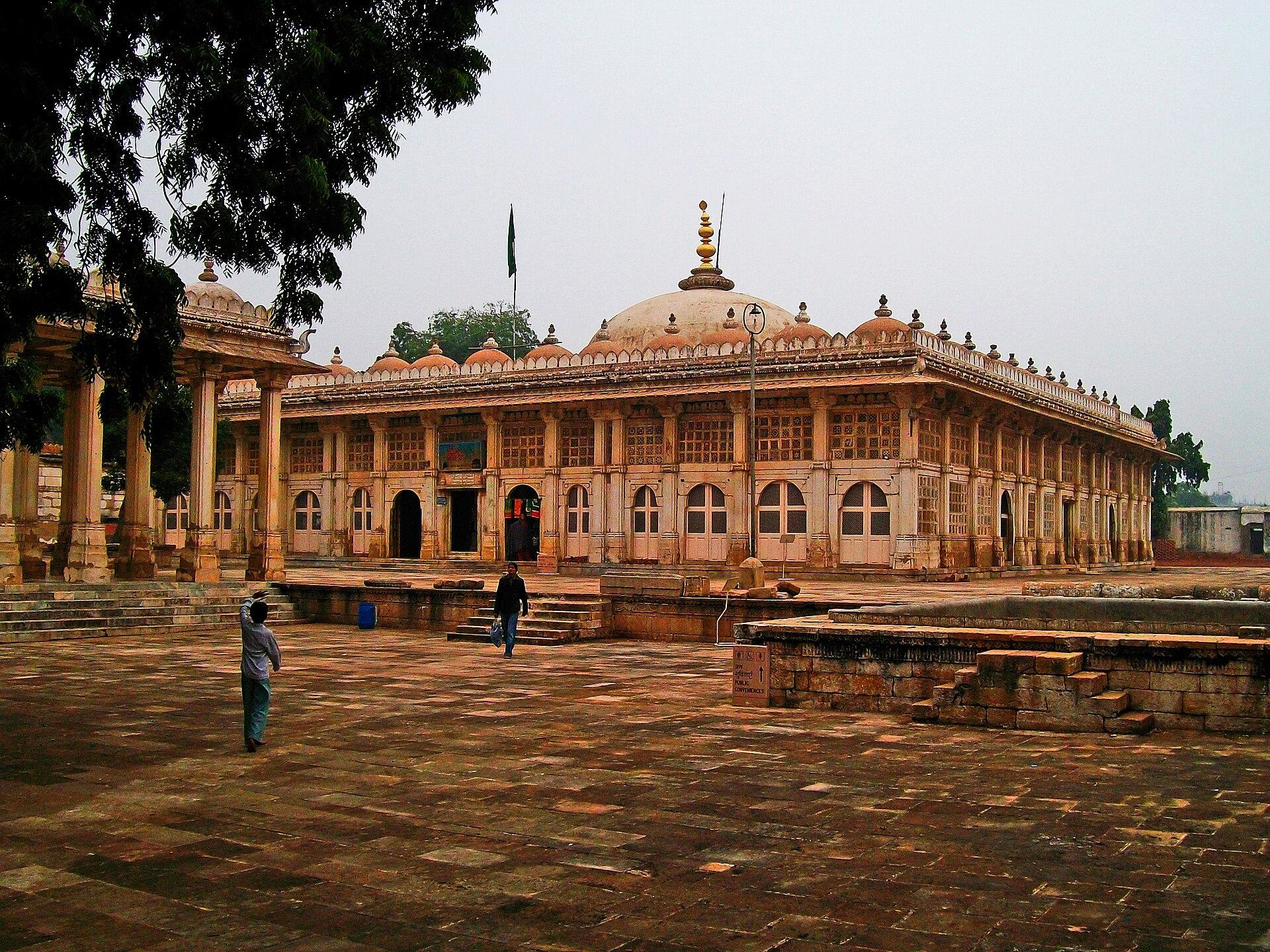
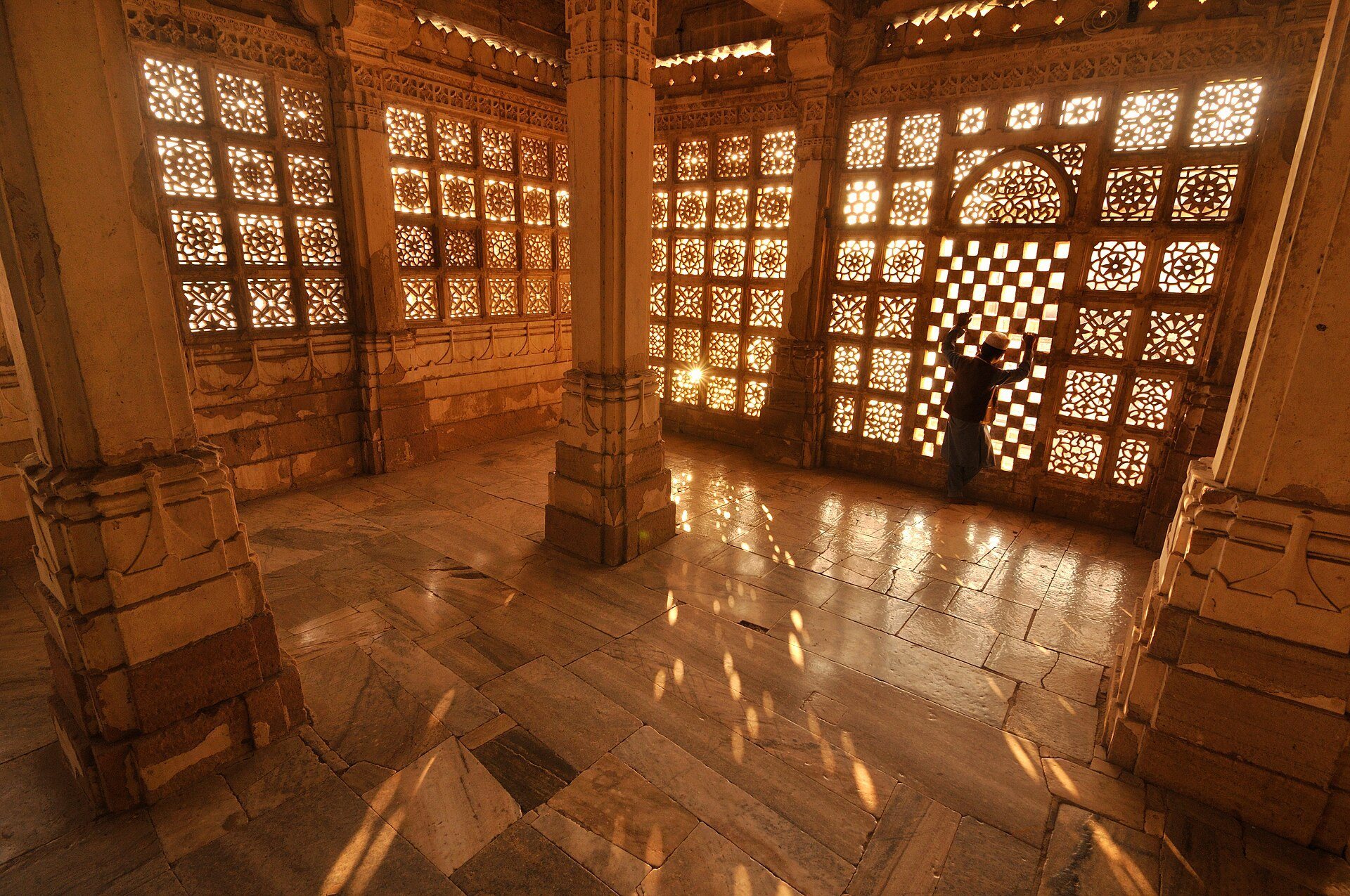
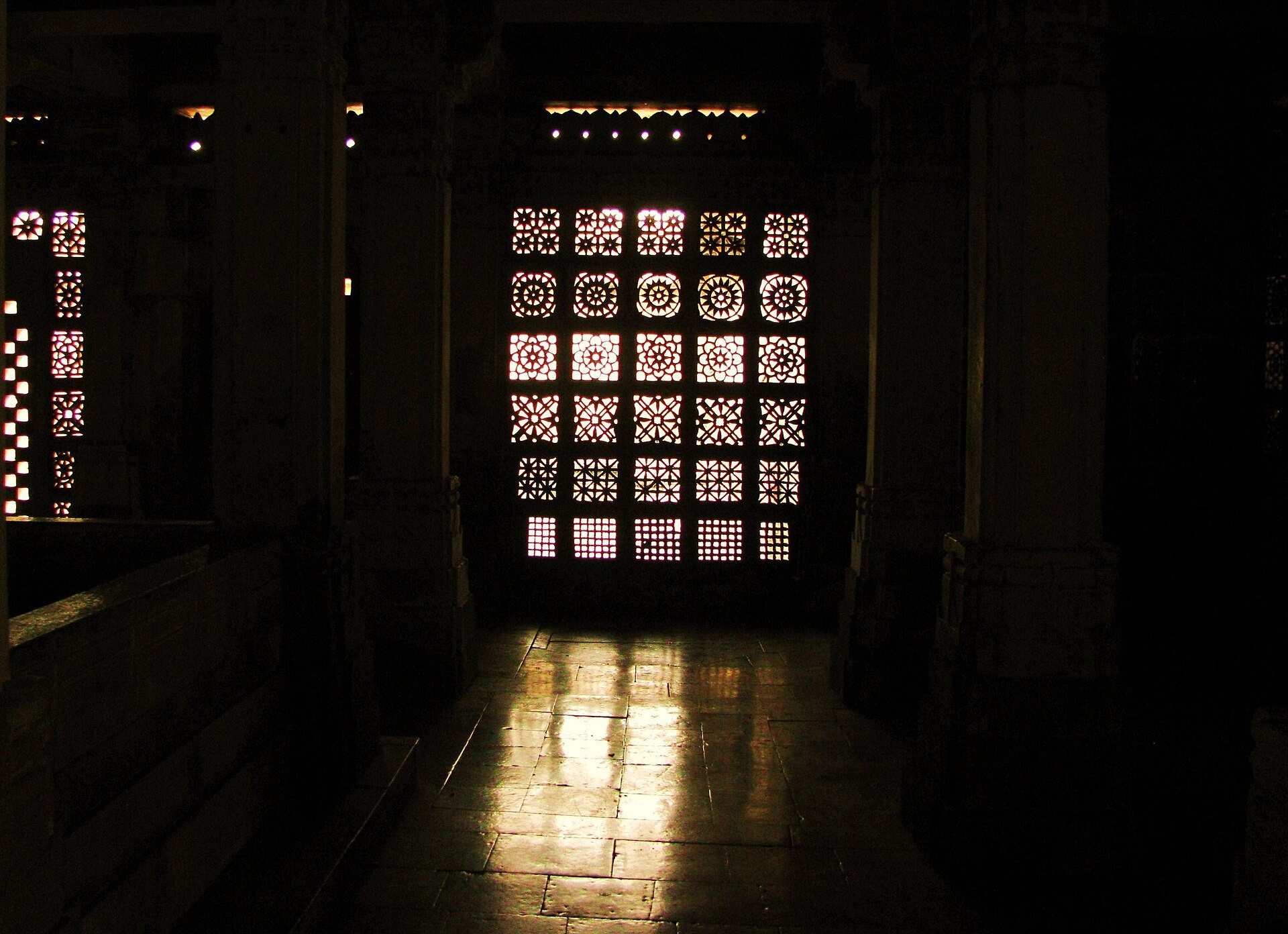
Built principally of stone, Sarkhej Roza combines Persian Islamic forms with Indian architectural traditions. Ringed domes, pillars and brackets, Indian motifs, and pierced stone trellises define its character. These trellises, also called jali work, are perforated screens carved from stone, while some screens are made of metal. Most of the buildings lack arches and rely on the trellises for structural stability. The surviving complex includes the Great Mosque, Sarkhej Lake, a palace and harem, pavilions, several mausoleums, and older associated buildings.
Lake and royal precinct
Sarkhej Lake
The Great Tank, or Sarkhej Lake, covers about 6.9 hectares and has an oblong shape. Flights of cut-stone steps enclose its edges, and a richly decorated sluice controls the movement of water into or out of the lake. The lake formed the central setting for the later royal expansion of Sarkhej.
Palace and harem
Mahmud Begada’s palace and harem occupy the lake’s southwestern corner. The buildings survive in a ruined condition and belong to the royal group added during the sultan’s expansion of the complex.
Mausoleums and saintly tombs
Mausoleum of Shaikh Ahmed Khattu Ganj Bakhsh
A covered eastern gateway on the northern bank of the lake leads to the mausoleum of Shaikh Ahmed Khattu Ganj Bakhsh. Described as the largest mausoleum of its kind in Gujarat, it has stone trellis work along its sides, a stone pavilion in front, and an intricately cut open metal screen around the tomb.
Royal mausoleums
Across the courtyard from Ganj Bakhsh’s mausoleum stand two mausoleums joined by a porch. The eastern building contains the tombs of Mahmud Begada and his son Muzaffar Shah II. The western mausoleum contains the tomb of Rajbai, Muzaffar Shah’s queen.
Tomb of Baba Ali Sher
A small whitewashed tomb south of the lake marks the burial place of Baba Ali Sher, a saint regarded as even more highly revered than Ganj Bakhsh. A separate roza associated with Baba Ishaq and Bawa Ganj Bakhsh is also among the complex’s named components.
Great Mosque and surrounding buildings
Great Mosque
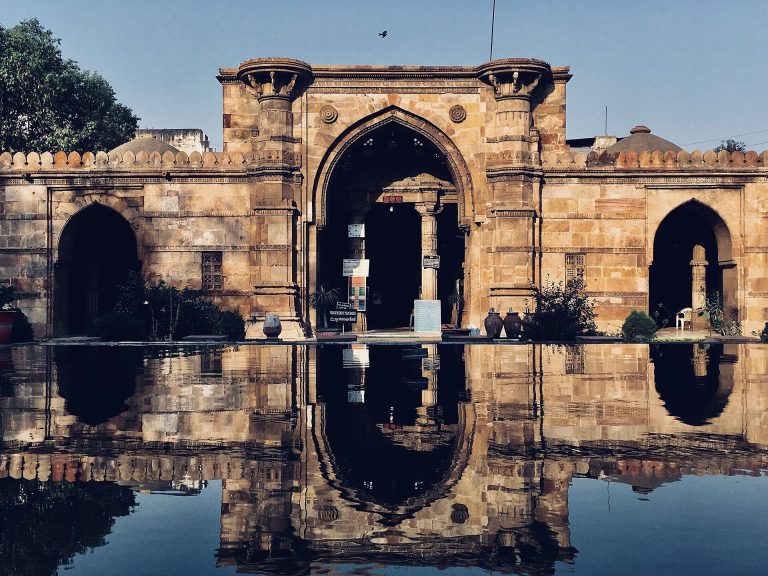
Beyond Ganj Bakhsh’s mausoleum lies a courtyard covering more than one acre and surrounded by cloisters, which are covered, colonnaded walkways around a courtyard. The courtyard contains a mosque slightly smaller than Ahmedabad’s Jama Mosque. It has no minarets, and its shallow roof eaves give the exterior a restrained appearance. The interior is noted for its simple grace.
Associated buildings
The principal group of remains is surrounded by additional mosques and other old buildings. Together with the lake, platforms, pavilions, cloisters, royal structures, and mausoleums, they preserve the complex’s combination of religious, dynastic, and public spaces.