Cheshmeh-Ali: An Archaeological Site at Ancient Ray
Site at a Glance
- Rating
- 4.6
- Popularity
- Very Low
- Country
- Iran
- Primary era
- Medieval
- Eras represented
- Stone Age, Classical, Medieval, Modern
- Civilizations
- Abbasid, Parthian, Qajar
- Site type
- City
On this page16 sections
History
Cheshmeh-Ali is an archaeological site at the northern edge of ancient Ray in Tehran Province, Iran. Its permanent spring, fertile surroundings, defensible hill, and position on a route along the Alborz attracted settlement from prehistoric times. The site preserves evidence from early farming communities through the Parthian, Islamic, and Qajar periods.
Prehistoric settlement
The earliest occupation belongs to the Neolithic and Chalcolithic sequence of the central Iranian plateau. The Neolithic was the period when farming, animal domestication, settled communities, and pottery developed, while the Chalcolithic, or Copper Age, followed it before the widespread use of bronze. Cheshmeh-Ali ware is generally dated from about 5500 BCE, and the wider Cheshmeh-Ali cultural complex from approximately 5500 to 4800 BCE. Archaeologists also distinguish the IA and IB phases, which belong broadly to the period between about 5500 and 4000 BCE.
During this long prehistoric occupation, people cultivated crops and kept animals. The associated cultural tradition extended across the central Iranian plateau for roughly three millennia. Burial practices included placing bodies beneath house floors, covering them with red ochre, and sometimes burying infants in small jars. The settlement was abruptly abandoned during the third millennium BCE and occupied again from the second millennium BCE. Early Iron Age material, dated approximately 1200 to 1000 BCE, has also been recovered.
Parthian and Islamic Ray
The later Parthian complex is separated from the first Neolithic settlement by an apparent chronological gap of about 3,000 years. The Parthians ruled a major Iranian empire from the third century BCE to the third century CE. At Cheshmeh-Ali, a substantial complex from approximately the third century BCE to the third century CE may have served as a temple and may have included a Zoroastrian fire installation, a place associated with the ritual use of fire in Zoroastrian worship. Coins linked to the reigns of Mithridates I, Pakoros II, Mithridates II, Orodes II, Phraates IV, and Vonones I belong to this period.
Cheshmeh-Ali later formed part of early Islamic Ray, an important historic city south of modern Tehran. Its hilltop fortifications are generally dated to the early Abbasid period, from the eighth to ninth centuries, when Ray was a strategic center. Coins indicate activity during the Umayyad, Abbasid, Buyid, Seljuk, and Timurid periods. Coins bearing the image of Shah Rukh Mirza indicate that the latest Islamic layer belongs to the fourteenth or fifteenth century.
Research and later history
French-led investigation began in 1912 under J. de Morgan and continued in 1924 through the French diplomatic mission in Tehran. Erich F. Schmidt carried out larger excavations from 1934 to 1936, opening more than 600 square metres around the spring during three seasons. His work revealed prehistoric, Parthian, and Islamic evidence, although his wider research remained incomplete after his death in 1964. Finds and records became distributed among museums in Tehran, the University Museum of the University of Pennsylvania, the Boston Museum of Fine Arts, and the Oriental Institute in Chicago.
Donald E. McCown’s 1942 synthesis of Iranian prehistoric chronology classified the Cheshmeh-Ali material into IA and IB groups. Later comparisons related the sequence to sites including Tape-Hissar, Tape-Sialk, Tape-Zageh, and Tepe-Gabristan. Investigations led by Hassan Fazeli in the late 1990s were more limited because modern suburbs had covered much of the site’s former peripheral area. A 1998 to 1999 campaign by Iran’s cultural-heritage authorities, the University of Tehran, and the University of Bradford opened trenches on the eastern and western sides of the mound. These trenches reached 10 metres and exposed evidence from the sixth, fifth, and early fourth millennia BCE. During the 2000s, Fazeli’s collaboration with British, Australian, and American archaeologists supported comparative study of materials held in Tehran and Pennsylvania.
In the early nineteenth century, Fath Ali Shah, the Qajar ruler of Iran from 1797 to 1834, ordered a large rock relief above the spring. Cheshmeh-Ali was then a busy recreational place visited by travelers and local residents, including people who washed carpets in the spring because they believed its mineral water renewed them. The spring was placed on Iran’s national heritage list in 1934 and was also registered as the third natural monument of Tehran Province. From 2017, construction of Tehran Metro Line 6 disrupted underground water channels feeding the spring. Its flow became intermittent and then stopped, leading to official investigations in 2018 even after nearby construction activity was suspended.
The spring was formerly called Surena, Sureni, or Surbani. The name may relate to the Suren family, a prominent Iranian noble house during the Parthian and Sasanian periods. The current name refers to Ali, the first Imam of Shia Islam. A further tradition connects the spring with the birth of Zoroaster’s mother, although that association is not historically established.
Remains
Hill and spring
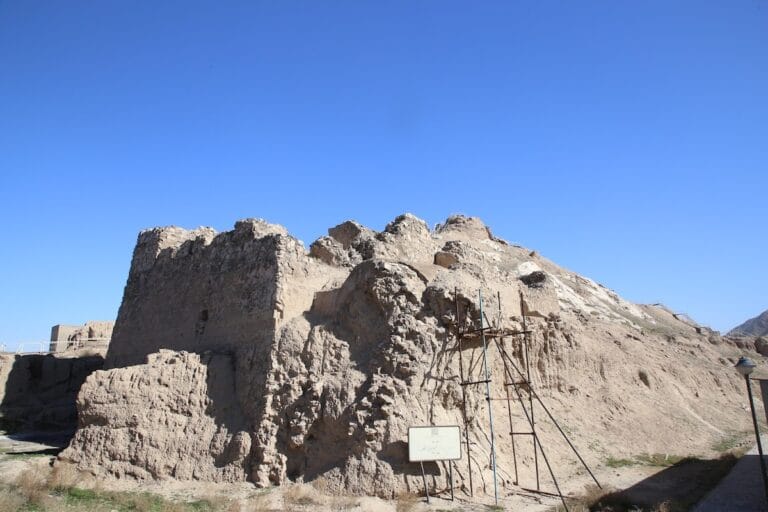
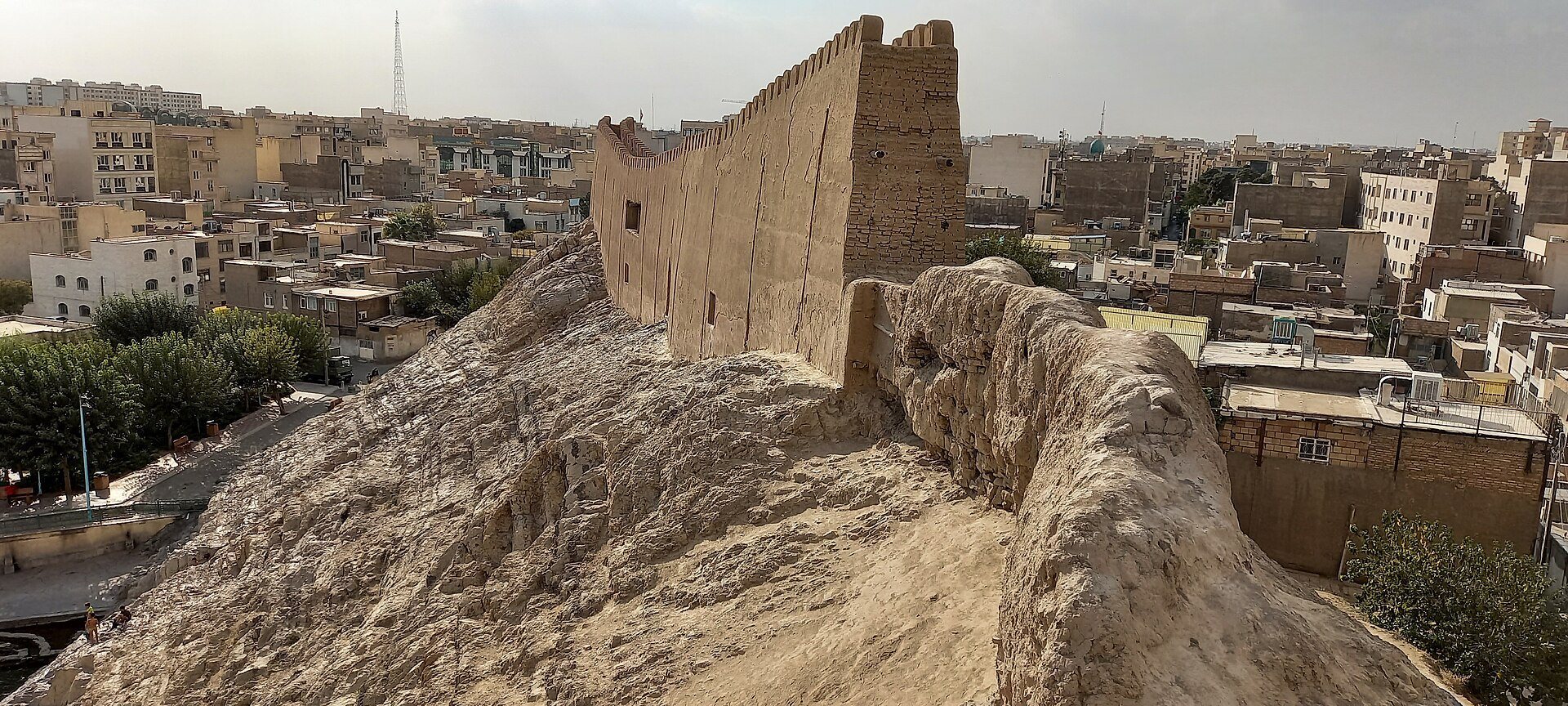
The physical site consists of a natural spring, a granite hill, and the archaeological area around them. The hill rises about 15 metres above the surrounding ground and extends approximately 400 metres from east to west, with its base at about 1,070 metres above sea level. The spring emerges from the southern side and flows first southward and then southeastward. It lies near Kuh-e Safaieh and Rashkan Fortress, about 300 metres to their northwest, within the northern part of ancient Ray.
Prehistoric settlement
Houses and construction
The earliest houses were small structures made from packed earth and coated with mud. Later buildings used unfired mudbrick. Builders pressed fingers into the brick surfaces to help mortar adhere, and these impressions were sometimes covered with plaster and painted red.
Pottery and burial evidence
Early pottery was handmade without a wheel. Some vessels used soft clay tempered with straw, had polished surfaces, and carried simple geometric decoration. Other wares were red, tempered with sand, polished, and painted black. Later Cheshmeh-Ali pottery has a reddish-orange body with a slip coating and a frequently polished surface that could appear black or dark brown. Decoration includes geometric and plant designs, long-legged birds, donkeys, goats, dogs, fish, and occasional human figures.
IB pottery displays concentric grooves associated with the introduction of the potter’s wheel. Decoration is concentrated toward the upper parts of vessels, while tall circular bases often carry three or four vertical lines. The designs include geometric, plant, animal, and human forms in dark brown, black, and unevenly fired red. Examples include a vessel dated about 5000 to 4500 BCE and a bowl dated about 5500 to 4500 BCE, both held by the Los Angeles County Museum of Art.
Parthian complex
Courtyard building
The Parthian building was constructed from mudbrick around a central courtyard, with rooms arranged around it. Its form has led to an interpretation as a temple and possibly as a place containing a Zoroastrian fire installation, though that identification remains uncertain. Coins were found both inside and outside the complex. About 500 copper coins came from the same level outside it, together with fragments of greenish-blue glazed vessels. Gray pottery from the early Parthian period is conserved in the National Museum of Iran in Tehran.
Islamic fortifications and burials
Fortification walls
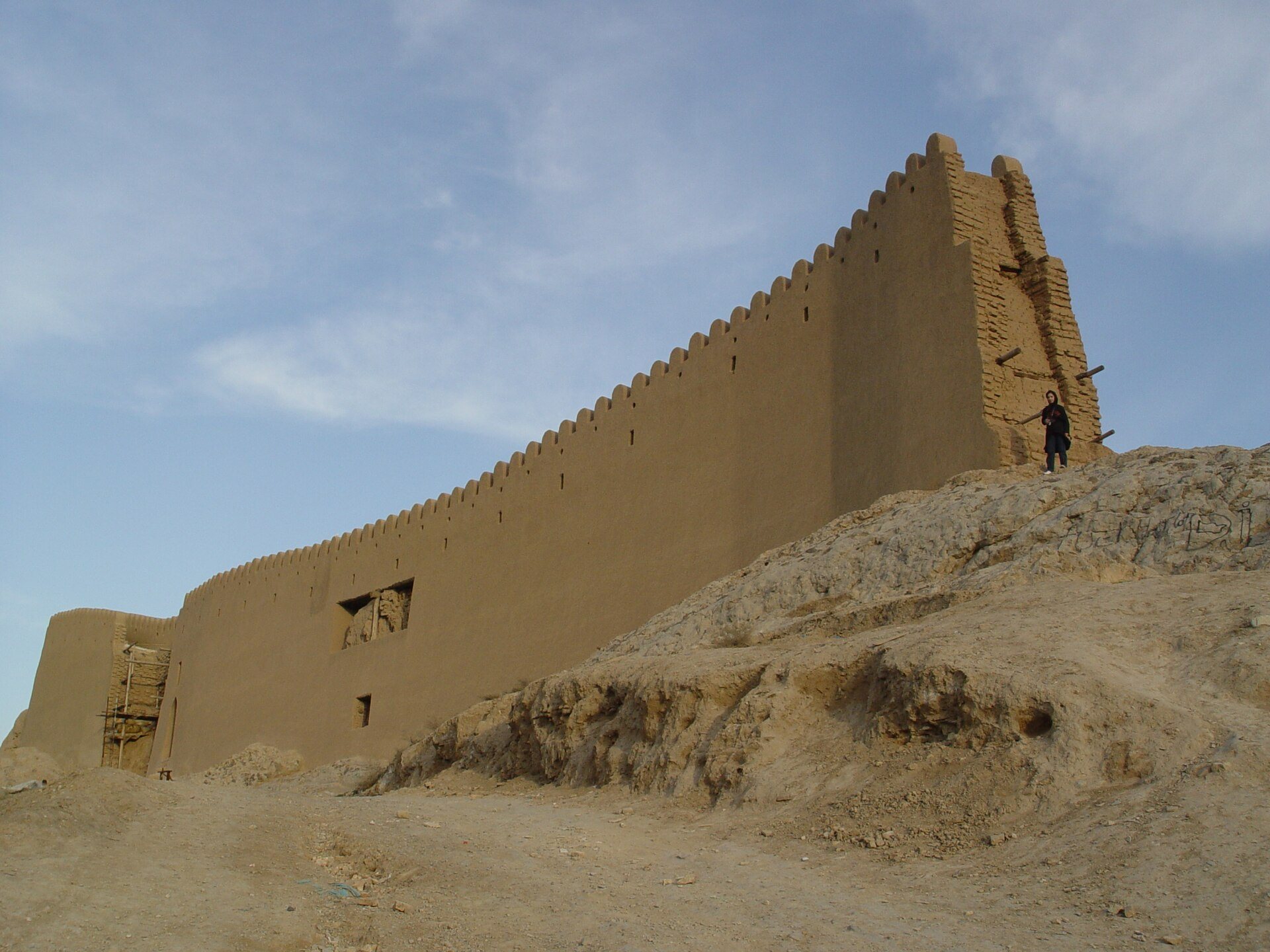
The early Islamic city included fortification walls that followed the contours of the hill. In the medieval period, these walls formed the northern boundary of fortified Ray. The western section has since been substantially reconstructed.
Mausoleums and graves
Within an earth layer about two metres thick, excavations exposed small mausoleums, several graves with poorly preserved skeletons, and alabaster gravestones decorated with religious ornament in Kufic, an early angular style of Arabic calligraphy. The associated coins represent early Islamic, middle Islamic, and Timurid phases.
Qajar rock relief
Relief of Fath Ali Shah
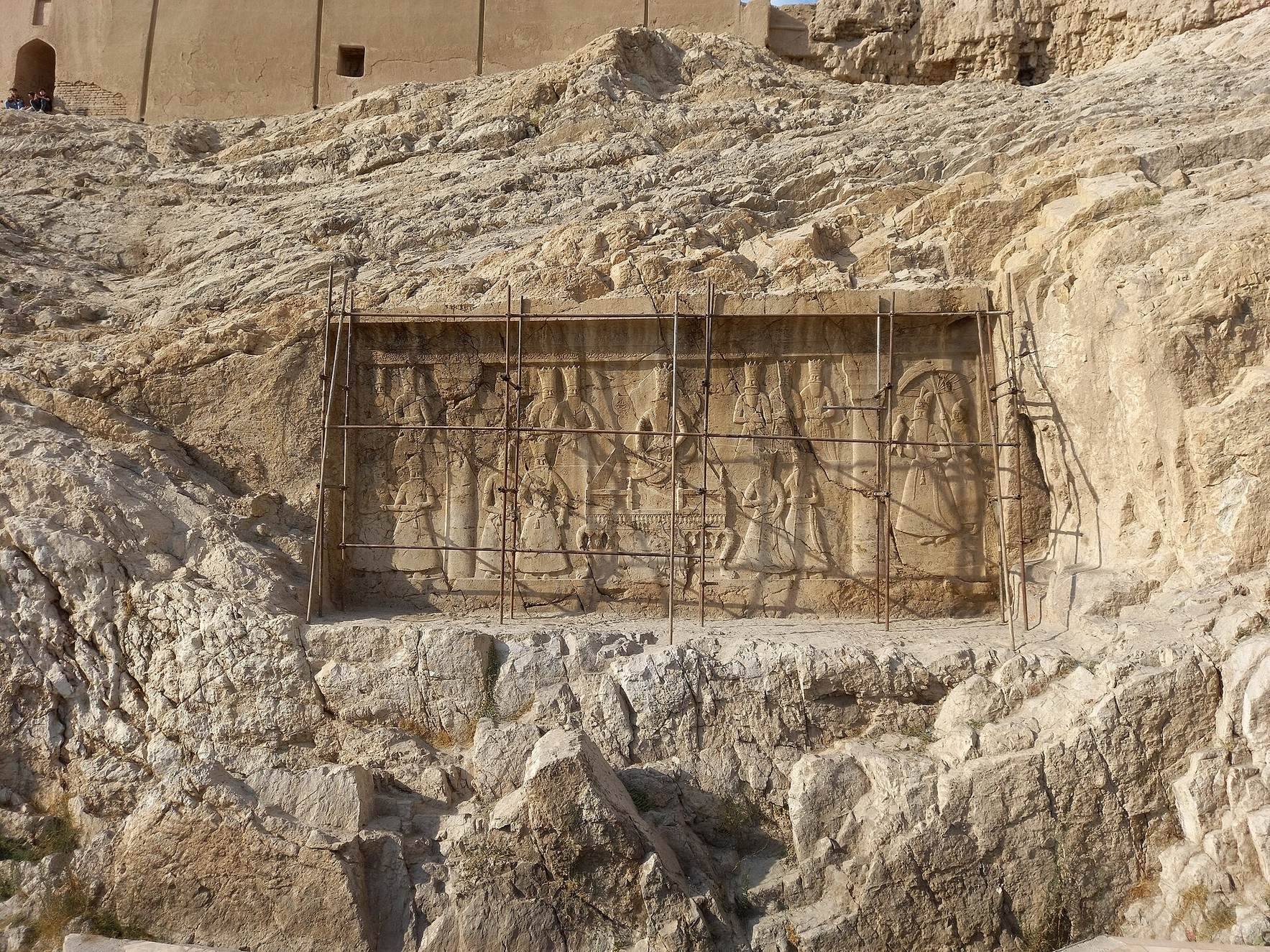
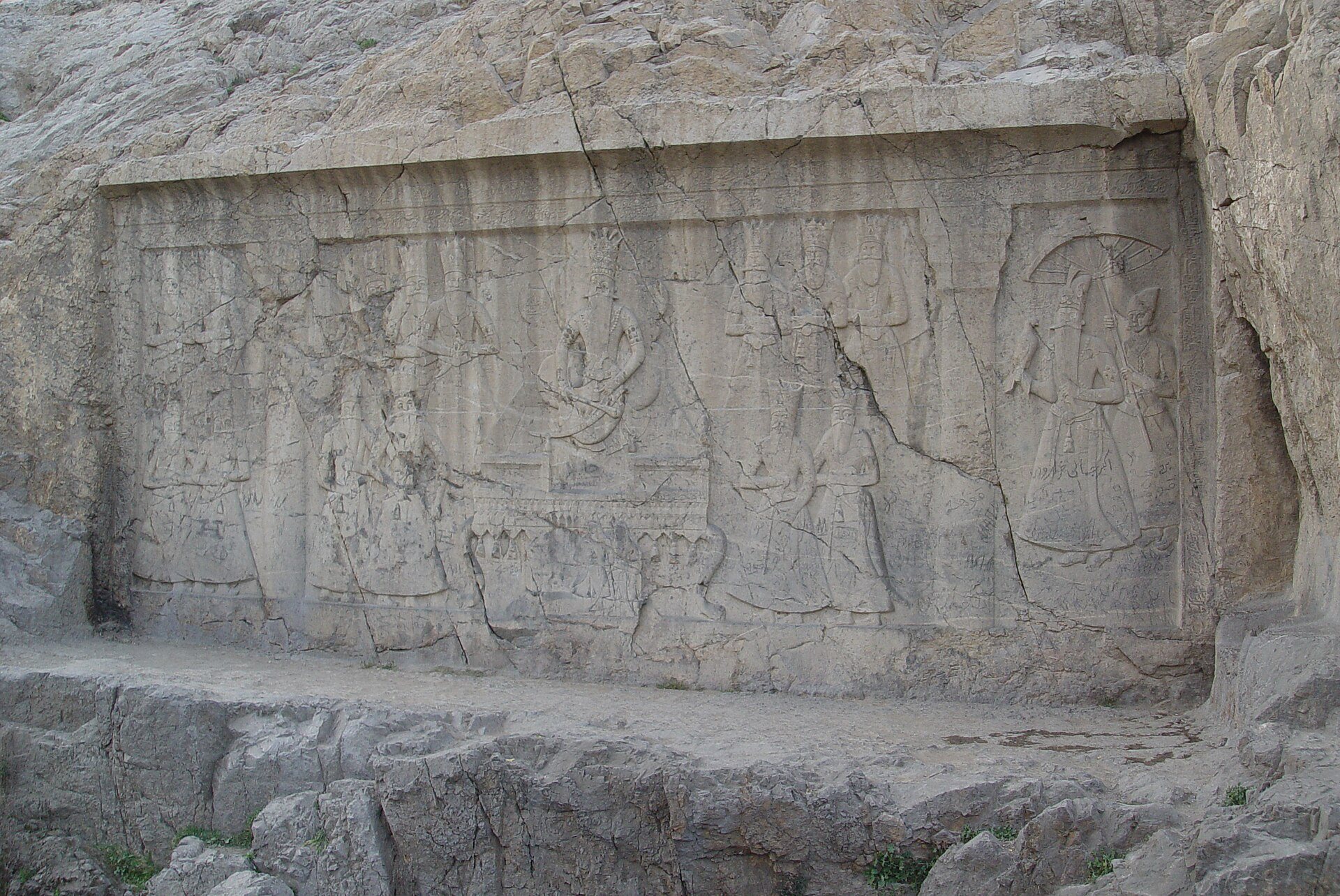
The large Qajar relief is carved directly above the eastern part of the spring. It measures approximately 12 by 5 metres and is divided into three panels by two columns, with inscriptions along its upper and side edges. The central panel shows Fath Ali Shah seated on a throne. He wears a tall cap with three aigrettes, carries a sword and dagger at his belt, and holds a sceptre. A falcon rests on his right hand, while an attendant with a parasol stands behind the throne.
Retainers appear in two rows around the ruler. The figures on his right are identified as Naib Sultan, Hussein Ali, Tagi Mirza, Muhammad, Ali Mirza, Fath Ali Mirza, Abdullah Mirza, Bachme Mirza, and one unidentified figure. Those on his left are Ali Nagi Mirza, Veri Mirza, and Malek Mirza. Hedar Mirza and Mohalah Mirza stand beside the ruler, while the two smallest figures are Muchul Mirza and Kameran Mirza. The represented figures wear long beards. The composition draws on Achaemenid and Sasanian rock reliefs, especially those at Behistun and Naqsh-e Rostam, and belongs to a wider group of comparable reliefs commissioned by Fath Ali Shah in Kermanshah Province and Fars.