El Kab: The Ancient Egyptian City of Nekheb
Site at a Glance
- Rating
- 4.3
- Popularity
- Very Low
- Country
- Egypt
- Primary era
- Classical
- Eras represented
- Stone Age, Bronze Age, Iron Age, Classical
- Civilizations
- Egyptian, Ptolemaic, Roman
- Site type
- City
On this page17 sections
History
El Kab is the archaeological site of the ancient Egyptian city of Nekheb, on the east bank of the Nile in Egypt, at the mouth of Wadi Hillal opposite Hierakonpolis. Its earliest temple foundation probably dates to the late fourth millennium BC, and the site preserves a long sequence of occupation from prehistoric settlements through the Early Dynastic period, later Egyptian kingdoms, the Greco-Roman era, and the early Islamic period.
Early City and Religious Center
Nekheb became the capital of the third nome of Upper Egypt, an administrative province of ancient Egypt. It was one of the early urban centers of the Early Dynastic period, and during part of the New Kingdom it surpassed Hierakonpolis, on the opposite bank, in local importance. Its principal deity was Nekhbet, a goddess represented as a white vulture and associated with Upper Egypt. Her cult made the city an important religious center.
The temple remains belong mainly to the Eighteenth through Thirtieth Dynasties, while the wider settlement includes material from the Early Dynastic period to the Ptolemaic Kingdom. The necropolis preserves evidence for the early history of the Eighteenth Dynasty and the reunification of Egypt. Among the officials connected with Nekheb were Sobeknakht II, whose actions helped protect the Theban Sixteenth or Seventeenth Dynasty from forces invading from Kush; Ahmose son of Ebana, an admiral who fought the Hyksos; and Setau, a priest and local official under Ramesses III.
Greco-Roman and Later Occupation
During the Greco-Roman period, the town flourished as Eileithyias polis, a Greek name meaning “city of Eileithyia.” Eileithyia was a Greek goddess associated with childbirth, whom the Greeks identified with Nekhbet. The settlement was also known in Latin as Lucinae Civitas. It appears to have been destroyed around AD 380, possibly as a result of military or political events.
The ancient city remained important into the early Islamic period but was almost entirely destroyed during the Arab invasion in the eighth century. The surrounding hills continued to preserve inscriptions and graffiti from Predynastic, Pharaonic, and Islamic times. The site also includes the lower walls of a Coptic monastery, reflecting the continued occupation of the wider area after the ancient town’s decline.
Archaeological Investigation
Scientific excavation began in the late nineteenth century with James Quibell, whose work concentrated mainly on the cemetery east of the town. Frederick William Green, Archibald Henry Sayce, Joseph John Tylor, and Somers Clarke also investigated the site. Belgian archaeologists took over the project in 1937, while research from the 1980s increasingly focused on areas north and northeast of the ancient settlement.
In 1967, Pierre Vermeersch discovered well-stratified Epipaleolithic campsites at El Kab. The Epipaleolithic was a transitional period between the Upper Paleolithic and the Neolithic. Radiocarbon dates place these camps around 6400–5980 BC, and their small stone tools became type examples of the El Kabian microlithic industry. They help bridge the archaeological gap between the Upper Paleolithic and Egypt’s earliest Neolithic communities.
Remains
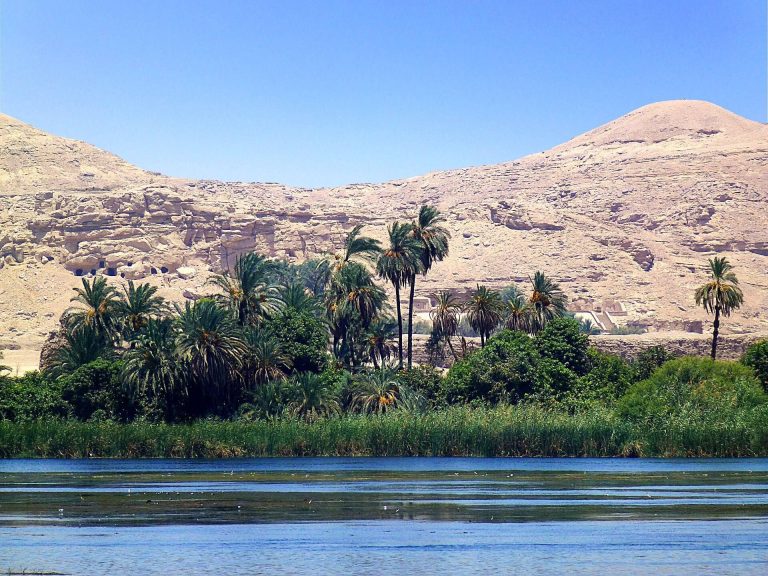
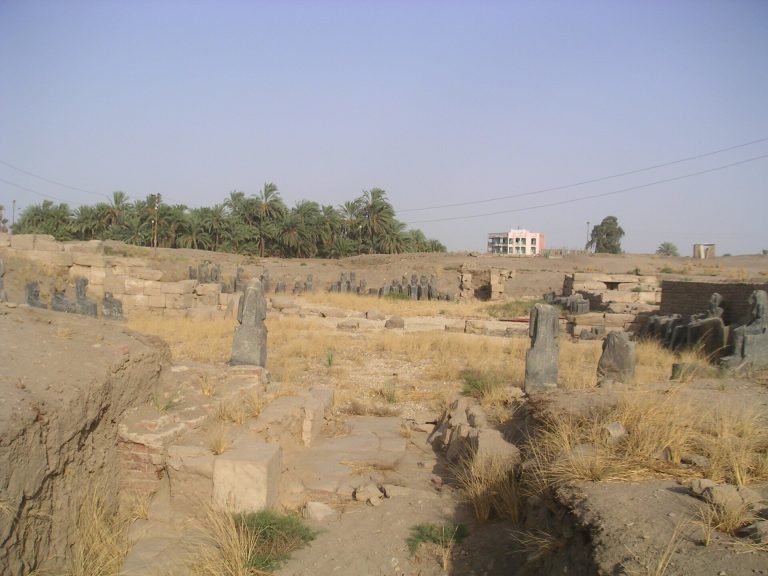
El Kab occupies a bay between sandstone cliffs to the north and south. Sandstone was used for the temples, while changes in the Nile’s course and erosion altered the relationship between the settlement and the floodplain. The ancient city, its temple precincts, the cemetery on the southern hillside, and later remains together show the changing organization of the site across several millennia.
City Walls and Temple Precinct
Late Period Enclosure
The ancient settlement is enclosed by massive sun-dried mud-brick defenses generally attributed to Nectanebo II and dated to the Late Period, around the Thirtieth Dynasty. The enclosure covers about 25,000 square metres and measures approximately 530 metres on each side. Its walls are about 6 metres high and 12 metres thick and remain substantially preserved. Ramps beside the monumental gates provided access to the top of the rampart.
Three wall systems were identified. One double wall enclosed part of the ancient town, a second double wall surrounded the temple group, and a large wall crossed the settlement while enclosing land that had not been inhabited. The movement of the Nile threatened the earlier town wall, prompting construction farther from the river.
Temple of Nekhbet
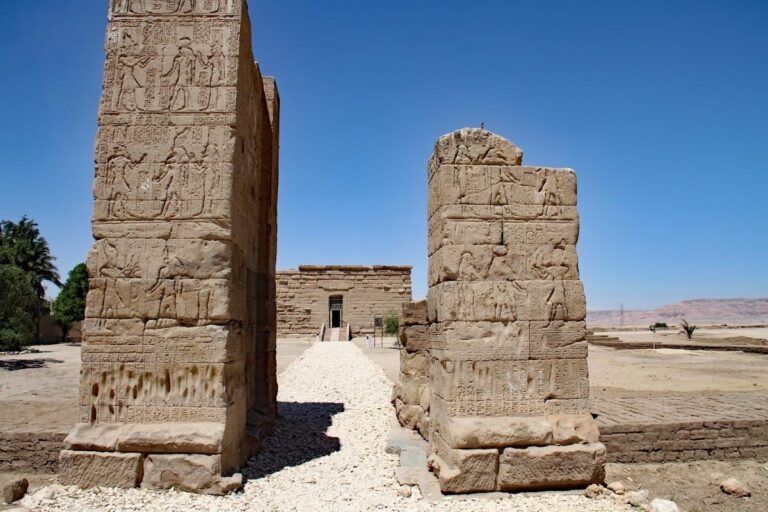
Near the center of the settlement are the remains of sandstone temples dedicated to Nekhbet and Thoth. The temple of Nekhbet had an earliest foundation probably dating to the late fourth millennium BC, while the surviving complex was formed largely under the Thirtieth Dynasty and the reign of Achoris. It included three monumental gateways, a hypostyle hall whose roof was supported by rows of columns, a sanctuary, and crypts. The most prominent temple ruins lie in the southwestern part of the city.
Temple of Thoth
A temple dedicated to Thoth was attached to the western wall of the temple group. Thoth was associated with writing, knowledge, calculation, and the ordering of the cosmos. The remains include a pylon, or monumental temple gateway, dating to the reign of Ramesses II, a colonnaded court, a three-aisled hypostyle hall, and a sanctuary.
Temples Outside the Enclosure
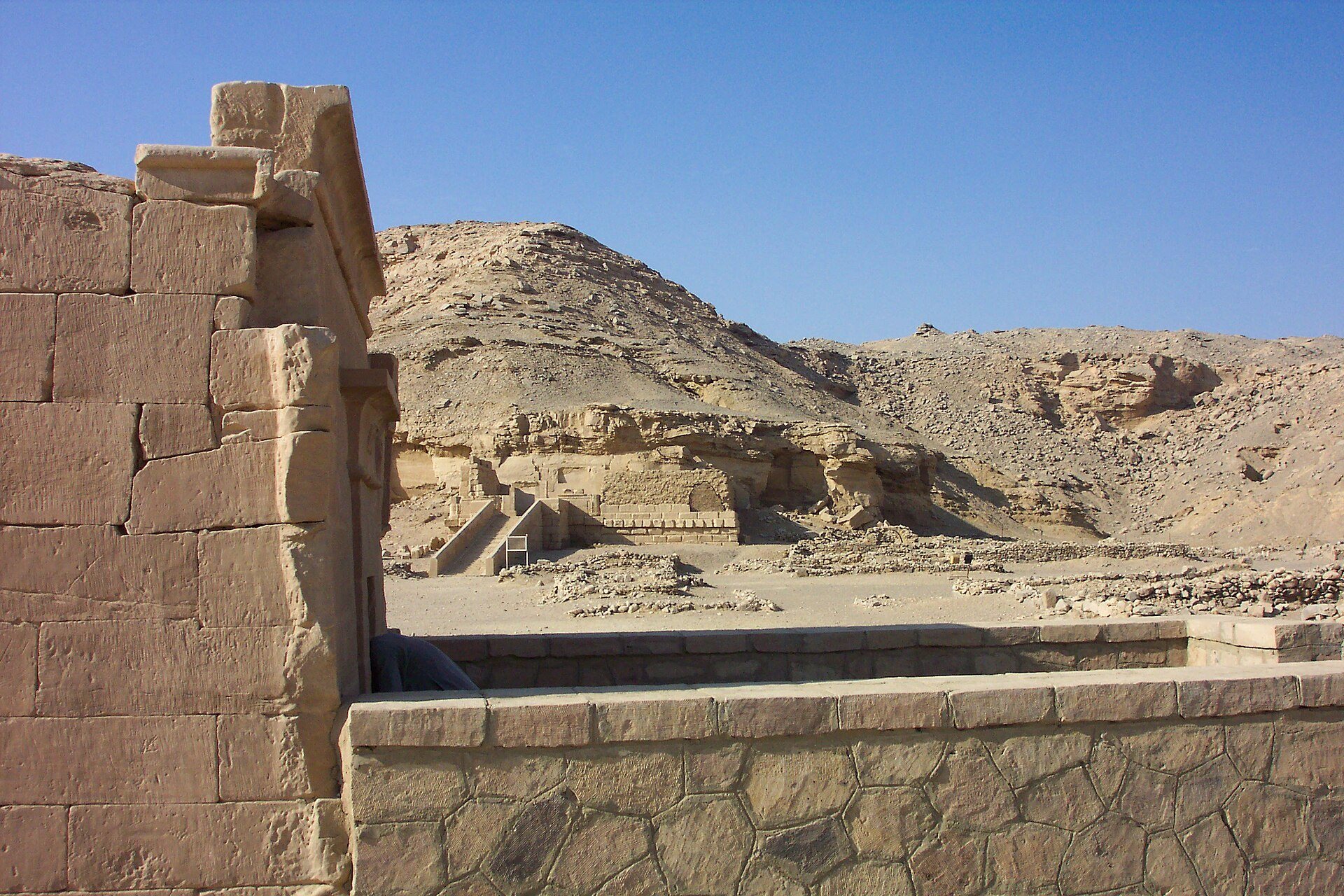
Outside the city walls stood a temple with a surrounding ambulatory, or passage for movement around the building, constructed under Thutmose III. Another temple dates to the period of Nectanebo II. A partly rock-cut Ptolemaic temple, known as a hemispeos, was cut into the cliff face.
Necropolis of the Officials
The necropolis lies about 600 metres outside the city enclosure on the southern slope of the hill overlooking the settlement. Its rock-cut tombs belonged to ruling families, officials, and priests from the Middle Kingdom, the period of conflict with the Hyksos, and the beginning of the Eighteenth Dynasty. The Hyksos were foreign rulers who controlled much of northern Egypt before their expulsion by the rulers who established the New Kingdom.
Many additional mountain tombs are inaccessible. The known tombs commonly contain recesses for offerings and spaces for sarcophagi, and they preserve the careers and religious concerns of the local elite.
Tomb of Ahmose Pen-Nekhbet
Tomb EK2 belonged to Ahmose Pen-Nekhbet. Its inscriptions concern the reigns of Ahmose I and Thutmose III. The tomb is currently closed to the public.
Tomb of Paheri
Tomb EK3 belonged to Paheri, a local official, scribe, and tutor of Prince Wadjemes. Built on a platform above the preceding tomb, it is exceptionally well preserved. Paintings in its vaulted chamber show agriculture, flax harvesting, cattle and pig keeping, hunting, fishing, Paheri with the young prince, and members of Paheri’s family.
Tomb of Setau
Tomb EK4 belonged to Setau, a nomarch, or provincial governor, of El Kab and chief prophet of Nekhbet under Ramesses III through Ramesses IX. At the entrance, Setau wears a leopard skin and holds a ewer. A stela shows Setau and his wife kneeling before Re, the sun god. Above them, a solar boat carries the sun as a winged scarab, accompanied by baboon figures associated with Thoth.
The tomb is about 10 metres long and 4 metres wide. Its vaulted ceiling is painted, and a geometric frieze runs along the upper walls. On the east wall, Setau’s son Merybast presents offerings to Setau and his wife Maatmerout.
Tomb of Ahmose Son of Ebana
Tomb EK5 belonged to Ahmose son of Ebana. It contains a main vaulted chamber and a raised secondary chamber that is now blocked. A large scene shows Ahmose with his grandson Paheri. The tomb also has an invocation above the passage to the secondary chamber, a historical inscription describing Ahmose’s victory over the Hyksos, and a list of nine male and ten female servants. Scenes on the west wall were hammered out.
Tomb of Reneny
Tomb EK7 belonged to Reneny, chief priest of Nekhbet and nomarch of El Kab under Amenhotep I, Thutmose I, and Thutmose II. Its decoration includes scenes of mummification and priests purifying the deceased. A sarcophagus bears the Eye of Horus, while another scene shows a priest wearing the mask of Anubis during the opening-of-the-mouth ritual. The tomb also names members of Reneny’s family.
Prehistoric, Greco-Roman, and Christian Remains
The earliest cemetery contained unmummified burials with the heads oriented north. Pottery, beads, paint slabs, and mirrors accompanied the burials. The surrounding cliffs preserve petroglyphs and inscriptions from Predynastic, Pharaonic, and Islamic times. Many Sixth-Dynasty inscriptions are short texts naming inhabitants of El Kab and providing evidence for the way Egyptian communities recorded their local population.
The Greco-Roman settlement survives mainly as lower courses of house walls. Coins dating from the first through fourth centuries and Demotic and Greek ostraca, fragments of pottery or stone used for writing or drawing, were recovered from the town. The lower walls of a Coptic monastery add a later architectural layer to the remains.