Jawi Temple: A Singhasari Hindu-Buddhist Mortuary Temple in East Java
Site at a Glance
- Rating
- 4.5
- Popularity
- Medium
- Country
- Indonesia
- Primary era
- Medieval
- Eras represented
- Medieval
- Civilizations
- Unclassified
- Site type
- Religious
- Remains
- Temple
On this page7 sections
History
Jawi Temple is a late-thirteenth-century Hindu-Buddhist temple on the eastern slope of Mount Welirang in Candi Wates village, Prigen, Pasuruan, East Java, Indonesia. Associated with the Singhasari kingdom, it served as a place of worship and as a mortuary temple, a monument connected with the commemoration of a deceased ruler, for Kertanegara, Singhasari’s last king.
Foundation under Kertanegara
The Nagarakretagama, a court poem associated with the fourteenth-century Majapahit king Hayam Wuruk, says that Kertanegara ordered the temple’s construction. It identifies the monument as a place of worship for followers of the Shiva-Buddha tradition, which joined Shaivite Hindu and Buddhist ideas. Kertanegara’s ashes are believed to have been placed at Jawi Temple, Singhasari Temple, and Jago Temple.
The temple’s position away from the Singhasari center has been interpreted as a possible indication of strong local support for the Shiva-Buddha tradition. The region may also have provided a base for Kertanegara’s supporters. In the historical narrative surrounding Jawi, his son-in-law Dyah Wijaya hid there after Kertanegara was overthrown by Jayakatwang of Gelang-gelang, before fleeing to Madura. This interpretation remains conjectural.
Memory, damage, and restoration
The Nagarakretagama records that Hayam Wuruk visited Jawi, or Jajawa, around 1359 while returning from a tour of Majapahit’s eastern provinces. He stopped to make offerings for Kertanegara, his great-grandfather, whose memory the temple honored. The poem describes the monument as a Shaivite sanctuary with Buddhist ornamentation and records two mortuary statues of Kertanegara expressing both religious traditions.
The same text states that lightning struck the temple in 1331. The image of Akshobhya, a Buddha associated with the eastern direction, then disappeared. This event was interpreted as a manifestation of shunyata, the Buddhist concept of emptiness or the absence of inherent existence.
Jawi Temple was restored from 1938 to 1941 and again from 1975 to 1980. The first campaign remained incomplete because some stones were unavailable, while the later reconstruction project was completed in 1982. Indonesia recognizes Jawi Temple as a nationally ranked cultural heritage site, and the East Java Cultural Heritage Preservation Office manages it.
Remains
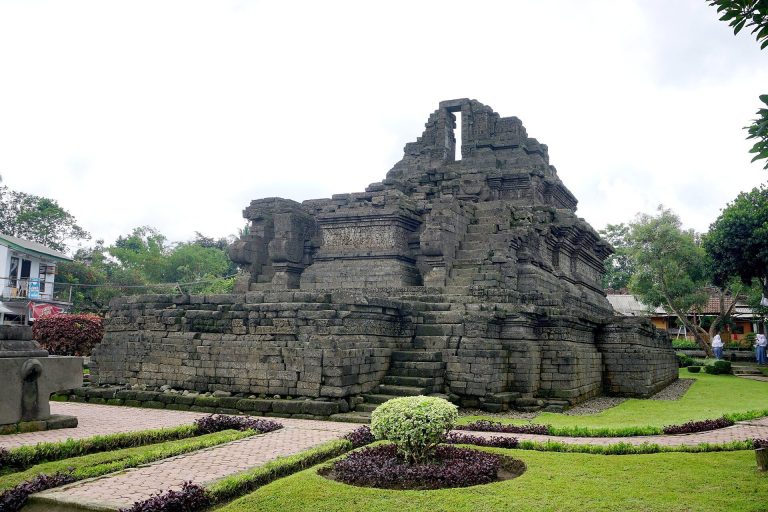
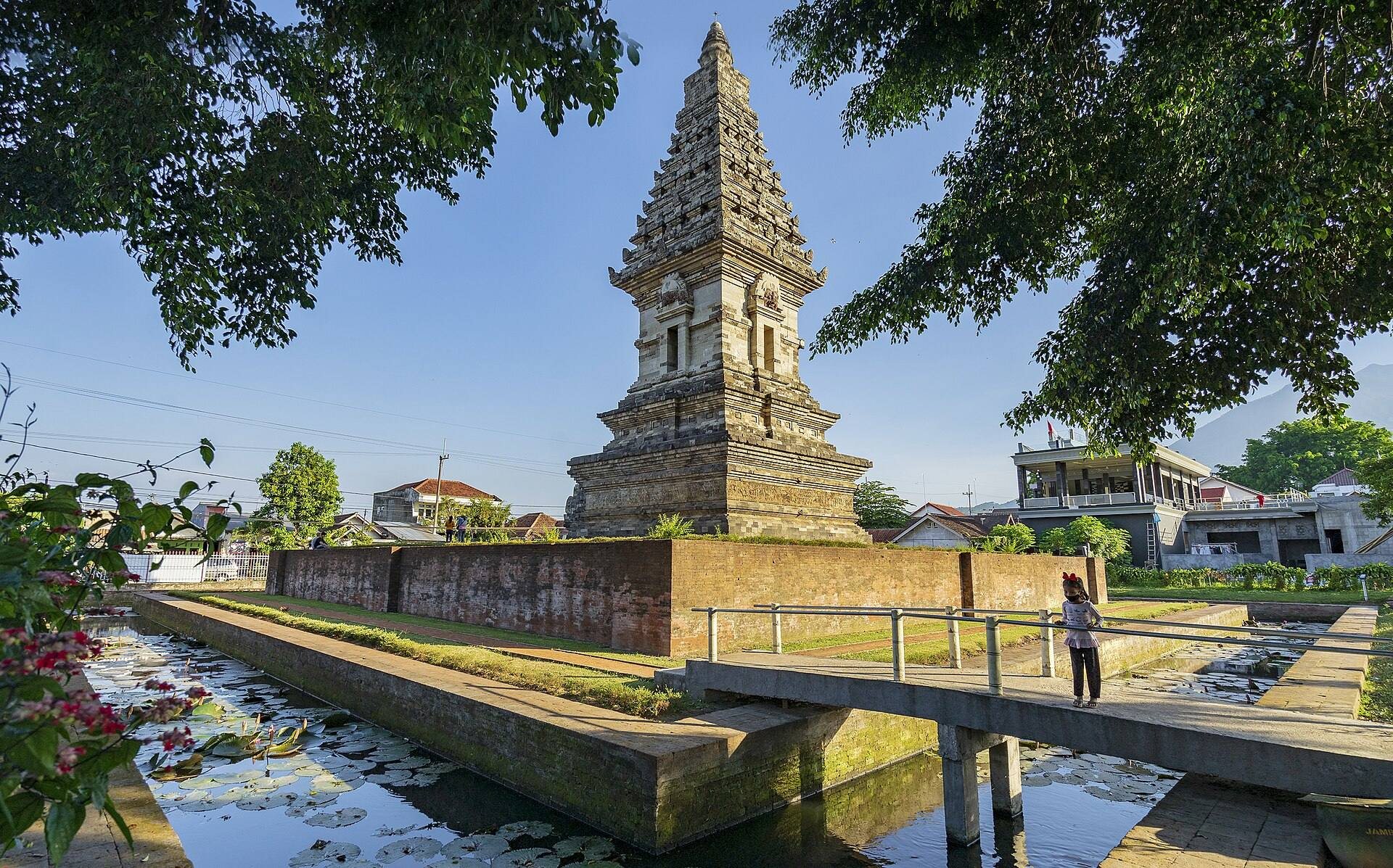
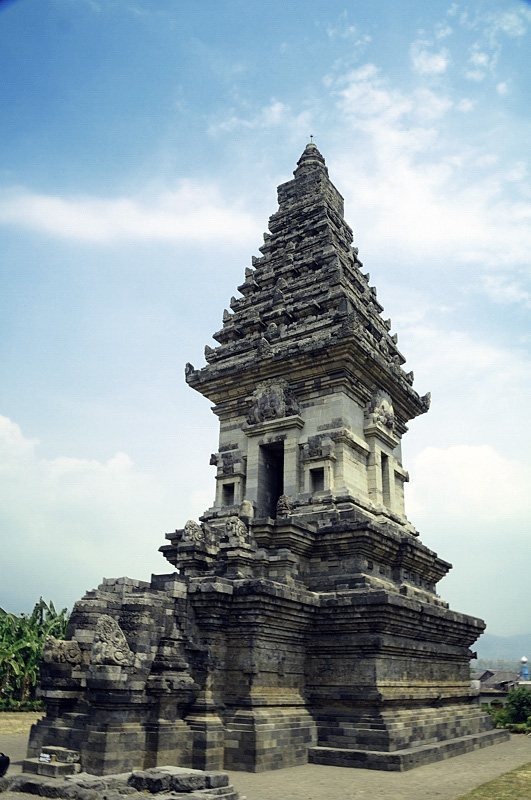
The temple compound occupies approximately 40 by 60 meters within a red-brick enclosure about 2 meters high. A moat surrounds the compound and contains flowering lotus plants. At its center, the stone temple rises about 24.5 meters above a base measuring approximately 14.2 by 9.5 meters. Its tall, slender profile ends in a receding pointed roof crowned by cubes and a stupa, a Buddhist architectural form associated with relics or sacred presence.
Construction and orientation
The building uses andesite, with black stone in its lower portion and white stone above. This difference has led to the possibility that the temple was built in two phases using distinct techniques. Its lower structure has Shaivite associations, while its upper elements are Buddhist. The main cella, or principal inner chamber, and the principal staircase face east. The rear of the temple faces Mount Penanggungan.
The eastward orientation has prompted different interpretations of the temple’s purpose. Some scholars argue that it was not designed mainly for worship or circumambulation because worship temples commonly face a sacred mountain. Others regard it as a worship temple whose orientation reflects Buddhist influence.
Reliefs and subsidiary structures
Reliefs cover parts of the temple walls, although their meaning remains undeciphered. The shallow carving and the lack of supporting inscriptions or texts may have contributed to this difficulty. One wall fragment depicts Jawi Temple together with nearby buildings, including three subsidiary temples on the eastern side of the main shrine. Those structures now survive close to ground level.
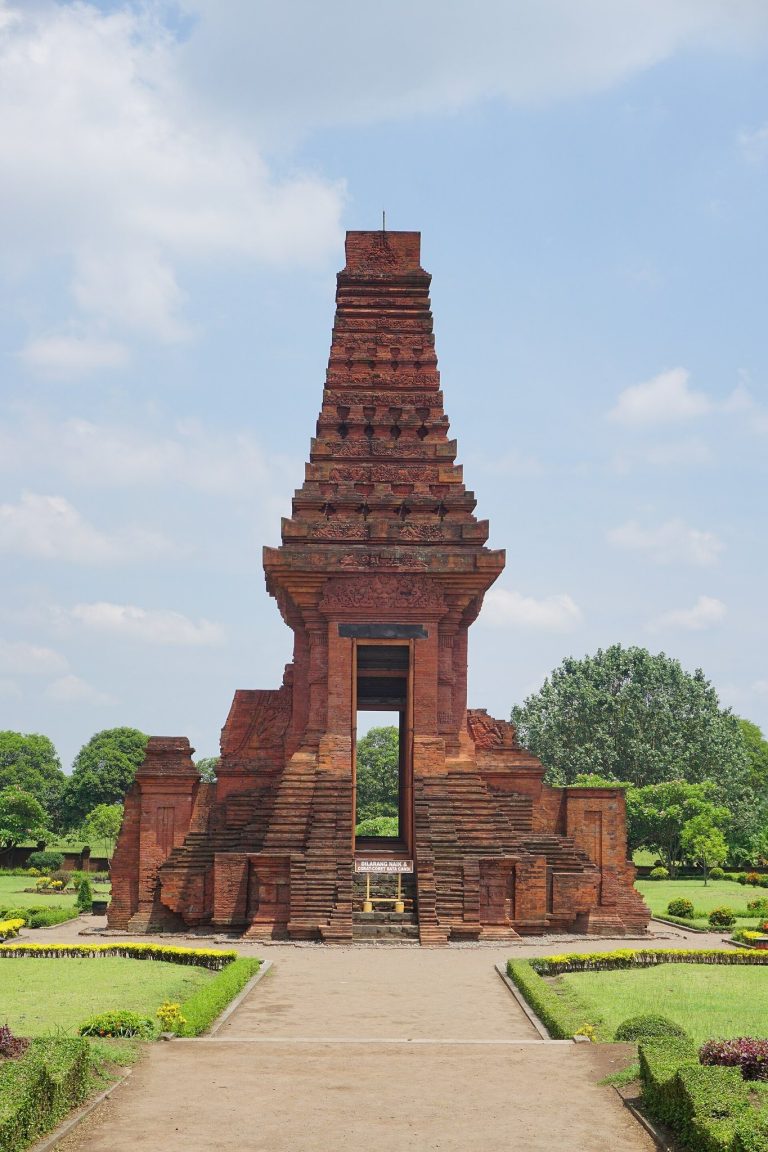
The fragment also shows a western candi bentar, a split gateway made of two opposing halves. The surviving remains of this gateway consist mainly of heaps of red bricks. Inside the temple, a clearly carved relief of the deity Surya occupies the center of the highest part of the interior.
Shrine images and surviving sculpture
The principal shrine contained an image of Shiva, with the image of Maha Akshobhya above it. Niches held images of Nandisvara, Durga, Ganesha, Nandi, and Brahma. The Durga image is preserved at the Mpu Tantular Museum in Surabaya, while the other recovered images are preserved at the Trowulan Museum. Fragments believed to belong to the Brahma image are kept in a room or storage area inside the temple.
Other sculptures from Jawi were removed from their original positions and placed in museums or elsewhere for protection from theft. One Jawi image was held at Hotel Tugu Park in Malang, a relocation criticized because it separated the sculpture from its historical and ritual context. The temple’s architectural form remains substantially intact, while broken statue fragments are kept in a storage area behind the building.