Tombs of the Kings: A Hellenistic Necropolis in Cyprus
Site at a Glance
- Rating
- 4.4
- Popularity
- High
- Country
- Cyprus
- Primary era
- Classical
- External website
- Open
- Eras represented
- Classical, Medieval
- Civilizations
- Ptolemaic
- Site type
- Burial
- Remains
- Necropolis
On this page8 sections
History
Tombs of the Kings is a large rock-cut necropolis in Chlorakas, Cyprus, near Paphos, developed mainly during the third century BC in the Hellenistic period under Ptolemaic rule. Its predominantly Greek architectural forms, Egyptian-influenced models, and imposing scale reflect the status of Ptolemaic officials and other wealthy members of Paphian society. Despite its name, no kings were generally buried there.
A Ptolemaic necropolis
The cemetery belonged to the wider ancient settlement of Nea Paphos. Its larger tombs were used by officials of the Ptolemaic administration and other high-ranking families, whose prosperity shaped the size and decoration of the underground complexes. The Ptolemaic period was the era of the dynasty founded by Ptolemy I after the death of Alexander the Great, when Cyprus came under Egyptian rule.
Burials continued at the necropolis until the third century AD. Later, early Christians used parts of the site as a refuge during periods of persecution. During the Middle Ages, squatters occupied some of the tombs and altered portions of their original architecture. A medieval pottery kiln and changes to individual tombs show that at least part of the complex also acquired domestic or other secular uses.
Rediscovery and archaeological investigation
The name Tombs of the Kings was coined during the second quarter of the twentieth century, apparently because of the tombs’ monumental scale. Richard Pococke described the necropolis in 1738, followed by Joseph von Hammer-Purgstall in 1800 and Domingo Badía in 1806. Ludwig Ross produced the first specialist drawings in 1845. Further nineteenth-century visitors included Edmond Pottier, Wilhelm Dörpfeld, and Max Ohnefalsch-Richter. Dörpfeld also photographed the tombs for the German Archaeological Institute at Athens.
Luigi Palma di Cesnola, then the United States consul in Cyprus, began excavating the site in 1870. The first excavations under scientific supervision took place in 1915 under Menelaos Markides, curator of the Cyprus Museum. Cleaning of the largest tombs began in 1937, was interrupted during the Second World War, and resumed from 1945 to 1952.
Systematic excavation began in 1977 under the Cypriot archaeologist Sophocles Hadjisavvas. The work examined Hellenistic funerary customs and supported the preparation and conservation of the site. Excavation, conservation, and reconstruction continued into the early twenty-first century, although conservation of the rock was interrupted in 1990 and work remained in progress in 2012. The necropolis forms part of the ruins of Nea Paphos, included in the Paphos World Heritage property inscribed by UNESCO in 1980.
Burial evidence and historical interpretation
Rhodian amphorae, two-handled vessels used for transporting goods, were placed among some burial offerings. Stamps on their handles, together with other objects from the same graves, help date material from the Hellenistic and early Roman eastern Mediterranean. The proximity of the sea affected the survival of human remains, while grave robbing probably removed many valuable offerings before official archaeological missions reached the tombs.
Evidence suggests that individual families could possess their own tomb complexes, containing several types of graves. Larger groups of tombs had cisterns supplying water for purification, and funeral pyres received offerings that included birds, eggs, and fruit. An interpretation of Tomb 8 has proposed a connection with the Ptolemaic dynasty and with the burial of the last king of Cyprus after the Roman occupation. This remains an archaeological interpretation of one tomb rather than evidence that the necropolis was a royal cemetery.
Remains
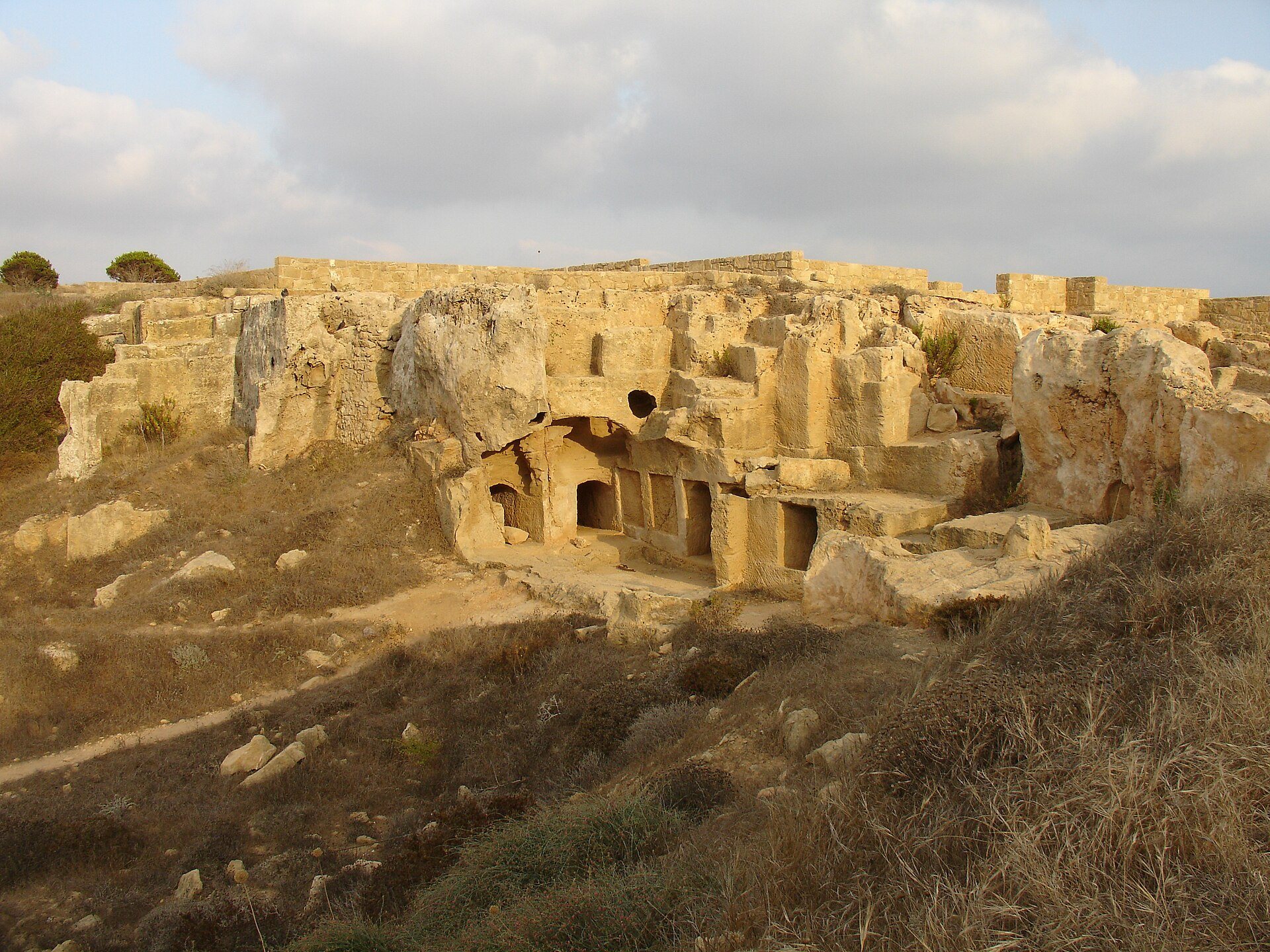
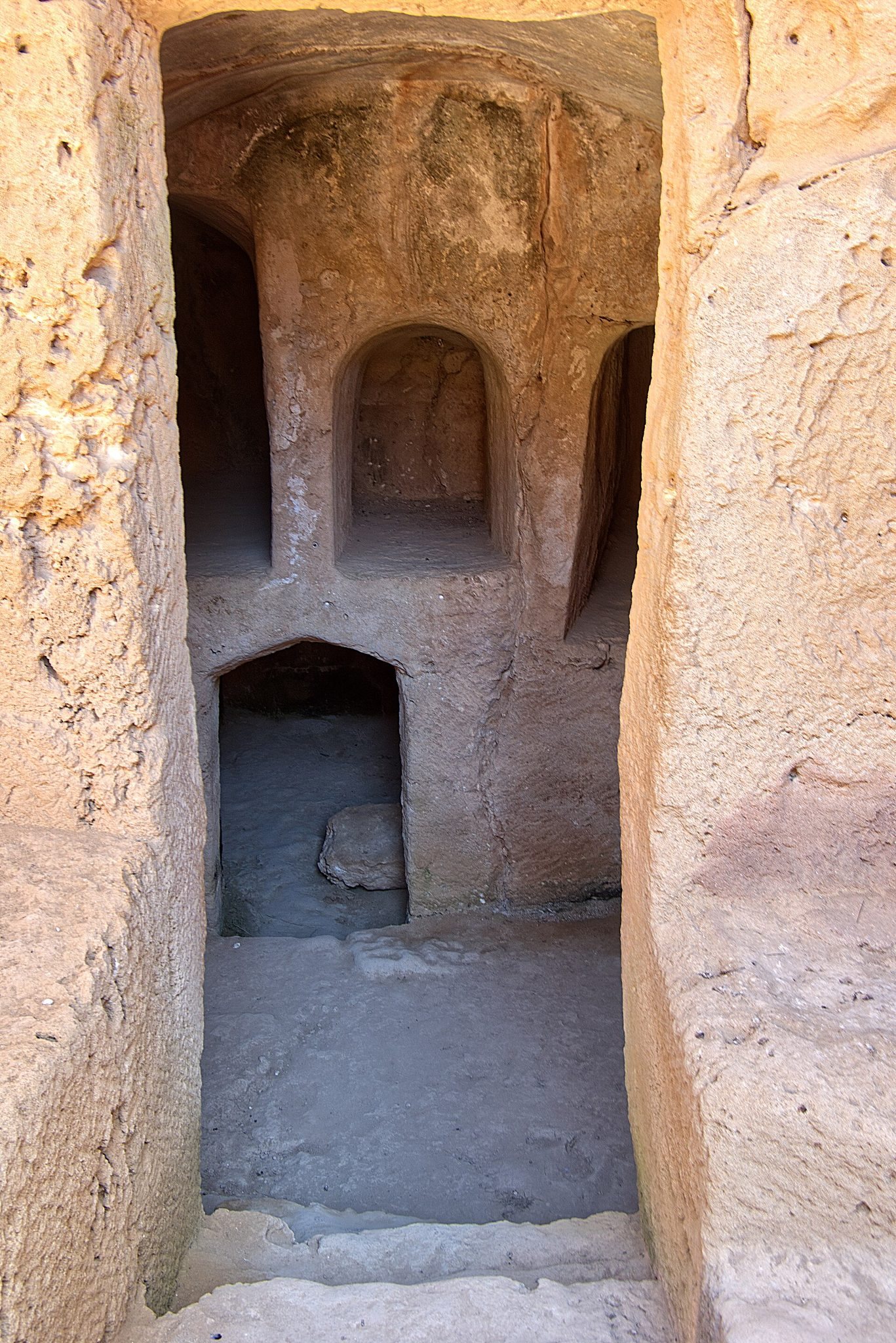
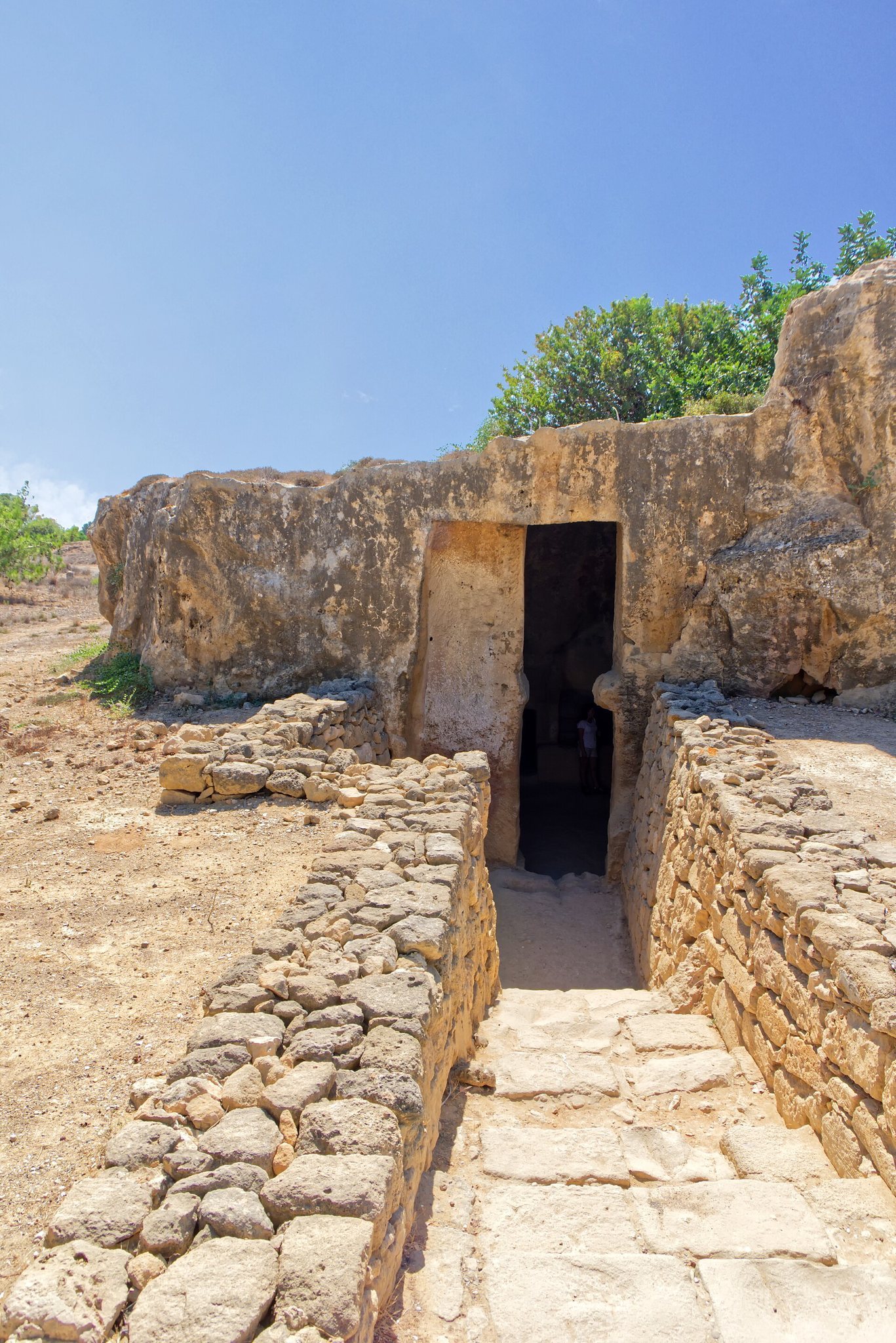
The necropolis covers approximately 32.6883 hectares. Its underground tombs were cut into solid native limestone and include shaft tombs, chamber tombs, and atrium or peristyle tombs. A dromos, meaning a passage leading into a tomb, commonly descends to the burial area. In chamber tombs, the stepped approach opens into a rectangular room with tunnel-shaped burial recesses, or loculi. In atrium tombs, the approach leads to an interior court surrounded by a peristyle, a colonnade enclosing the courtyard.
Rock-cut tomb architecture
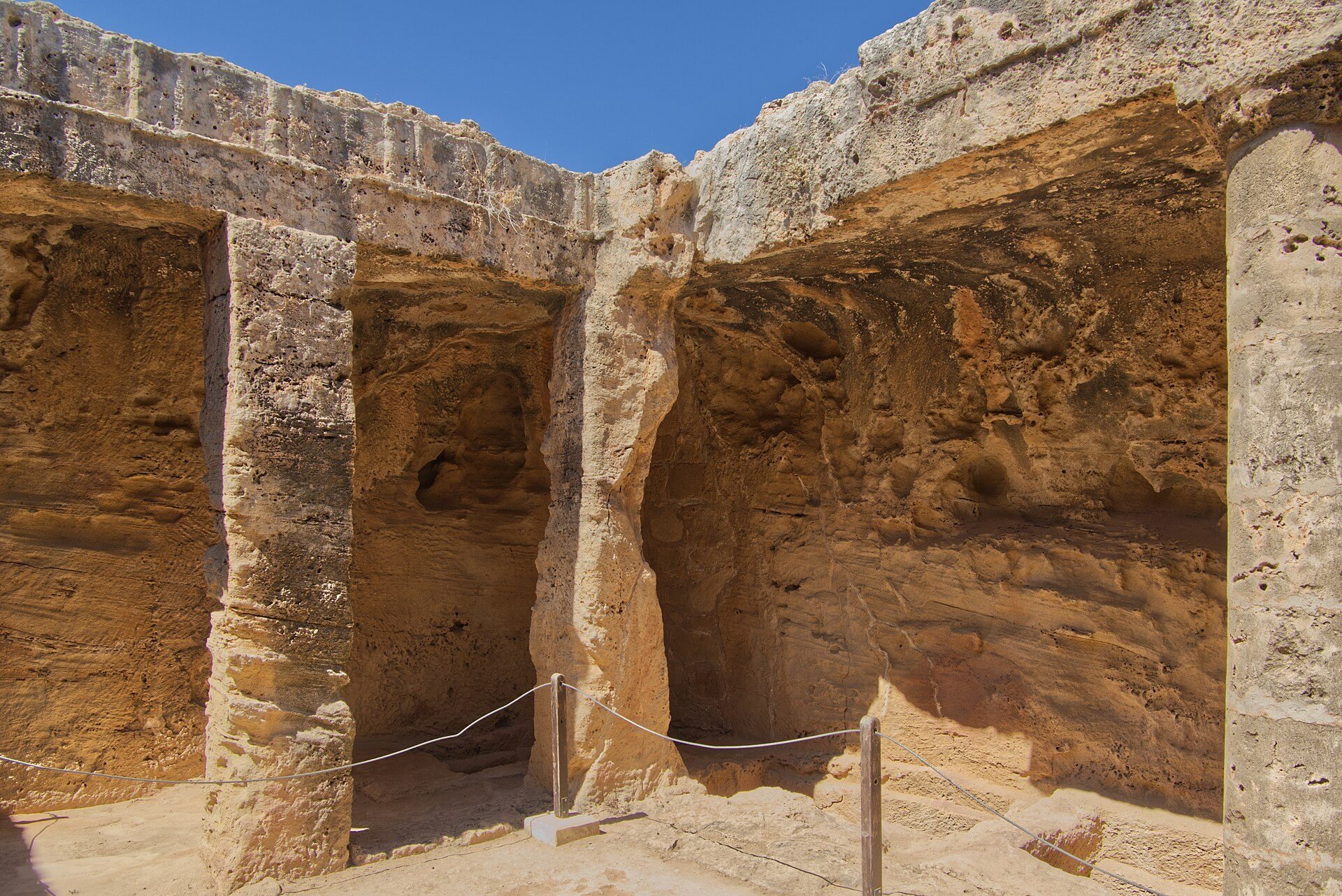
Entrances from the peristyles lead to antechambers and then to individual or connected burial chambers intended for repeated use. Square piers and Doric columns were carved directly from the bedrock. Doric columns use the oldest of the main classical Greek orders and generally have plain capitals. Above them were horizontal beams or single-piece architraves, while alternating metopes and triglyphs formed the upper parts of the friezes. Recesses above the beams probably supported the original coverings. Some tombs retain stucco or frescoed wall decoration.
Individual tombs preserve varied arrangements. Tomb 1 has a dromos, while Tomb 2 contains burial niches and an offering niche on its northern side. Tomb 3 has a peristyle, Tomb 6 contains a funerary cippus, or commemorative pillar, in the centre of its atrium, and Tomb 8 includes a burial niche with a portal. These features belong to a complex designed to accommodate multiple burials rather than a single interment.
Modified and distinctive complexes
Tomb 5 was altered when its atrium was closed, a change associated with its later use as a dwelling. Another tomb beyond the centre of the complex differs from the standard peristyle arrangement. A massive block stands in the middle of a court cut into the rock, creating a form more closely resembling the Mustafa Pasha necropolis in Alexandria.
The northern part of the necropolis contains a funerary complex discovered in 1983. Its stepped dromos extends for 20 metres before reaching a peristyle, and the tomb has rich stucco decoration. Its design has been associated with Alexandria, although Macedonian tombs were also considered possible models. The chambers were probably looted during the Roman period, and traces of crosses show that some were reused during the early Christian period.
Objects and later features
Excavated material includes third-century BC pottery such as amphorae, unguentaria, and lamps, together with gold jewellery, gold myrtle leaves, an ivory pyxis, and coins from the second century BC and the period associated with Cleopatra. A pyxis was a small container commonly used for cosmetics or personal items. Many of the recovered artefacts are held in the Paphos District Museum.
The medieval pottery kiln provides physical evidence for activity after the principal burial phases. Along with the domestic alteration of Tomb 5, it shows how parts of the underground cemetery were adapted for purposes unrelated to their original funerary use.